

Discover the power of Natural Language Processing in Customer Service. Learn how NLP, sentiment analysis, and intent recognition can transform your small business support.
.png)
Are you a small business owner who feels like you’re constantly juggling customer support requests? Do you wish you had a secret weapon to handle inquiries faster, keep customers happier, and free up your time to focus on growth?
If you answered yes, get ready to discover something truly transformative. It’s called Natural Language Processing in Customer Service, and it’s the closest thing to magic your business will ever experience. This powerful technology is now accessible and essential for all businesses online. Let’s dive into the magic of Natural Language Processing in Customer Service and see how this can change your business forever.
Imagine a computer that doesn't just see words, but actually understands what you mean. That’s the core idea behind Natural Language Processing (NLP). Natural Language Processing (NLP) is a universal translator and decoder ring for human language.
Natural Language Processing (NLP) is a branch of Artificial Intelligence (AI) that teaches computers to read, interpret, and generate human language, whether it’s spoken or written. This is the same technology that powers Siri, Alexa, and ChatGPT—and now it's available to transform your customer service. For your business, this means your customer service tools can finally understand the messy, complicated, and often emotional way your customers communicate.
NLP breaks down language into smaller, understandable pieces:
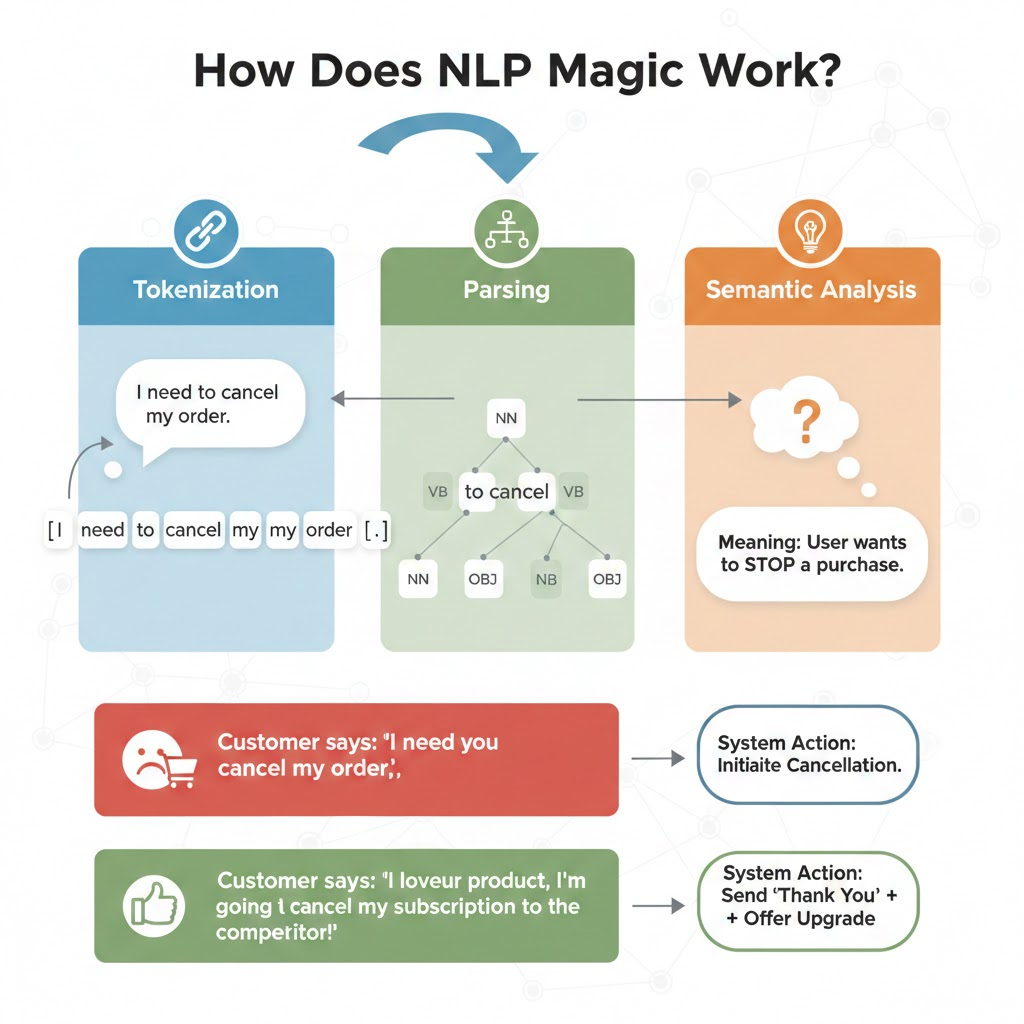
By doing this, an NLP-powered system can tell the difference between a customer saying, "I need to cancel my order," and "I love your product, I'm going to cancel my subscription to the competitor!"
Why should a busy small business owner care about this technology? Because Natural Language Processing in Customer Service directly solves your biggest support challenges: speed, consistency, and understanding. Here are the three core superpowers NLP brings to your customer interactions:
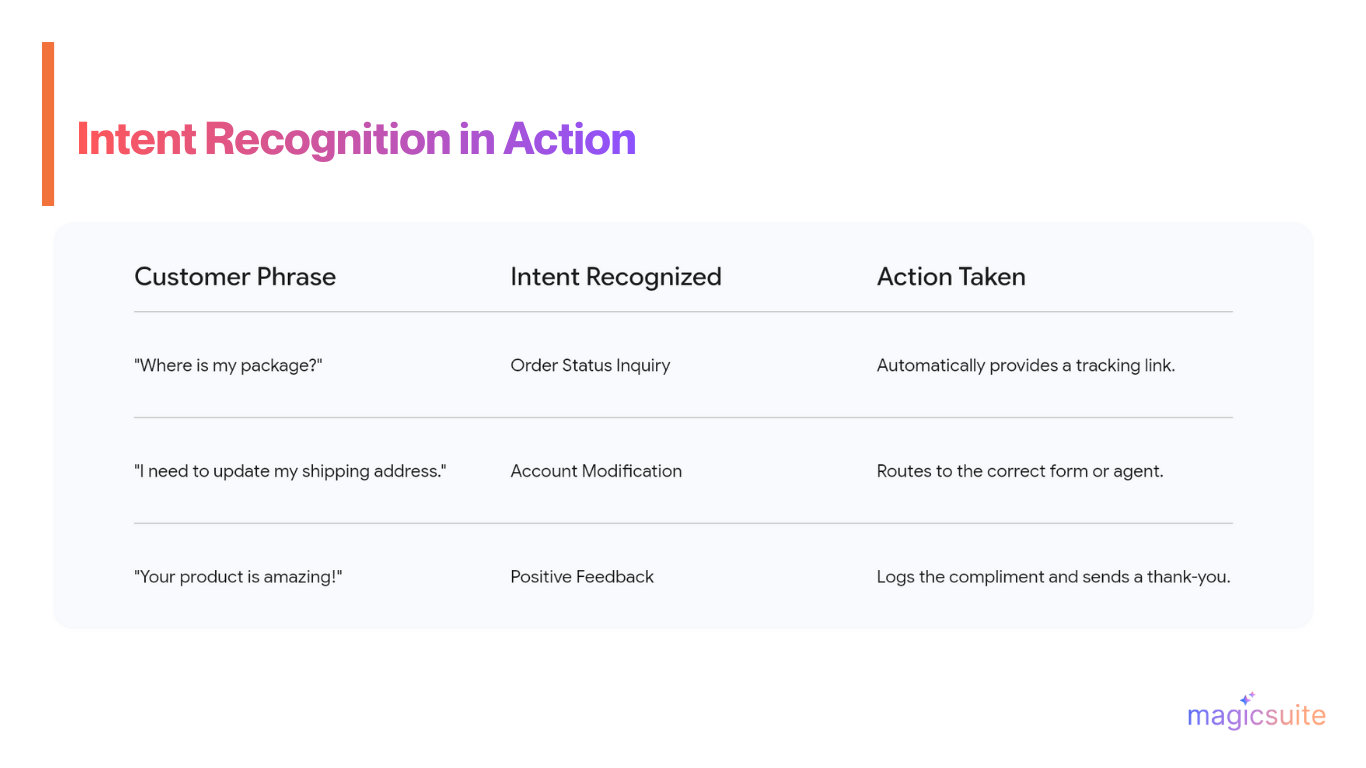
When a customer contacts you, they have a goal. They want to know their order status, change their address, or ask about a product feature. This goal is their intent. Intent recognition is the NLP superpower that instantly figures out why the customer is reaching out. Instead of a traditional chatbot that only responds to exact keywords, an NLP-powered tool can understand the intent even if the phrasing is unique.
In the context of virtual assistants or AI chatbots, credit unions are leveraging AI in customer service to deflect calls to the AI virtual agent to automate 40 percent of the requests and reduce the call wait time in the call center.
The Three Types of Customer Intent
When your system recognizes intent accurately, it can provide the exact information customers need, route complex issues to specialized team members and offer relevant product recommendations
Customers don't always use polite, neutral language. Sometimes they are frustrated, excited, or confused. Sentiment analysis is the NLP superpower that detects the emotion, or sentiment, behind the customer's words.
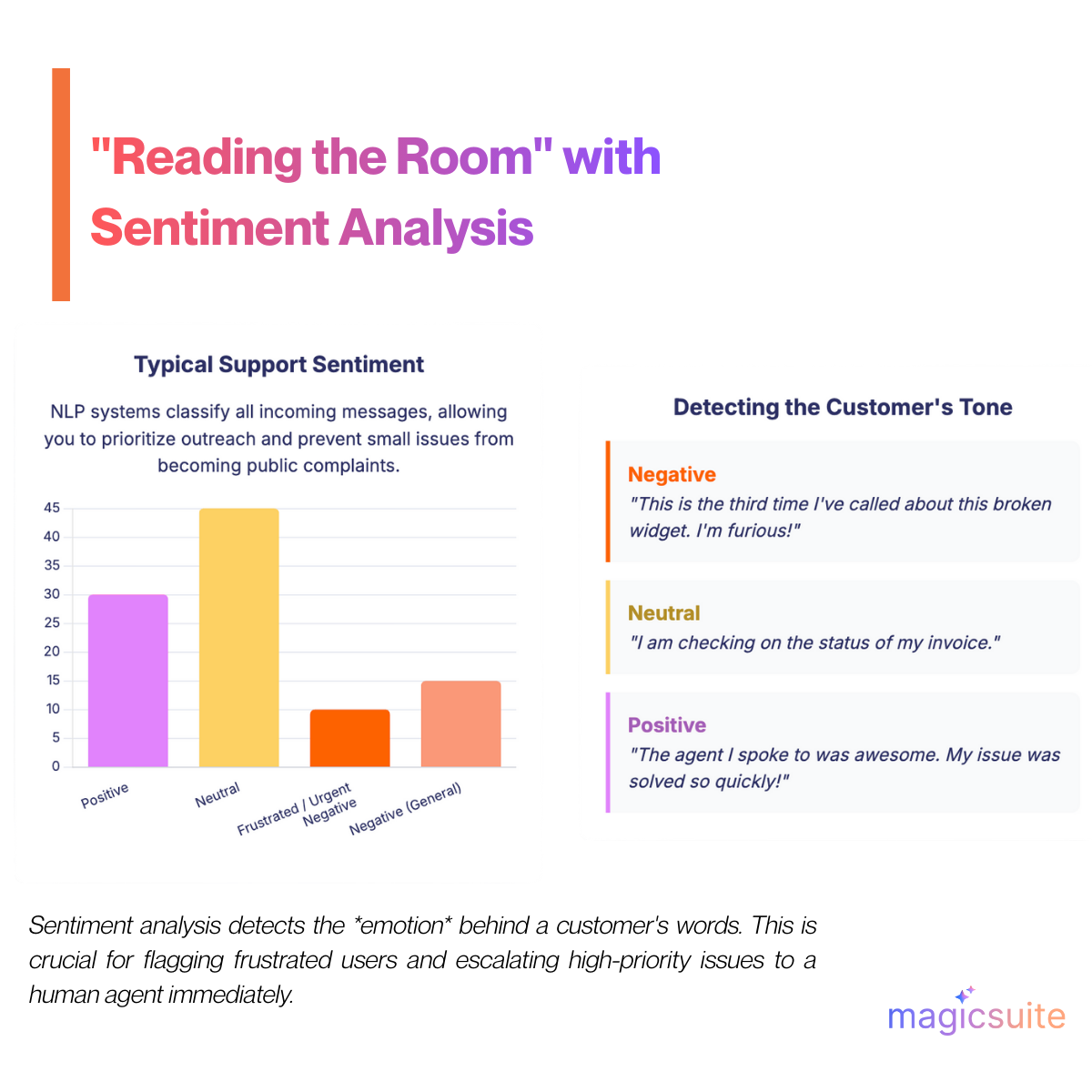
This is crucial because the tone of a conversation often matters more than the words themselves. Sentiment analysis classifies the customer's message as positive, negative, or neutral.
When a system instantly flags a "furious" customer, you can immediately escalate that conversation to a human agent. This proactive customer service approach prevents a small issue from becoming a public complaint. By proactively addressing negative sentiment, you can turn a frustrated customer into a loyal advocate.
Your small business doesn't sleep, and neither do your customers. NLP-powered conversational AI, like chatbots and virtual assistants, provides round-the-clock support. This is a game-changer for small business owners who can't afford to hire a night shift team. Your AI assistant is always on, ready to answer common questions and handle routine tasks instantly.
Consistent, 24/7 support means faster response times and happier customers, without increasing your payroll. It also ensures that every customer gets the same high-quality, accurate answer every time, regardless of which agent (or AI) they interact with.
More on What Happens in an AI Chatbot Conversation?
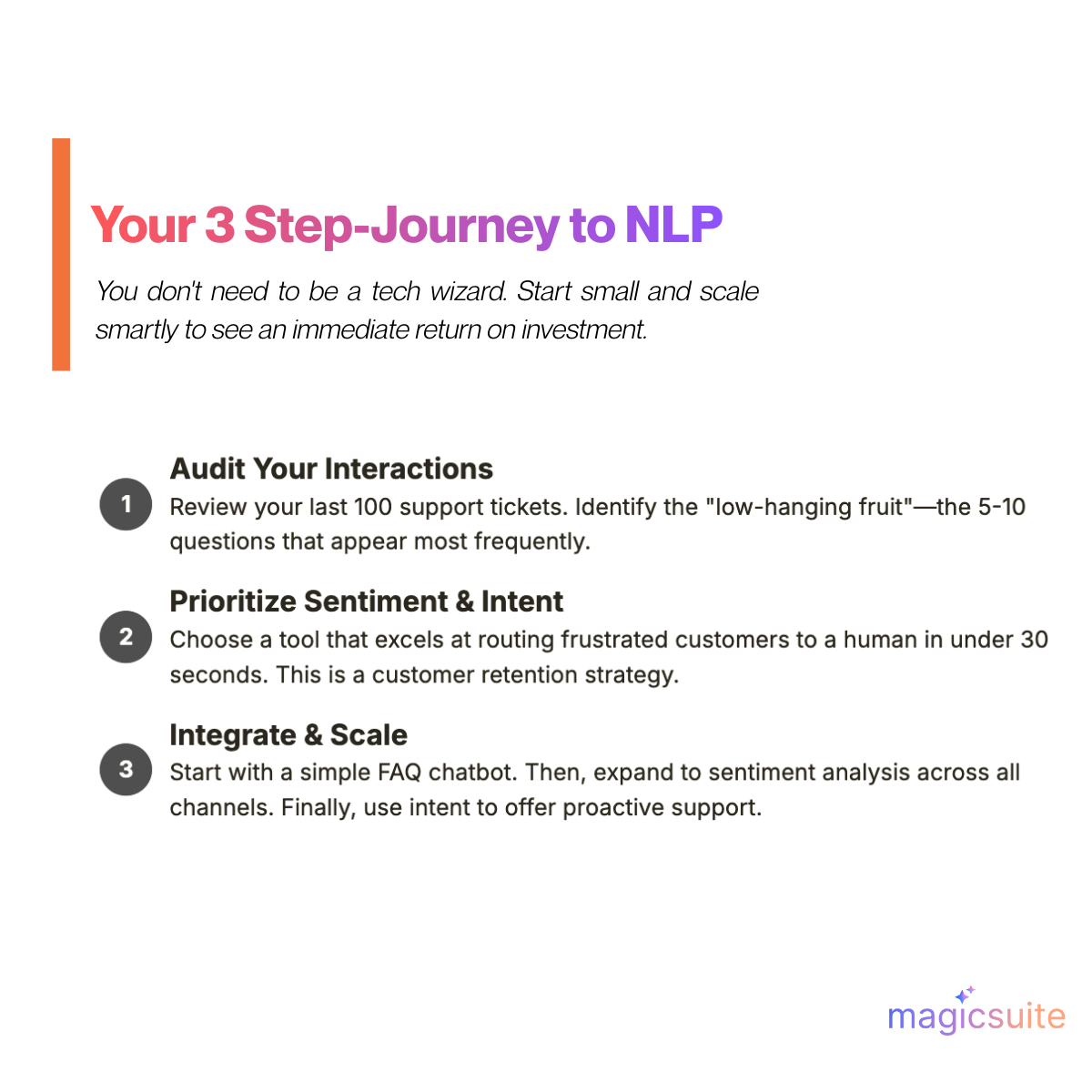
Here are three practical steps you can take today:
Before you implement any new tool, you need to know what your customers are actually asking.
This audit will show you exactly where Natural Language Processing in Customer Service will deliver the fastest return on investment.
For a small business, every customer relationship is vital. You can't afford to lose a customer because of a slow or impersonal response. When choosing an NLP solution, prioritize its ability to perform sentiment analysis and intent recognition. These are the features that protect your brand reputation and ensure a high-quality customer experience. A system that can route a frustrated customer to a human agent in under 30 seconds is not just a tool, it's a customer retention strategy.
Start small. Don't try to automate everything at once.
The world of customer service is changing rapidly. Big names like Amazon and Netflix use NLP to manage millions of interactions daily. But the real story is how this technology is empowering the underdog—the small business owner. Natural Language Processing in Customer Service allows you to offer the same level of instant, personalized, and magical support as the industry giants, all without the massive overhead.
You might be thinking, "This sounds great, but I'm a small business owner, not a tech wizard. Is this too complicated for me?" At MagicSuite, we believe that powerful AI should be accessible and useful for everyone.
MagicTalk is designed to put a human touch on cutting-edge AI technology, making it incredibly easy for you to deploy these NLP superpowers in your own customer service. MagicTalk takes the complexity out of Natural Language Processing in Customer Service. You don't need to code or hire a data scientist. You simply train it with your existing knowledge base, and it instantly gains the ability to:
1.Understand Intent: Instantly recognize what your customers need.
2.Analyze Sentiment: Flag frustrated customers for immediate human attention.
3.Provide Instant Answers: Handle up to 80% of routine inquiries automatically.
Ready to discover the magic of AI? Visit MagicTalk today and transform your customer service from a chore into a competitive advantage.

Hanna is an industry trend analyst dedicated to tracking the latest advancements and shifts in the market. With a strong background in research and forecasting, she identifies key patterns and emerging opportunities that drive business growth. Hanna’s work helps organizations stay ahead of the curve by providing data-driven insights into evolving industry landscapes.