

Data-backed analysis on the future of customer service. Will AI Kiosks replace your Human Help Desk agents? Learn how businesses are achieving massive efficiency with a Human-AI partnership.
.png)
The growth of AI Kiosks and smart automation is forcing many businesses to ask a serious question: Will the traditional Human Help Desk soon be unnecessary? As artificial intelligence (AI) quickly becomes part of customer service and business support, the way we interact with clients is changing forever. The answer is complex. AI-powered self-service is ready to manage the simplest, repetitive tasks. However, it's unlikely to replace human agents completely.
Instead, we are moving toward a future of strong cooperation. AI will improve the human element of service, not eliminate it. This change is supported by data showing greater efficiency and lower costs, but the need for human empathy and advanced problem-solving skills offsets it.
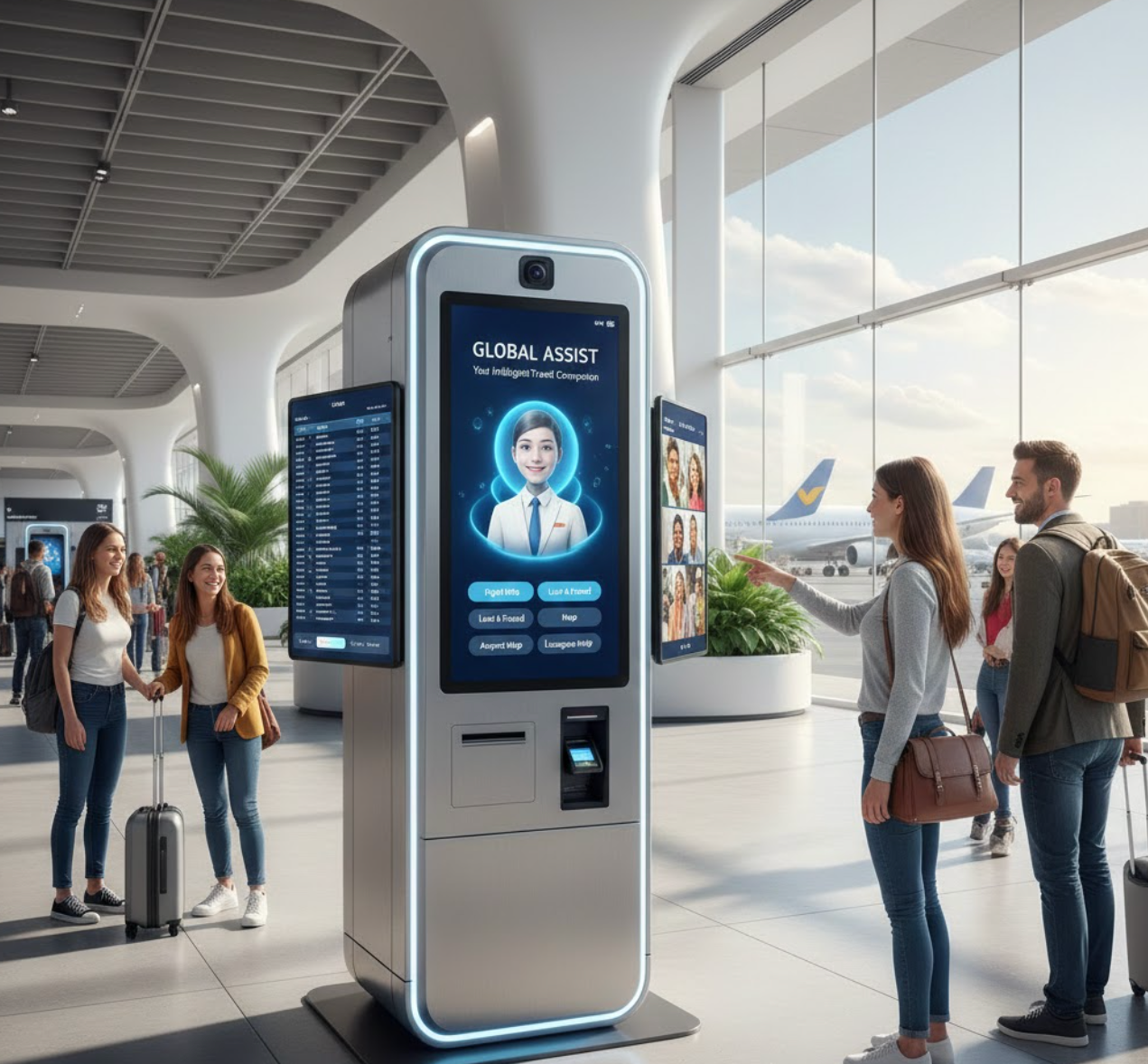
AI Kiosks are far more than just better self-checkout machines. They are intelligent, interactive systems. They use machine learning (ML) and natural language processing (NLP) to offer detailed, personal service. They lead the self-service technology market, which is expected to grow significantly—from about $33.2 billion in 2022 to roughly $73.8 billion by 2030. Another report from Grand View Research provides a slightly higher projection, estimating the market size at $34.03 billion in 2022, growing to $92.24 billion by 2030, at a compound annual growth rate (CAGR) of 13.8%.
Companies report significant operational improvements after using intelligent automation:
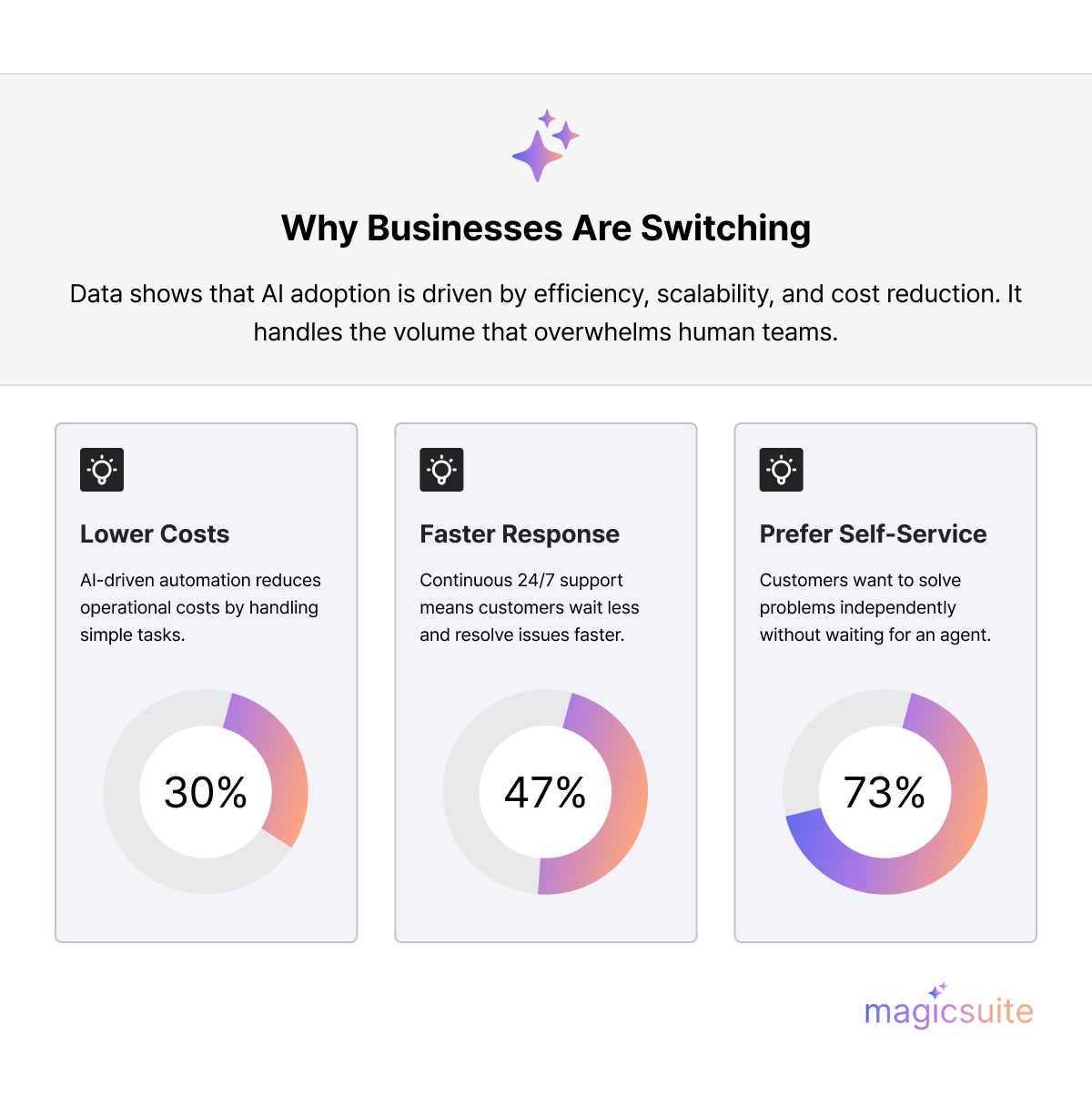
Lower Costs
AI-driven automation can cut customer service operational costs by about 30%. This is primarily achieved by streamlining processes and reducing the need for manual handling of routine tasks. Businesses using AI have seen a 25% drop in total customer service costs.
Always Available and Fast
Unlike a Human Help Desk, AI Kiosks offer continuous support, 24 hours a day. They can handle multiple customer questions simultaneously without becoming fatigued. This results in an estimated 47% faster response time. For some issues, resolution times have dropped by 87%.
Customers Prefer Self-Service
The data clearly show that customers prefer to solve problems on their own. Research shows 73% of customers want to resolve issues independently. Over 60% of U.S. consumers prefer automated self-service for simple tasks. In the fast-food industry, over 80% of young customers prefer restaurants with self-service kiosks.
AI Kiosks are now used for much more than just retail. They are changing service delivery everywhere:
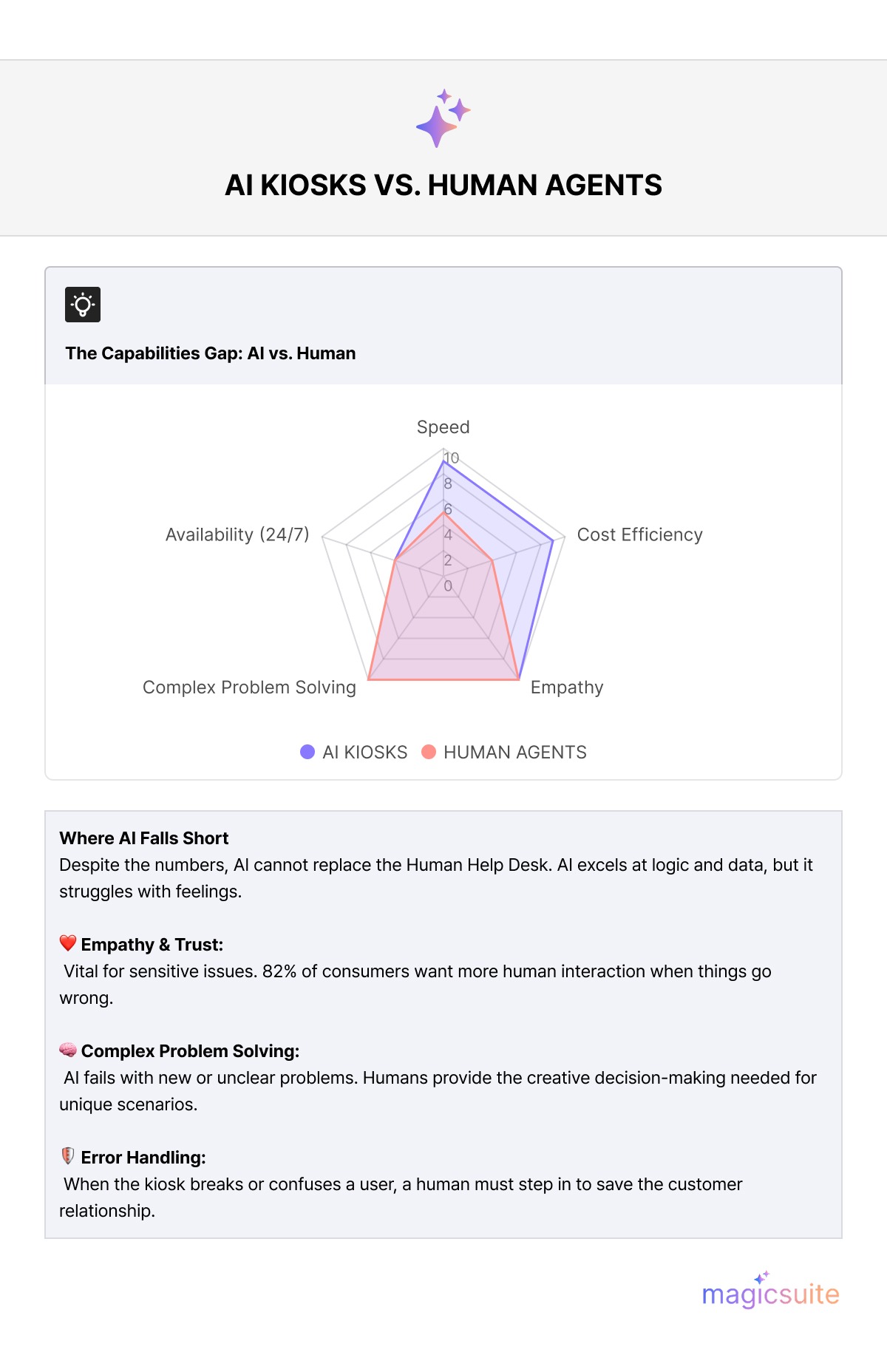
Despite the excellent numbers for AI efficiency, the idea that AI Kiosks will fully replace the Human Help Desk is too simple. It ignores the lasting importance of human interaction, especially when problems are stressful or complicated.
The key differences provided by a human help desk—qualities AI cannot fully copy—are empathy, good judgment, and creativity.
Understanding Emotions and Empathy
AI is great at logic and data but struggles with feelings. A human agent offers the "human touch." This is vital for building trust and loyalty over time. For sensitive or emotional issues—like a financial mistake or a serious complaint—customers strongly prefer a kind human voice. Some studies show 82% of consumers want more human interactions from companies.
Solving New and Complex Problems
AI Kiosks are perfect for basic, predictable questions (e.g., "Where is my package?" or "How do I change my password?"). But they often fail when faced with new, unclear, or very complex problems. These issues require fresh ideas, a deep understanding of the situation, and human decision-making.
Handling Errors and Frustration
When an AI system breaks down (like a self-checkout error) or gives a confusing answer, human agents must step in. They fix the frustration and save the customer relationship.
Also read Help Desk Automation Reduce Ticket Volume by 60%
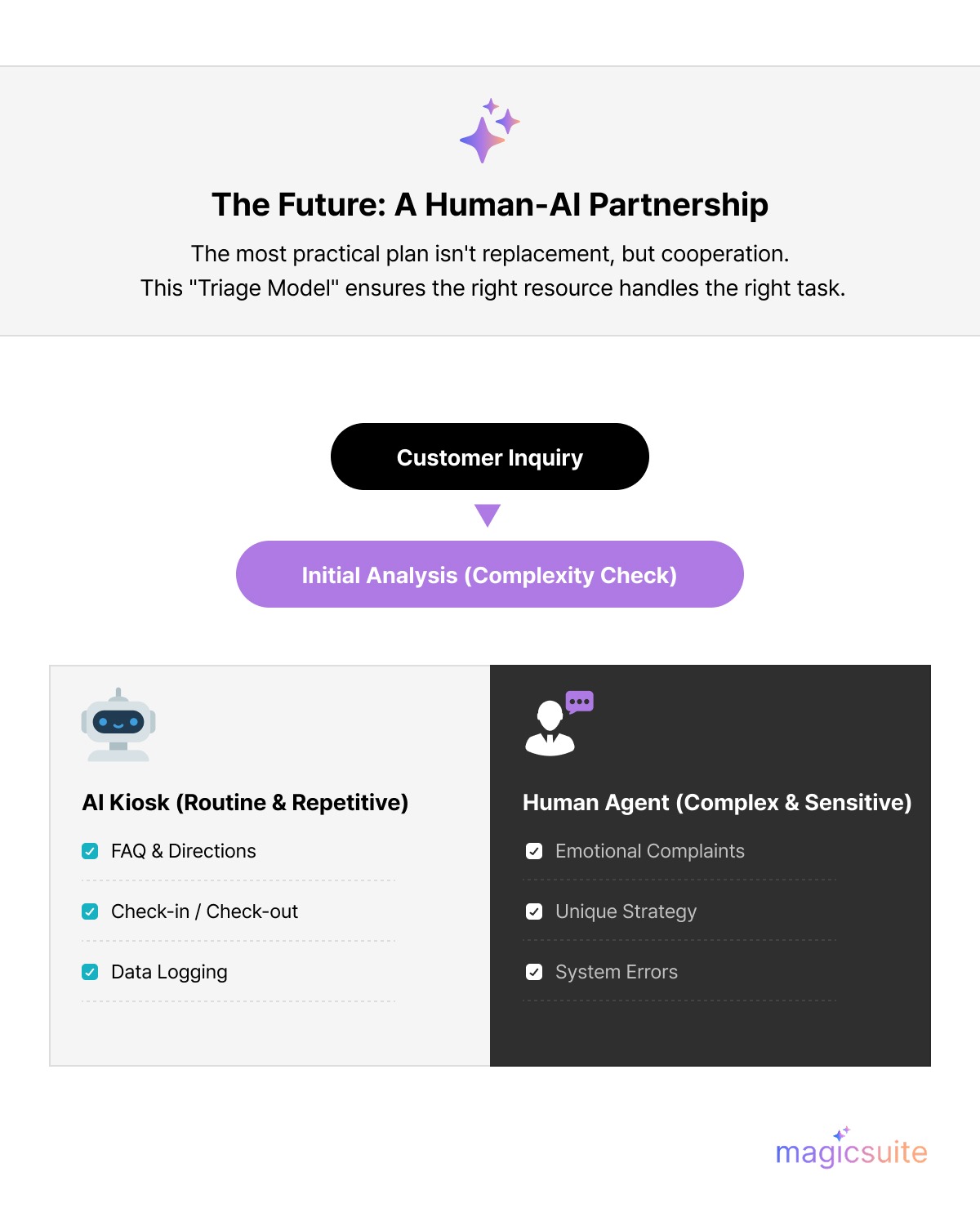
The most practical plan for the future of service is one in which AI Kiosks and the Human Help Desk work together seamlessly. This model is called the Human-AI Partnership.
This partnership makes the best use of both human and machine strengths:
As AI takes over the tedious, repetitive tasks, the human agent's job changes. They stop being mere ticket closers and become strategic problem-solvers and relationship managers. Their new focus is on vital human skills such as listening well, calming angry customers, and focusing only on the difficult tickets that cause the most customer unhappiness or need complex policy decisions. The reality is that AI won't replace people; it will make them better. It eliminates manual work and lets agents focus on high-value activities that truly drive satisfied customers and business innovation.
Moving to an AI-enhanced system is not about choosing between an AI Kiosk or a Human Help Desk. It is about building a modern, flexible, and balanced support system.
To successfully add AI Kiosks without losing customers or hurting the current support team, business leaders should follow these steps:
The momentum behind AI Kiosks is clear, driven by strong efficiency and savings stats. AI is transforming basic support, delivering faster, 24/7 service for common problems. The prediction that AI will handle 95% of all customer interactions by 2025 underscores the scale of this shift. However, eliminating the Human Help Desk is neither technically nor socially feasible. The essential human abilities of empathy, good judgment, and creative solutions are the main strengths of the modern service industry.
The future of service is a cooperative system. AI Kiosks will be the reliable, always-on engine for quick service, while the Human Help Desk will become a highly skilled, focused team. They will build deep relationships, solve complex problems, and provide the crucial emotional support that no computer program can truly match.
Ready to build your own Human-AI Partnership and achieve both efficiency and loyalty?
See how MagicSuite.ai helps businesses automate 80% of routine requests while elevating your human agents to high-value work. Schedule a demo →

Hanna is an industry trend analyst dedicated to tracking the latest advancements and shifts in the market. With a strong background in research and forecasting, she identifies key patterns and emerging opportunities that drive business growth. Hanna’s work helps organizations stay ahead of the curve by providing data-driven insights into evolving industry landscapes.