

Discover the definitive 2026 customer service staffing framework. Learn how hybrid AI-human models reduce costs by 35% while improving CSAT. Implementation guide included.
.png)
Customer service staffing in 2026 has moved beyond the "Human vs. AI" debate. Success now depends on Orchestration—the ability to blend Generative AI and human expertise into a single, fluid workforce. Organizations adopting this hybrid model are projected to reduce operational costs by 30-45% while maintaining 24/7 availability.
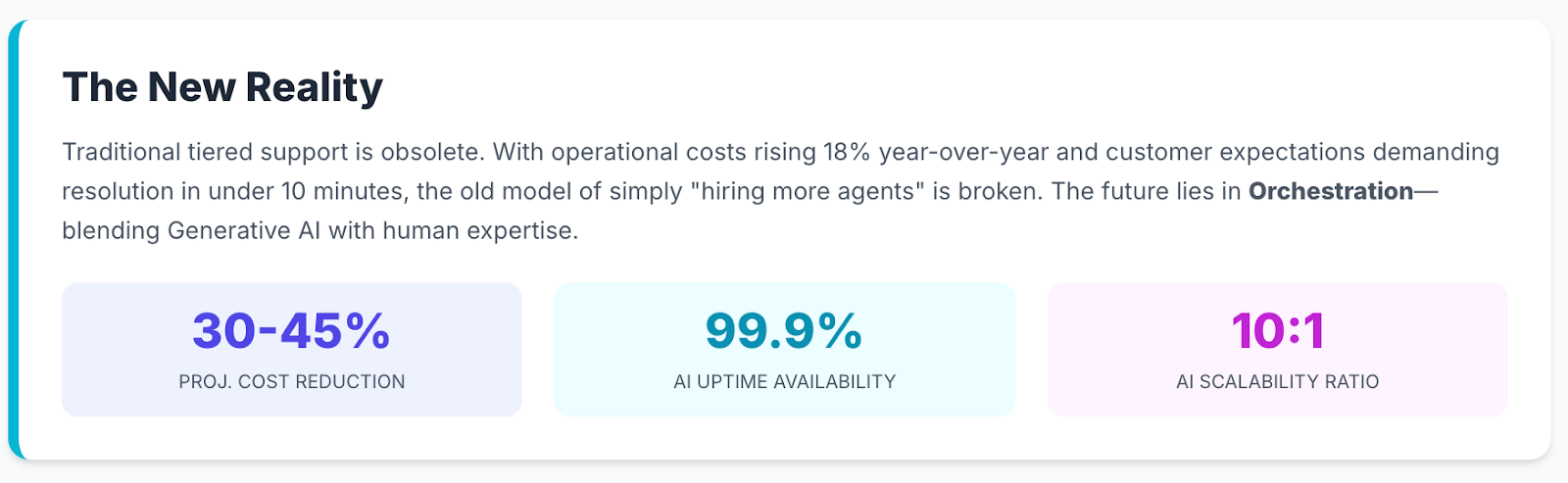
Traditional tiered support is officially obsolete. According to Gartner, 85% of customer service organizations have transitioned to AI-augmented staffing. The average cost per contact has risen to $8.01 for live channels, while AI-assisted interactions cost just $0.60, creating significant pressure to optimize staffing.
Today's staffing challenges include:
The traditional model of hiring more agents to meet demand no longer works. Forward-thinking organizations are rebuilding their staffing strategies around intelligent automation, flexible workforce models, and outcome-based metrics.
To build a future-proof team, leaders should follow the SCALE methodology to transition from a headcount-heavy model to an outcome-based one.
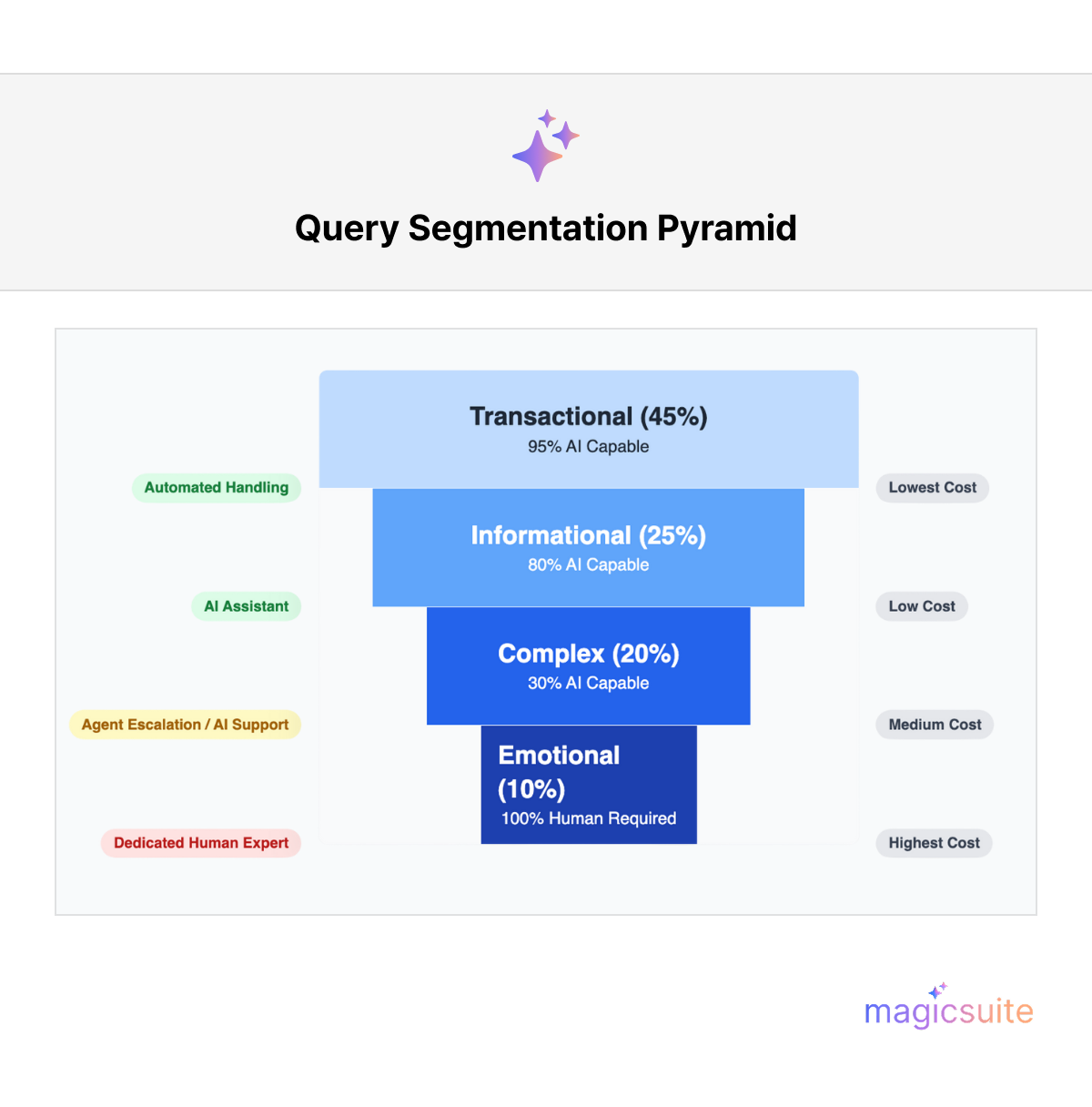
Analyze your interaction data to categorize queries by their "Automation Potential" or four distinct buckets:
Use the 2026 Staffing Formula to account for the efficiency of AI-human handoffs:
Required FTE = (Total Interactions × Average Handle Time) / (Available Hours × Occupancy Rate × Shrinkage Factor)
Industry benchmarks for 2026 planning:
Ensure your staffing aligns with where your customers actually live.
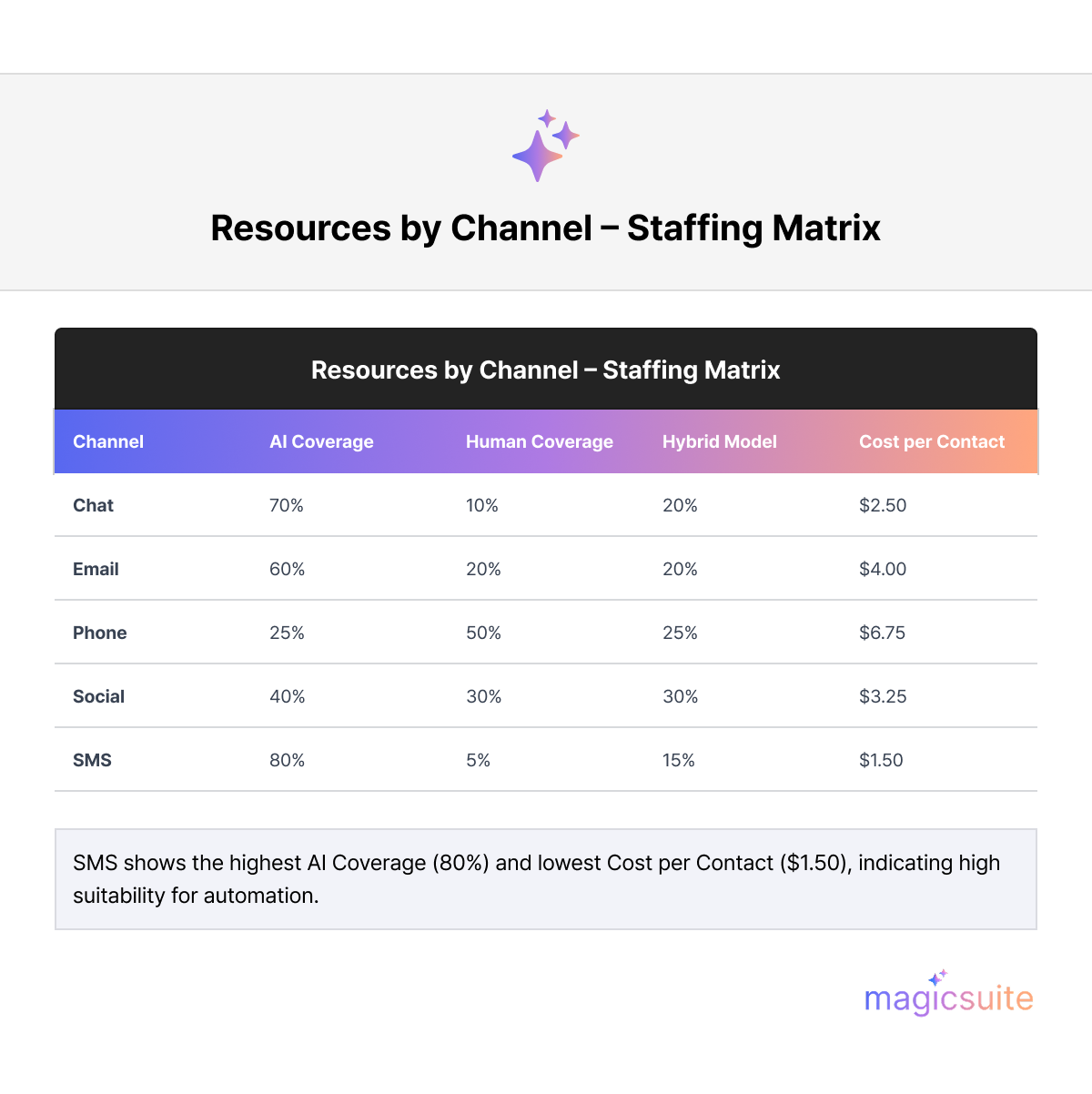
Tip: Prioritize automation across digital channels while maintaining a human presence for voice and emotional support scenarios.
Replace the rigid 9-to-5 desk model with a Three-Tier Workforce Structure:
Shift your customer service KPIs from "Speed" to "Value." Establish monthly review cycles focusing on
For a 100-agent contact center transitioning to a hybrid model:
Traditional Model Annual Cost: $4,500,000
Hybrid Model Annual Cost: $2,925,000 (35% reduction)
ROI Timeline:
Essential platforms for the 2026 staffing model:
Track these metrics weekly to ensure staffing model success:
Efficiency Metrics
Gartner predicts that by 2026, 1 in 10 agent interactions will be automated by LLMs, but for routine "transactional" queries.
Quality Metrics
Case in point: Octopus Energy integrated Generative AI into their email responses and found that AI-generated emails achieved a higher satisfaction rate (80%) than those written by human staff (65%), directly boosting NPS.
Workforce Metrics
Salesforce’s "State of Service" report indicates that high-performing service teams using AI are 1.9x more likely to achieve significant AHT reductions than underperformers.
Use this framework to calculate your potential savings:
Annual Savings = (Current Cost per Contact × Annual Volume) - (Hybrid Model Cost per Contact × Annual Volume)
Where:
Example for 1 million annual contacts:
1. Over-Automating Too Quickly
Don’t deploy AI across all channels simultaneously. Phase rollout by query type, starting with high-volume, low-complexity interactions
2. Neglecting Change Management
There will be resistance from agents and fear of job loss. Position AI as an augmentation tool, provide reskilling opportunities, celebrate human-AI collaboration wins
3. Underestimating Training Needs
Agents can be unprepared for a hybrid model. So allocate 40 hours for initial training, 4 hours for monthly ongoing training
4. Poor Data Quality
It’s a problem if AI is trained on incomplete or incorrect data. Invest 20% of implementation time in data cleaning and preparation
5. Ignoring Customer Preferences
Don’t force AI interactions when customers want humans. Always provide an easy escalation path, and track channel preference data.
MagicTalk's platform addresses the complexities of hybrid staffing models through:
Intelligent Query Routing: Automatically categorizes and routes queries to the optimal resource (AI or human) based on complexity, sentiment, and customer history.
Dynamic Scaling: Instantly adjusts AI capacity during volume spikes, eliminating the need for overstaffing.
Agent Copilot Mode: Provides real-time suggestions and knowledge to human agents, reducing training time by 60%.
Unified Analytics: Single dashboard showing both AI and human performance metrics, enabling data-driven staffing decisions.
No-Code Configuration: Business users can adjust routing rules and AI responses without IT involvement.
Learn more about how MagicTalk can accelerate your staffing transformation at MagicSuite.ai.
Q: How quickly can we expect ROI from a hybrid staffing model?
A: Most organizations achieve positive ROI within 6-8 months. Initial implementation costs are offset by immediate efficiency gains, with full benefits realized by month 12.
Q: What happens to our existing agents when we implement AI?
A: Successful transitions focus on augmentation, not replacement. Agents typically shift to handling more complex, higher-value interactions, while AI handles routine queries. This often leads to higher job satisfaction and lower turnover.
Q: How do we maintain quality when using AI for customer service?
A: Quality actually improves in hybrid models. AI ensures consistent, accurate responses to routine queries, while human agents have more time to address complex issues. Regular quality monitoring and continuous AI training maintain high standards.
Q: What's the minimum scale needed to justify a hybrid model?
A: Organizations handling 50,000+ annual interactions see positive ROI. Smaller volumes can still benefit through shared AI services or platforms like MagicTalk that offer usage-based pricing.
Q: How do we handle channel-specific staffing needs?
A: Create channel-specific strategies based on complexity and customer preference. Digital channels (chat, email) typically support higher automation rates while voice remains more human-centric.
The future of customer service lies in intelligent orchestration, not replacement. By adopting a hybrid AI-human staffing model, organizations can scale support, reduce costs, and elevate customer satisfaction in a sustainable, future-proof way.
Join the top 15% of contact centers using intelligent orchestration.
🔗 Book a Strategy Session with MagicTalk to see your custom ROI projection.

Luke is a technical market researcher with a deep passion for analyzing emerging technologies and their market impact. With a keen eye for data and trends, Luke provides valuable insights that help shape strategic decisions and product innovations. His expertise lies in evaluating industry developments and uncovering key opportunities in the ever-evolving tech landscape.