

What is a hybrid customer service model? Learn how to combine AI efficiency with human empathy to scale your CX. Discover the benefits of blended support, seamless handoffs, and 24/7 service scalability for modern businesses.

The modern customer demands speed, accuracy, and empathy, often simultaneously. For CX leaders, Technical Decision Makers, and Small Business Owners, the challenge is clear: how do you scale operations to meet rapidly increasing volume while maintaining the quality of every single interaction? The answer lies in the hybrid customer service model (HCSM).
A hybrid customer service model is a strategic framework that combines the efficiency and speed of AI-powered automation (like chatbots and virtual agents) with the critical thinking, empathy, and problem-solving skills of human agents.
This integrated approach ensures that routine inquiries are resolved instantly and cost-efficiently by machines, while complex, sensitive, or high-value customer issues are escalated to a qualified human agent with full contextual awareness.
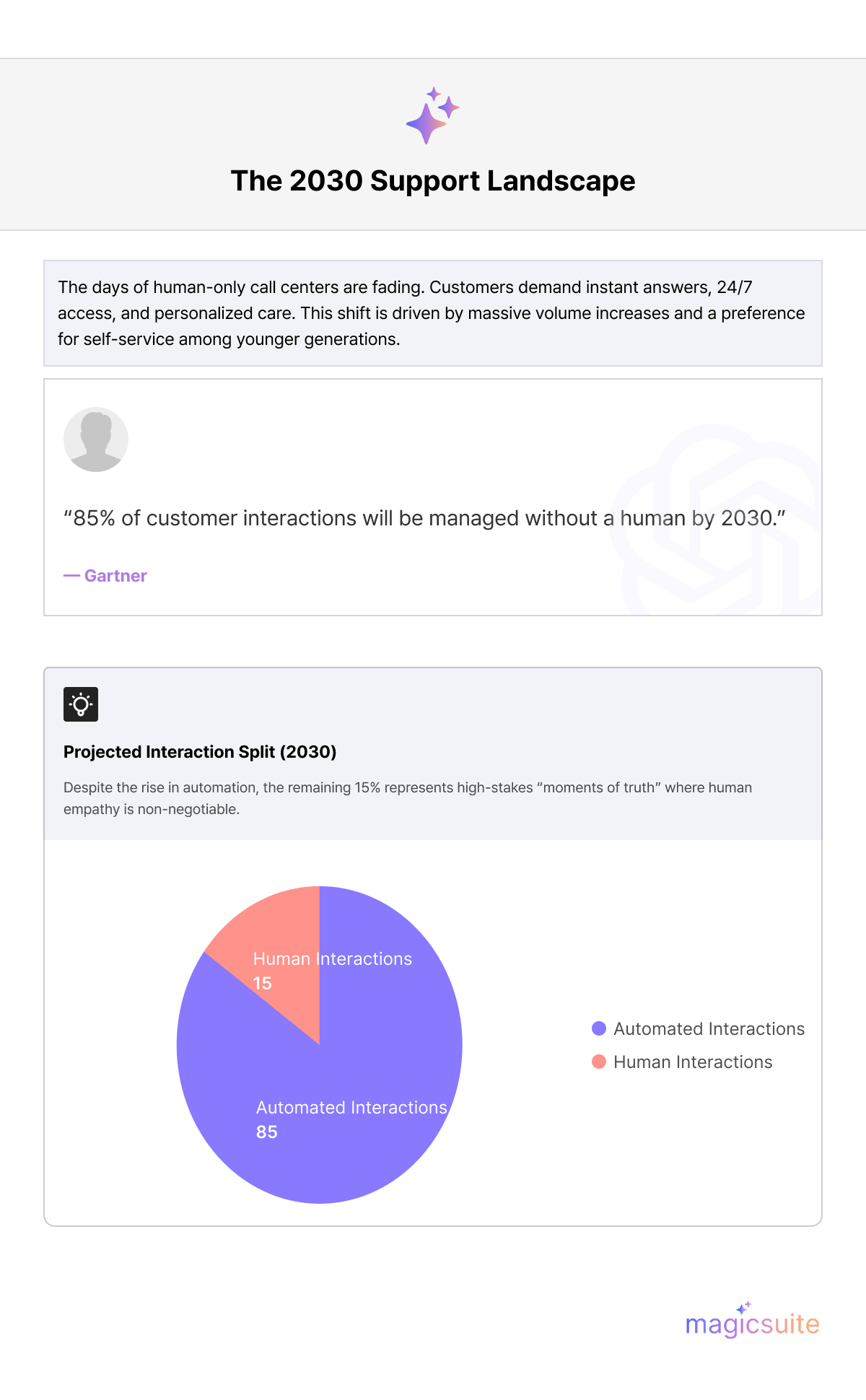
The days of relying solely on large call centers or slow email queues are over. Today’s customers expect instant access and personalized attention. According to recent Gartner studies, 85% of customer interactions will be managed without a human by 2030, yet empathy remains non-negotiable for high-stakes issues. Traditional, human-only support models simply cannot keep pace with this demand for 24/7, multi-channel availability, often leading to agent burnout and high operational costs.
This is where the hybrid customer service model steps in. The HCSM is not just about having a chatbot and a phone number; it’s a strategic combination of automated/AI support tools and human agents working together within a single, unified ecosystem. It is a philosophy centered on assigning the right resource—human or machine—to the right interaction at the optimal time.
"The hybrid customer service model is the engine of modern CX, leveraging AI for speed and scale while preserving human expertise for moments of truth."
This article will define the core components of the HCSM, analyze its transformative benefits, clarify its distinction from other models, and provide actionable steps for successful implementation.
Read more on Customer Service Staffing Models for 2026
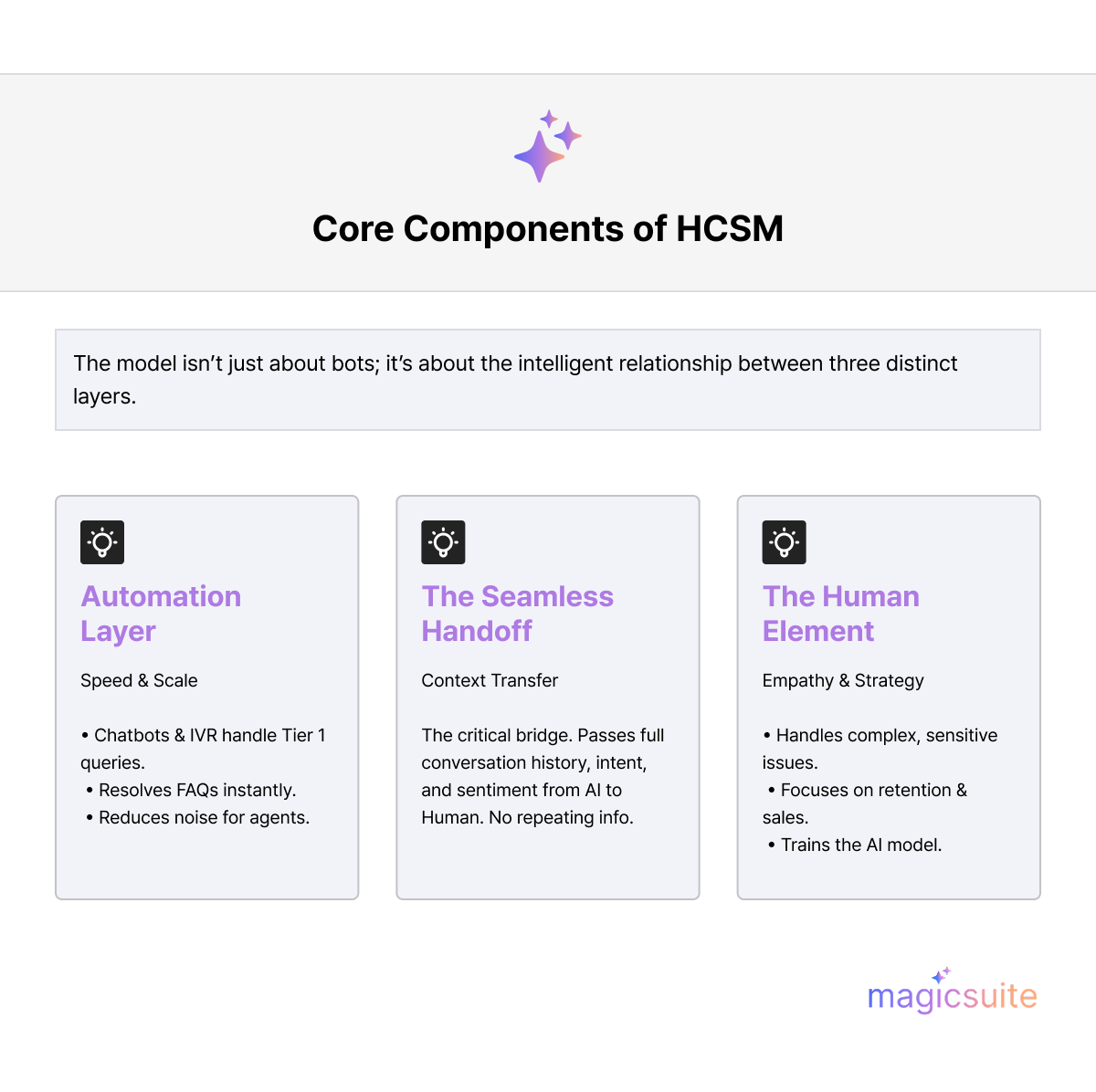
The success of a truly blended support structure hinges on the intelligent, well-defined interaction among three distinct yet interconnected layers.
In an HCSM, human agents transition from reactive answer providers to strategic problem solvers. Their role is redefined to focus on complex, sensitive, or high-value issues that require emotional intelligence, negotiation, or deep institutional knowledge.
The AI tools are the first line of defense, providing instantaneous, scalable, and tireless service. The goal is to resolve the vast majority of simple, repeatable queries without human intervention.
Chatbots and Virtual Assistants
These are the workhorses, handling Tier 1 queries, FAQs, and transactional tasks (e.g., "What is my order status?", "How do I reset my password?"). Tools like MagicTalk are designed for this, offering sophisticated NLU to understand intent quickly.
Intelligent IVR/Voicebots
Moving beyond frustrating press-1 menus, modern voicebots can understand spoken language to route calls accurately and resolve simple issues entirely over the phone, significantly improving cost efficiency.
Self-Service Portals
Robust knowledge bases and community forums empower customers to find answers themselves, a preferred method for roughly 70% of millenials and Gen Z consumers. This maximizes 24/7 availability.
The true test of a hybrid system is the transition point. Nothing frustrates a customer more than being asked to repeat information they have already provided to a bot. The seamless handoff involves passing the complete conversation context—including the customer’s identity, the questions asked, the answers provided, and the stated frustration level—from the AI to the human agent’s screen.
"In a hybrid model, the quality of service is measured not just by the speed of the bot, but by the smoothness of the baton pass to the human agent."
For solutions like MagicTalk, this contextual transfer is achieved through deep CRM integration and a unified desktop application for the agent. This is fundamental to optimizing first contact resolution.
The adoption of a hybrid model moves beyond simple cost-cutting; it’s a strategic investment in long-term customer loyalty and operational resilience. Here are the key benefits for business and customers:
Purely human models are limited by staffing, time zones, and lunch breaks. HCSM eliminates these constraints:
Companies utilizing an HCSM can typically handle a surge in contact volume of up to 400% without noticeable dips in response speed.
This is the key metric for Technical Decision Makers. By offloading up to 80% of routine inquiries to the automation layer, businesses realize significant gains:
"AI doesn't replace the human agent; it elevates them from data entry clerks to customer success specialists."
The primary source of cost efficiency comes from deflection. Automating up to 80% of low-complexity, high-volume interactions allows businesses to reduce the necessity for large teams of human agents handling repetitive tasks. This shift lowers labor costs, decreases average handle time (AHT), and allows the remaining human agents to focus on high-value, revenue-generating activities.
Ultimately, the customer is the winner in the HCSM, experiencing the best of both worlds:
CX platforms with robust AI/human integration see customer satisfaction (CSAT) scores improve by an average of 15% to 20% compared to traditional models.
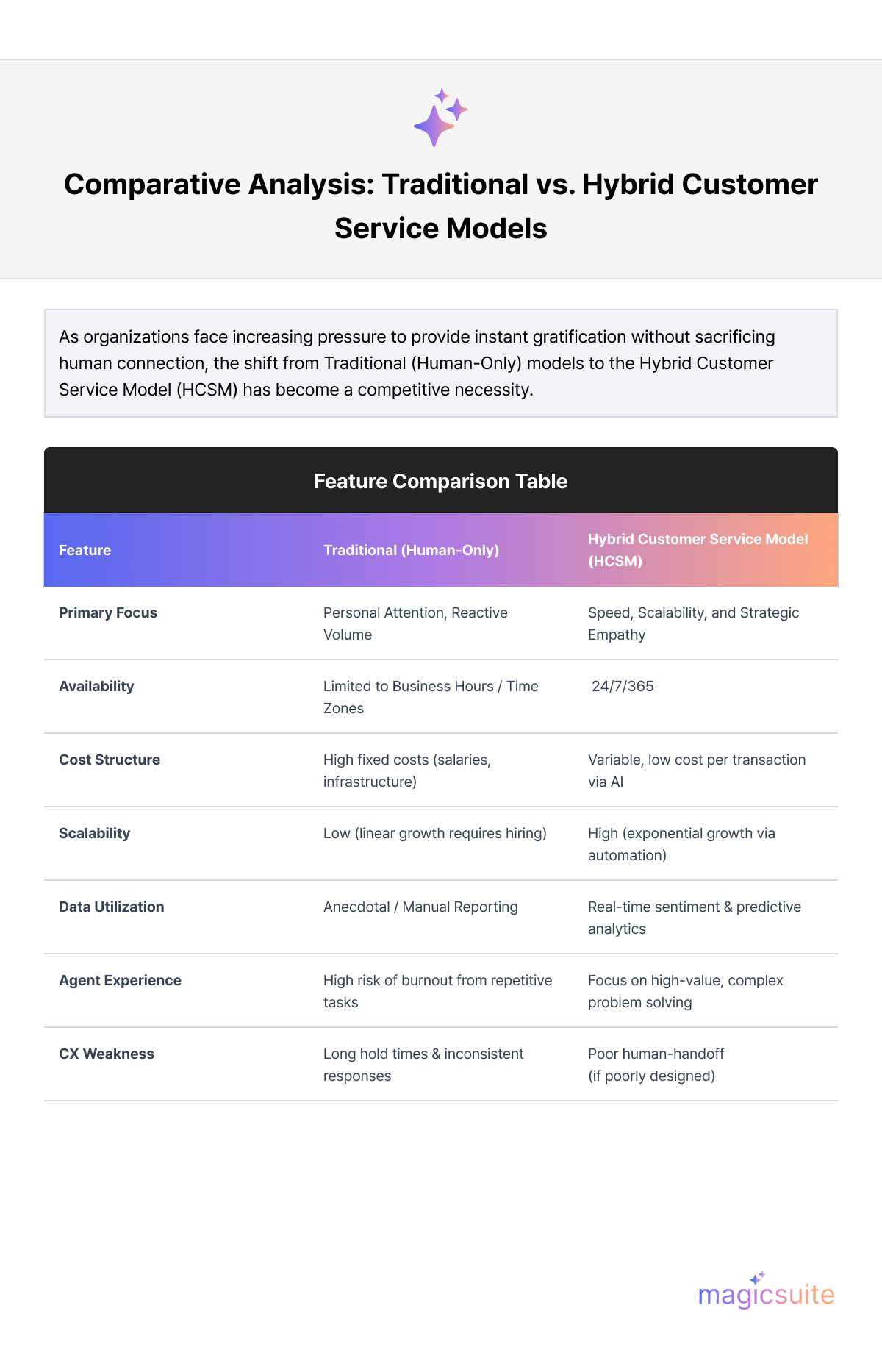
AI is best suited for transactional, informational, and high-frequency, low-complexity queries. Examples include: checking order status, tracking shipments, basic account balance inquiries, password resets, FAQ answers, and service troubleshooting guided by predefined steps. These tasks are typically resolved instantly, boosting customer satisfaction.
Understanding the hybrid customer service model requires distinguishing it from other common support strategies.
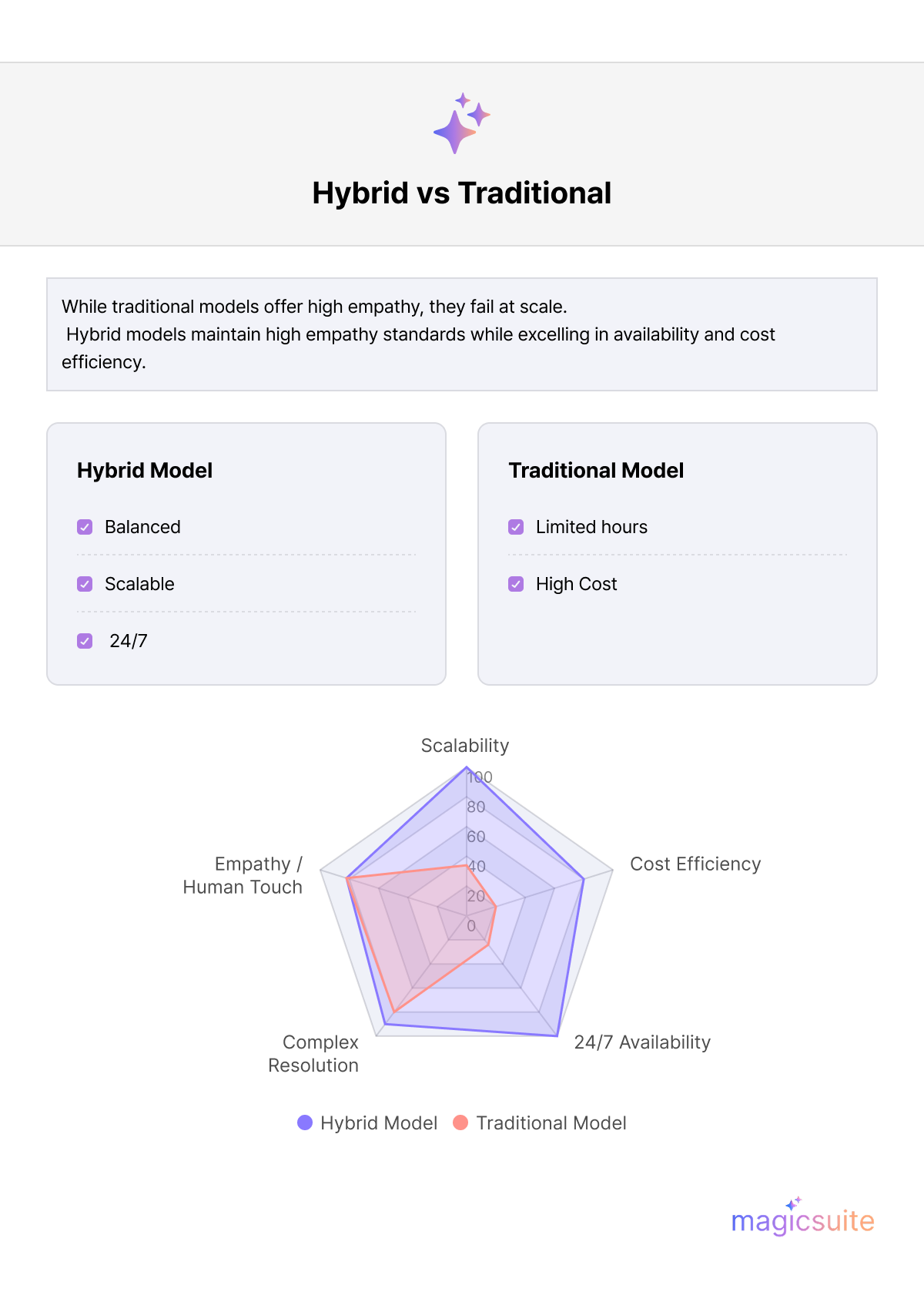
While the terms multichannel support and omnichannel support relate to channel availability, the hybrid model relates to workflow integration.
"Omnichannel connects the dots between channels; Hybrid connects the intelligence between man and machine."
For CX Leaders and Technical Decision Makers, transitioning to a hybrid model requires careful planning and the right technology stack.
The first step is a data-driven audit. Analyze your support tickets from the past 6-12 months.
Identify Tier 1 Queries
Which questions consume the most of the agent's time? Look for questions with high volume, low complexity, and static answers (e.g., "Where is my refund?," "What are your business hours?"). Industry data suggest that up to 65% of all calls are transactional or informational and are prime for automation.
Map the Customer Journey
Identify friction points where automation can deliver immediate relief. For instance, if call queue times spike after 5 PM, that’s a clear opportunity for an after-hours voicebot to handle basic resets, maximizing service scalability.
The technology must support a unified data flow. This means choosing an AI platform that is deeply integrated with your CRM and other backend systems.
Unified Agent Desktop
The chosen AI platform must feed all conversation history, customer profiles, and intent data into a single screen for the human agent.
API Capabilities
Ensure the APIs allow for full contextual handoff, not just a simple redirect. MagicTalk is built on this principle, ensuring the AI layer and the human workspace are seamlessly interconnected.
Proactive Tools
Implement AI tools that monitor customer behavior on your website (e.g., spending too long on a help page) and proactively initiate contact before frustration sets in.
Training is crucial. Agents need to understand how to collaborate with, not compete against, the AI.
AI Monitoring & Correction
Agents must be trained to monitor the AI dashboard, identify where the bot failed, and step in strategically before the customer asks to speak to a manager.
Upskilling
Shift human training entirely toward soft skills, empathy, creative problem-solving, and emotional intelligence—the skills machines cannot replicate. The agent is now the escalation expert.
Workflow Familiarity
Agents need to be intimately familiar with the automated pathways to quickly diagnose why a customer was escalated and avoid retracing steps.
Absolutely not. While large enterprises benefit from its massive service scalability, the HCSM is perfect for Small Business Owners. Modern AI tools like MagicTalk are affordable and easy to integrate, making 24/7 availability and instant responses achievable without a large payroll. This levels the playing field, allowing small businesses to offer a premium, round-the-clock customer experience (CX) previously only accessible to major corporations.
While the hybrid customer service model is the clear path forward, implementation is not without challenges.
Potential Challenges:
Read more on AI Compliance and Privacy: A Guide for CX Leaders
The future of blended support is moving toward a state of hyper-personalization and prediction:
A Forrester study predicts that companies leading in predictive CX will see their revenue grow 1.5 times faster than competitors.
Omnichannel support is a technology strategy focused on connecting communication channels (such as chat, email, and phone) to ensure a seamless customer experience across platforms.
The Hybrid Customer Service Model is a workforce strategy that integrates AI and human agents across connected channels, ensuring the right resource (machine or person) handles each query at the right time. Hybrid defines the workflow; Omnichannel defines the connectivity.
The hybrid customer service model is not a futuristic concept; it is the definitive standard for modern customer support. It is the only scalable strategy that successfully balances the customer's need for instant resolution with their expectation of human empathy.
Delegating the bulk of Tier 1 queries to intelligent automation can free businesses from relying on expert human agents to focus on high-value interactions that truly build loyalty and drive revenue.
Ready to bridge the gap between AI and human support? See MagicTalk in Action — Experience seamless handoffs and 24/7 scalability.

Ace is the product manager of MagicSuite and multiple other projects at Makebot AI. With extensive experience in product development and leadership, Ace ensures that each project aligns with market needs and delivers innovative solutions. Passionate about technology and automation, Ace plays a crucial role in shaping AI-driven products that enhance efficiency and user experience.