

77% of Gen Z use phone support — data reveals what this generation actually expects from service.

Gen Z customer service refers to the expectations, behaviors, and communication preferences that consumers born between 1997 and 2012 bring to every support interaction. This generation is the first to grow up entirely in the digital age, giving them different baseline expectations around speed, self-sufficiency, personalization, and channel flexibility than any generation before them.
Understanding Gen Z customer service is not an optional exercise for CX leaders. Gen Z already represents 40% of the global consumer base and will surpass every other generation in spending power by 2031. The brands that figure out how to serve them well now are building the loyalty base that will define the next decade.
The most persistent misread in Gen Z customer service strategy is the assumption that digital natives refuse to use the phone. The data contradicts this directly.
According to Nextiva's 2025 study, 77% of Gen Z respondents have used phone support, and 72% say they are "likely" or "very likely" to choose phone support again. A separate PolyAI study of 1,000 US consumers found that 86% of Gen Z and younger millennials prefer calling customer service over digital-first options. This figure overturns years of CX assumptions. McKinsey's data, cited by Pylon, confirms that 71% of Gen Z customers say live phone calls are the quickest, most convenient way to resolve customer service issues.
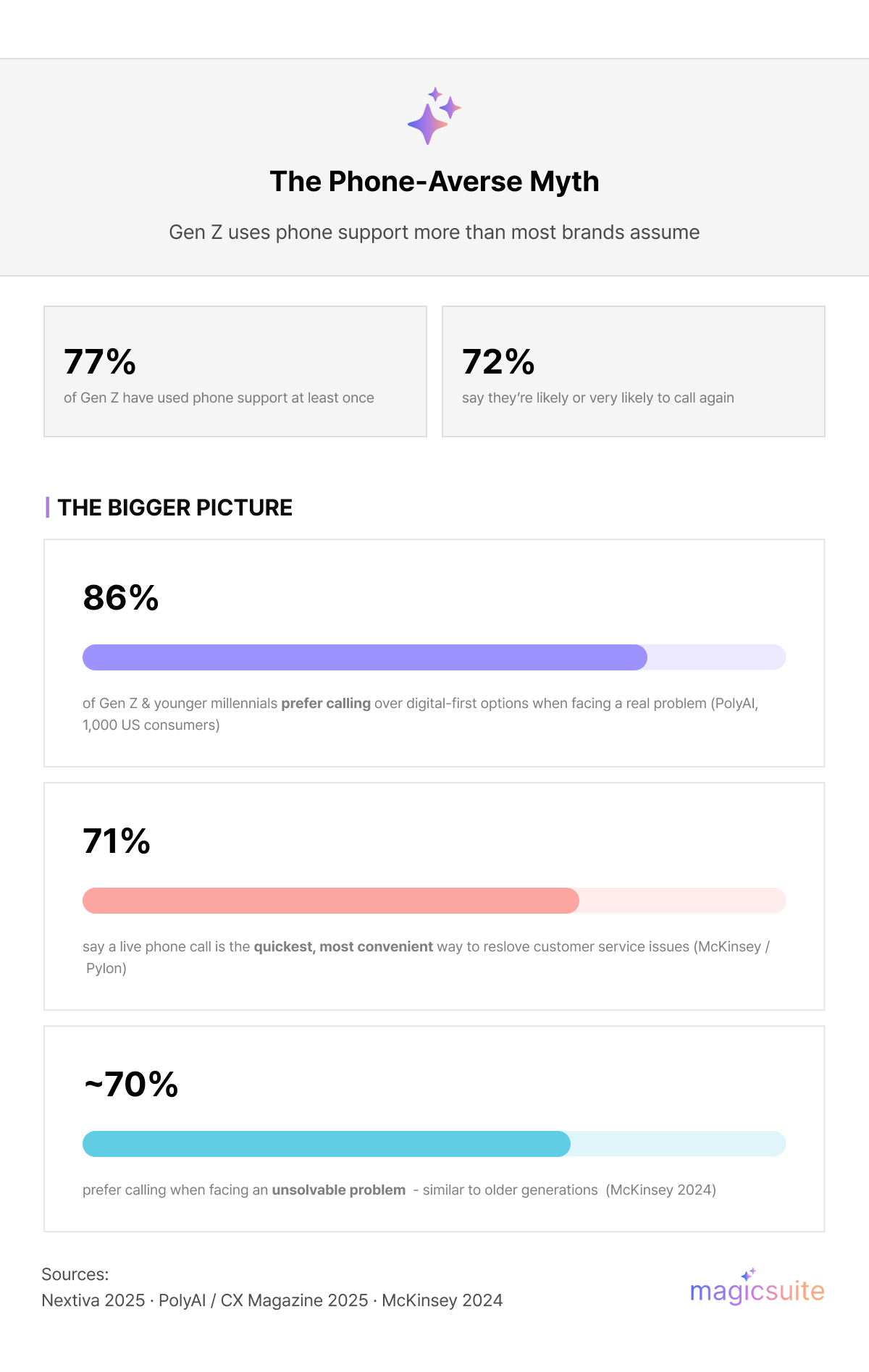
77% of Gen Z have used phone support, and 72% say they'd choose it again. The assumption that digital natives avoid using their phones doesn't hold up to the data.
McKinsey partner Brian Blackader, who co-authored the firm's 2024 "Where Is Customer Care?" research, described the finding directly:
"When facing an unsolvable problem, about 70 percent of Gen Z individuals prefer to make a phone call, a share similar to older generations. This preference changes for personal communications, such as contacting friends or family, where they favor texting or messaging apps. However, for serious issues with services like banking or telecommunications, they still turn to phone calls."
The distinction matters operationally. Gen Z does not dislike the phone. They dislike poor phone experiences: hold times, outdated interactive voice response systems, and agents who lack context. McKinsey partner Eric Buesing, global head of the firm's customer service operations practice, captured the longer arc of this:
"15 years ago, we were talking about the death of the contact center because the promise of digital was going to drive all interactions online and to apps. In fact, the opposite happened. We needed contact centers more than ever."
Buesing's additional observation on premium segments reinforces why this matters for high-value customers: Gen Z individuals in premium service tiers — banking, financial services, and similar categories — "expect high levels of service, akin to what baby boomers expect. They view phone service as a justified expectation for the fees they pay, demanding quality assistance and a positive experience as part of their service package."
Channel customer service for Gen Z is not a single-channel preference. It is a context-dependent hierarchy, and brands that fail to understand that distinction will frustrate rather than serve this cohort.
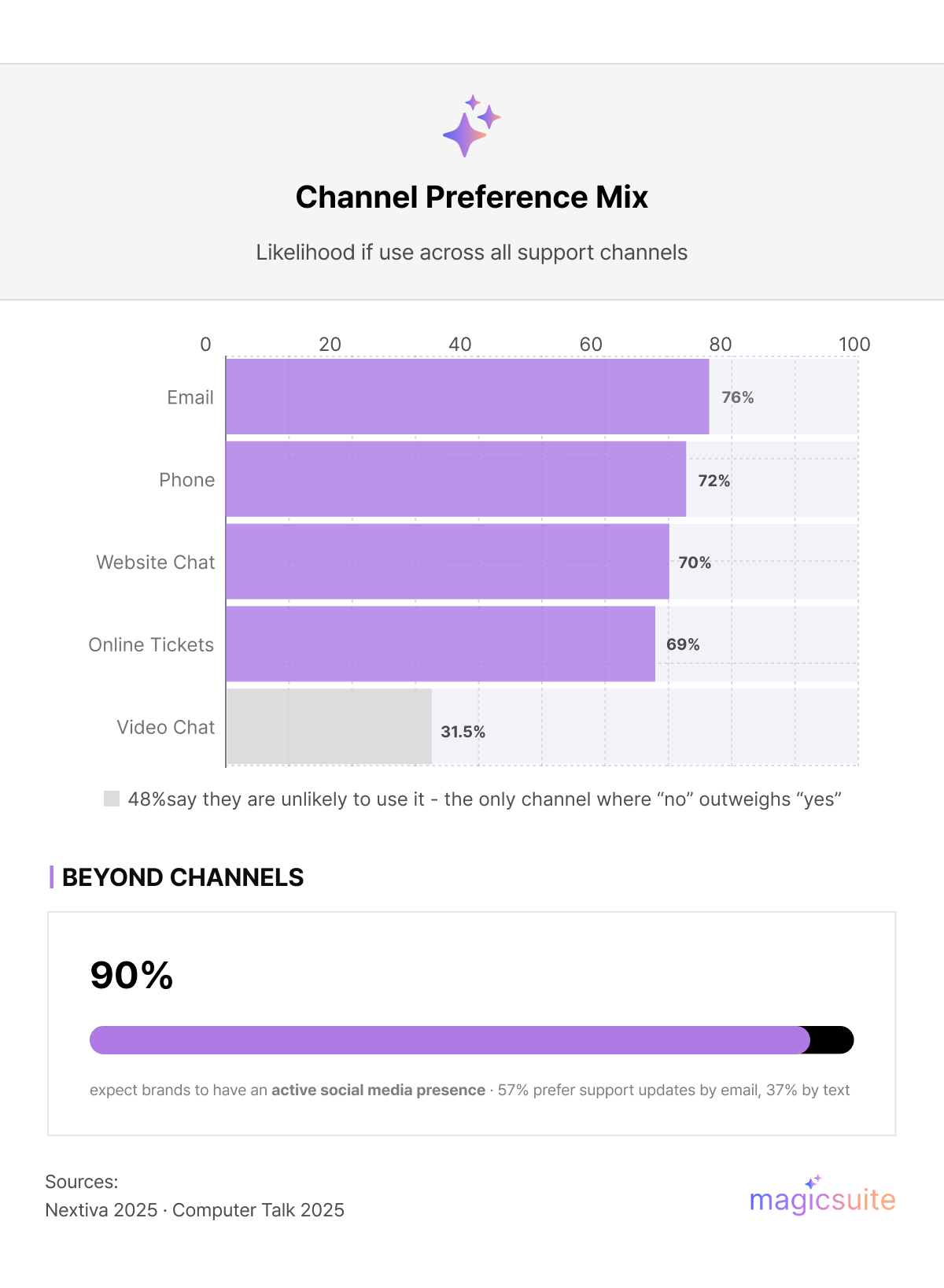
Gen Z's channel choice is situational, not fixed. Email (76%) and phone (72%) edge out chat and tickets, with video chat the only channel where "unlikely" outweighs "likely."
Nextiva's 2025 research mapped Gen Z channel preferences across a sample of consumers.
The full picture from Computer Talk's research includes social media and in-app messaging as part of the required channel set: 90% of Gen Z consumers expect companies to have an active social media presence, and around 13% use social media as their preferred contact method. Meanwhile, 57% of Gen Z consumers prefer support updates via email, and 37% prefer text messages.
The channel choice is rarely fixed. Gen Z selects a channel based on:
The operational implication is that multichannel presence is not enough. Only 13% of companies report that customer data, history, and context carry over fully across interactions and channels, according to Deloitte Digital. For Gen Z, a service journey that starts on chat and escalates to phone — but requires them to repeat their issue — reads as institutional incompetence. Customer satisfaction rates reach 67% with seamless omnichannel support, compared to just 28% for disconnected multichannel support, according to SQM Group research. Companies implementing omnichannel transformations see 5-15% increases in total revenue, and support costs drop by up to 30%.
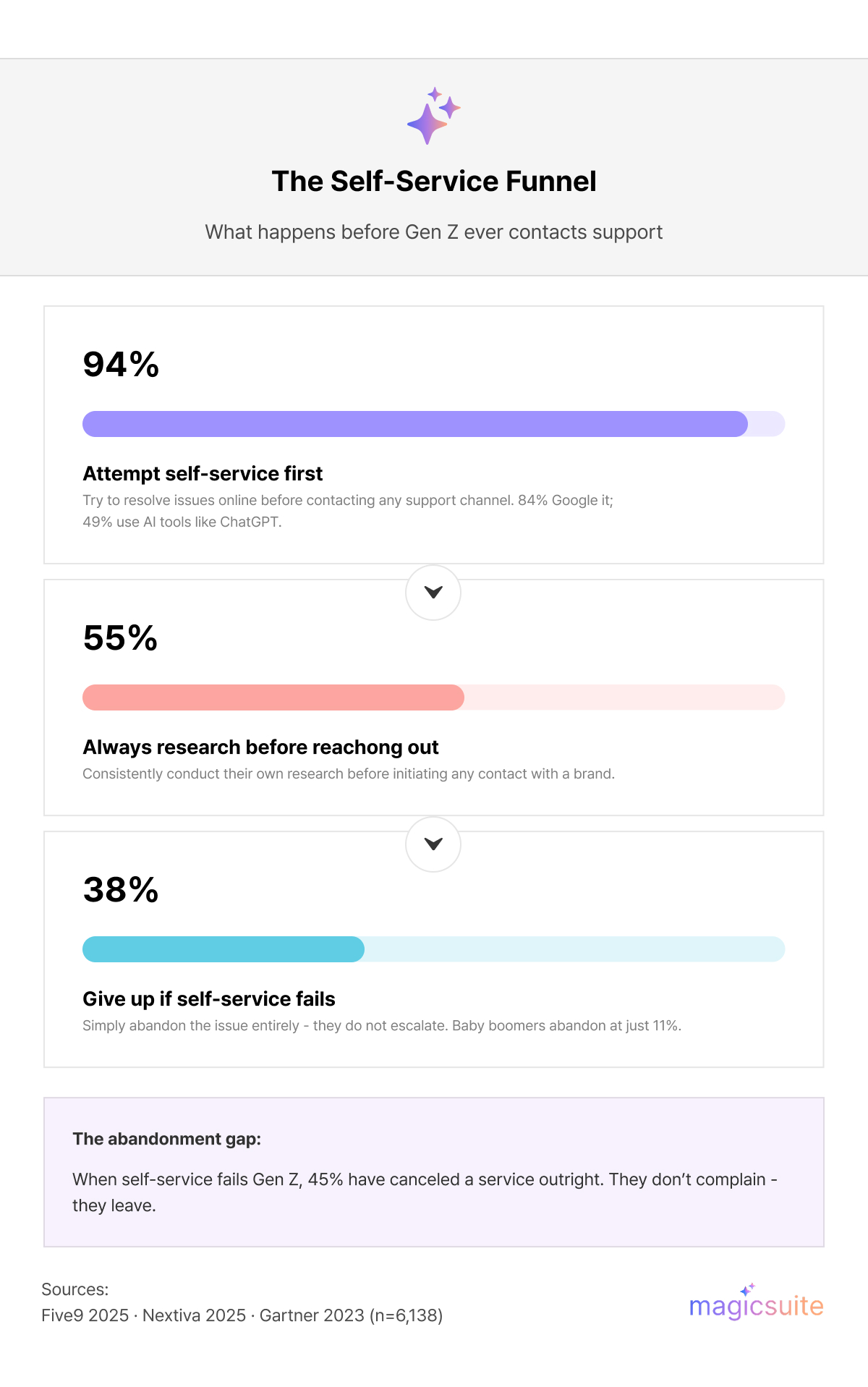
94% of Gen Z attempt self-service before ever contacting support. But when it fails, 38% abandon the issue entirely rather than escalate and 45% have canceled a service because of it.
Gen Z customer service begins before any human or AI agent is ever contacted.
Five9's 2025 Customer Experience Report found that Gen Z is the most likely generation to attempt self-service before contacting support — 94% try to resolve issues online first. Nextiva's data reinforced this: 55% of Gen Z respondents always or often conduct their own research before reaching out, 84% search Google, and 49% consult an AI tool like ChatGPT before making contact.
This creates a specific failure mode that many organizations underestimate. Gartner's survey of 6,138 customers found that 38% of Gen Z and millennial customers say they would simply give up on a customer service issue if it cannot be resolved through self-service. Among baby boomers, that figure drops to just 11%. When Gen Z self-service fails, they do not escalate — they abandon, and they often do not return. Nextiva's study found that 45% of Gen Z respondents have canceled a service because they could not access support in their preferred way.
The implication is precise: self-service and voice are not competing investments. They are sequential ones. AI-powered self-service that resolves straightforward issues, reduces inbound call volume, and reserves voice capacity for the complex situations that Gen Z still needs human help to navigate.
No complete treatment of Gen Z customer service avoids the cultural flashpoint that dominated headlines in mid-2025: the Gen Z stare.
The Gen Z stare describes a pattern widely reported in retail, hospitality, and service environments — a blank, expressionless response from young workers to customer greetings or simple questions, replacing the verbal acknowledgment older generations expect. The term gained mainstream traction in July 2025, covered by NBC News, Fortune, ABC News, Wikipedia, and others, generating millions of views on TikTok under #GenZStare.
Wikipedia defines it as a blank stare that members of younger generations give in situations where a verbal response would be more common or appropriate, and it occurs most frequently in customer service interactions. NBC News summarized the most common description as a vacant expression a Gen Zer gives in response to a question, observed across classrooms, restaurants, workplaces, and service settings.
The Gen Z stare has supply- and demand-side dimensions in customer service — and confusing them is where most CX commentary goes wrong.
On the supply side — Gen Z as workers: Research points to structural roots. University of Alabama professor Jessica Maddox observed that the behavior became more prevalent after pandemic-era lockdowns, noting an increase in silence upon returning to in-person settings. A 2024 study found that 40% of adults had gone three or more days without a single face-to-face conversation. Gen Z workers socialized during the pandemic built communication habits primarily through digital, asynchronous channels — making spontaneous in-person small talk unfamiliar rather than intentionally hostile. Fortune reported a measurable management toll: 27% of managers say they would prefer not to hire Gen Z, and 18% say they have considered leaving their roles because of the challenges of managing younger workers.
On the demand side — Gen Z as customers: The same generation that produces the stare as workers carries its own expectations as customers. Those expectations are direct, outcome-focused, and low on patience for scripted pleasantries. What older generations call warmth, Gen Z often reads as performative. What Gen Z calls efficiency, older managers may read as coldness. For businesses, the mismatch is real — but the solution is operational, not generational.
For Gen Z workers in service roles, structured communication training that treats professional interaction as a learned skill — not an assumed disposition — is the practical response. For Gen Z customers, the expectation is not warmth. It is competence. Brands that conflate the two design training programs that miss the mark and service experiences that frustrate the very customers they intend to serve.
Eric Buesing's framing of good service applies directly:
"The principles of 'know me, know my issue, and understand me' are easily said and very difficult to achieve. The organizations that manage to do well in this area invest considerable effort in understanding how to meet these expectations. It's not a game you win. It's a game you play. You're always trying to get better."

60% of Gen Z value AI for speed and convenience, but only 55% trust it for accuracy. For urgent or sensitive issues, 47% still want a human and they expect the brand to know when to make that switch.
Gen Z is the generation most willing to engage with AI-powered customer service — and the most demanding about what that AI actually delivers.
Five9's 2025 Consumer Survey found that 60% of Gen Z value the speed and convenience of AI chatbots. They are also the most forgiving generation after a poor chatbot experience: only 20% say they would refuse to use a chatbot again after a negative interaction, compared to 61% of baby boomers. This gives brands real latitude to iterate and improve AI deployments without permanently losing Gen Z customers.
The trust gap is real. Only 55% of Gen Z trust AI to provide accurate information, and 21% remain actively skeptical, according to Five9's research. This skepticism centers on sensitive or high-stakes situations, such as financial matters, healthcare, and billing disputes, where inaccurate AI responses can have tangible consequences. Forty-seven percent of Gen Z still prefer a human agent when issues become urgent or emotionally charged.
Buesing's McKinsey research projects that generative AI could reduce phone volumes by 50% within five years, but he noted early implementation has been slower than anticipated: "The moments that truly matter will still require a human touch."
For Gen Z, the AI-to-human boundary is intuitive. They do not request either one. They expect the brand to know which is appropriate and to make the transition seamless. AI tools that dead-end Gen Z without a clear human path compound frustration rather than resolving it.

88% of Gen Z are loyal to five or fewer brands. What Sephora, Target, and Apple have in common: outcome-focused service, frictionless escalation, and full context continuity across every channel.
Gen Z loyalty is concentrated and conditional. Research cited by Computer Talk found that 88% of Gen Z consumers consider themselves loyal to five or fewer brands. Getting into that set requires consistent execution across every touchpoint, not a single strong interaction.
The stakes of a poor service experience are higher than they were for prior generations. Five9's consumer survey captured this through a 21-year-old Gen Z respondent:
"The worse my customer service experience is, the less likely I am to use the brand again. I shop online because it makes my life easier. I don't have the time to go into a store to purchase, but if buying stuff online is going to take hours or be difficult, then I won't use them anymore."
The brands winning Gen Z loyalty — Sephora, Target, and Apple, per Five9 research — share identifiable traits: direct, outcome-focused service; digital channels that resolve rather than deflect; frictionless escalation to human agents; and full context continuity across every channel switch. Sogolytics research confirms that Gen Z values seamless digital experiences that feel individual and relevant. Brands that treat this cohort as a demographic segment rather than distinct individuals do not retain them.
Gartner analyst Michael Rendelman has characterized Gen Z as fundamentally outcome-driven: they want to resolve an issue with minimum friction using whatever channel delivers that result fastest. The channel is a means. The outcome is the point. This reframes how contact center performance should be measured for this segment; channel abandonment and escalation rates become leading indicators of where service design is failing.
Gen Z customer service preferences do not require a reinvention of the contact center strategy. They require precision, not novelty.

Companies that deliver on this framework consistently will earn loyalty from the generation that will define the next 20 years of consumer spending. The organizations that treat Gen Z customer service as a niche adaptation rather than a structural priority will discover that 45% abandonment figure firsthand.

Hanna is an industry trend analyst dedicated to tracking the latest advancements and shifts in the market. With a strong background in research and forecasting, she identifies key patterns and emerging opportunities that drive business growth. Hanna’s work helps organizations stay ahead of the curve by providing data-driven insights into evolving industry landscapes.