How RAG and LLMs Turn Institutional Knowledge Into Marketing Intelligence
September 4, 2026
8
mins
20% of firms capture 74% of AI value - RAG turns scattered institutional knowledge into revenue.
KEY TAKEAWAYS
What Enterprise Marketing Leaders Need to Know
RAG + LLM
01
AI adoption is widespread, but high performance remains rare.
Enterprise AI adoption reached 88% of organizations in McKinsey's 2025 State of AI survey, while AI high performers still represent only about 6% of respondents.
02
RAG turns institutional knowledge into usable marketing intelligence.
Retrieval-augmented generation grounds LLM outputs in verified company data, transforming static knowledge bases into a working source of AI marketing intelligence.
03
A small group of companies captures most AI-driven value.
PwC's 2026 AI performance study found that just 20% of companies capture 74% of all AI-driven value, highlighting the importance of governance and execution discipline.
04
Marketing is emerging as one of AI's strongest productivity opportunities.
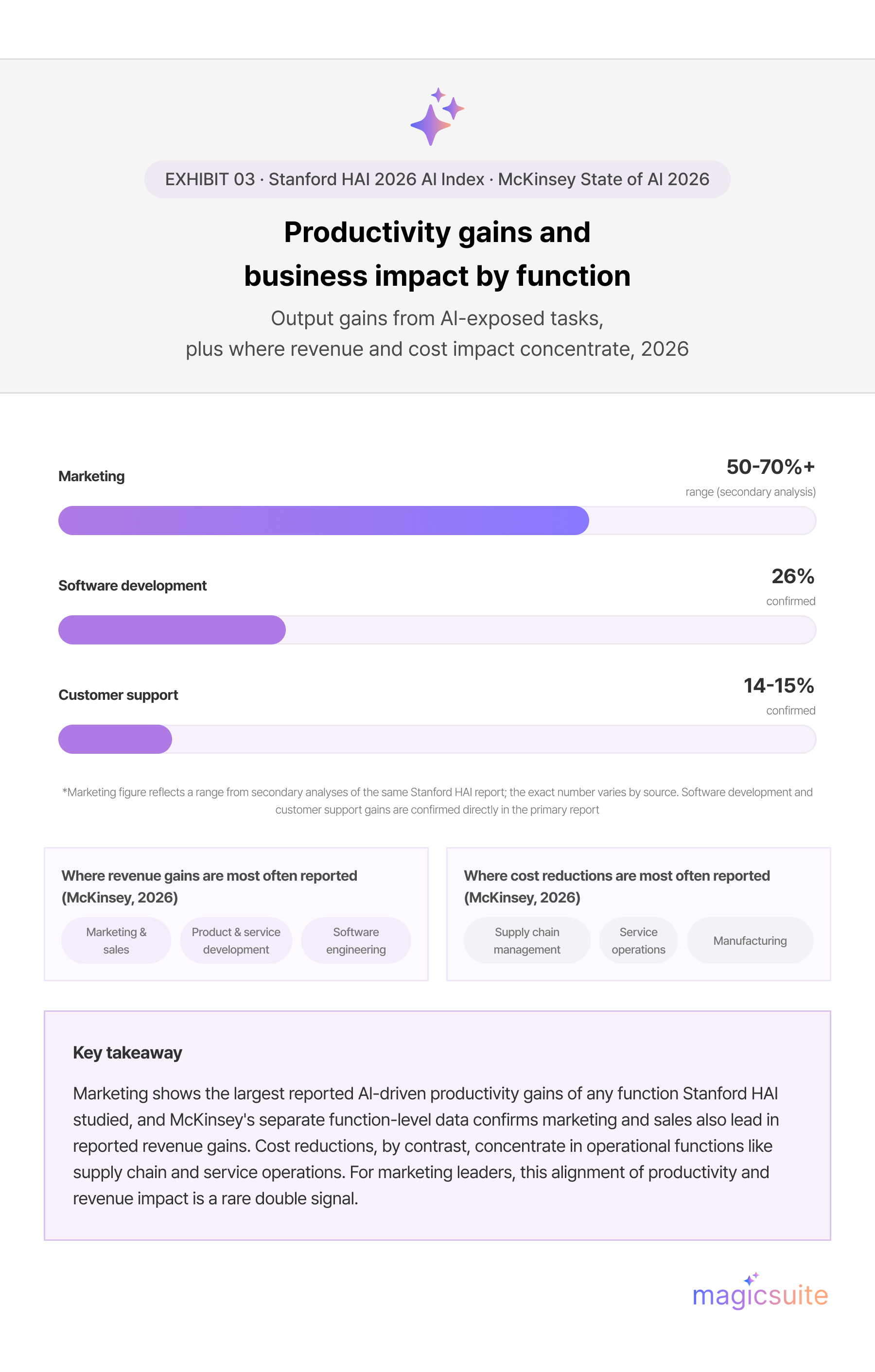
Coverage of Stanford HAI's 2026 AI Index points to major AI-driven productivity gains in marketing output, alongside confirmed gains of
26% in software development and 14%–15% in customer support.
05
Marketing and sales are among the clearest revenue-side AI winners.
McKinsey's 2026 State of AI survey finds that revenue gains from AI are most often attributed to marketing and sales, followed by product and service development and software engineering.
06
Skills remain a bigger scaling barrier than technology.
Deloitte's 2026 survey of 3,235 business and IT leaders identified
insufficient worker skills as the leading barrier to integrating and scaling AI across existing workflows.
07
Unified retrieval infrastructure is critical to enterprise RAG performance.
Enterprise RAG and LLM systems deliver their strongest returns when institutional knowledge, customer data, and marketing workflows operate through a shared retrieval layer instead of disconnected tools.
Introduction
Ask ten enterprise marketers where their best customer insight lives, and most will point to a folder, a wiki, or a colleague who left the company two years ago. That is the real cost of scattered institutional knowledge: expertise that exists but cannot be found, retrieved, or applied at the speed a campaign demands. Retrieval-augmented generation (RAG) and large language models (LLMs) close that gap by connecting AI systems directly to an organization's verified data, research, and performance history.
Enterprise generative AI adoption crossed 88% in McKinsey's 2025 survey, and the 2026 follow-up shows nearly nine in ten organizations still using AI regularly, yet most companies still cannot convert that access into measurable marketing intelligence. This article examines what separates AI leaders from laggards, how RAG for marketing and LLM for marketing use cases actually change workflow economics, and what the latest data from McKinsey, Deloitte, PwC, Gartner, IDC, and MIT Sloan reveals about turning institutional knowledge into a durable competitive asset.
What RAG and LLMs Actually Do With Institutional Knowledge
Enterprise RAG is an architecture that retrieves relevant, verified documents (product specs, brand guidelines, customer research, past campaign results) and feeds them to an enterprise LLM at the moment it generates a response. Instead of relying only on what a model learned during training, the system pulls current, proprietary context and grounds its output in it. This is the difference between an AI that invents a plausible-sounding claim and one that cites your actual pricing sheet, your actual customer segment data, or your actual Q3 campaign report.
For AI knowledge management, this shift matters because institutional knowledge has always been abundant but poorly indexed. Enterprise search historically returned a list of documents; modern enterprise knowledge management platforms built on RAG return a synthesized, sourced answer. Gartner's Market Guide for Enterprise AI Search frames this evolution plainly, noting that generative AI is transforming enterprise search from information retrieval into information synthesis for both employees and AI agents.
Signal: Marketing teams generate enormous volumes of research, creative assets, and performance data that rarely reach the people who need them next. Evidence: Gartner's Top Trends in Data and Analytics for 2026 projects that 40% of enterprises will adopt GraphRAG techniques by 2029 specifically to improve factual accuracy and reasoning in complex retrieval tasks. Implication: The organizations investing in retrieval infrastructure now are building the foundation that later determines whether generative AI in marketing produces trustworthy output or expensive noise.
The Adoption-Value Gap: Why Most Organizations Use AI but Few See Returns
Enterprise AI has moved past the experimentation question. McKinsey's 2025 State of AI survey, based on responses from 1,993 organizations across roughly 105 countries, found that 88% of companies used AI regularly in at least one business function, up from 78% a year earlier. The 2026 edition, fielded in May and June 2026 across 1,719 participants in 97 nations, confirms the trend continued: nearly nine in ten respondents report regular AI use, and 44% now report AI scaling across their enterprise, up from 38% the year before.
The value picture looks very different. McKinsey defines "AI high performers" as organizations that attribute more than 5% of EBIT to AI and report significant value from it; that group has held steady at about 6% of respondents across both the 2025 and 2026 surveys. In the 2026 survey, 37% of respondents attribute at least some EBIT impact to AI, essentially unchanged from the year before. PwC's separate 2026 AI performance study, drawing on 1,217 senior executives at mostly billion-dollar-revenue companies, arrived at a strikingly consistent finding: just 20% of companies capture 74% of all AI-driven value. Separately, PwC found that just one in eight CEOs report both increased revenue and reduced costs from AI, while 56% report neither benefit, according to its 29th Global CEO Survey.
Two independent studies, from McKinsey and PwC, converge on the same pattern: a small cohort of high performers captures most of the value while the majority sees marginal or unmeasurable returns.
The gap is not a technology gap. It is a capability gap in data architecture, workflow redesign, and governance maturity.
For marketing leaders evaluating AI-powered marketing analytics investments, this means vendor selection matters less than integration discipline.
Why Enterprise RAG Is the Missing Link for Marketing Intelligence
Marketing has historically been an early adopter of generative AI, and the returns show it. Stanford HAI's 2026 AI Index confirms productivity gains of 26% in software development and 14% to 15% in customer support from AI-exposed tasks, and widely cited secondary coverage of the same report puts marketing output gains meaningfully higher still. That gap exists because marketing work (content variation, segmentation, campaign analysis) maps cleanly onto what LLMs do well, provided the model is grounded in accurate source material.
This is where RAG for marketing earns its keep, and it is what separates a genuinely useful LLM for marketing deployment from a generic chatbot wrapper. Without retrieval, an LLM asked to draft product messaging will guess at specifications, pricing, or positioning based on generic training data. With retrieval, it pulls from the actual product catalog, the actual customer data platform, and the actual approved brand voice guide. MIT Sloan Management Review's research on generative AI and organizational knowledge, conducted with IMD, found that companies making real progress beyond the experimentation phase share one trait: they use generative AI to unlock and connect knowledge across the enterprise rather than deploying it as an isolated point solution.
Practical enterprise use cases now in production:
Grounding AI customer insights in unified first-party data so personalized messaging reflects actual purchase history and consent status, not inferred guesses.
Powering internal Q&A over campaign archives, so a marketer can ask what messaging worked in a prior product launch and receive a sourced, specific answer.
Automating compliance-checked content generation in regulated sectors, where every claim must trace back to an approved source document.
McKinsey's 2026 survey reinforces the pattern at the function level: revenue gains from AI use are most often attributed to marketing and sales, followed by product and service development and software engineering, while cost reductions are most frequently reported in supply chain management, service operations, and manufacturing. Marketing is, by McKinsey's own function-level breakdown, one of the clearest revenue-side winners in the current wave of enterprise AI deployment.
What Separates AI High Performers From Everyone Else
The gap between high performers and the rest is not primarily about which model or vendor a company chose. PwC's AI performance study tested 60 distinct management and investment practices, grouped into what it calls an AI fitness index, spanning both technical foundations and how broadly and strategically AI is applied. The practices that correlated most strongly with performance were organizational, not technical.
Technical Factors
Unified data architecture. High performers connect CRM, customer data platforms, and content repositories to a single retrieval layer rather than maintaining siloed AI pilots.
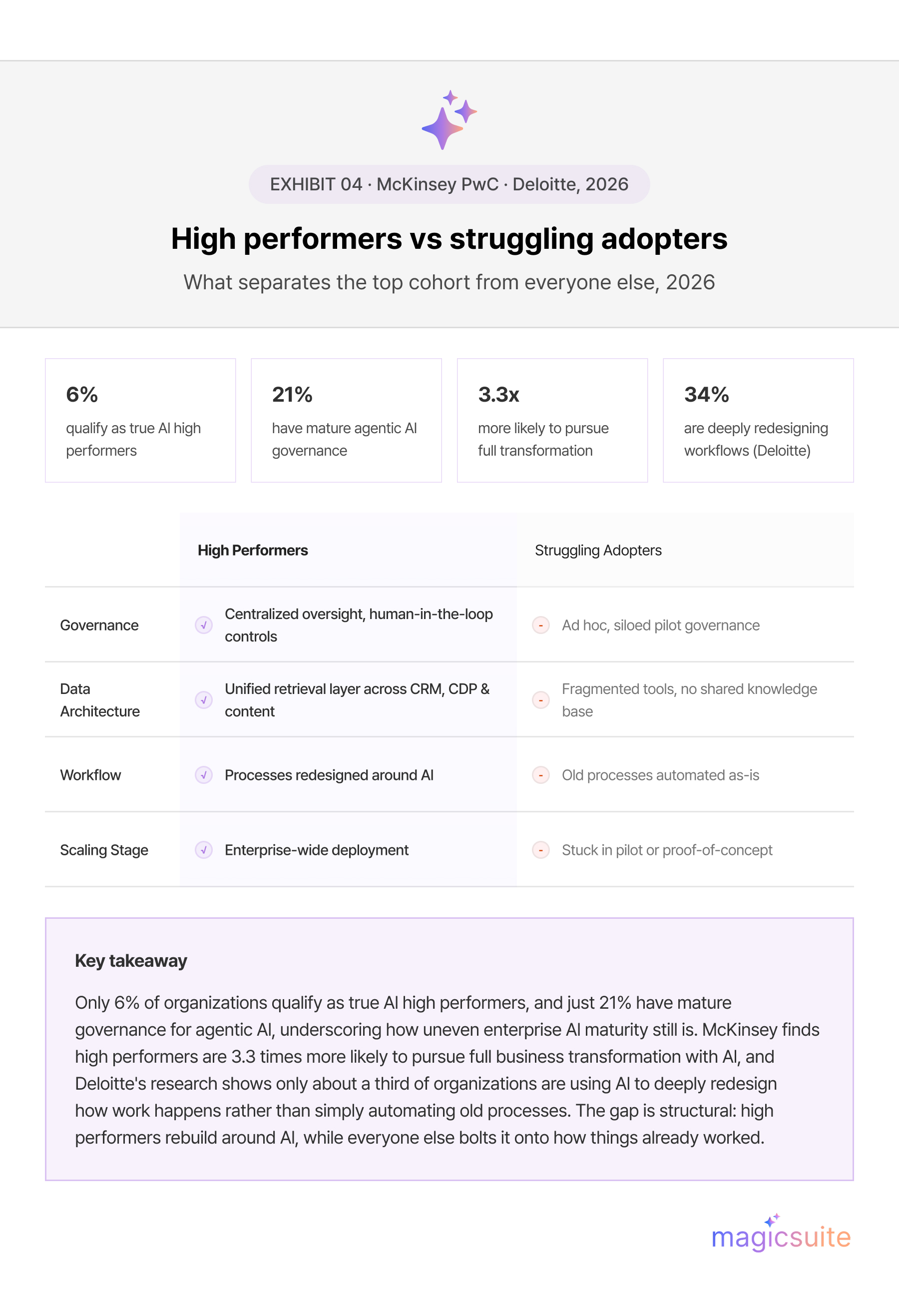
Governance-by-design. Deloitte's 2026 research on agentic AI governance found only 21% of organizations have a mature governance model for agentic AI, leaving most exposed to compliance and accuracy risk as usage scales.
Measurement infrastructure. Companies that can attribute AI's contribution to specific revenue or cost outcomes are far more likely to secure continued investment, according to PwC's AI performance study.
Organizational Factors
Workforce skills. Deloitte's survey of 3,235 leaders across 24 countries identified insufficient worker skills as the single biggest barrier to integrating AI into existing workflows, ahead of budget or technology constraints.
Workflow redesign, not automation of old processes. Deloitte found that one-third of organizations are using AI to deeply transform how work happens, while another third apply it only at the surface level with little structural change. The deep-transformation group is where most measurable value concentrates.
Executive accountability. McKinsey's 2026 research shows AI high performers are 3.3 times more likely than other companies to intend to fundamentally transform their business with AI within three years, and nearly three-quarters report redesigning workflows because of AI, up from 55% the year before.
Measurable Business Outcomes: Productivity, Revenue, and Cost
Enterprises evaluating AI investment should weigh outcomes at both the function level and the enterprise level, because the two rarely move together yet.
Productivity: Stanford HAI's 2026 AI Index confirms AI-linked productivity gains of 26% in software development and 14% to 15% in customer support; secondary coverage of the same report cites even larger gains in marketing output specifically.
Revenue: McKinsey's 2026 survey finds that revenue gains from generative AI are most often reported in marketing and sales, followed by product and service development and software engineering.
Cost: The same McKinsey survey finds that cost reductions concentrate most heavily in supply chain management, service operations, and manufacturing.
Enterprise-wide return: IDC's 2024 study, sponsored by Microsoft, measured an average $3.70 return per dollar invested in generative AI across surveyed enterprises, with top adopters reporting closer to $10.30 per dollar, though PwC's separate research shows this kind of outsized return concentrates heavily among a minority of companies.
Signal: Function-level wins do not automatically translate into enterprise-level financial impact. Evidence: McKinsey's 2026 survey found that only 37% of organizations can attribute any EBIT impact to AI at all, essentially unchanged from the prior year. Implication: Marketing leaders should treat function-level ROI as a starting case for investment, not proof that enterprise-wide transformation has already occurred.
Common Challenges When Scaling Enterprise AI Knowledge Systems
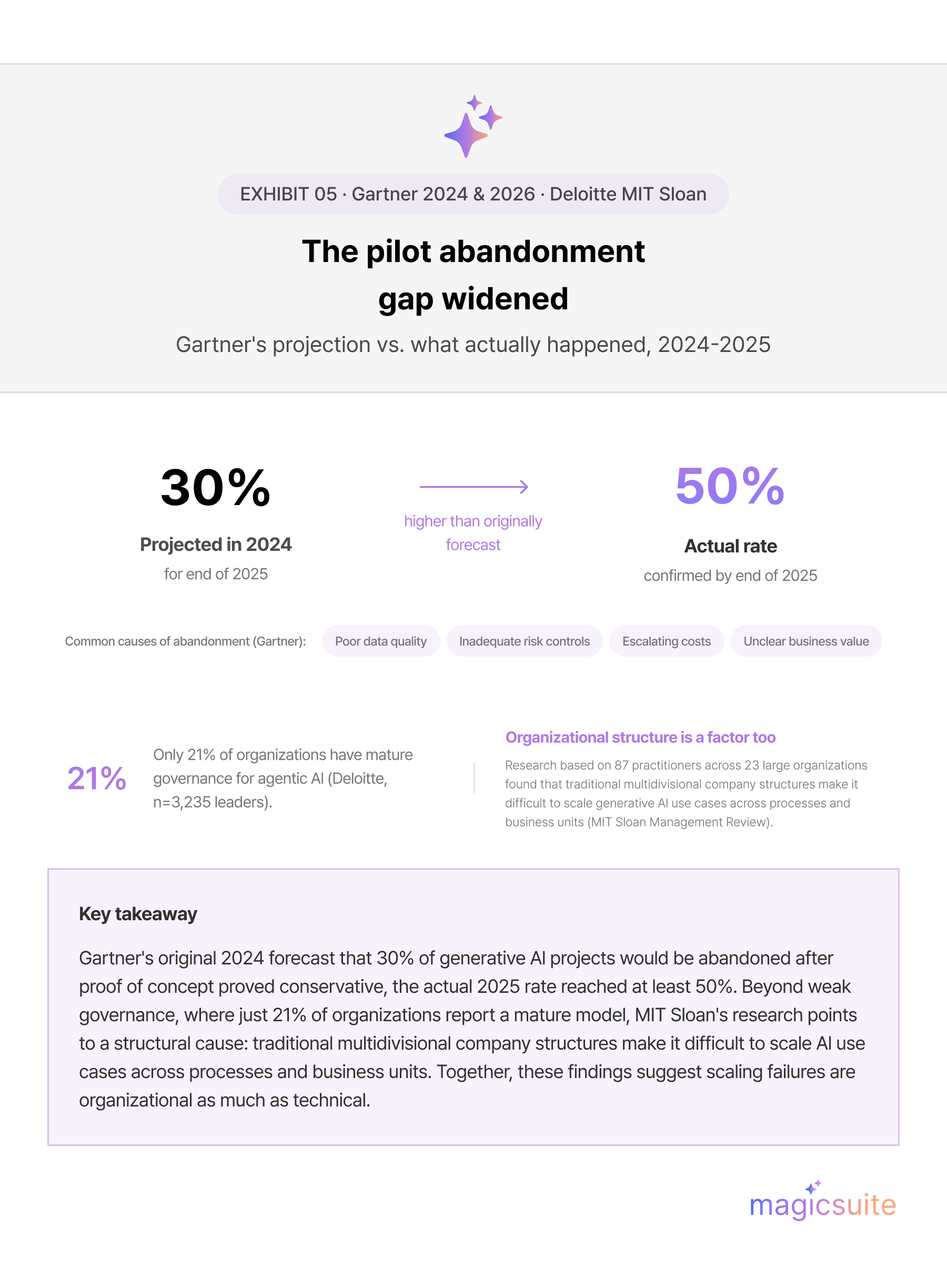
Scaling from a working pilot to enterprise-wide deployment remains the industry's central failure point. Gartner projected in 2024 that 30% of generative AI initiatives would be abandoned after proof of concept by the end of 2025, citing poor data quality, inadequate risk controls, escalating costs, and unclear business value. Gartner's own follow-up research found the actual rate came in higher: by the end of 2025, at least 50% of generative AI projects had been abandoned after proof of concept, for the same underlying reasons. The pattern researchers call "pilot purgatory" (AI that performs well in a controlled test but never reaches production) shows up consistently across McKinsey, Deloitte, and Gartner research.
Data quality and fragmentation. Enterprise knowledge is often siloed across departments, formats, and permission structures, which undermines the retrieval layer any RAG system depends on.
Governance gaps. Deloitte's finding that only 21% of organizations have mature agentic AI governance means most companies are scaling exposure faster than they are scaling oversight.
Skills shortages. Deloitte identifies workforce skills, not infrastructure, as the leading obstacle to integration.
Measurement blind spots. PwC found that even among companies investing heavily in AI, most cannot clearly attribute financial outcomes to specific initiatives, which makes it difficult to justify further investment or kill underperforming projects.
Organizational structure, not just technology. MIT Sloan Management Review's research on scaling generative AI value, based on interviews with 87 practitioners across 23 large organizations, found that traditional multidivisional company structures make it difficult to scale generative AI use cases across processes and business units.
High Performers vs. Laggards: A Side-by-Side View
Dimension
AI High Performers
Struggling Adopters
EBIT impact from AI
More than 5% attributed to AI, McKinsey's threshold for "high performers"
Under 5%, if measurable at all, or no attributable impact
Governance maturity
Centralized oversight, human-in-the-loop controls
Ad hoc, siloed pilot governance
Data architecture
Unified retrieval layer across CRM, CDP, and content systems
Fragmented tools with no shared knowledge base
Workflow approach
Redesigning processes around AI
Automating existing processes with little structural change
Reported ROI
Closer to $10.30 per dollar invested among top adopters (IDC/Microsoft)
Roughly $3.70 per dollar invested on average (IDC/Microsoft)
Scaling stage
Enterprise-wide deployment
Stuck in pilot or proof-of-concept phase
Strategic Recommendations for Turning Knowledge Into Marketing Intelligence
Consolidate customer, campaign, and product data into a single retrieval layer before expanding LLM use cases, since fragmented sources undermine grounding quality regardless of which model sits on top.
Establish governance and human review checkpoints early, matching Deloitte's finding that mature governance correlates with safer, more scalable agentic AI deployment.
Redesign marketing workflows around AI's strengths, rather than automating the same approval chains and content processes that existed before generative AI, following the pattern Deloitte identifies among its "deep transformation" cohort.
Build measurement frameworks that connect AI usage to specific revenue or cost outcomes from day one, since PwC's research shows measurement discipline is one of the clearest differentiators of high performers.
Treat enterprise RAG as core marketing infrastructure, not a side project, given that McKinsey already places marketing among the functions seeing the strongest revenue gains from generative AI.
Conclusion
The enterprise AI story in 2026 is no longer about whether to adopt generative AI. Adoption has reached nearly nine in ten organizations, according to McKinsey's most recent survey. The story now is about which organizations can convert institutional knowledge, sitting in CRMs, research archives, and campaign histories, into AI systems that retrieve it accurately and apply it consistently.
The data is consistent across McKinsey, PwC, Deloitte, Gartner, and Stanford HAI: a small cohort of high performers is capturing a disproportionate share of AI-driven value, and the difference comes down to data architecture, governance, and workflow redesign rather than model choice. For marketing organizations specifically, the opportunity is unusually strong. Marketing already shows some of the highest productivity gains and revenue outcomes of any function measured. The enterprises that treat enterprise LLM and RAG infrastructure as a long-term knowledge asset, rather than a short-term content tool, are the ones positioned to compound that advantage over the next several years.
ENTERPRISE AI KNOWLEDGE
Turn institutional knowledge into
actionable AI intelligence.
Connect enterprise knowledge, customer data, and business workflows with AI built to retrieve the right information and turn it into useful, context-aware intelligence.
Enterprise AI for smarter knowledge retrieval, automation, and decision-making.
FAQ
Frequently Asked Questions
5 QUESTIONS
RAG for marketing is an AI architecture that retrieves verified company data, such as product details, customer records, and past campaign results, and feeds it to a language model before it generates content. This grounds marketing output in real, current information instead of relying solely on the model's general training data.
A standard chatbot answers from what a model learned during training. Enterprise RAG connects that model to live, permissioned company data at query time, so responses reflect current pricing, inventory, customer history, or policy documents rather than generic or outdated information.
Gartner has found that most generative AI projects are abandoned after proof of concept due to poor data quality, inadequate risk controls, escalating costs, or unclear business value. McKinsey and Deloitte add that fragmented data, weak governance, and workflows that were never redesigned around AI keep many pilots from reaching enterprise-wide production.
McKinsey finds marketing is among the functions most likely to report AI-driven revenue gains, and coverage of Stanford HAI's 2026 AI Index points to large productivity gains in marketing output specifically. Actual returns vary widely; PwC found that only a minority of companies capture most of the available value.
Start with customer data platform records, approved brand and product documentation, and historical campaign performance data. These sources ground the highest-volume marketing tasks, personalization, content generation, and reporting, in verifiable, current information.
Source note:
Statistics, research findings, and industry projections in this article are based on the publications listed above. Readers should consult the linked original sources for full methodology, context, and the latest available data before reusing individual figures.
Luke is a technical market researcher with a deep passion for analyzing emerging technologies and their market impact. With a keen eye for data and trends, Luke provides valuable insights that help shape strategic decisions and product innovations. His expertise lies in evaluating industry developments and uncovering key opportunities in the ever-evolving tech landscape.