

AI and RAG are transforming how manufacturers capture, search, and use knowledge.
Manufacturing runs on knowledge that rarely lives in one place. Standard operating procedures sit in binders on the shop floor. Engineering rationale is buried in decades-old change orders. The reasoning behind a machine setting often exists only in a senior technician's memory. As that generation retires, the knowledge often leaves with them. AI in manufacturing is now being aimed squarely at this problem, not just at robotics or predictive maintenance.
Generative AI in manufacturing, paired with retrieval-augmented generation, is turning scattered technical knowledge into something searchable, explainable, and usable in seconds. But the data tells a more complicated story than the hype suggests: adoption is nearly universal, while measurable value remains rare. This article breaks down what the latest verified research says about where manufacturing knowledge management actually stands, and what separates the organizations capturing real value from those still stuck in pilot mode.
For eight consecutive years, McKinsey's Global Survey on AI has tracked which business functions report the heaviest AI use. In the 2025 edition, drawn from nearly 2,000 respondents across 105 countries, knowledge management joined IT and marketing and sales as one of the functions with the most reported AI activity for the first time. The reason is structural: knowledge management is where AI agents can capture information, process it, and deliver it back through a conversational interface, exactly the kind of task generative AI is suited for.
Manufacturers have an unusually acute version of this problem. Advanced manufacturing companies, including aerospace, automotive, semiconductors, and electronics, accumulate vast technical know-how over decades, but much of it lives in individual employees' heads rather than in documented systems. Deloitte's 2026 Manufacturing Industry Outlook, based on a survey of 600 manufacturing executives, identifies agentic AI as a way to help capture retiring employees' tacit knowledge, generate autonomous shift handover reports and work instructions, and turn that captured expertise into standard operating procedures that speed up onboarding for new workers.
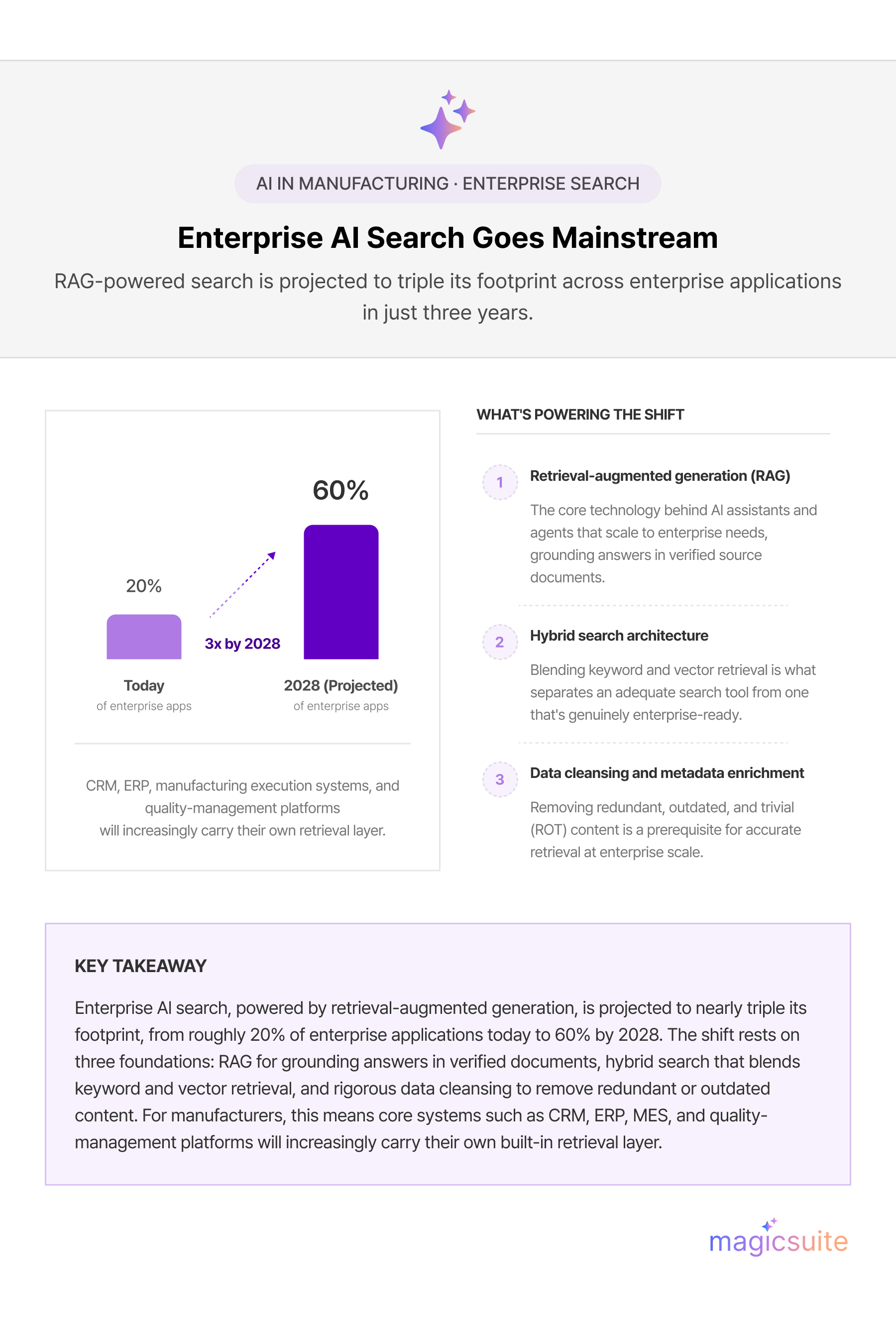
The technical shift enabling this is retrieval-augmented generation. Rather than relying on a general-purpose model's training data, which knows nothing about a specific plant's equipment history or a proprietary maintenance manual, RAG in manufacturing retrieves the relevant passage from verified internal documentation first, then generates an answer grounded in that source. This distinction matters enormously in a regulated, safety-critical environment where a fabricated answer about torque specifications or chemical handling isn't a minor inconvenience.
Industry analysis of Gartner's Market Guide for Enterprise AI Search characterizes this category as software that retrieves and synthesizes information across enterprise repositories, and identifies RAG as the underlying technology behind AI assistants and agents built to work at enterprise scale. That same analysis reports a Gartner projection that enterprise AI search and assistant capabilities will be embedded in 60% of enterprise applications by 2028, up from roughly 20% today: a threefold increase in three years. For manufacturers, that means the CRM, the ERP, the manufacturing execution system, and the quality-management platform will increasingly all carry their own retrieval layer.
A manufacturing LLM built on this pattern differs from a generic chatbot in a few important ways:
Gartner's governance guidance for this category reportedly recommends cleansing legacy content, enriching metadata, and evaluating search data quality as part of a broader knowledge management program, with hybrid search that blends keyword and vector retrieval described as the differentiator between an adequate tool and one that's genuinely enterprise-ready.
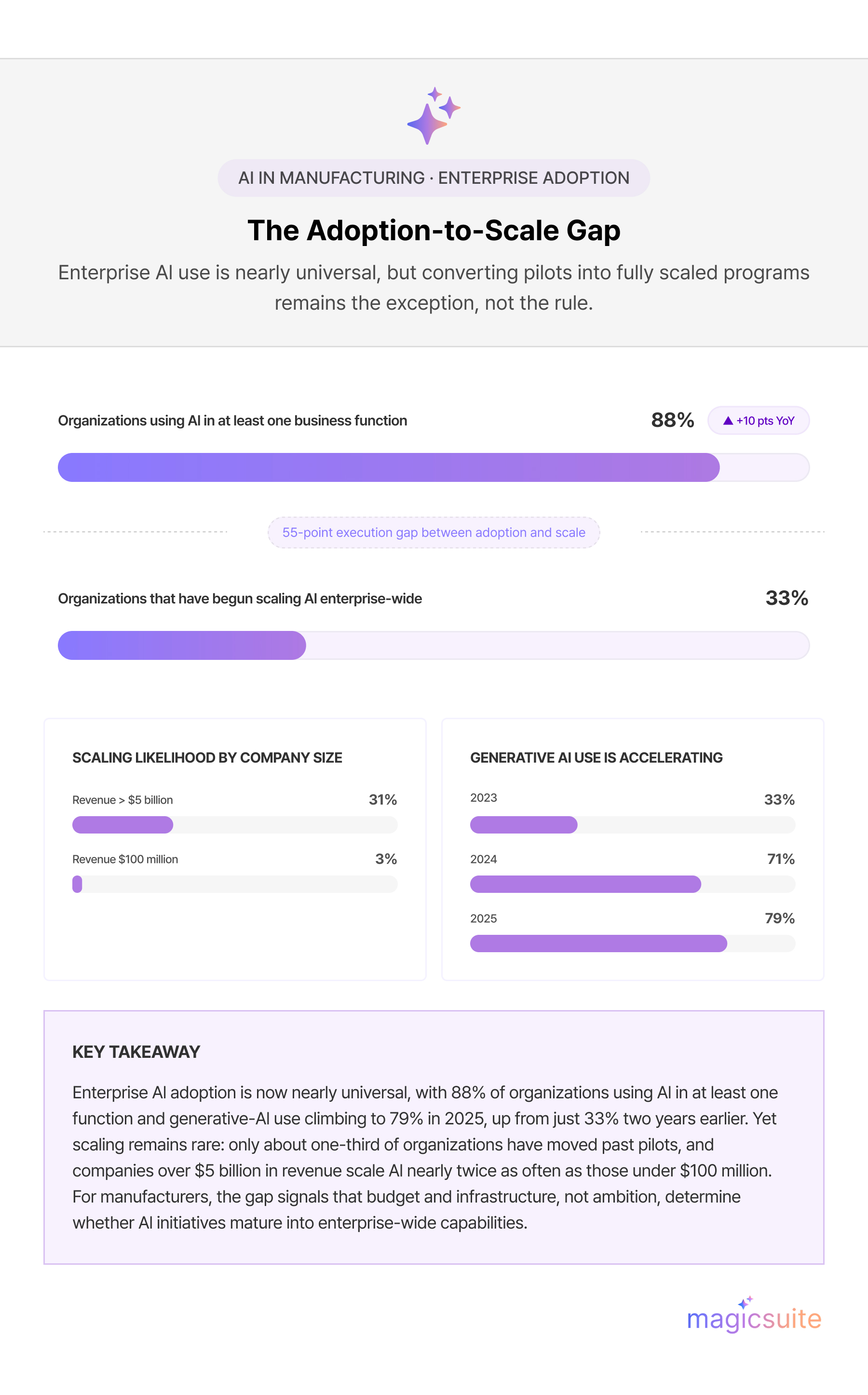
The headline adoption figures for enterprise AI in manufacturing look dramatic. McKinsey's 2025 survey found that 88% of organizations report regular AI use in at least one business function, up from 78% a year earlier. Generative AI use specifically climbed to 79% in 2025, up from 71% in 2024 and just 33% in 2023, according to McKinsey's own longitudinal tracking. But scale is a different story: nearly two-thirds of organizations have not yet begun scaling AI across the enterprise, and only about one-third report having reached that stage.
Company size matters more than most leaders expect. Nearly half of organizations with more than $5 billion in revenue have reached the scaling phase, compared with 29% of those under $100 million in revenue, a gap that reflects budget, data infrastructure, and change-management capacity rather than differences in ambition.
Within manufacturing specifically, Deloitte's 2025 Smart Manufacturing and Operations Survey of 600 executives found that 78% of respondents allocate more than 20% of their overall improvement budget toward smart manufacturing initiatives, prioritizing foundational tools like automation hardware, data analytics, and cloud computing as the base layer that AI knowledge systems depend on. Separately, the Manufacturing Leadership Council found that the share of manufacturers planning to use physical AI (robots with greater autonomy) is expected to more than double within two years, from 9% today to 22%.
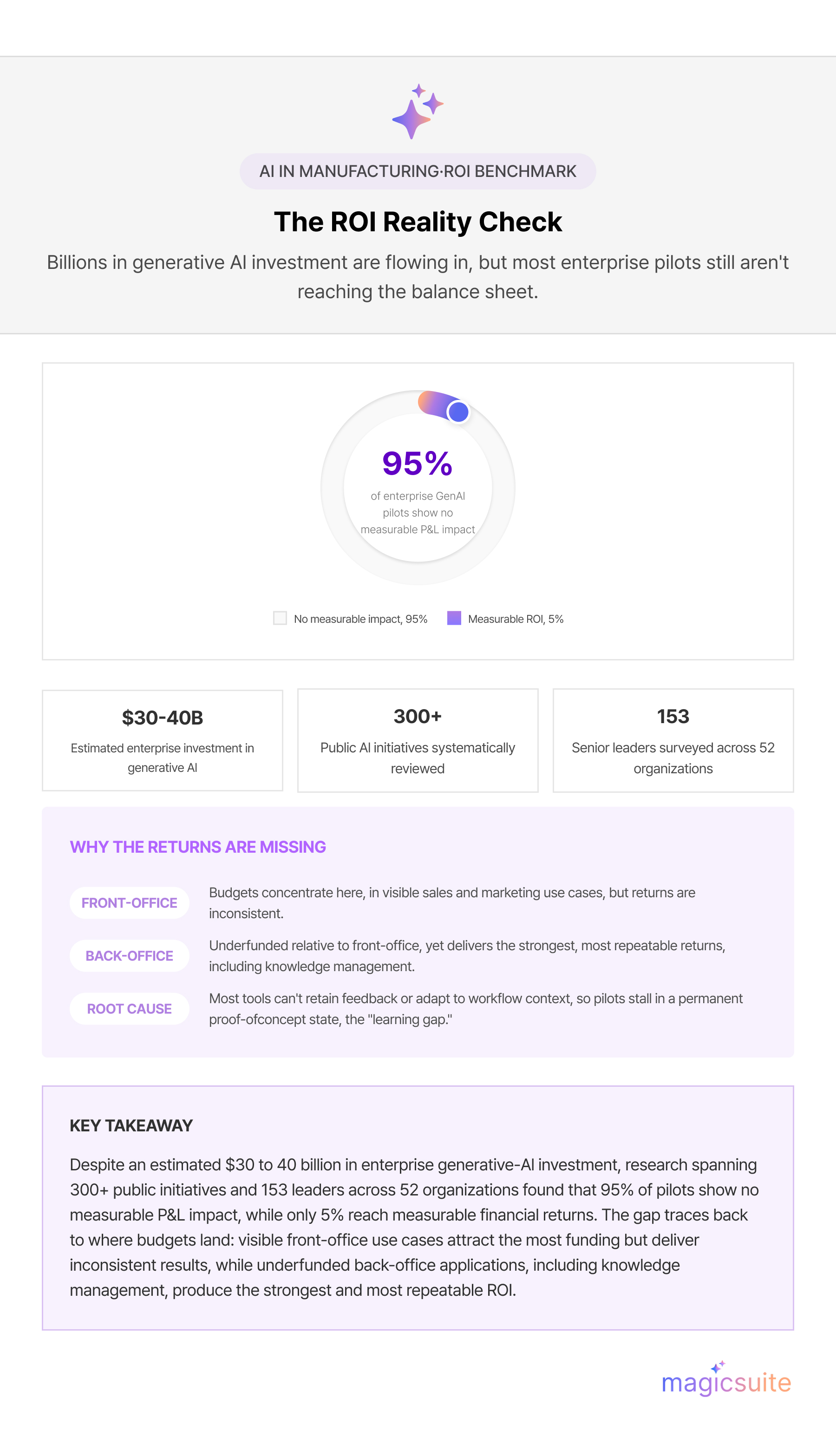
This is where the story turns sobering. A widely cited 2025 study from MIT's Project NANDA, based on a systematic review of more than 300 public AI initiatives, structured interviews with 52 organizations, and survey responses from 153 senior leaders, found that despite an estimated $30–40 billion in generative AI investment, 95% of enterprise pilots delivered no measurable impact on the P&L. (Note: some early press coverage of this report cited different sample figures, 150 interviews and 350 employee surveys, but the methodology above reflects what the published report itself states.)
The researchers attributed this primarily to a "learning gap": most deployed tools cannot retain feedback, adapt to workflow context, or improve over time, so they stall in a permanent proof-of-concept state rather than becoming durable systems. Notably, the study found that budgets are often concentrated in visible, front-office use cases like sales and marketing, while the highest returns tend to come from back-office automation, a pattern with direct relevance to manufacturing knowledge management, which is fundamentally a back-office capability.
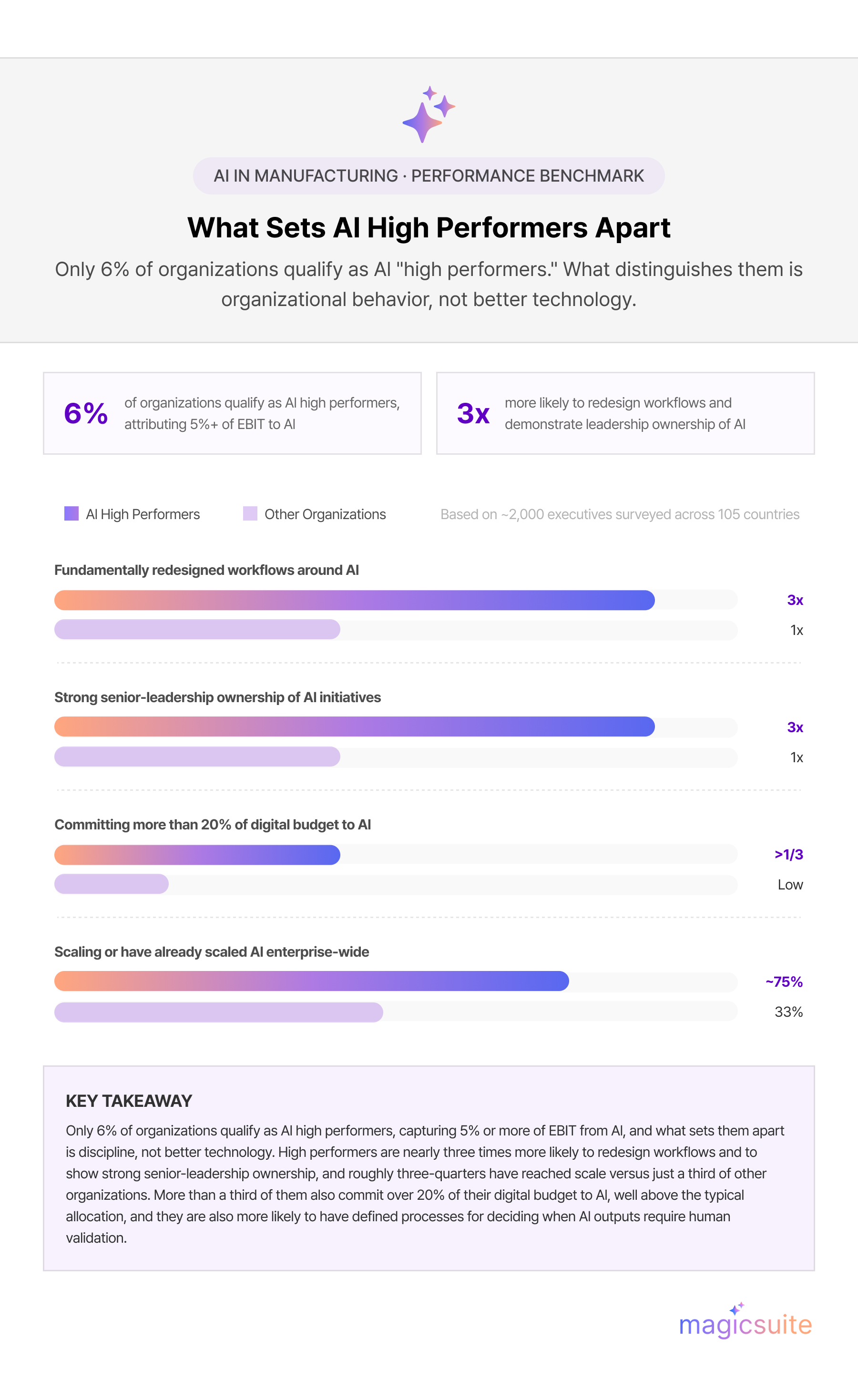
McKinsey's research reinforces this divide from a different angle. Only 6% of respondents qualify as AI "high performers": organizations attributing 5% or more of EBIT to AI and reporting significant enterprise value. What distinguishes them isn't better technology; it's organizational behavior:
Put simply: the technology gap between leaders and laggards is smaller than the execution gap. Redesigned workflows, sustained investment, and leadership commitment consistently separate organizations that capture value from those that don't.
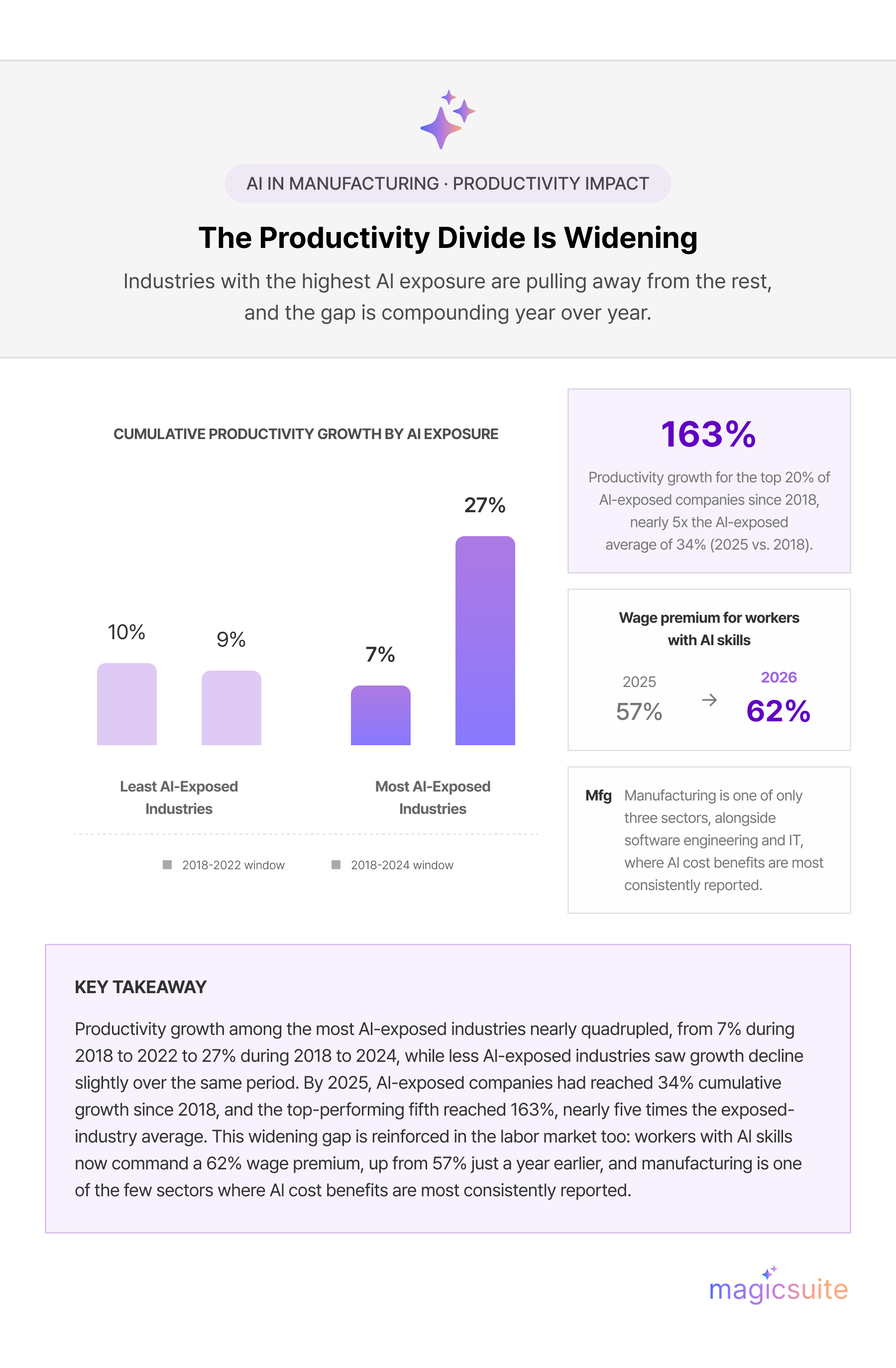
Where AI in manufacturing does work, the outcomes are becoming easier to quantify at the industry level, even if enterprise-wide EBIT impact remains rare. PwC's Global AI Jobs Barometer, based on nearly a billion job postings and thousands of company financial reports across six continents, found that industries most exposed to AI saw productivity growth roughly quadruple, from 7% (2018–2022) to 27% (2018–2024), while less-exposed industries saw productivity growth decline slightly over the same period. The 2026 edition of the same research found the most AI-exposed companies achieving 34% productivity growth relative to 2018, with the top-performing fifth of those companies reaching 163% growth, nearly five times the average for AI-exposed companies overall.
For manufacturing specifically, McKinsey's data shows cost benefits from AI use cases are most commonly reported in manufacturing, software engineering, and IT, more consistently than revenue gains, which tend to concentrate in marketing, sales, and product development instead. That pattern matters for how manufacturers should frame AI-powered knowledge management internally: it's primarily a cost and productivity lever, not a revenue-generation story, and setting expectations accordingly avoids the disappointment that fuels abandoned pilots.
Even organizations with strong pilots often stall before reaching enterprise scale. The barriers are consistent across the research:
Manufacturers weighing whether to build a proprietary manufacturing LLM or adopt a vendor platform tend to run into these same barriers regardless of build-versus-buy choice; the differentiator is less about the underlying model and more about whether the surrounding data, governance, and workflow redesign are in place to support it.
For manufacturers evaluating an AI-powered knowledge management deployment, the research points toward a few consistent, practical priorities:
The data paints a consistent picture: AI adoption in manufacturing is no longer in question, but AI value is still concentrated among a disciplined minority. The organizations separating themselves aren't necessarily using more advanced models: they're redesigning workflows, investing at a level that matches their ambition, validating outputs deliberately, and treating institutional knowledge as an asset worth capturing before it retires with the people who hold it.
For manufacturers, AI-powered enterprise search and RAG-based knowledge systems represent one of the more durable, back-office-anchored opportunities in this landscape, less flashy than customer-facing generative AI, but more consistently tied to measurable cost and productivity outcomes. The long-term implication is straightforward: manufacturers that treat AI knowledge management as an execution and governance discipline, not a one-time software purchase, are the ones most likely to convert today's pilots into tomorrow's competitive advantage.

Hanna is an industry trend analyst dedicated to tracking the latest advancements and shifts in the market. With a strong background in research and forecasting, she identifies key patterns and emerging opportunities that drive business growth. Hanna’s work helps organizations stay ahead of the curve by providing data-driven insights into evolving industry landscapes.