

10 enterprise agentic AI use cases with documented ROI — from customer service to FP&A automation.

Agentic AI refers to AI systems that autonomously plan, execute, monitor, and adapt multi-step workflows to achieve a defined goal, with minimal human input at each step.
Agentic AI is not a smarter chatbot or a faster generative AI tool. It is a goal-oriented system that:
MIT Sloan professor Kate Kellogg and her co-researchers define the capability precisely: AI agents "can execute multi-step plans, use external tools, and interact with digital environments to function as powerful components within larger workflows."
The distinction matters because of what Gartner calls "agentwashing": the widespread practice of labeling AI assistants as agents. A true AI agent operates with autonomy across multi-step workflows. An AI assistant that surfaces answers more quickly does not.
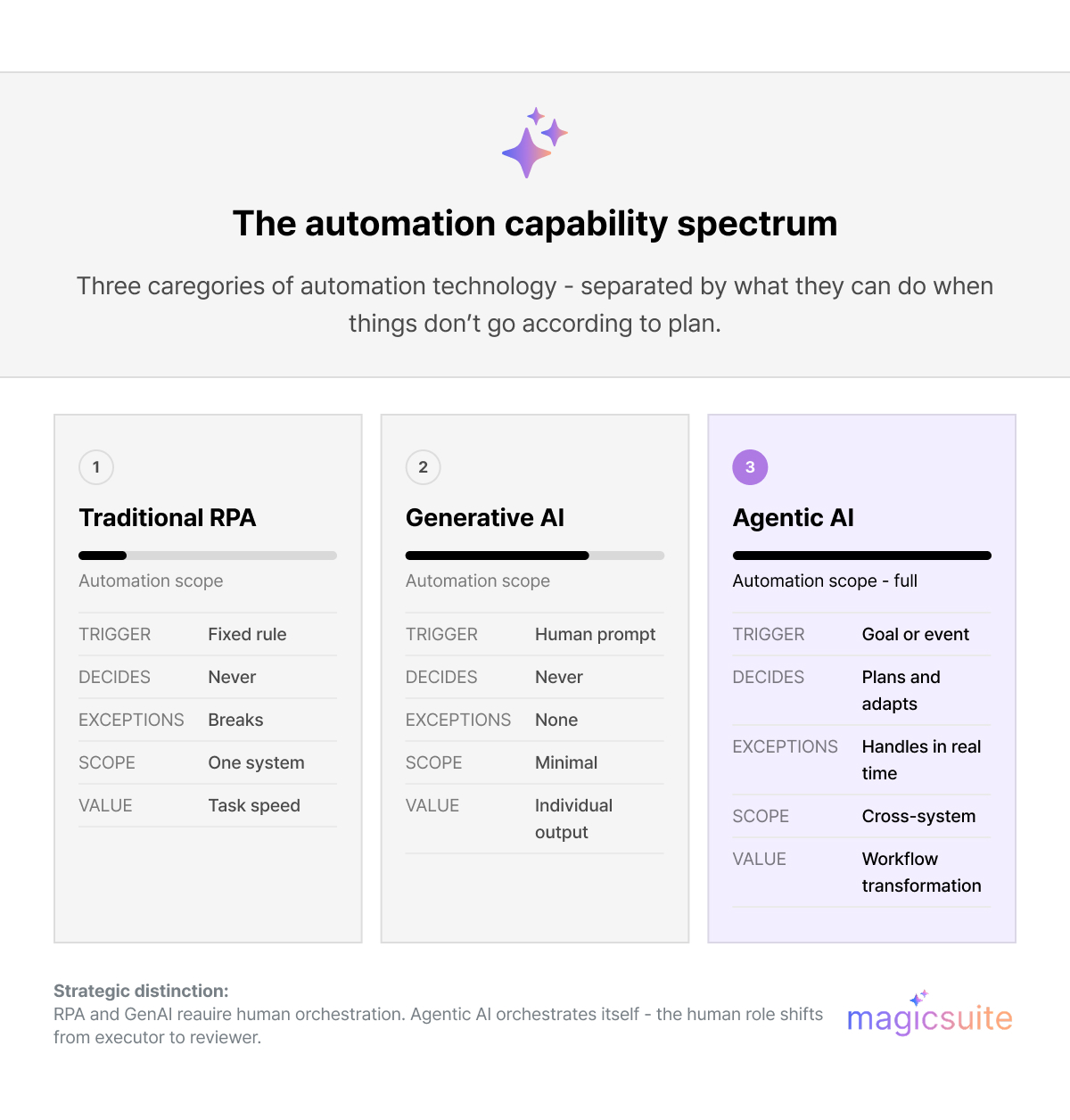
Fig.1. Three categories of automation compared by what they do when things don't go to plan. Agentic AI is the only one that adapts.
Nearly eight in ten companies have deployed generative AI. Roughly the same proportion reports no material impact on earnings. McKinsey calls this the "gen AI paradox": more AI activity, no bottom-line movement. The root cause is that 90% of high-value, function-specific use cases never leave pilot mode.
Sinan Aral, Professor of Management at MIT Sloan, puts the urgency plainly: "The agentic AI age is already here. We have agents deployed at scale in the economy to perform all kinds of tasks."
Agentic AI use cases are where that changes. Moving AI from horizontal copilots to vertical, end-to-end workflow automation is how organizations close the gap between experimentation and financial results.
Key market figures:
The pilot-to-production gap is the defining challenge of 2026. The sections below address where agentic AI is delivering measurable results and what separates organizations that are scaling from those still stuck in pilots.
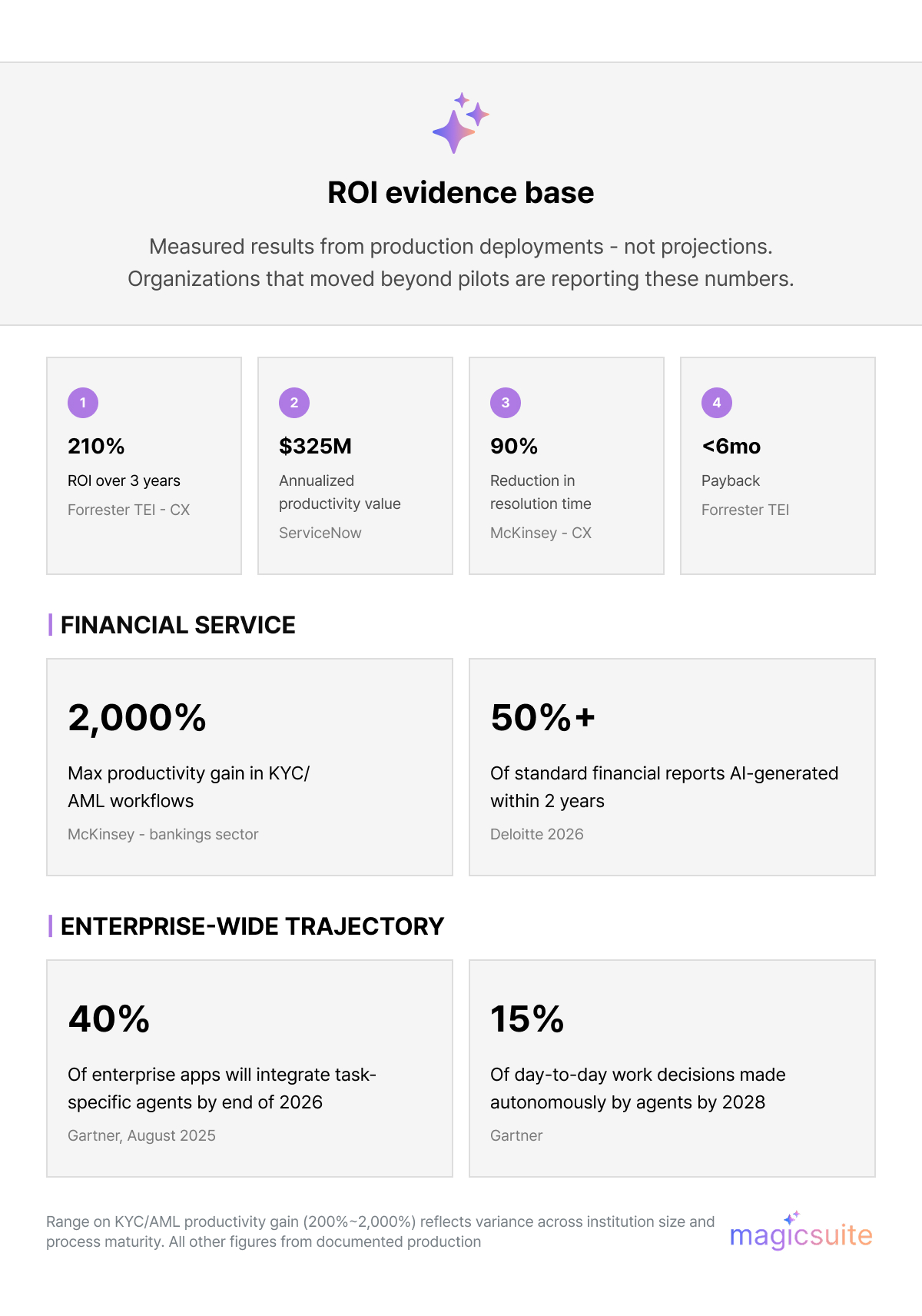
Fig. 2. Measured results from live deployments: 210% ROI, $325M in productivity value, 90% faster resolution. Payback in under six months.
Agentic AI in customer service handles the entire case lifecycle from intake to resolution, across every channel, without human handoff.
This is the most mature and well-documented agentic AI use case. When a customer submits a return request, an agentic system does not just provide the return policy. It checks eligibility, validates the order, initiates the refund, updates inventory, notifies the finance team, triggers reverse logistics, and confirms resolution with the customer, in real time, without a human touching the case.
Documented results:
Agentic customer service systems orchestrate across CRM, ticketing, inventory, and logistics within a single workflow. Edge cases are escalated with full context intact.
Best entry point for: Organizations with high inbound support volume, well-documented policies, and cross-system CRM/ticketing infrastructure in place.
IT operations has the highest scaled AI agent adoption of any enterprise function and is the most recommended first deployment for organizations new to agentic AI.
McKinsey's 2025 State of AI survey found that IT and knowledge management are the top two functions for using scaled AI agents. The technology sector leads all industries, with 24% of respondents reporting the use of scaled agents in software engineering and 22% in IT.
Agents handle L1 and L2 tickets (password resets, access provisioning, VPN issues, software installs), perform root cause analysis on infrastructure incidents, manage deployment rollbacks, and orchestrate DevOps pipelines. Trained on historical ticket data, these systems resolve the majority of requests without human involvement, escalating only genuinely complex cases.
The environment is auditable, workflows are contained, and the consequences of an agent error are manageable. Governance and monitoring practices built in IT operations transfer directly to higher-stakes deployments in finance or healthcare.
In financial services, agentic AI use cases center on high-volume compliance and processing workflows, where productivity gains are among the largest documented across sectors.
Know Your Customer (KYC) and Anti-Money Laundering (AML) processes require continuous cross-referencing of entity names, addresses, and social media profiles against CRM records, credit bureaus, payment gateways, banking data, and sanctions databases. McKinsey reports that banks implementing agentic AI for KYC/AML workflows are realizing productivity gains of 200% to 2,000%.
Insurance claims processing is equally well-suited. Agentic systems read structured claim forms, extract data from emails and scanned PDFs, assess damage using images, detect fraud signals, and manage the full claims lifecycle from intake to payout without manual intervention on routine cases.
Additional financial services agentic AI use cases:
Governance note: Explainability is non-negotiable for credit decisions. Agentic deployments in regulated finance require domain-specific LLMs grounded in proprietary regulatory knowledge, with full audit trails and role-based access controls built before deployment.
Agentic AI use cases in healthcare deliver the highest near-term value in workflows that currently consume the most clinical and administrative time.
Healthcare ranks among the top three industries for AI agent adoption globally, alongside technology and telecommunications.
Active healthcare agentic AI use cases:
MIT Sloan research published in 2025 found that in a healthcare agent deployment, 80% of implementation effort was devoted to data engineering, stakeholder alignment, governance, and workflow integration, rather than model development. Healthcare leaders should budget and plan accordingly.
Agentic AI in sales redefines outbound capacity by enabling autonomous SDRs to monitor intent, personalize outreach, and book meetings without human involvement.
Agentic sales systems reason about when and how to act. They monitor intent signals, including site visits, job changes, and funding announcements; evaluate prospect readiness; select the appropriate channel and message; orchestrate multi-touch sequences; and escalate to a human representative with context when the timing is right. In mature deployments, they schedule the meeting with no rep involvement.
Sales agentic AI use cases beyond outbound SDRs:
McKinsey data confirms that AI high performers are at least three times more likely to be scaling agents in marketing and sales than their peers. The insurance sector leads all industries in the use of scaled agents for sales, driven by high outbound volume and complex product-matching requirements.
Agentic AI use cases in supply chain shift the function from reactive disruption alerts to autonomous resolution: agents that not only flag problems but also fix them.
Production-grade supply chain agentic AI use cases:
McKinsey's CxO Agentic AI Survey identifies fleet routing and vertical-specific process automation as two of the four core enterprise agentic investment areas, with enterprises projecting that 15-30% of current roles' work in these domains could be handled by agents over the next three years.
HR is a high-potential agentic AI use case because the full talent lifecycle involves high-volume, pattern-driven workflows across multiple systems.
Agentic HR systems manage end-to-end recruiting: sourcing candidates across job boards, screening resumes against defined criteria, scheduling interviews across calendars, generating offer letters, and orchestrating onboarding tasks. Benefits queries, policy lookups, compliance checks, and leave management are handled autonomously, shifting HR professionals toward workforce planning and organizational development.
Key HR agentic AI use cases:
Agentic AI in legal and compliance addresses the function's core bottleneck: high document volume, complex judgment requirements, and continuously changing regulatory obligations.
The legal sector's AI adoption nearly doubled in a single year, from 14% active integration in 2024 to 26% in 2025, representing the fastest relative growth rate among tracked industry segments. 45% of law firms either use AI now or plan to make it central to their workflows within the next year.
Active legal agentic AI use cases:
Agentic AI use cases in software engineering are among the fastest-growing in the enterprise, with agents generating, testing, reviewing, and deploying code, thereby measurably reducing development cycle times.
The technology sector leads all industries in scaled AI agent deployment for software engineering at 24% scaled use, the highest of any function-industry combination in McKinsey's 2025 survey.
Software engineering agentic AI use cases:
Agentic AI in financial planning and analysis (FP&A) transforms the back office from a reporting function into a forward-looking intelligence layer by handling the data assembly work that previously consumed analyst time.
ERP vendors are embedding native FP&A agents directly into cloud platforms, shifting the finance function from reactive oversight to proactive analysis.
Back-office finance agentic AI use cases:
Deloitte projects that over 50% of standard financial reports will be AI-generated within two years, with the finance function's value contribution shifting from report production to judgment and strategic decision support.

Fig. 3. 80% of enterprises are piloting agentic AI. Only 11% have reached production. The gap is a data, integration, and governance problem — not a technology one.
Knowing which agentic AI use cases work is only part of the picture. The more pressing question is why 89% of pilots never make it to production deployment. Deloitte's 2025 Emerging Technology Trends study identifies three structural obstacles:
Most enterprise systems were built for human interfaces or point-to-point API integrations with defined schemas. Agents that need to read and write across multiple systems in real time encounter bottlenecks that require significant infrastructure investment.
Nearly half of organizations cite data searchability (48%) and data reusability (47%) as direct obstacles to their agentic AI strategy (Deloitte, 2025).
Enterprise data is not positioned for agent consumption. Traditional ETL pipelines were designed for batch reporting, not real-time agent reasoning. The required shift is toward enterprise search and indexing built on knowledge graphs, making organizational data discoverable without bespoke data engineering for each agent.
Without accountability structures, audit frameworks, and escalation protocols, it is not safe to move agents from sandboxed pilots to live operations that affect customers, financial records, or clinical decisions.
Organizations successfully scaling agentic AI share a consistent set of practices:
Aral frames the governance imperative directly: "It's absolutely imperative that every organization has a strategy to deploy and utilize agents in customer-facing and internal use cases. But that sort of agentic AI strategy requires an understanding and systematic assessment of risks as well as business benefits in order to deliver true business value."
In 2025, Moderna merged its CHRO and CIO functions, a structural signal that agentic AI is a workforce-shaping investment requiring joint ownership between people and technology leadership.
For enterprise leaders ready to move from experimentation to production, this framework synthesizes guidance from McKinsey, Deloitte, and Forrester research.
As Arthur Mensch, CEO of Mistral AI, writes in the foreword to McKinsey's agentic AI report: the right question for CEOs is no longer "How do we add AI?" but "How do we want decisions to be made, work to flow, and humans to engage?" Unlocking agentic AI's potential "calls for reimagining those workflows from the ground up, with agents at the core."
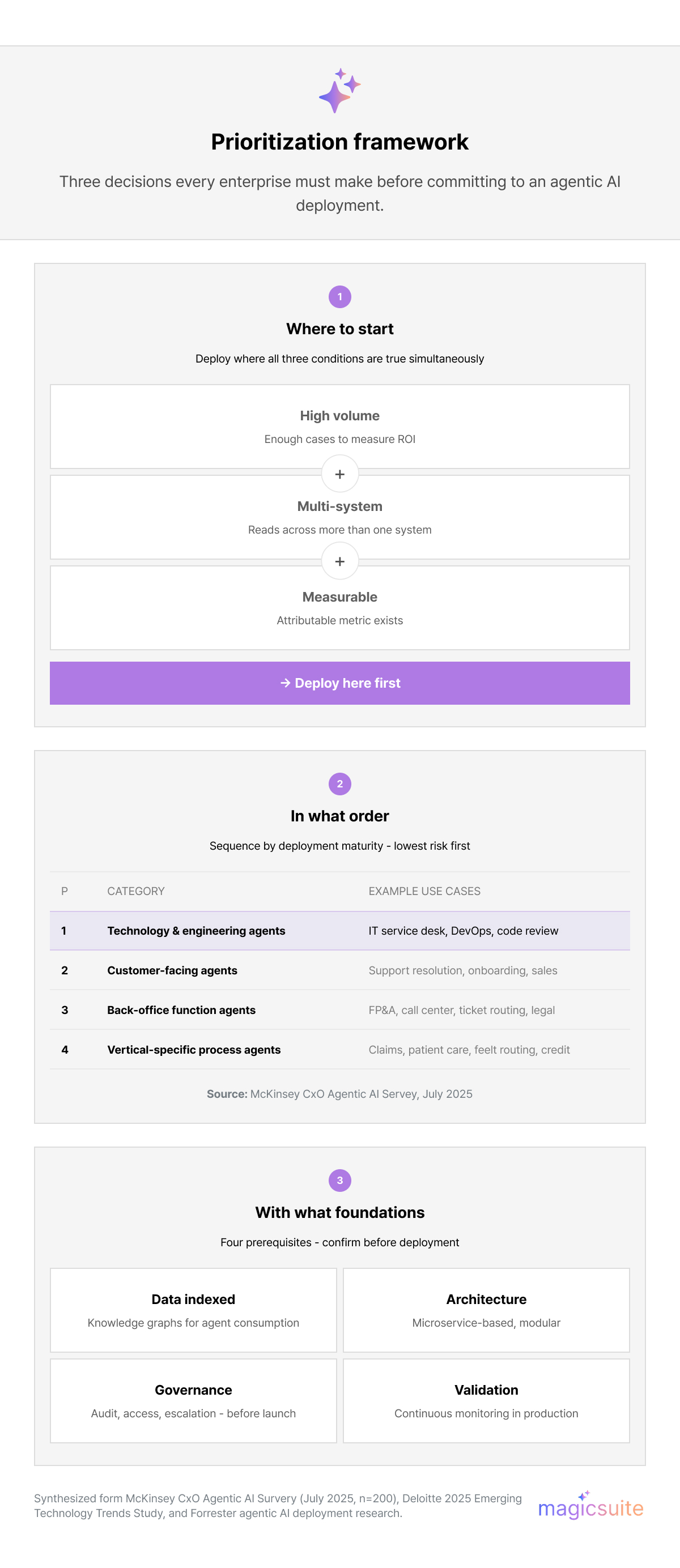
Fig. 4. Three decisions before any deployment: where to start, in what order, and with what foundations in place.
Identify workflows where all three conditions are true simultaneously:
Where all three intersect, the ROI case is strongest, and the path from pilot to production is most navigable.
McKinsey's research identifies four categories in order of typical deployment maturity:
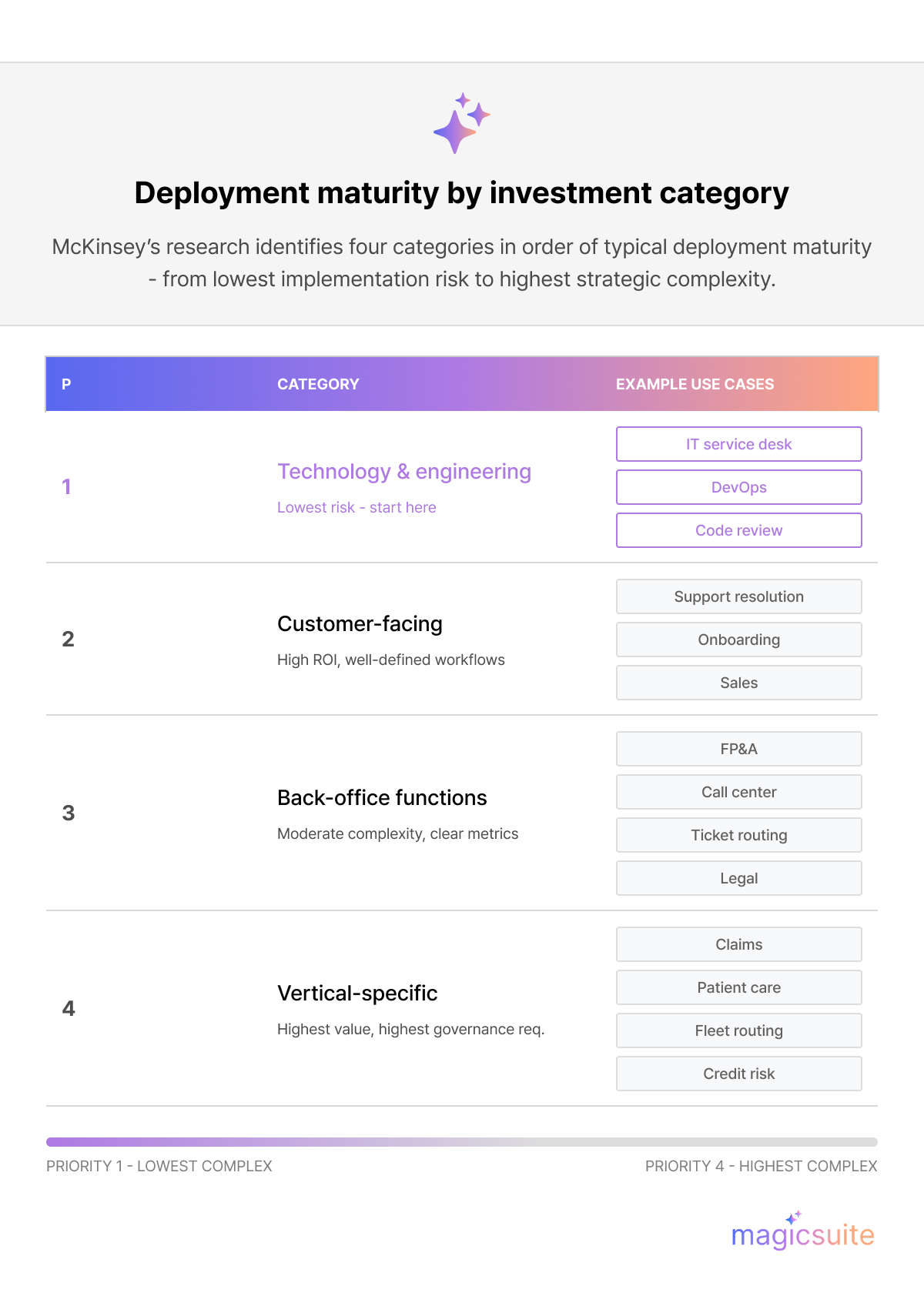
Fig. 5. McKinsey's four investment categories in order of deployment maturity — from IT service desk to vertical-specific process agents. Begin at Priority 1.
Before deployment, confirm these are in place:
The first wave of agentic AI relied on broad foundation models. The next wave is narrow: agents fine-tuned on proprietary enterprise knowledge for specific domains such as compliance review, patient triage, or claims processing. This improves accuracy and reduces the risk of hallucinations in regulated environments.
Complex enterprise workflows increasingly require networks of specialized agents coordinating with one another. A research agent feeds into a synthesis agent, which feeds into a drafting agent, all supervised by an orchestration layer. This architecture improves performance and makes individual agents easier to govern and replace.
As agentic systems take on what was previously human labor, task-completion billing and hourly AI-workforce pricing are beginning to replace seat-based software licensing. McKinsey estimates this shift could drive $100-$400 billion in incremental enterprise technology spending by the end of the decade, while contracting traditional IT services revenues by 20-30%.
Agentic AI use cases, in which AI systems autonomously plan, execute, and adapt multi-step workflows, are proving out across 10 enterprise functions: customer service resolution, IT operations, financial compliance, healthcare administration, sales development, supply chain management, HR recruiting, legal review, software engineering, and FP&A automation. Documented results include ServiceNow's $325 million in annualized CX value, McKinsey's 200%-2,000% KYC/AML productivity gains, and Gartner's projection of 40% enterprise app integration by the end of 2026. The pilot-to-production gap remains the primary challenge, rooted in data architecture, legacy integration, and governance deficits rather than the technology itself. Organizations that prioritize high-volume, multi-system workflows, build governance before deployment, and partner rather than build independently are converting pilots into production faster than their peers.

Hanna is an industry trend analyst dedicated to tracking the latest advancements and shifts in the market. With a strong background in research and forecasting, she identifies key patterns and emerging opportunities that drive business growth. Hanna’s work helps organizations stay ahead of the curve by providing data-driven insights into evolving industry landscapes.