

Smart ticket routing uses AI to cut resolution times and boost FCR by 20–35% in customer support.

Smart ticket routing is the automated process of directing customer support tickets to the correct agent, team, or resolution channel, without requiring a supervisor or dispatcher to make that decision manually.
It uses machine learning (ML) models and natural language processing (NLP) to read each ticket's content, classify the issue, and match it to the best available resource.
Traditional routing methods rely on simple rules: route all billing tickets to Team A, technical issues to Team B. Smart routing goes further by accounting for agent skill level, current workload, customer tier, issue urgency, and historical resolution data. The result is a routing decision that is both faster and more accurate than anything a human dispatcher can execute at scale.
Smart ticket routing answers one question on every incoming ticket: who is the right person to solve this, right now?
Here is the core mechanics of how smart ticket routing works:
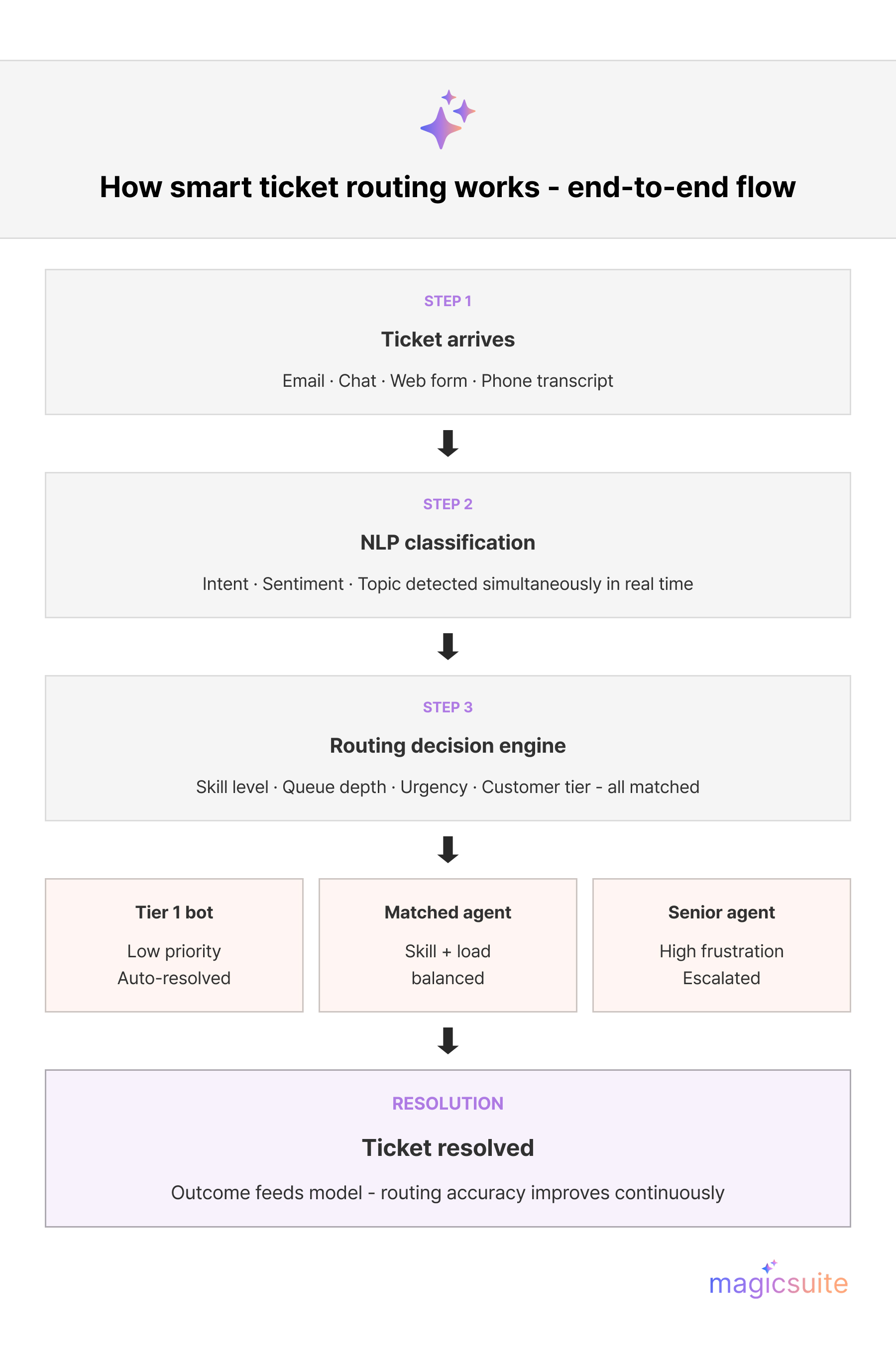
Every smart routing engine starts with classification. When a ticket enters the system via email, chat, web form, or phone transcript, an NLP model reads the message and assigns it to a category. This goes beyond keyword matching. Modern classifiers identify intent ("I want a refund"), sentiment (frustrated, neutral, satisfied), and topic (billing, technical, onboarding) in a single pass.
This classification feeds the routing logic. A ticket classified as "high-urgency billing complaint from enterprise customer" gets a fundamentally different routing path than "general product question from a free-tier user."
Once classified, the system matches the ticket to an agent. Skill-based routing maps ticket types to agent competencies, so an agent with certified expertise in your enterprise product line handles enterprise escalations. Load balancing ensures that no single agent is overwhelmed while others sit idle by distributing tickets based on current queue depth and estimated handling time.
According to Salesforce's 2024 State of Service report, teams using AI-assisted routing reduce agent idle time by up to 28% while simultaneously cutting queue overflow incidents.
Advanced routing systems monitor emotional signals. A ticket that starts with "I've contacted you three times about this" triggers a different response than a first-time inquiry about the same issue. Sentiment-aware routing escalates high-frustration tickets to senior agents automatically, before the customer asks to speak to a manager.
This is where intelligent ticket routing pays its most visible dividends: resolving customer emotions, not just customer issues.
The market for AI-powered routing has matured rapidly. These are the platforms with the strongest routing capabilities as of 2026. For a broader look at how AI handles tickets end-to-end, see our guide to leading AI tools for support ticket resolution.
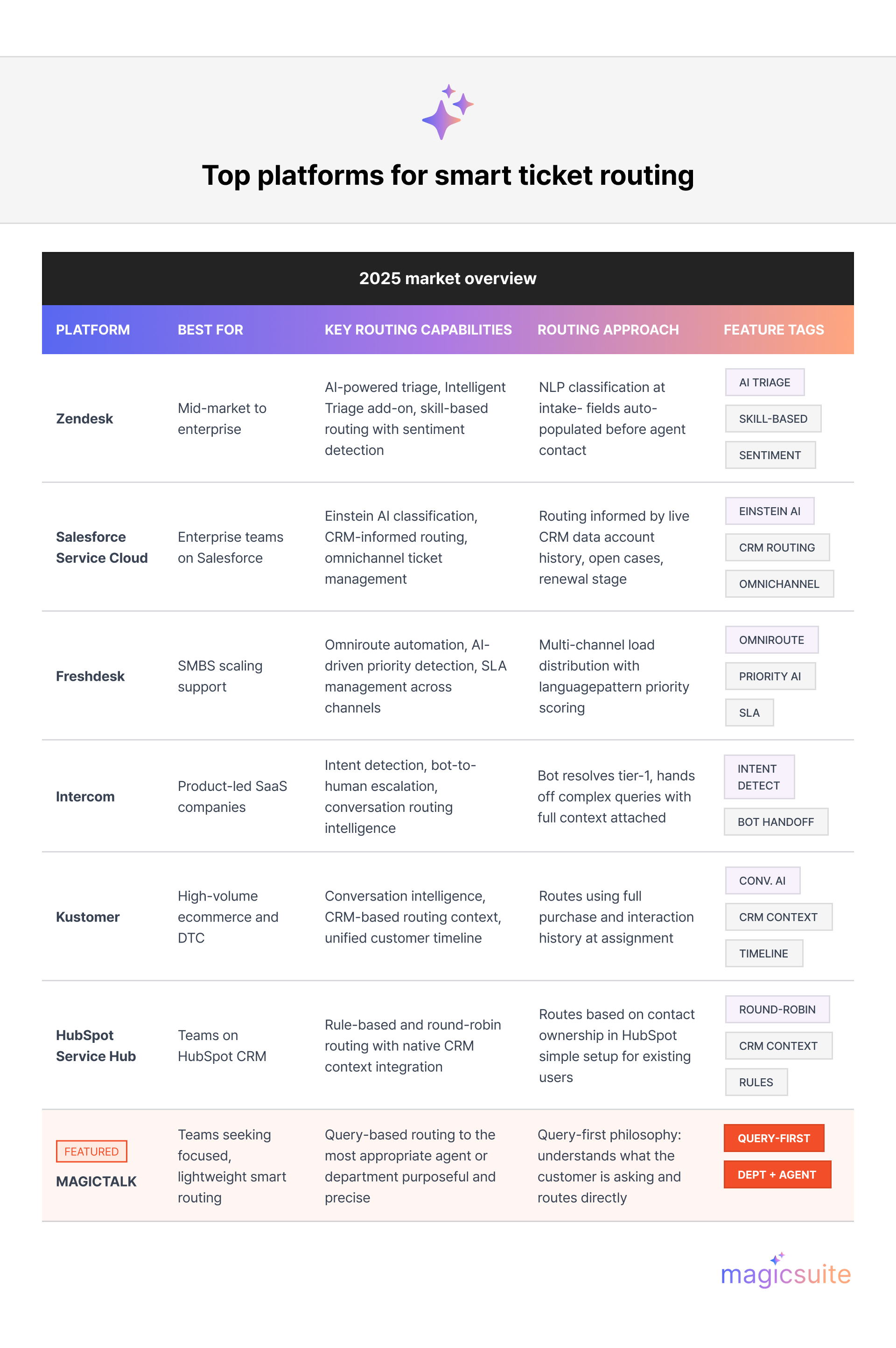
Zendesk's Intelligent Triage add-on classifies tickets by intent, language, and sentiment at intake, automatically populating fields and triggering routing rules before a human agent ever touches the ticket. For teams handling 500+ tickets per day, this eliminates the triage bottleneck entirely.
Einstein AI integrates routing directly with CRM data. When a ticket arrives, Einstein cross-references the customer's account history, open cases, and product usage before assigning the ticket. This means routing decisions are informed by business context, not just ticket content. A customer approaching renewal, for example, is routed to a customer success-aligned agent rather than a generic support queue.
Freshdesk's Omniroute engine distributes tickets across email, chat, phone, and social channels simultaneously, using skill-based, load-balanced logic to assign conversations. Its AI detects ticket priority based on language patterns and customer tier, flagging SLA-risk tickets for immediate escalation. For SMBs that need enterprise-grade routing without enterprise-grade implementation costs, Freshdesk delivers strong value.
MagicTalk approaches routing with a query-first philosophy: it analyzes each incoming query and routes it directly to the most appropriate agent or department. For support teams that want clean, purposeful routing without the overhead of a full enterprise platform, MagicTalk delivers a focused solution that keeps tickets moving to the right hands from the moment they arrive.
The operational case for smart routing is well-documented. Here is what the data confirms.

FCR is the single most predictive metric for customer satisfaction. When tickets land with the right agent on the first assignment, they are resolved in a single interaction. Misrouted tickets require transfers, repeat contacts, and re-explanation, each of which drags FCR down.
Forrester's 2024 Customer Service Technology research confirms that organizations deploying AI-based routing see FCR improvements of 20–35% within the first six months. This metric directly drives gains in customer satisfaction (CSAT) and net promoter score (NPS), since customers who resolve issues on first contact are exponentially more likely to remain loyal.
Agents spend less time on context-gathering when tickets arrive pre-classified and pre-prioritized. Smart routing systems attach relevant customer history, previous ticket data, and suggested resolutions to each assigned ticket. According to McKinsey's 2024 analysis of AI in service operations, intelligent routing and pre-classification tools reduce AHT by an average of 15–20% across enterprise deployments. To track how much of your ticket volume AI resolves before routing is even needed, see this breakdown on how to measure AI deflection rates.
Load-balanced routing eliminates the problem of unequal distribution. In teams that use manual assignment, senior agents often absorb a disproportionate share of complex tickets, while junior agents handle below-capacity workloads. Intelligent routing distributes tickets based on real-time queue data, improving utilization rates and reducing the risk of burnout from chronic overload.
Customer satisfaction is a downstream output of faster, more accurate resolution. When smart routing reduces transfer rates, wait times, and repeat contacts, CSAT rises as a direct consequence. Zendesk's 2025 CX Trends Report confirms that companies using AI-assisted routing report CSAT scores 12 percentage points higher than those relying on manual assignment processes.
Faster handle times, fewer escalations, and reduced misrouting translate directly into lower cost per ticket. When tier-1 automations handle the simplest queries and routing systems ensure that complex queries reach qualified agents immediately, support organizations can reduce operational costs without compromising service quality. For a deeper look at the financial case, read our analysis on the business ROI of AI ticketing systems.
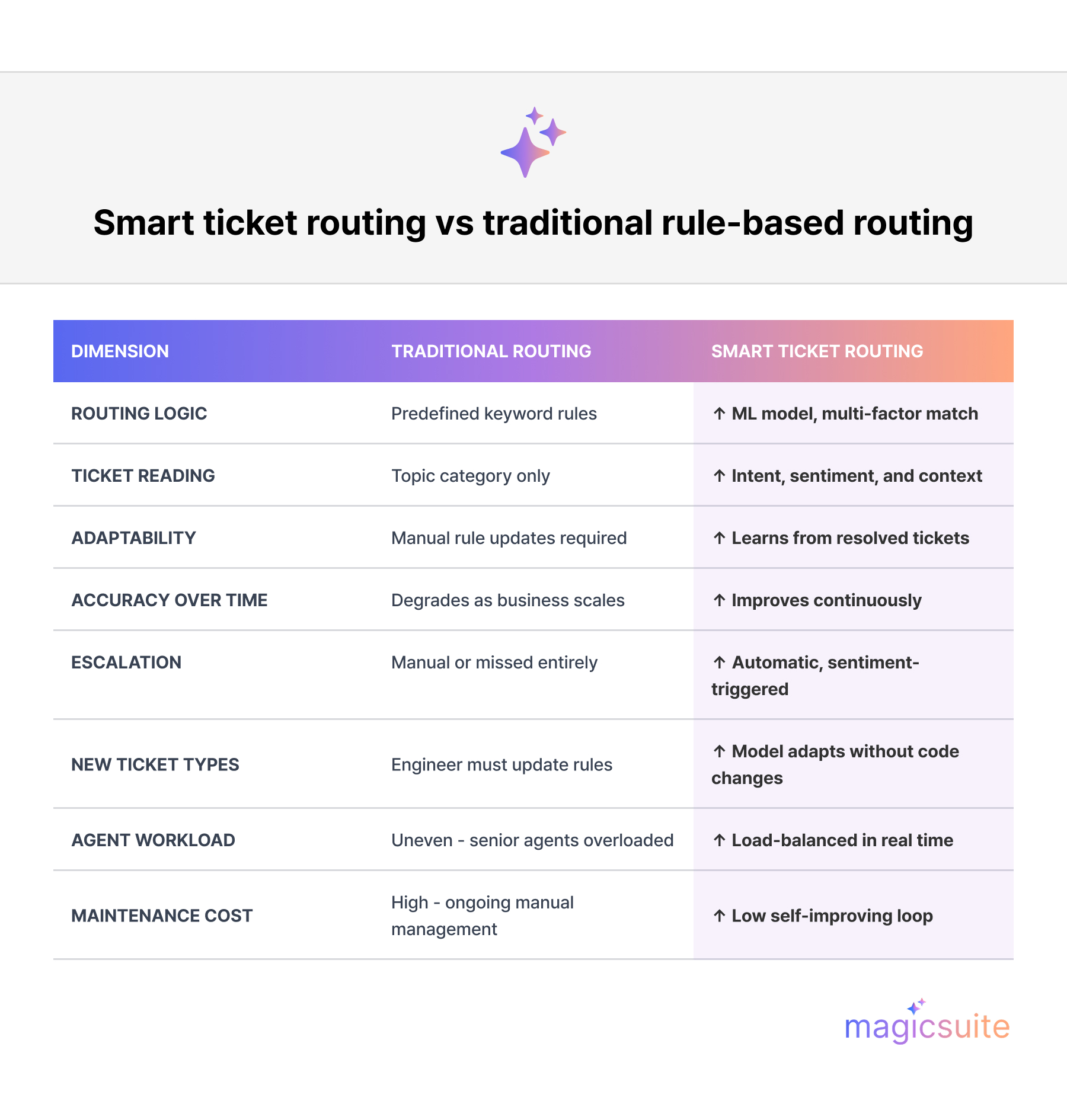
The difference between smart routing and traditional routing is not just speed. It is adaptability. Traditional rule-based systems are static: they route based on predefined conditions that must be manually maintained. Add a new product line, a new language, or a new ticket type, and someone has to update the rules.
Smart routing models learn from outcomes. As agents resolve tickets, the model tracks which assignments led to fast, high-satisfaction resolutions and adjusts future routing accordingly. This self-improving loop means routing accuracy increases over time, rather than degrading as the business evolves. For growing support organizations, that adaptability is not a nice-to-have feature. It is a structural requirement.

Hanna is an industry trend analyst dedicated to tracking the latest advancements and shifts in the market. With a strong background in research and forecasting, she identifies key patterns and emerging opportunities that drive business growth. Hanna’s work helps organizations stay ahead of the curve by providing data-driven insights into evolving industry landscapes.