

Master AI deflection rates with this complete guide. Learn ticket deflection formula, avoid false metrics, and see industry benchmarks to prove your AI’s ROI.
.png)
AI deflection is not a vanity metric; it is a core operational KPI. As organizations shift toward Domain-Specific Language Models (DSLMs), the focus has moved from simple automation to Verified Resolution. AI deflection rate measures the percentage of customer support queries resolved by AI tools without human agent involvement, helping businesses optimize costs and efficiency.
This comprehensive guide explores everything you need to know about measuring AI deflection rates, including strategies, formulas, benchmarks, tools, and frequently asked questions.
AI deflection refers to the process of routing or resolving customer inquiries through automated channels—such as AI chatbots, virtual agents, or self-service platforms—without involving a human support agent.
By deflecting inquiries to AI-powered systems, businesses can:
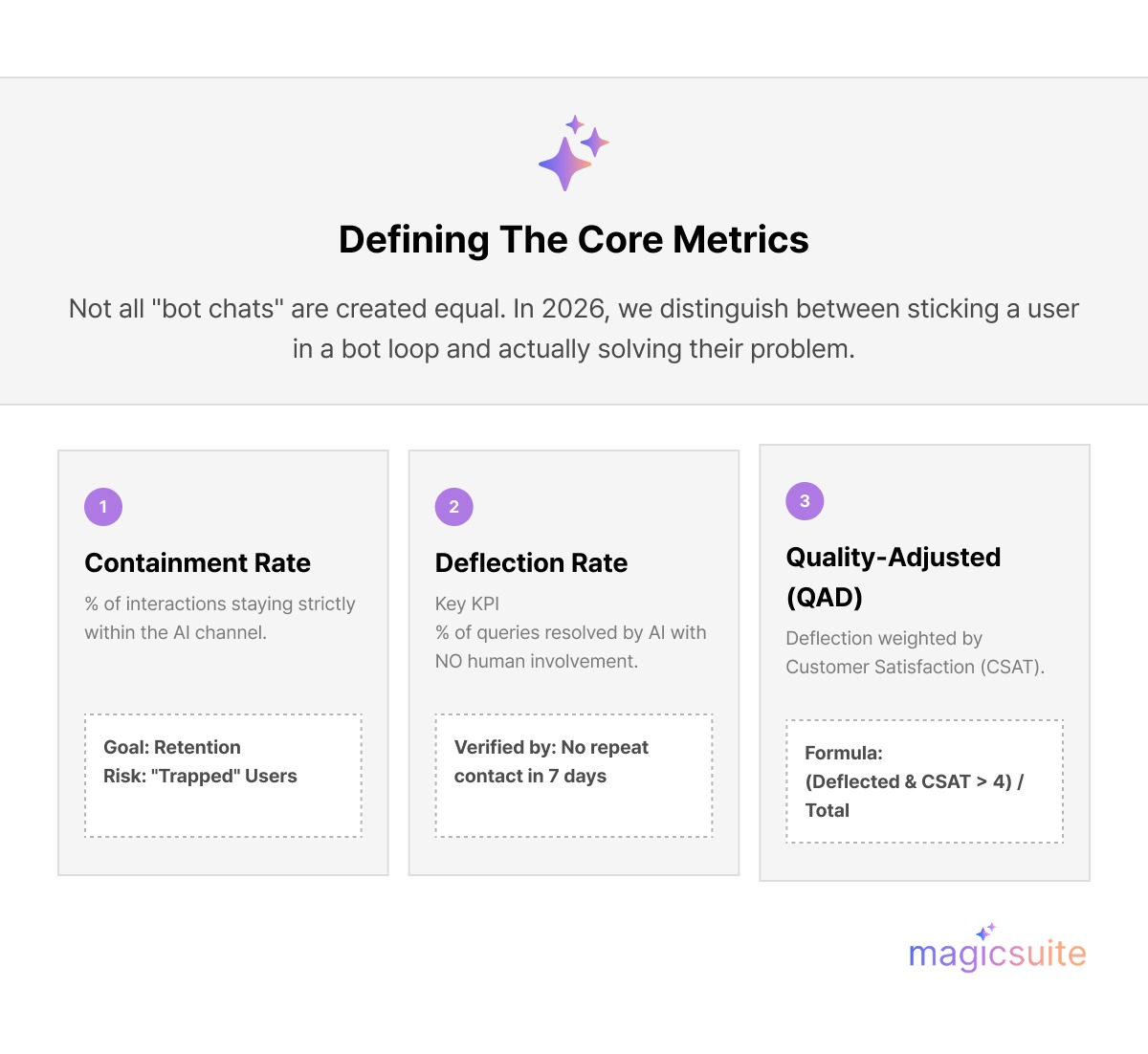
Containment rate measures the percentage of chatbot sessions that remain within the bot without immediate escalation to a human agent, focusing solely on retention (e.g., 80% of chats completed in the bot).
Deflection is further supported by verifying true resolution through post-interaction outcomes, such as positive feedback surveys, no repeat queries within 30 days, or successful self-service actions like password resets. For example, a 90% containment might drop to 60% deflection if customers reopen tickets later, underscoring why deflection is the superior ROI metric.
Track both: aim for containment > deflection to ensure quality escalations when needed.
Measuring deflection reveals cost savings: each AI-resolved query saves $5–15 compared with human handling. It highlights AI ROI, with top performers achieving 70-90% rates alongside high CSAT scores. Businesses use it to refine bots, reduce backlogs, and scale support without proportional headcount growth. By letting an AI system handle Tier 1 queries or repetitive tasks, organizations achieve:
To measure performance reliably, you must track the right data points. Below are essential AI deflection KPIs (Key Performance Indicators):
Read more of these metrics on Customer Support KPIs You Should Track to Measure AI Impact
Here’s the formula to calculate the AI Deflection Rate:
AI Deflection Rate (%) = (Total AI-Resolved Interactions / Total AI Interactions Initiated) x 100
If 10,000 people engage with your chatbot, and 7,000 have their issues resolved without needing an agent:
(7000 / 10000) x 100 = 70%
A 70% AI deflection rate generally indicates a well-tuned system, depending on industry standards.
For quality adjustments: Quality-Adjusted Rate = (Deflected with CSAT ≥4 / Total Deflected) × 100.
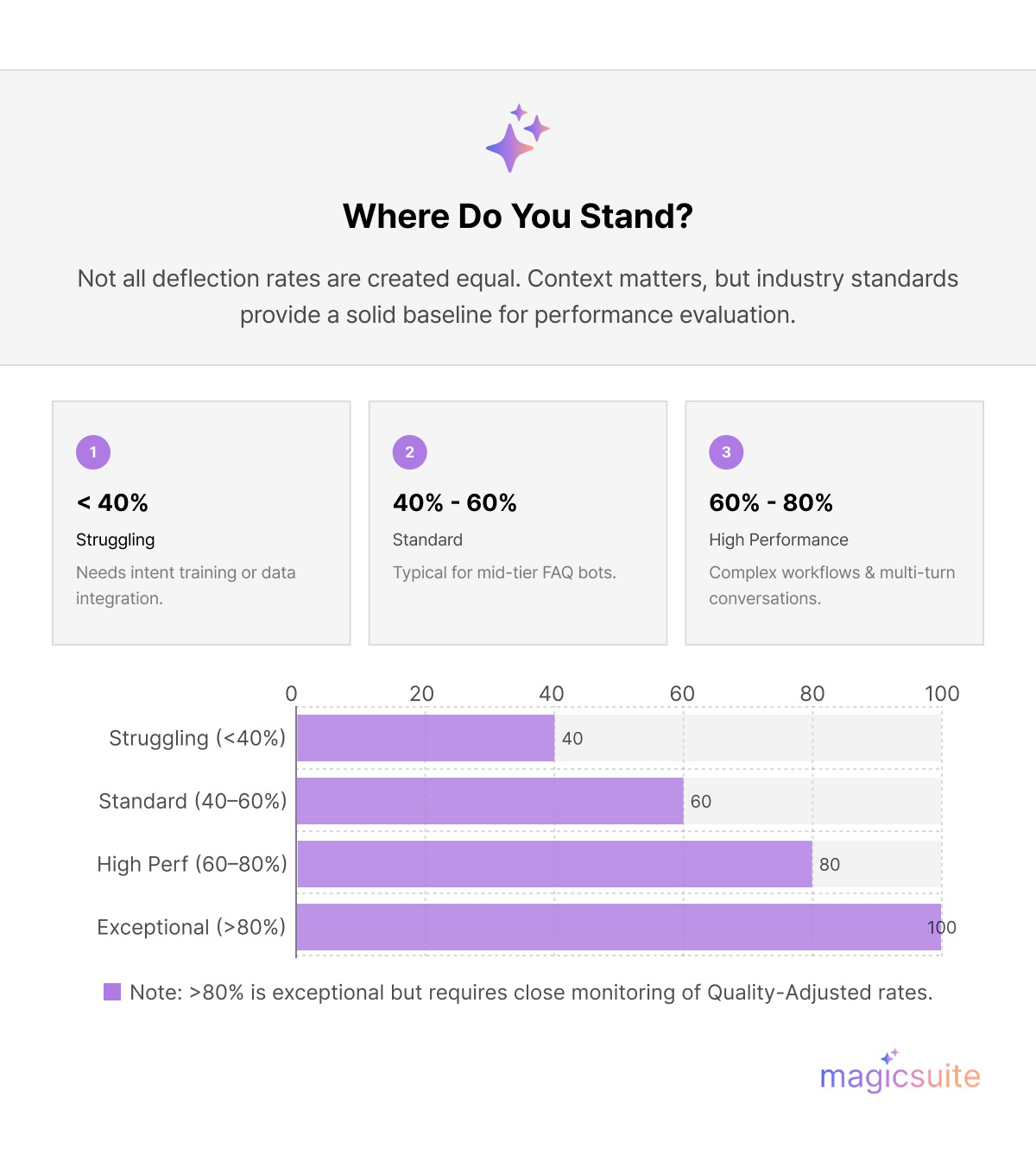
A good AI deflection rate starts at 20-30% for basic implementations, marking a solid baseline at which self-service begins to meaningfully reduce human workload. Rates of 40-60% indicate strong performance in mid-tier setups, especially in high-volume sectors like e-commerce, while rates above 70% signal excellence for advanced AI systems with semantic understanding and integrated knowledge bases.
Always adjust for quality by factoring in CSAT scores above 4/5 or low repeat contacts within 7 days—unadjusted high rates often hide false positives. For context, top-quartile performers in SaaS average 80-90% in 2026, correlating with 20-30% cost savings per query.
Case Study (Banking): Bank of America’s AI assistant, Erica, surpassed 1 billion interactions by 2025, effectively reducing call center load by 17% through high-precision deflection of routine inquiries (e.g., balance checks, card locks).
Follow these steps to calculate deflection precisely.
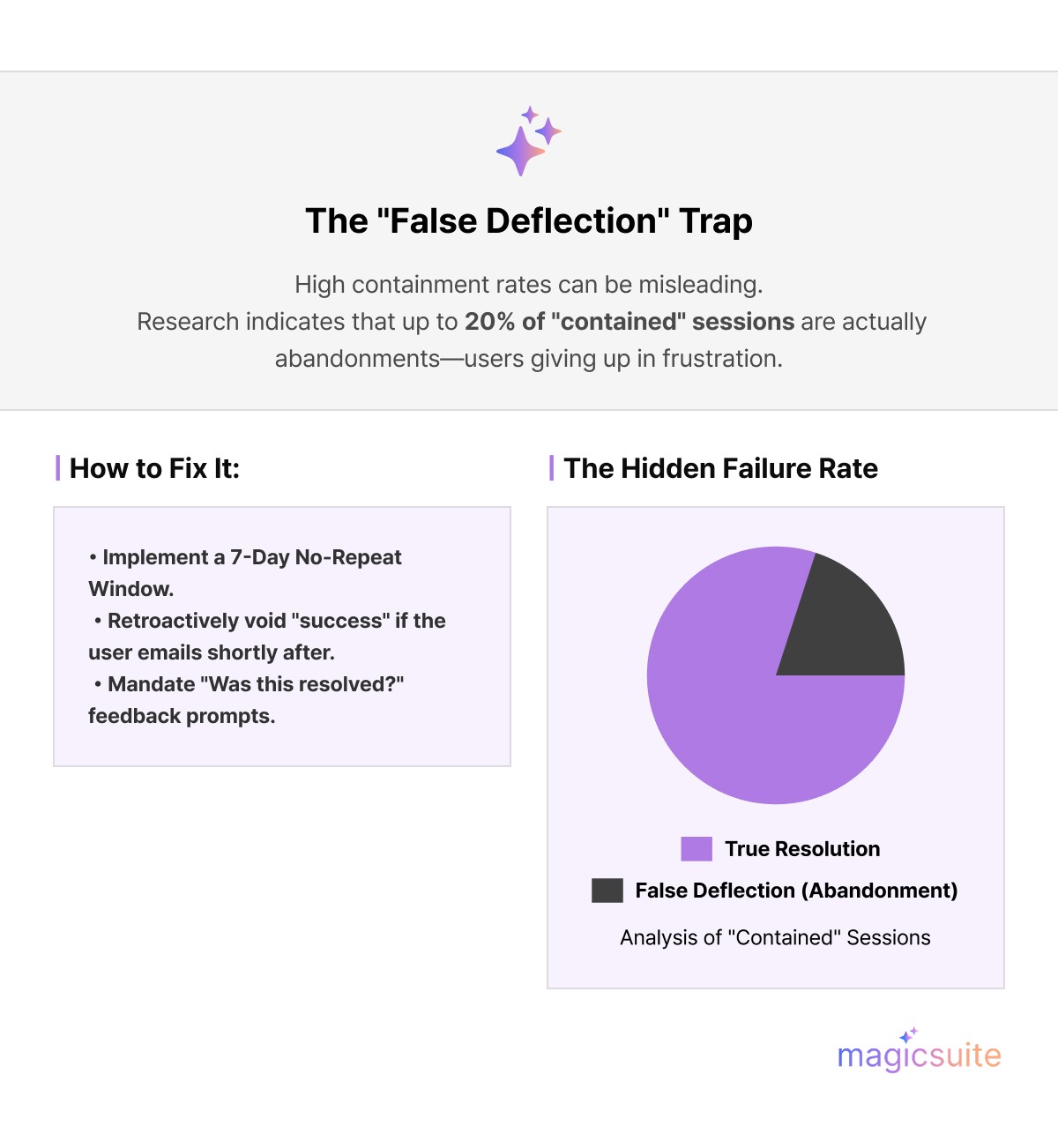
A 2025 report from Simplr highlights that up to 20% of "contained" sessions are actually instances in which customers abandon the chat out of frustration rather than for resolution. False deflection occurs when AI "resolves" issues that customers leave unresolved, inflating metrics without real value—a pattern common in 20-40% of basic bot interactions. Prevent it by mandating explicit feedback mechanisms, such as "Was this resolved?" thumbs-up/down prompts at the end of the session, targeting >80% positive responses.
To combat false metrics, technical frameworks now mandate a 7-to-14-day "No-Repeat" window. If a customer reaches out for the same intent within this window, the initial AI session is retroactively marked as a "False Positive."
For accurate measurement and performance insights, gather data across multiple touchpoints. Use:
Integrate data sources with BI tools (Tableau, Looker) for real-time dashboards.
A well-integrated AI tech stack makes all the difference. Here are industry-leading tools to help you measure AI deflection with precision:
Look for tools offering NLP breakdowns, user sentiment detection, and funnel drop-off tracking.
Despite its benefits, accurately measuring deflection isn’t always straightforward. Here are some pitfalls to avoid:
Ensure your measurements are trustworthy and actionable by following these expert tips:
The next wave of AI in customer support goes beyond basic metrics into predictive insights, voice AI deflection, and emotion-aware automation.
Upcoming advancements include:
As Generative AI matures, deflection analytics will shift from historical to predictive models.
Understanding how to measure AI deflection rates is strategic. As AI continues to reshape how companies interact with their users, precision in how we track, optimize, and evaluate deflection performance is non-negotiable. Master this metric now, and you’ll be riding the next big wave in customer experience.

Hanna is an industry trend analyst dedicated to tracking the latest advancements and shifts in the market. With a strong background in research and forecasting, she identifies key patterns and emerging opportunities that drive business growth. Hanna’s work helps organizations stay ahead of the curve by providing data-driven insights into evolving industry landscapes.