

Compare the best AI chatbots for customer support. Real performance data, pricing, and ROI analysis. See how top companies save time and money with AI customer service.
%20(4).png)
Your support team is drowning. Average response times stretch to 12 hours. Customer satisfaction scores drop monthly. The average cost of a customer service interaction is $15.50. If you handle 1,000 tickets monthly, that's $186,000 annually. For growing businesses, this number quickly becomes unsustainable.
But there's a solution that major companies already use. AI chatbots now handle 70% of customer inquiries without human intervention. Companies like Shopify reduced support costs by 33% while improving customer satisfaction by 24%. This guide examines the 10 best AI chatbots for customer support in 2025. You'll see real performance data, actual costs, and measurable ROI.
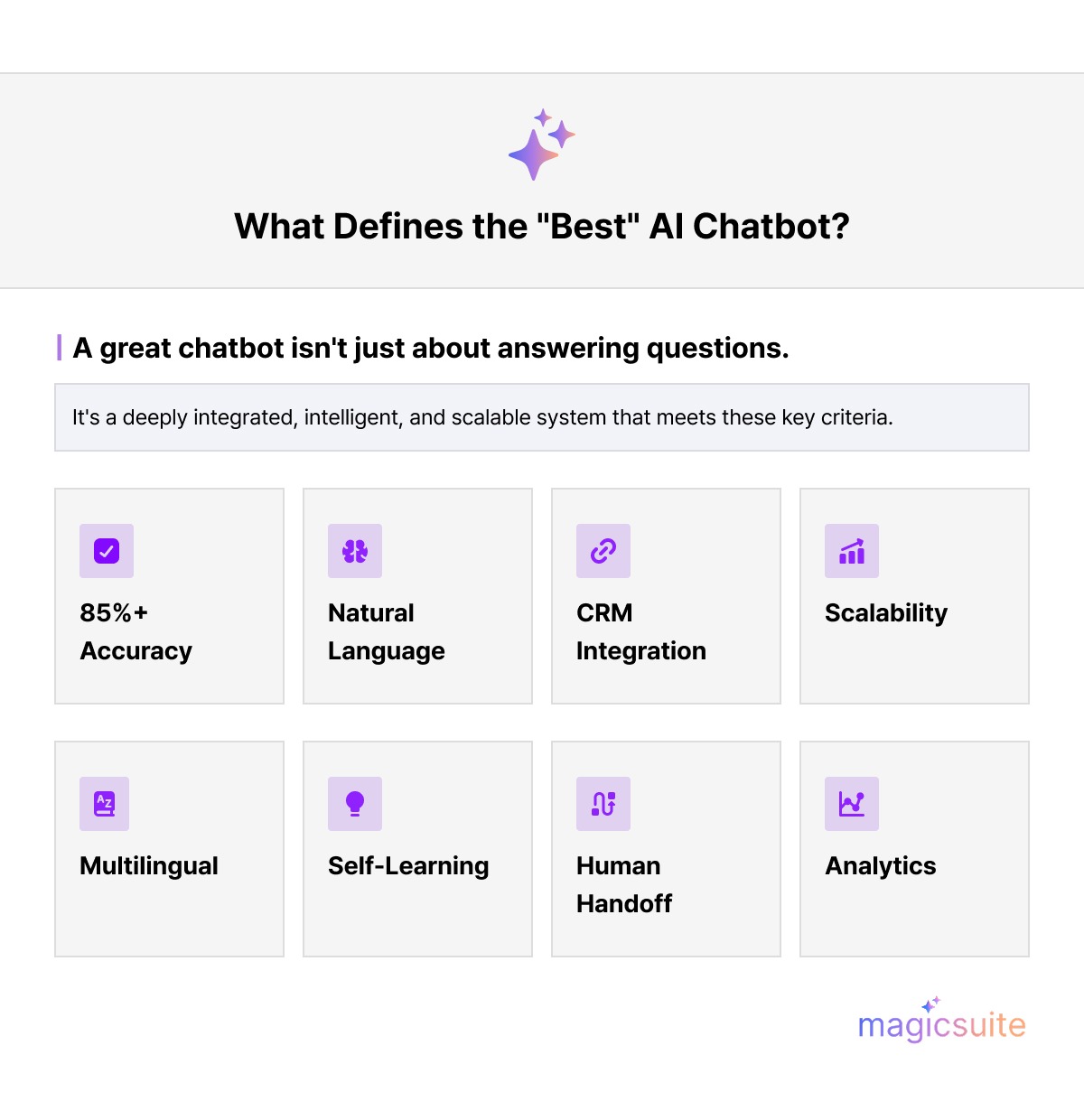
Not all chatbots are created equal. The best AI chatbot for customer support must meet specific criteria:
According to Gartner, by 2027, chatbots will become the primary customer service channel for 25% of organizations. Choosing the right platform now determines your competitive position for years.
We evaluated 20 leading platforms based on performance data, customer reviews, and independent testing. Here are the top 10 performers:
MagicTalk stands out for its privacy-first approach and ease of implementation. Unlike complex enterprise platforms that require months of setup, MagicTalk deploys in just days.
Key Features:
Performance Data:
Pricing:
Best For: Companies prioritizing data privacy, fast implementation, and transparent AI interactions.
Zendesk integrated AI directly into its Support platform. The advantage is seamless data flow and unified reporting.
Key Features:
Performance Data:
Pricing:
Limitation: Requires the Zendesk ecosystem. Not ideal for companies using other helpdesk platforms.
Intercom's Fin uses GPT-4 technology for sophisticated conversations. It excels at complex technical support scenarios.
Key Features:
Performance Data:
Pricing:
Consideration: Higher per-resolution cost can add up quickly for high-volume support operations.
Freshdesk's Freddy AI provides robust capabilities at competitive pricing. A strong option for companies scaling their support operations.
Key Features:
Performance Data:
Pricing:
Real Results: Delivery Hero uses Freddy AI across 50+ markets. They reduced first response time by 64% and handled 40% more tickets with the exact headcount. Average handle time decreased from 8 minutes to 4.5 minutes.
Sweet Spot: Companies with 5-20 support agents seeking affordable AI automation.
Ada specializes in no-code AI that marketing and support teams can manage without the need for developers.
Key Features:
Performance Data:
Pricing:
Real Results: Zoom uses Ada to handle 40% of their support volume. The bot resolved 120,000 conversations in Q1 2024, resulting in approximately $1.8 million in savings in support costs. Their AI handles everything from account issues to technical troubleshooting.
Note: Best suited for large enterprises with substantial support volume (10,000+ monthly interactions).
Drift excels at conversational marketing while providing solid customer support capabilities.
Key Features:
Performance Data:
Pricing:
Real Results: Marketo uses Drift to qualify leads and handle initial support questions. They increased qualified lead volume by 35% while reducing support team workload by 28%. Revenue attributed to Drift conversations: $2.4 million in 12 months.
Consideration: A higher price point makes sense primarily if you need both sales and support automation.
LivePerson pioneered conversational commerce and now offers sophisticated AI for customer support.
Key Features:
Performance Data:
Pricing:
Real Results: Virgin Media handles over 1 million conversations monthly through LivePerson. Their AI containment rate of 74% saves approximately $4.3 million annually. They've reduced average wait times from 3 minutes to under 30 seconds.
Strength: Exceptional for high-volume operations across multiple messaging platforms (WhatsApp, SMS, Facebook Messenger, Apple Business Chat).
Kustomer combines CRM capabilities with AI-powered customer service, providing context-rich interactions.
Key Features:
Performance Data:
Pricing:
Real Results: Glovo, the delivery platform, uses Kustomer across 25 countries. They handle 2.5 million monthly conversations with a team 40% smaller than projected. AI handles 58% of inquiries automatically, with seamless handoff for complex issues.
Differentiator: Exceptional context awareness. Agents see full customer history instantly, improving both AI and human interactions.
Tidio offers surprisingly powerful AI at entry-level pricing, making it ideal for small teams.
Key Features:
Performance Data:
Pricing:
Real Results: A boutique clothing retailer using Tidio reduced response time from 4 hours to under 3 minutes. With just two support staff, they handle 800 monthly inquiries. Annual savings compared to hiring additional staff: $42,000.
Best for: Businesses with fewer than 1,000 monthly support inquiries seeking affordable automation.
HubSpot's chatbot integrates seamlessly with its marketing, sales, and service hub, creating unified customer experiences.
Key Features:
Performance Data:
Pricing:
Real Results: A B2B software company using HubSpot's chatbot increased qualified leads by 54% while reducing support ticket volume by 38%. Their chatbot answers product questions, schedules demos, and creates support tickets—all within the HubSpot ecosystem.
Limitation: The best value is achieved when using the whole HubSpot platform. Standalone, other options may offer better features per dollar.
Important Context: The resolution rate varies significantly based on the complexity of the use case and the quality of implementation. Companies with well-documented knowledge bases see 15-25% higher resolution rates across all platforms.
Let's calculate real savings based on typical implementation:
Baseline Metrics (Without AI):
With AI Chatbot (60% Resolution Rate):
Annual Savings: $217,200
This represents a 58% reduction in cost. Most companies achieve full ROI within 3-4 months.
Additional Benefits:
According to IBM, businesses spend over $1.3 trillion annually on customer service. AI chatbots could reduce this by 30%, resulting in a global savings of $390 billion.
Consider these factors when selecting a platform:
Low volume (under 500/month): Opt for cost-effective options such as Tidio, MagicTalk Starter, or HubSpot Free. Complex enterprise platforms aren't worth the investment.
Medium volume (500-5,000/month): Platforms like MagicTalk Professional, Freshdesk Freddy, or Intercom Fin offer the best value-to-feature ratio.
High volume (5,000+ per month): Enterprise solutions like Ada, Zendesk AI, LivePerson, or Kustomer justify their higher costs at scale.
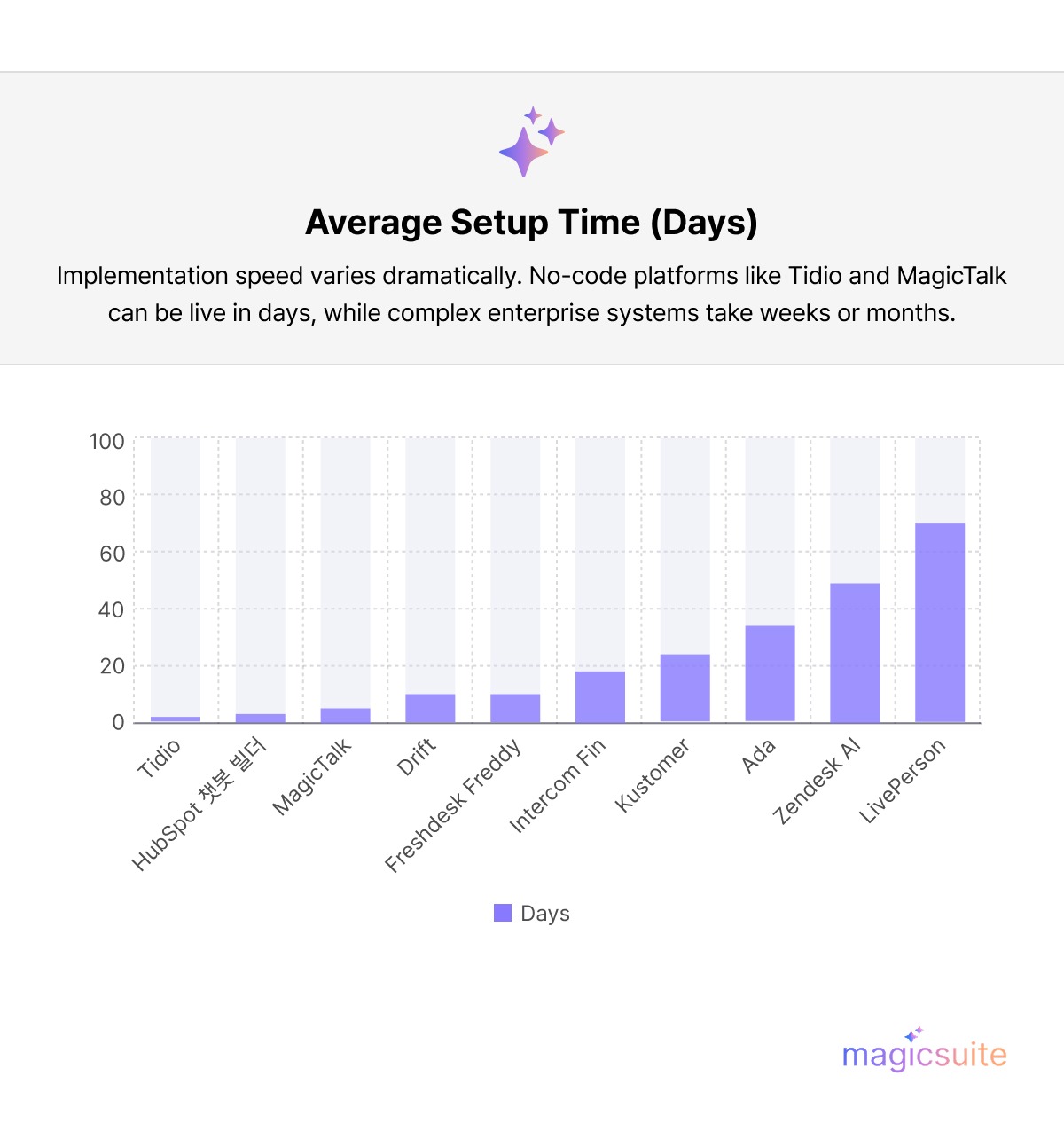
No technical team: Choose no-code platforms (MagicTalk, Ada, Tidio, HubSpot). Setup should take days, not months.
Limited technical resources: Mid-tier platforms with guided setup (Intercom, Freshdesk, Kustomer) work well.
Full development team: Any platform works. Consider customization needs and API capabilities.
Map your current tech stack:
Select platforms that offer native integrations for your essential tools. Custom integration projects typically cost between $10,000 and $50,000.
Integration Leaders:
Regulated industries (healthcare, finance): Prioritize platforms that hold relevant certifications (e.g., HIPAA, SOC 2, ISO 27001). MagicTalk, Zendesk, LivePerson, and Kustomer offer comprehensive compliance features.
EU customers: GDPR compliance is mandatory. Ensure data residency options meet requirements.
Payment processing: PCI DSS compliance is non-negotiable if handling payment data.
Choose platforms with robust multilingual support:
Choose scalable platforms with flexible pricing. Intercom's per-resolution model, MagicTalk's tiered pricing, or Ada's enterprise scaling work well.
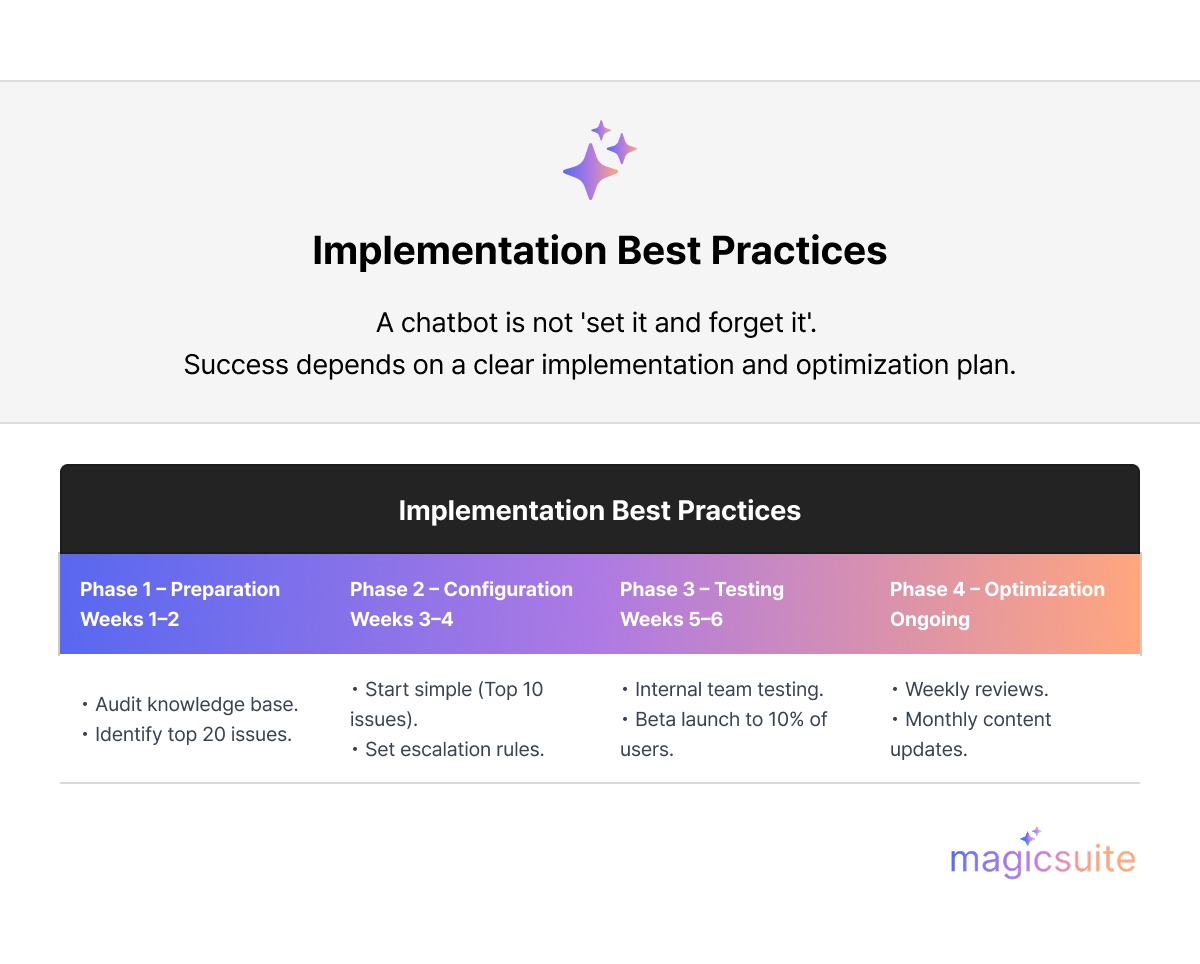
Buying the best AI chatbot isn't enough. Implementation determines success or failure.
Audit your knowledge base: AI chatbots are only as good as the information they access. Clean, organize, and update your help documentation.
Slack spent 6 weeks preparing content before launching its AI chatbot. Result? 81% resolution rate, 15% higher than similar companies.
Identify top issues: Analyze your last 1,000 support tickets. What are the most common questions? These become your AI's priority training areas.
Map conversation flows: Document ideal resolution paths for the top 20 issues. This guides AI training.
Start simple: Configure responses for your top 10 most common issues first. Perfect these before expanding.
Set escalation rules: Define when the AI should transfer to humans. Complexity, sentiment, and customer value are common triggers.
Customize personality: Your chatbot should match your brand voice. Casual for DTC brands, professional for B2B, friendly for hospitality.
Mailchimp's chatbot utilizes humor and personality—precisely in line with their brand. Customer engagement rates are 34% higher than generic implementations.
Internal testing: Have your support team use the chatbot. They'll identify gaps and issues quickly.
Beta launch: Release to 10-20% of customers. Monitor performance obsessively.
Gather feedback: Ask beta users to rate the chatbot experience. Act on feedback immediately.
Weekly reviews: Check resolution rates, customer satisfaction, and escalation triggers.
Monthly updates: Add new topics based on recurring unresolved issues.
Quarterly audits: Comprehensive review of all metrics. Adjust strategy as needed.
Spotify reviews chatbot performance weekly. They've increased resolution rates from 54% to 78% over 18 months through continuous optimization.
AI can't resolve issues if information doesn't exist or is poorly written. Companies with incomplete knowledge bases see 30-40% lower resolution rates. Ensure that you invest in documentation first. Hire a technical writer if necessary. This pays for itself quickly.
Frustrated customers are trapped in AI loops, without access to human support. Customer satisfaction drops dramatically. Negative reviews mention "can't reach a human."
Always provide clear escalation options. "Chat with a person" buttons should be visible.
Launching the chatbot, then ignoring it. Resolution rates stagnate or decline as products change and new issues emerge. The solution is to assign an owner. Weekly reviews are mandatory, not optional.
Marketing the chatbot as "solving everything" when it handles basic issues only. Customer expectations exceed reality. Disappointment follows. Be transparent. "Our AI assistant handles common questions. For complex issues, we'll connect you with our team."
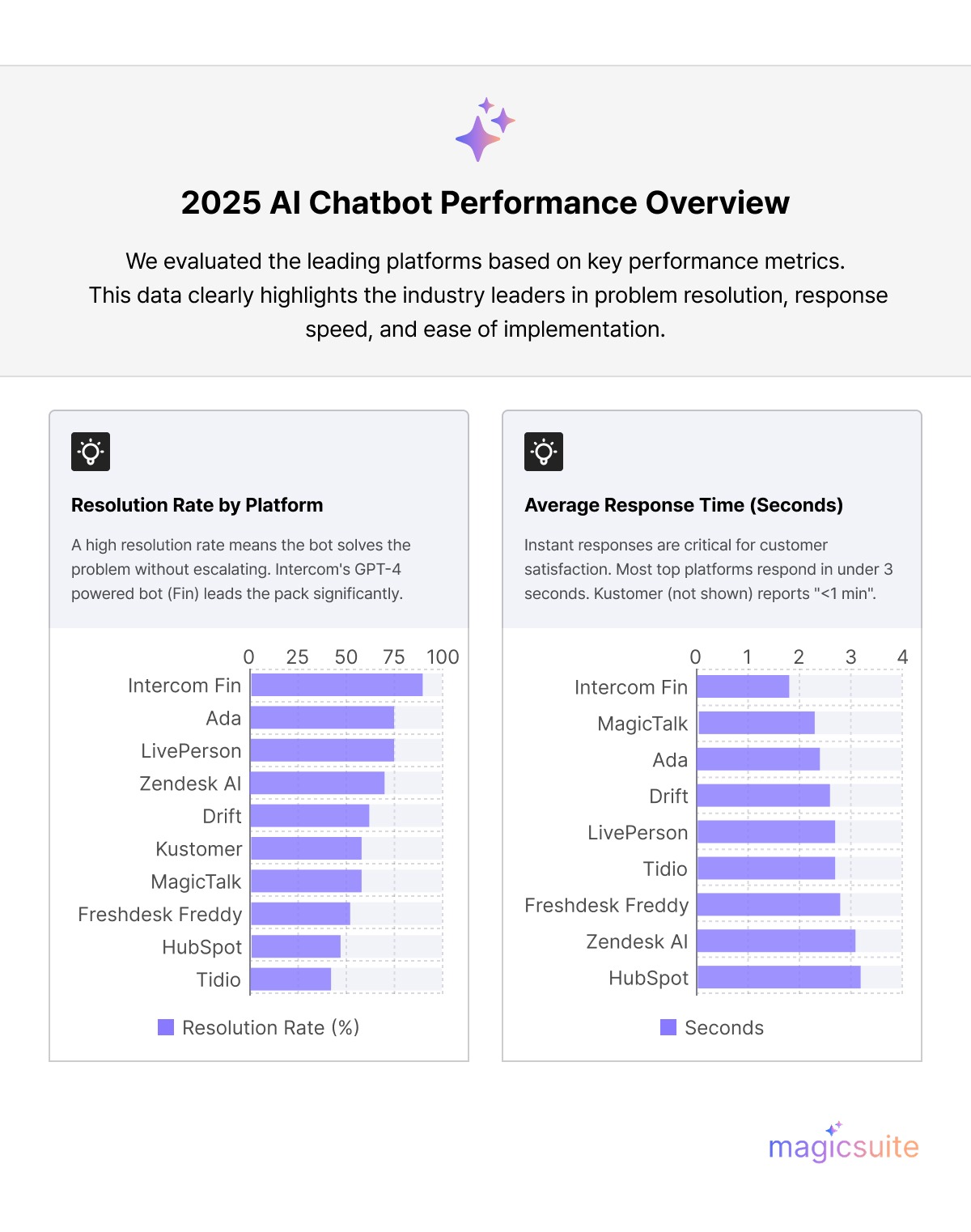
Not regularly reviewing chatbot performance data. Set up weekly dashboards. Track resolution rate, customer satisfaction, escalation patterns, and common unresolved queries.
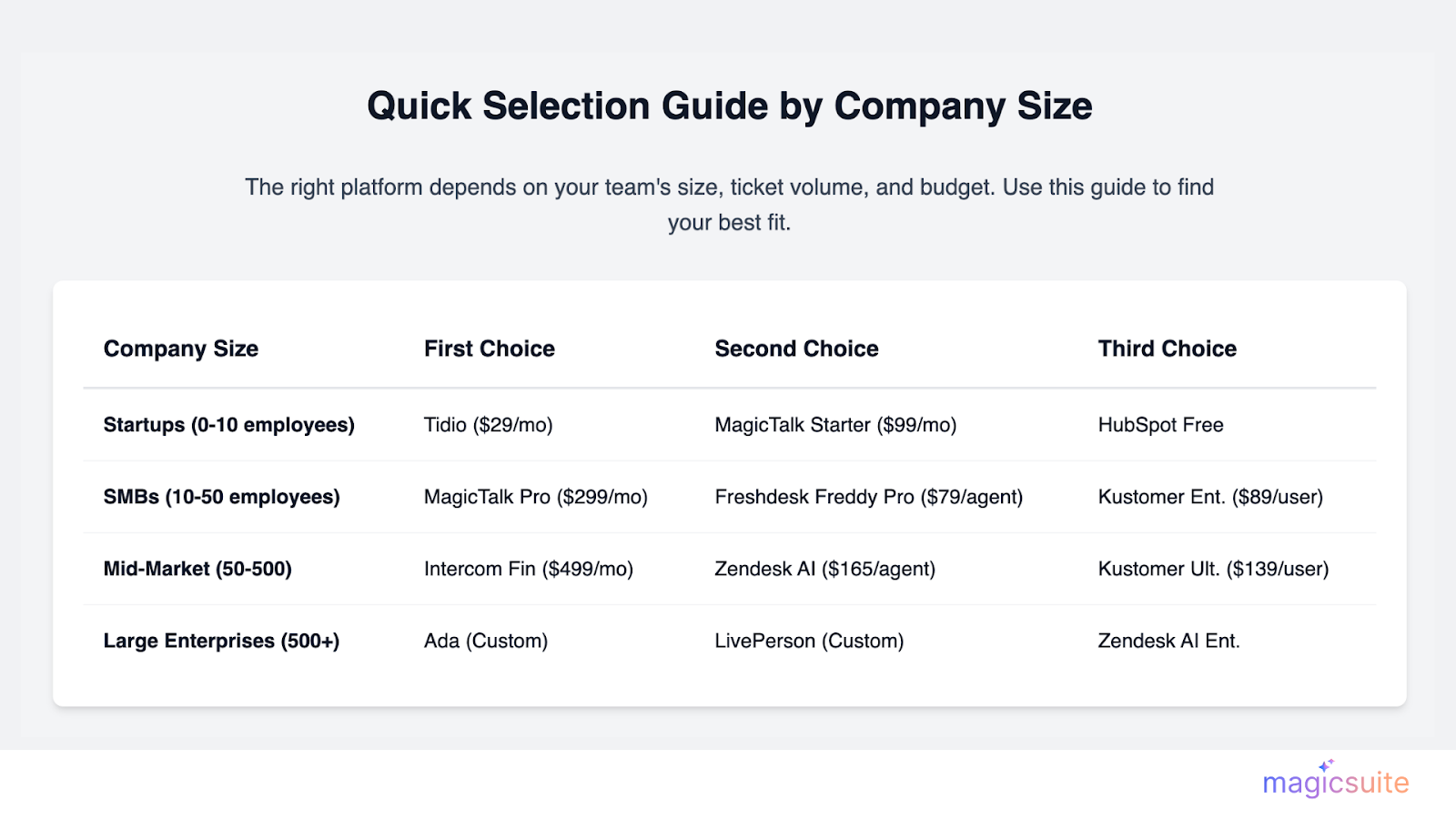
Startups & Small Businesses (0-10 employees):
Small to Medium Businesses (10-50 employees):
Mid-Market Companies (50-500 employees):
Large Enterprises (500+ employees):
Don't let support costs drain your budget while customers wait hours for responses. MagicTalk makes AI customer support accessible, affordable, and effective.
Why businesses choose MagicTalk:
Ready to cut support costs while improving customer satisfaction?
Start your free trial with MagicTalk and discover how AI can transform your customer support. Join thousands of companies saving time and money with intelligent automation.
You don't need to be a wizard to use the power of AI. Make every day magical with MagicTalk.

Hanna is an industry trend analyst dedicated to tracking the latest advancements and shifts in the market. With a strong background in research and forecasting, she identifies key patterns and emerging opportunities that drive business growth. Hanna’s work helps organizations stay ahead of the curve by providing data-driven insights into evolving industry landscapes.