

74% of orgs say AI meets ROI expectations - yet only 3% have scaled it in operations. Deloitte's why.

Customer service transformation is no longer a future-state ambition-it is the operational reality confronting every enterprise that competes on customer relationships. For years, organizations invested in AI as a cost reduction play: automating routine queries, deflecting tickets, and replacing headcount. That framing is proving insufficient for the scale of disruption now underway.
Deloitte's research tells a different story. Across its multi-year "State of Generative AI in the Enterprise" survey series-tracking more than 2,700 director- to C-suite-level respondents globally-the firm has documented a decisive shift: AI customer experience is no longer an experiment. It is becoming the architecture of how enterprises compete on service, loyalty, and growth. This article examines what Deloitte and peer research institutions have found about the forces reshaping AI customer experience operations, who is winning, and what separates meaningful transformation from costly stagnation.
For most of the 2010s, customer service was treated as a cost center to be optimized-not a strategic lever to be invested in. Generative AI has fundamentally altered that calculus.
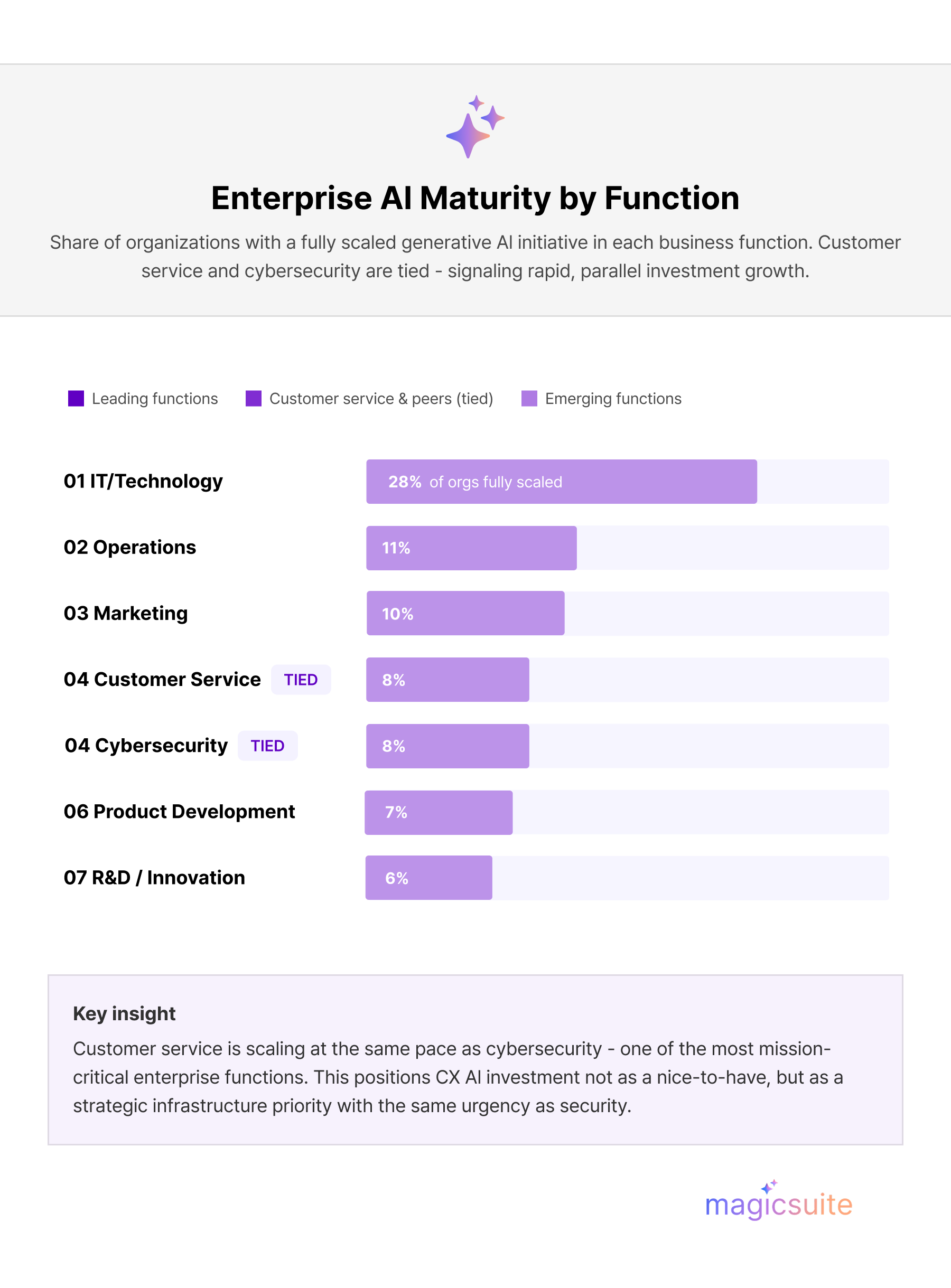
Deloitte's Q4 2024 "State of Generative AI in the Enterprise" report, surveying 2,773 global executives, found that IT leads as the most advanced function (28%), with operations (11%), marketing (10%), and customer service and cybersecurity (tied at 8%) close behind. More significantly, the survey found that organizations increasingly view generative AI customer experience initiatives not as efficiency projects, but as competitive differentiation platforms.
This strategic reframing matters because it changes how organizations prioritize, measure, and govern their AI investments. McKinsey's research confirms the scale of the opportunity: customer operations is one of the four largest value pools for generative AI globally, alongside marketing and sales, software engineering, and R&D. The firm estimates that AI-powered customer experience operations alone could contribute hundreds of billions in annual value through assisted resolution, intelligent knowledge surfacing, and next-best-action recommendations.
The implication for enterprise leaders is direct: treating generative AI as a support function initiative, rather than a strategic growth program, leaves significant value unrealized. Enterprises that integrate customer experience AI at the workflow level-not just the surface level-are the ones pulling ahead.
Deloitte's multi-wave survey series provides one of the most granular views of enterprise AI adoption available. Several findings from the 2024 data are particularly instructive for customer experience leaders.
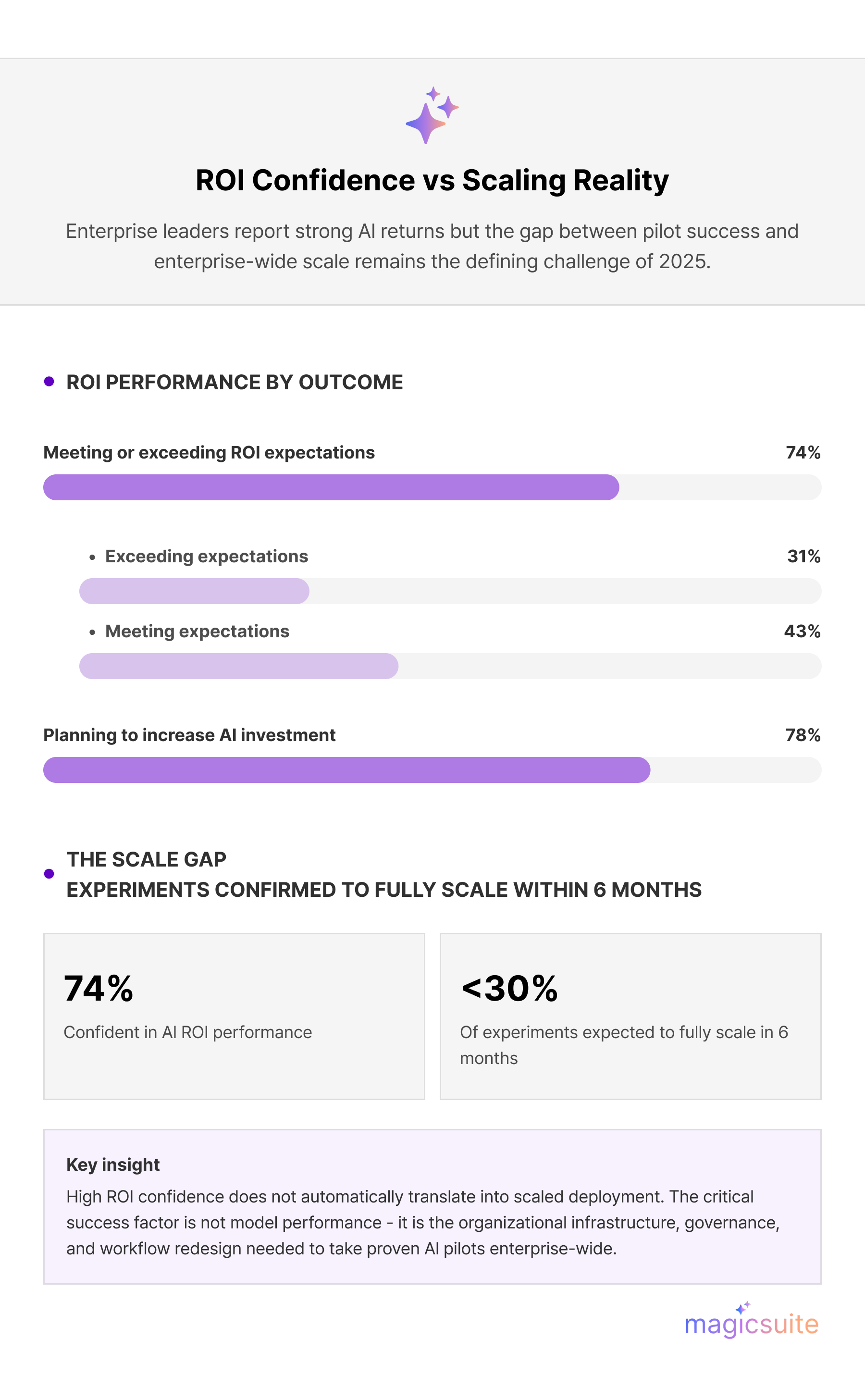
First, confidence remains high despite headwinds. 78% of organizations plan to boost their AI investment in the near term, suggesting a shift from the hype cycle to strategic, real-world implementation. This investment intent is notable because it persists even as organizations confront real scaling challenges-indicating that enterprise leaders view current friction as transitional, not structural.
Second, ROI signals are encouraging but uneven. 74% of respondents reported that their most advanced GenAI initiative is meeting or exceeding ROI expectations-with 43% meeting and 31% exceeding expectations. However, the report is equally candid about the pace of scaling: more than two-thirds of respondents report that 30% or fewer of their experiments will be fully scaled in the next three to six months.
Third, the functional ranking of AI maturity reveals where customer experience sits in the enterprise hierarchy. Among organizations' most advanced (fully scaled) initiatives, IT leads at 28%, followed by operations at 11%, marketing at 10%, and customer service and cybersecurity tied at 8% each. Customer service's position in this ranking-on par with cybersecurity and well ahead of product development (7%) and R&D (6%)-signals accelerating investment, even if enterprise-wide deployment maturity remains a work in progress.
For customer experience leaders, this picture is both a challenge and an opportunity. The ROI validation is real; the path to scale requires deliberate organizational investment beyond technology procurement.
Perhaps the most operationally relevant Deloitte research for practitioners comes from Deloitte Digital's 2026 Global Contact Center Survey, which engaged 600 global organizations and 3,000 consumers. The findings provide a ground-level view of how generative AI in customer service is changing the economics and performance of customer experience operations.
Key data points from the survey include:
Deloitte Digital's "Future of Service" framework, developed from this research base, positions AI-first customer service transformation around three pillars: delivering elite customer experience at scale, translating AI advances into measurable ROI, and enhancing workforce effectiveness. The emphasis on workforce effectiveness-rather than workforce reduction-is a deliberate signal about where durable value is created.
Generative AI in its current form-primarily assistive, text-generating, and recommendation-based-is already producing measurable outcomes in AI-driven customer service. But the trajectory points toward something more consequential: agentic AI, which takes customer experience automation from rule-based deflection to genuinely autonomous, multi-step resolution.
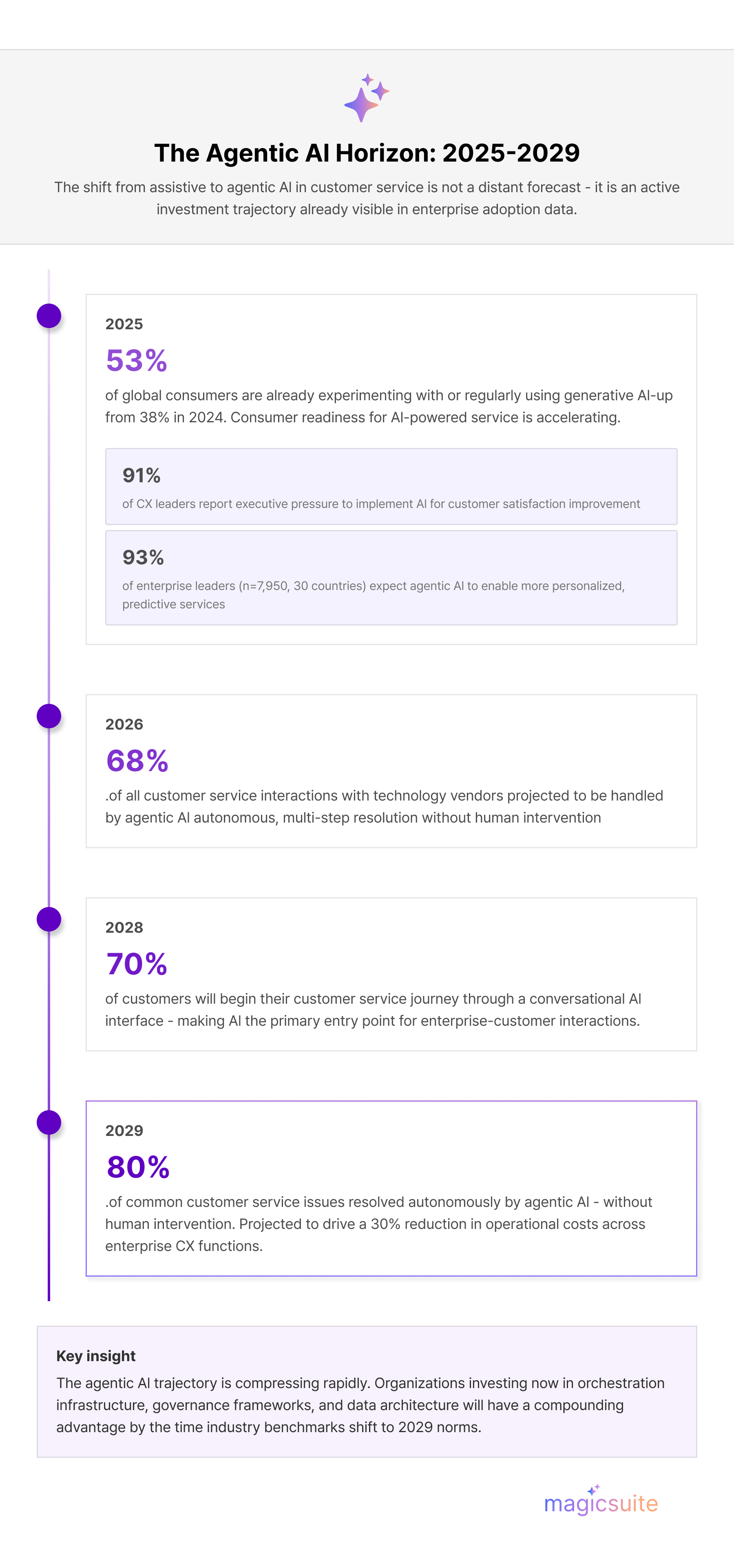
By 2029, agentic AI will autonomously resolve 80% of common customer service issues without human intervention, leading to a 30% reduction in operational costs, according to Gartner. This is not a marginal efficiency improvement; it represents a structural redesign of how service operations function.
Gartner's data on enterprise pressure and adoption provides important context:
Cisco's 2025 research adds a demand-side dimension: by 2026, 68% of all customer service and support interactions with technology vendors are expected to be handled by agentic AI, with 93% of respondents predicting that agentic AI will enable more personalized, proactive, and predictive services.
The consumer trust dimension is equally important. Deloitte's 2025 Connected Consumer Survey finds that most surveyed consumers (53%) are now either experimenting with generative AI or using it regularly-up sharply from 38% in 2024. Consumer familiarity with AI-powered tools creates a more receptive environment for AI-powered customer experience deployments, reducing the adoption friction that characterized earlier rollouts.
If agentic AI defines the operational future of customer service, personalization defines its revenue future. This is where generative AI customer experience platforms create value that transcends cost reduction.
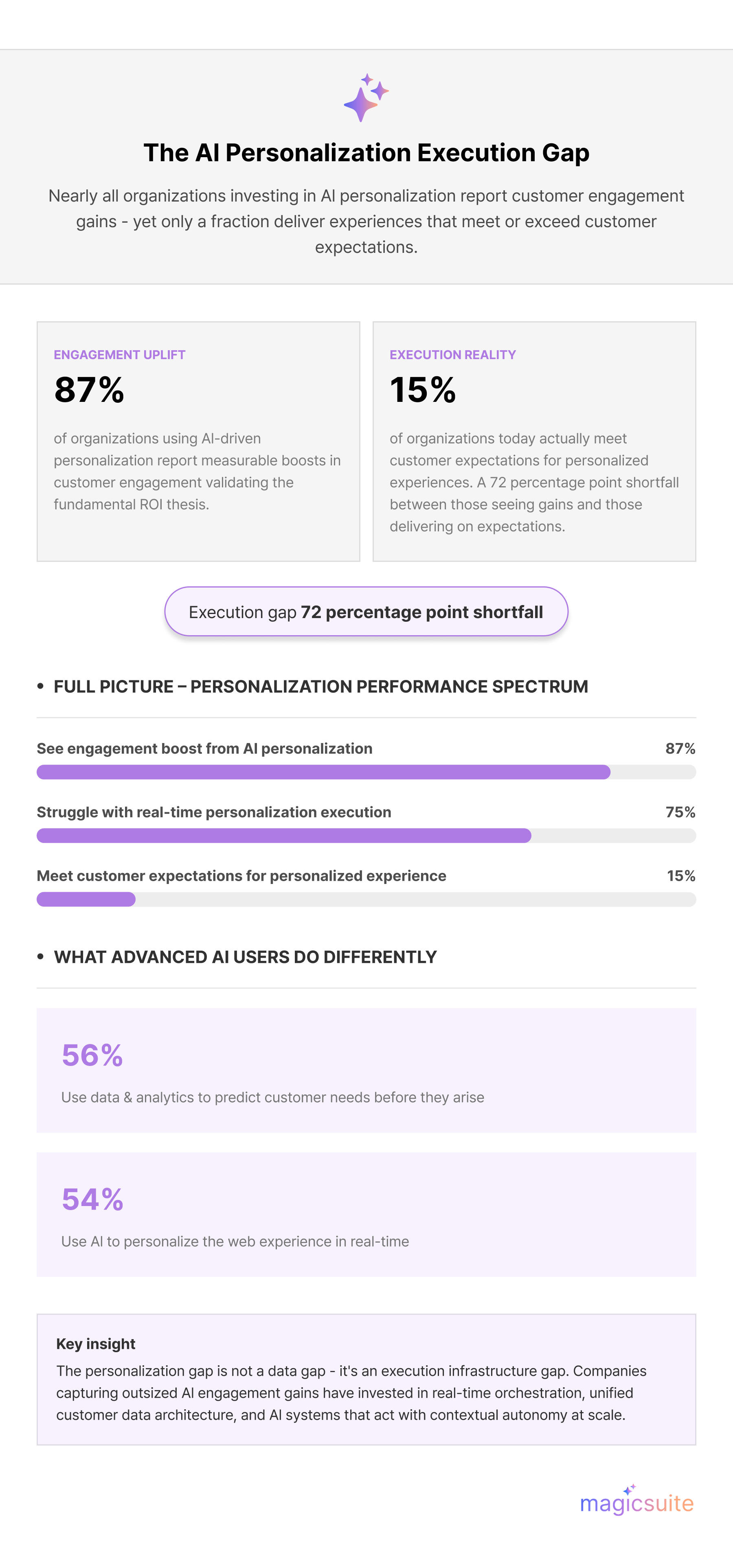
Adobe's 2025 AI and Digital Trends report, drawing on more than 8,000 consumers and 3,400 executives globally, found that 87% of organizations leveraging AI-driven personalization have already seen boosts in AI customer engagement. Yet the same research reveals a striking execution gap: only 15% of organizations today meet customer expectations for surprise and delight in personalized experiences, and real-time personalization is a major challenge for 75% of practitioners.
This gap between aspiration and execution is where strategic generative AI customer experience differentiation is created. Advanced organizations are doing something structurally different: 56% of the most advanced users of generative AI in marketing and CX use data and analytics to predict customer needs, and 54% use AI to personalize the web experience.
McKinsey's research on high-performing AI adopters reinforces this pattern. Organizations that achieve outsized returns from customer experience AI share two characteristics: they set growth and innovation objectives alongside (not instead of) cost reduction goals, and they redesign workflows around AI rather than bolting models onto legacy processes.
The practical implication is that personalization at scale requires more than model selection. It demands unified customer data architecture, real-time orchestration capability, and governance frameworks that allow AI to act with appropriate autonomy across touchpoints. Companies that invest in this infrastructure are building durable competitive advantages-not merely efficiency ratios.
The most persistent finding across Deloitte, McKinsey, and Gartner research is that scaling challenges are fundamentally organizational, not technological. This distinction matters enormously for organizations planning their next phase of customer experience automation investment-where the bottleneck is almost never the AI model itself, but the infrastructure and organizational readiness surrounding it.
Key scaling barriers, as documented by Deloitte's 2024 survey series:
McKinsey's service operations research makes this pattern vivid: only 11 percent of companies worldwide are using gen AI at scale, and only 3 percent of organizations have scaled a gen AI use case in an operations-related domain. The implication is striking-widespread deployment of AI in CX remains an unsolved organizational problem even for companies with significant technology resources.
High performers solve this by treating AI customer engagement as a change management program with technology components, rather than a technology program with change management considerations. The sequence matters: strategy, operating model, then deployment.
Not all generative AI investments in customer experience are equal-and the performance gap between high performers and the broader enterprise population is widening. Understanding what differentiates successful adopters is essential for any organization evaluating its AI-powered customer experience strategy.
Deloitte's Q4 2024 survey data shows that cybersecurity and IT functions lead in ROI realization, while cybersecurity adoption rates stand out, with 44% of implementations exceeding ROI expectations. Customer service and marketing are close behind, with strong adoption trajectories and improving return profiles.
McKinsey's 2025 State of AI report (n=1,993 participants across 105 countries) reveals a critical misalignment: companies that focus exclusively on cost reduction underperform those that target growth and innovation alongside efficiency. Only 39% of organizations can link any EBIT impact to AI, and for most of those, the impact is below 5%. Over 80% still don't see a clear enterprise-wide effect on their bottom line.
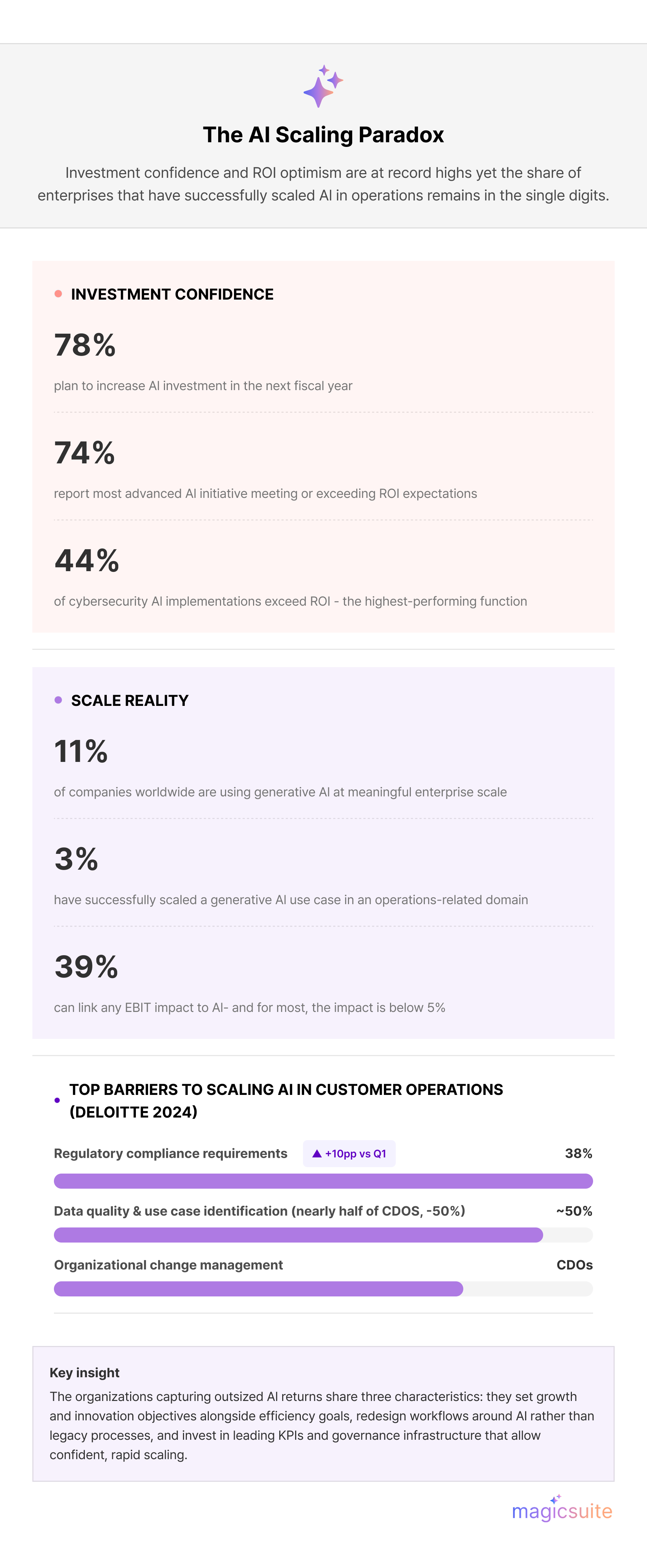
What distinguishes the 6–10% of organizations capturing outsized returns? Three consistent factors emerge across research:
Deloitte's own agentic AI framework for customer reimagination, developed in partnership with Google, reflects these principles. It positions AI-driven customer service not as headcount replacement but as a capability to "automate up to 90% of post-interaction work" while enabling approximately "50% increase in service efficiency"-outcomes achieved through intelligent workflow redesign, not simple automation.
One important nuance in the generative AI customer experience landscape-one that both Deloitte and Gartner have begun to surface-is that the cost economics are more complex than early narratives suggested.
Gartner research predicts that the cost per resolution for generative AI in customer service will exceed $3 by 2030-higher than many offshore human agents-as infrastructure demands, orchestration layers, and governance requirements accumulate.
This finding does not invalidate the AI investment thesis. It refines it. As Gartner analysts have noted, if AI-driven customer service improves retention, drives upsell, and increases customer lifetime value, higher per-resolution costs may still deliver superior overall ROI compared to labor arbitrage strategies. The value proposition must extend beyond ticket deflection.
The real cost of AI extends beyond model usage: enterprise deployments require orchestration layers, governance controls, RAG pipelines, monitoring systems, and human fallback-turning AI into a long-term operational infrastructure investment.
This means that organizations planning customer service transformation through generative AI must build cost models that account for the full technology stack, ongoing governance requirements, and the human expertise needed to manage and improve AI systems over time. Framing AI-powered customer experience as a long-term operational capability-rather than a one-time technology purchase-is what separates enterprises that hit their ROI targets from those that consistently miss them.
Deloitte's structured approach to AI-driven customer reimagination offers a useful framework for understanding what successful deployment looks like in practice. Their engagement model-moving clients from vision to value through AI discovery labs, minimum viable product deployment, and enterprise AI readiness assessments-reflects lessons learned from deployments across industries.
The model is premised on a recognition that customer experience operations sit at the intersection of technology capability and organizational readiness. Neither alone is sufficient. Organizations that have the most advanced AI models but lack data governance infrastructure, change management capability, or clear value measurement frameworks consistently underdeliver on their AI investments.
The three primary failure modes Deloitte identifies in generative AI in customer service deployments are:
Solving these problems requires investment upstream of the model-in data architecture, integration infrastructure, and operating model design. Companies that build these foundations first scale faster and sustain higher performance levels than those who deploy AI models into unprepared environments.
Deloitte's sustained research into generative AI enterprise adoption offers a more nuanced and strategically useful picture than the prevailing market narrative. Yes, generative AI in customer service is producing real ROI for organizations that deploy it thoughtfully. Yes, adoption is accelerating and investment intent remains strong globally. But the research is equally clear that technology procurement alone does not drive transformation.
The enterprises that will define the next era of AI-powered customer experience are those that treat this moment as an operating model reinvention-redesigning workflows, building data infrastructure, investing in governance, and measuring outcomes with the rigor they apply to any major capital allocation decision.
Deloitte's forecast is not that AI-driven customer service and customer experience AI might reshape operations. It is that the reshaping is already underway-and that the competitive gap between organizations that execute with discipline and those that experiment without strategy will compound rapidly over the next three to five years. The defining decisions for most enterprises are happening now.

Joseph is a Technical Communications Specialist responsible for translating complex technical concepts into clear, engaging, and accessible content for diverse audiences. He collaborates closely with technical teams, product experts, and stakeholders to develop documentation, reports, knowledge resources, and communication materials that support business objectives and enhance user understanding.