Why Enterprise Retailers Need Their Own LLM Instead of Generic AI
July 30, 2026
7
mins
70–85% of AI pilots fail - RAG-grounded enterprise LLMs close the gap generic chatbots can't.
Key Takeaways
01Enterprise AI adoption is widespread, but measurable value remains rare
— 88% of organizations use AI in at least one function, while only about 6% generate more than 5% of EBIT from it.
02Generic AI creates accuracy, privacy, and control limitations for retailers
— public models are not persistently connected to live inventory, pricing, customer histories, supplier terms, or proprietary operating rules.
03RAG turns a private enterprise LLM into a reliable retail system
— every answer can be grounded in current product catalogs, pricing engines, inventory databases, policies, and governed internal knowledge.
04Most AI failures are caused by weak foundations rather than weak models
— fragmented data, poor integration, unclear ownership, limited governance, and disconnected workflows prevent pilots from scaling.
05Retailers capturing ROI treat enterprise AI as core infrastructure
— they combine governed data, redesigned workflows, private processing, sustained investment, and business metrics tied to revenue, cost, and productivity.
Introduction
Every large retailer now has some form of generative AI running somewhere in the business. Few have anything resembling a strategy for it. That distinction is becoming the difference between organizations that turn AI into a durable advantage and organizations quietly funding a growing list of stalled pilots. Enterprise retailers face a specific version of this problem: their most valuable data - pricing logic, inventory positions, loyalty histories, supplier terms - is exactly the data a generic, shared AI model was never built to handle safely or accurately. This article examines what the latest research says about where AI investment actually pays off, why generic tools plateau fast in retail environments, and what separates retailers extracting real value from an enterprise LLM from those still stuck experimenting.
The Enterprise AI Adoption Numbers Retailers Can't Ignore
AI adoption in large organizations has crossed from early experimentation into default infrastructure. But the research is consistent on one point: adoption of enterprise AI has decoupled from value.
McKinsey's 2025 global survey of nearly 2,000 organizations across 105 countries found that 88% now regularly use AI in at least one business function - yet only about 6% qualify as "AI high performers" attributing more than 5% of EBIT to AI.
The same research found that roughly two-thirds of organizations have not yet begun scaling AI across the enterprise; most remain in isolated pilots that never reach production.
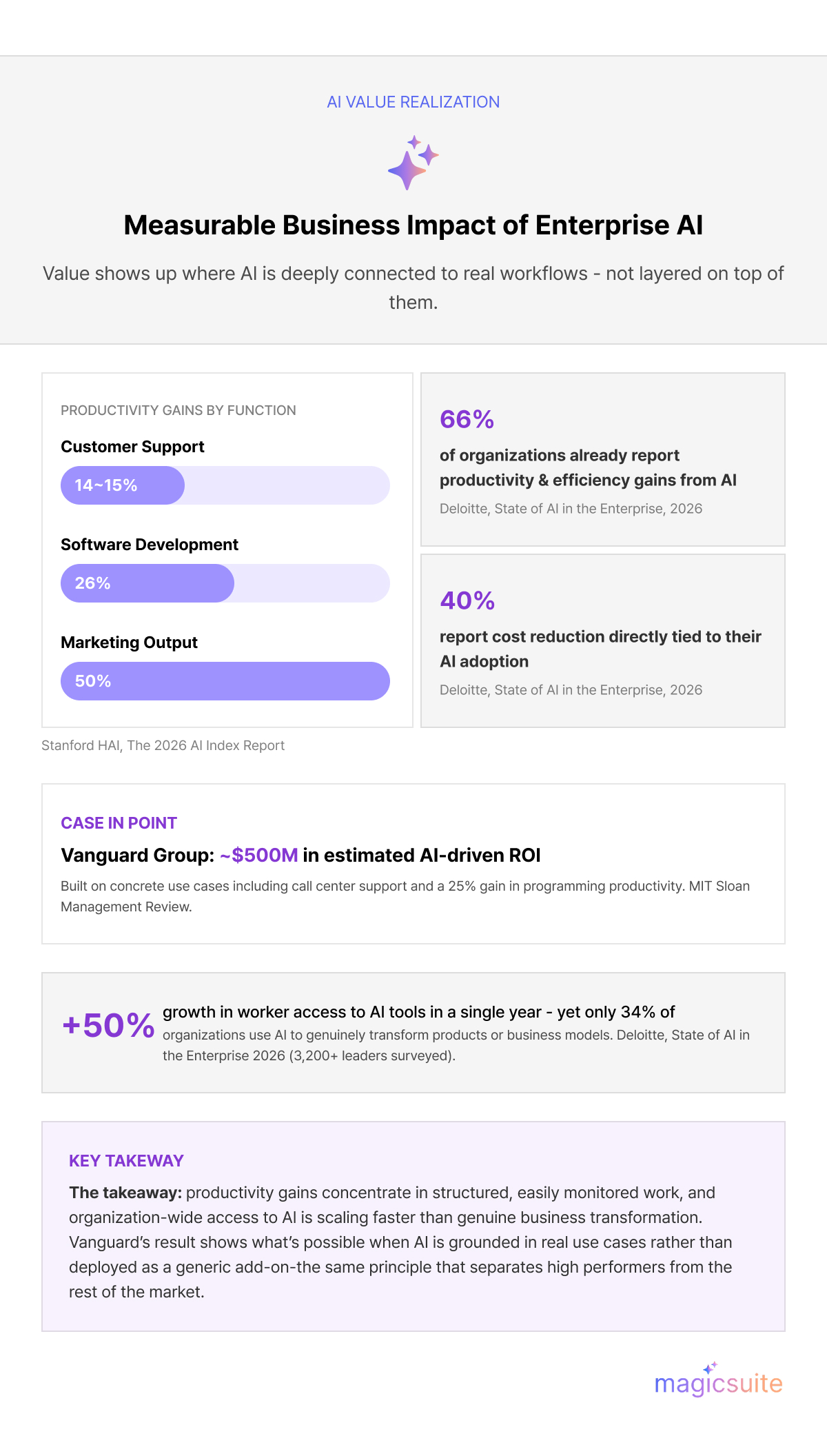
Deloitte's 2026 State of AI in the Enterprise survey of over 3,200 senior leaders found worker access to AI tools rose 50% in a single year, yet just 34% of organizations report using AI to genuinely transform products, services, or business models rather than automate existing tasks.
For retail specifically, Deloitte's Global Retail Industry Outlook found that 67% of executives expect to have AI-driven personalization capabilities within the next year - an ambitious target set against a sector Deloitte's own retail and consumer products research describes as still early in generative AI maturity. That gap between ambition and readiness is precisely where the choice between a generic chatbot and a purpose-built enterprise system matters most.
Why Generic AI Chatbots Stall Out in Retail Environments
Off-the-shelf AI chatbot deployments tend to perform well in demos and poorly in production, for reasons that are structural rather than fixable with better prompting.
They aren't grounded in live retail data. A general-purpose model has no persistent connection to a retailer's actual inventory feed, current promotions, or SKU-level pricing. It answers from static training data or shallow integrations, which is why so many retail chatbot pilots produce confidently wrong answers about stock or price.
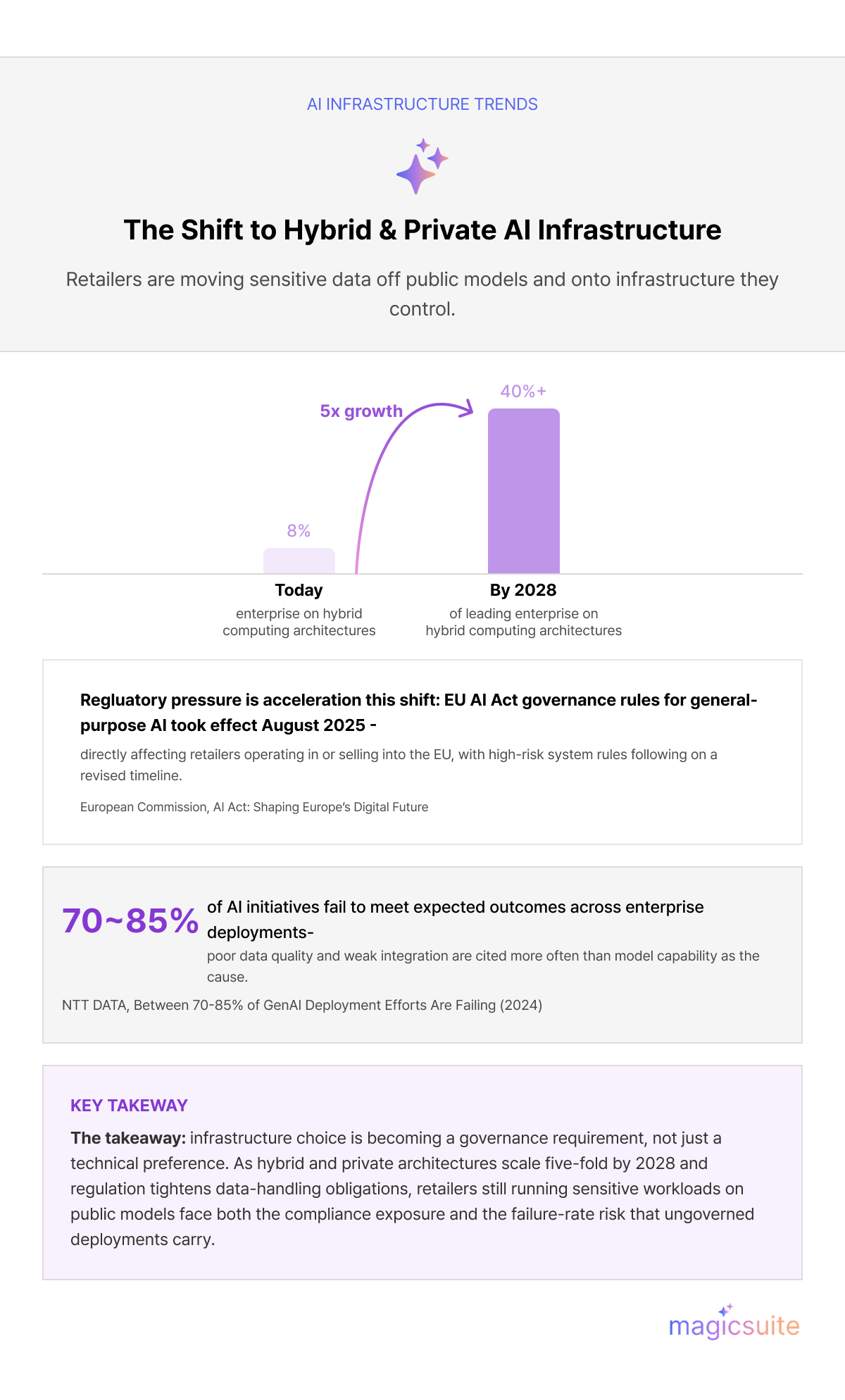
They create uncontrolled data exposure. Feeding proprietary sales data, supplier contracts, or customer histories into a shared public model raises questions most retail legal and compliance teams are no longer willing to wave through. Gartner projects that by 2028, more than 40% of leading enterprises will have adopted hybrid computing architectures for critical business workflows - up from roughly 8% today - with high-sensitivity tasks kept off public infrastructure and processed inprivate LLM environments instead.
They fail industry-specific accuracy bars. This is a widely documented problem: estimates of AI initiatives failing to meet expected outcomes commonly range from 70% to 85% across multiple analyst and consulting sources, with poor data quality and weak integration cited more often than model capability as the root cause. In retail, an AI agent that mishandles a return policy or misquotes a price isn't a minor error - it's a customer trust and revenue problem.
They're built for generality, not your business. A generic model treats a home-goods retailer and a grocery chain identically. It has no concept of a retailer's margin structure, seasonal demand patterns, or loyalty program rules unless painstakingly re-explained in every session - an approach that doesn't scale past a handful of use cases.
What an Enterprise LLM Actually Solves
An enterprise LLM - a model deployed and controlled within the retailer's own infrastructure, fine-tuned or grounded on the retailer's proprietary data - addresses each of these failure points directly rather than papering over them with prompt engineering. The core question isn't whether to adopt AI; it's whether the LLM for enterprise use is one your business actually controls, or one you're merely renting access to.
Retrieval-Augmented Generation as the Foundation
RAG is the mechanism that makes enterprise-owned AI fundamentally different from a generic chatbot. Instead of relying only on what a model learned during training, RAG retrieves current, verified information from a retailer's own systems - product catalogs, pricing engines, inventory databases - before generating a response.
This is why RAG has become the default architecture for regulated and data-sensitive industries requiring auditable, source-cited answers rather than plausible-sounding guesses.
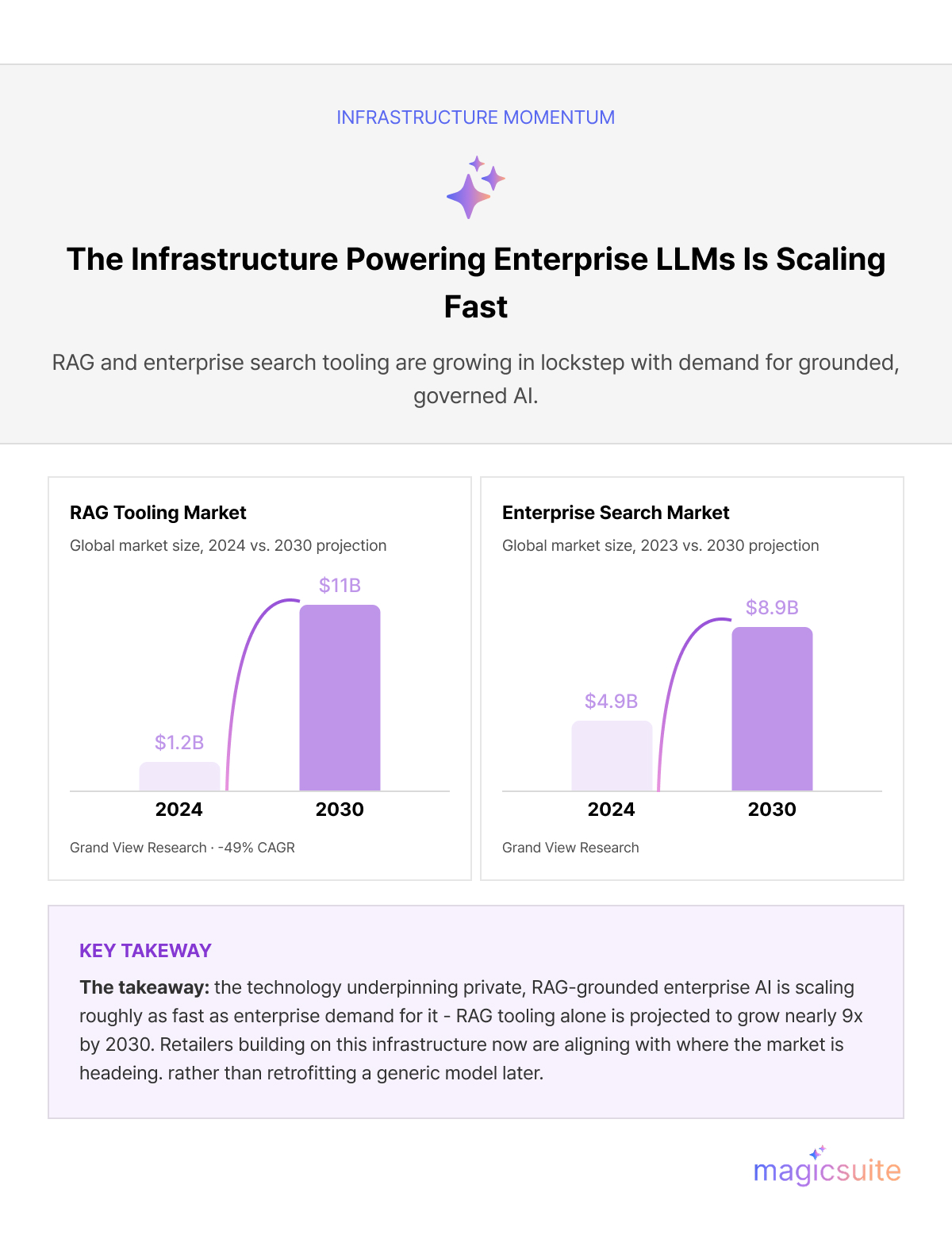
The enterprise search and RAG tooling market has grown accordingly: Grand View Research estimated the global RAG market at roughly $1.2 billion in 2024, projected to reach $11 billion by 2030 - a signal of how fast enterprises are moving from generic models to grounded, retrieval-based systems.
For retailers, this means an enterprise AI chatbot can answer "is this in stock at the Chicago store" or "what's our current return window for this SKU" correctly, every time, because the answer is retrieved from a live source rather than recalled from training data.
Enterprise Knowledge Management, Not Just Conversation
A private LLM layered over a retailer's internal knowledge base functions as anenterprise knowledge management system as much as a conversational tool. Buyers, store operations teams, and customer service agents query one governed system instead of hunting across disconnected wikis, spreadsheets, and legacy intranets.
The broader enterprise search market itself is expanding steadily alongside this shift - Grand View Research estimated it at roughly $4.9 billion in 2023, projected to nearly double to $8.9 billion by 2030, as AI and machine learning capabilities get built into search infrastructure.
AI-powered enterprise search built on a retailer's own product and policy data removes the accuracy penalty that comes from a generic model guessing at institutional knowledge it was never trained on.
Data Control as a Business Requirement, Not a Compliance Checkbox
Retailers hold some of the most sensitive commercial data in any industry: real-time pricing strategy, supplier terms, loyalty and purchase histories tied to identifiable customers. Regulatory pressure on how that data touches AI systems is intensifying, not easing.
The EU AI Act's governance rules and obligations for general-purpose AI providers became applicable on August 2, 2025, directly affecting any retailer operating in or selling into the EU. High-risk system obligations were originally set to follow on August 2, 2026, though the European Commission's "Digital Omnibus" agreement has since pushed the compliance deadline for standalone high-risk systems later, while keeping the GPAI governance rules already in force.
Analysts tracking enterprise AI infrastructure describe this period as the point where the "paste it into a public chatbot" era closes for regulated and data-sensitive businesses, replaced by infrastructure retailers actually control and can audit.
Running a private, retailer-owned LLM turns data residency, access logging, and audit trails into properties of the architecture itself, rather than promises made by a third-party API provider.
Why Some Retailers Get ROI and Others Don't
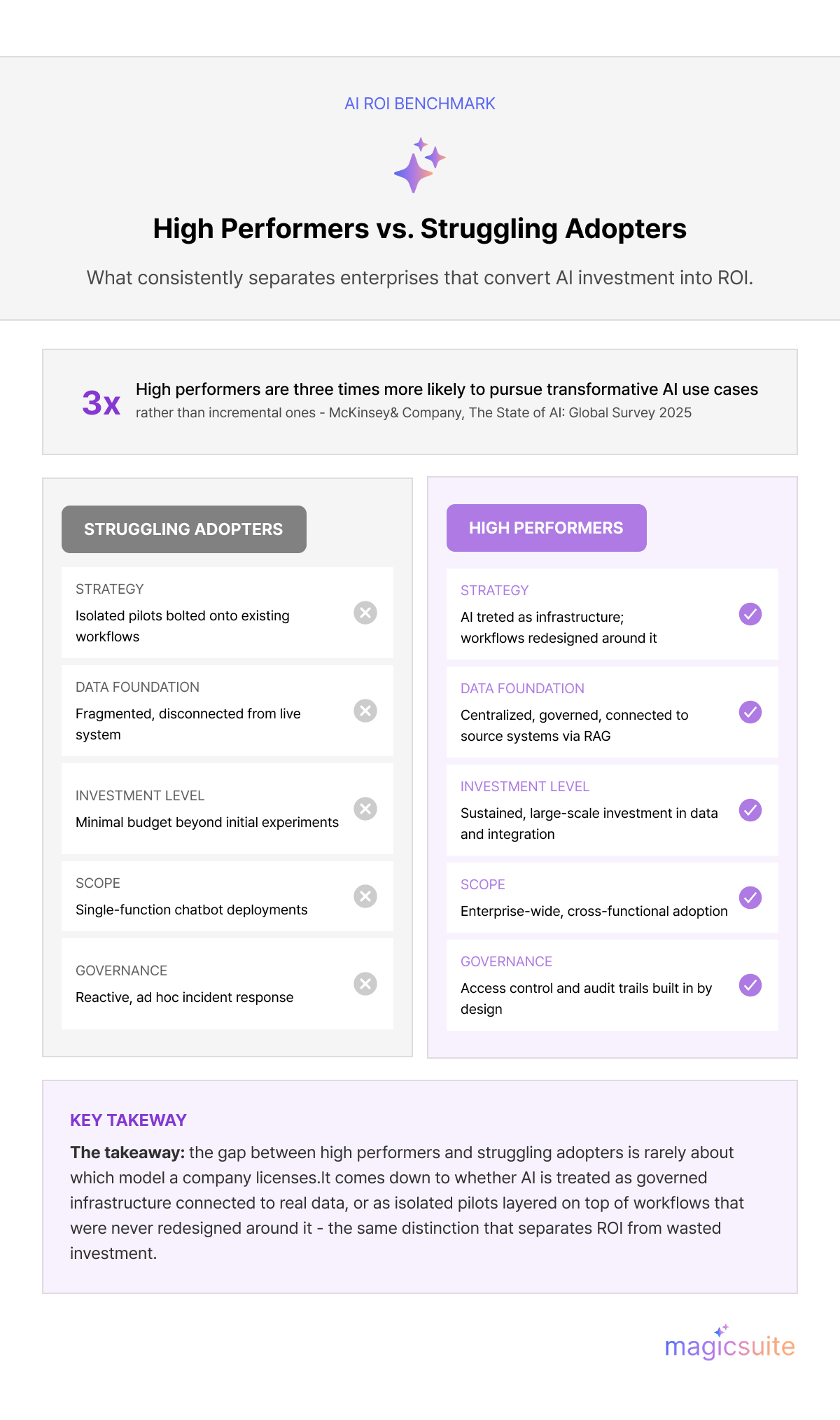
The research is unusually consistent about what separates AI winners from the rest, and it has little to do with which model a company licenses.
McKinsey's research reinforces this pattern directly: high-performing organizations are more than three times as likely to pursue transformative AI use cases rather than incremental ones, and they consistently redesign processes around AI instead of layering it onto legacy workflows. Deloitte's retail-specific findings echo the same divide - organizations moving with clear strategy, dedicated use cases, and governed data infrastructure are the ones capturing tangible personalization and efficiency gains, while the broader field remains in early exploration.
Common challenges enterprises face when scaling AI initiatives include:
Fragmented or poor-quality data that can't support reliable retrieval
Underinvestment in the integration work needed to connect AI to real operational systems
Treating AI as a single-team project rather than a cross-functional capability
No clear governance model for what data can touch which AI system
Measuring pilots on novelty rather than on defined business outcomes
Measurable Business Outcomes Retailers Are Already Seeing
Stanford HAI's 2026 AI Index reports measurable productivity gains concentrated in structured, easily monitored work: roughly 14–15% in customer support, 26% in software development, and 50% in marketing output - with smaller gains in tasks that require deeper reasoning or judgment.
MIT Sloan Management Review's coverage of enterprise AI scaling highlights Vanguard Group's own estimate of close to $500 million in AI-driven ROI, built on concrete use cases including call center support and a 25% improvement in programming productivity.
Deloitte's 2026 State of AI in the Enterprise survey found improving productivity and efficiency is the most commonly realized benefit, with 66% of organizations already reporting gains, and 40% reporting cost reduction directly tied to AI adoption.
The pattern across all of this research is the same: value shows up where the AI system is deeply connected to real business data and workflows, not where it's a generic add-on layered on top of them.
Strategic Recommendations for Enterprise Retailers
Treat the LLM as infrastructure, not a feature. Budget and govern it the way you would a core data system, not a marketing experiment.
Ground every deployment in RAG. Connect the model to live inventory, pricing, and policy data rather than relying on static training knowledge.
Separate sensitive workloads from public models. Route pricing strategy, customer PII, and supplier data through infrastructure you control.
Invest in data quality before scale. Fragmented data is the single most common reason pilots stall before reaching production.
Measure specific outcomes, not adoption. Track resolution time, conversion impact, cost per interaction, and revenue influence - not just usage counts.
Build cross-functional ownership. The retailers pulling ahead assign clear accountability across IT, operations, and customer experience rather than isolating AI in one team.
Conclusion
The gap between enterprises that talk about AI and enterprises that profit from it is no longer about who has access to the most capable model - nearly everyone does. It's about who controls their data, grounds their AI in what's actually true about their business, and treats deployment as an infrastructure decision rather than a chatbot experiment. For enterprise retailers, where pricing accuracy, inventory truth, and customer trust are the business, a generic AI tool will always hit a ceiling that a properly governed, RAG-grounded enterprise LLM does not. The retailers separating themselves over the next several years won't be the ones that adopted AI first - they'll be the ones that owned it.
Enterprise Retail AI
Build retail AI around your data, your rules, and your customers.
MagicSuite helps enterprise retailers connect AI to live product catalogs, pricing, inventory, policies, and proprietary knowledge through governed RAG architecture—delivering more accurate answers, stronger data control, and measurable business outcomes.
A generic AI chatbot operates on a shared model without a persistent connection to a retailer’s proprietary systems. An enterprise LLM is deployed within governed infrastructure and grounded through RAG in live catalog, inventory, pricing, policy, and operational data.
Retail information changes continuously. RAG retrieves current inventory, prices, promotions, return rules, and product details when a query is made, reducing the risk that the model will answer from outdated training data.
Initial infrastructure and integration costs may be higher. However, the business calculation should also include failed pilots, inaccurate customer-facing answers, compliance risk, data exposure, and the long-term cost of systems that cannot scale across enterprise workflows.
Not necessarily. Many enterprises use a hybrid architecture. General, low-sensitivity tasks can remain on public models, while pricing strategy, customer PII, supplier contracts, loyalty data, and proprietary operations are routed through private, governed infrastructure.
Fragmented and poorly governed data is one of the most common causes. Other barriers include limited integration with operational systems, unclear ownership, weak governance, insufficient long-term funding, and workflows that were never redesigned around AI.
Retailers should track business-linked metrics such as resolution time, cost per customer interaction, conversion lift, revenue influence, employee productivity, return-handling accuracy, and reductions in escalations—not usage volume alone.
Hanna is an industry trend analyst dedicated to tracking the latest advancements and shifts in the market. With a strong background in research and forecasting, she identifies key patterns and emerging opportunities that drive business growth. Hanna’s work helps organizations stay ahead of the curve by providing data-driven insights into evolving industry landscapes.