

CMOs put 15.3% of budgets into AI but only 30% are ready to scale it. McKinsey confirms 6% win.

Marketing leaders have never moved this fast. In two budget cycles, generative AI in marketing went from a small test to a major budget line, with CMOs now putting more than 15% of budgets toward it. But spending is growing far faster than the systems and people needed to use it. Research on enterprise AI from Gartner, McKinsey, and MIT points to the same pattern: companies are buying AI tools faster than they build the capacity to use them. This is the CMO's AI paradox, and it matters for next year's budget planning.
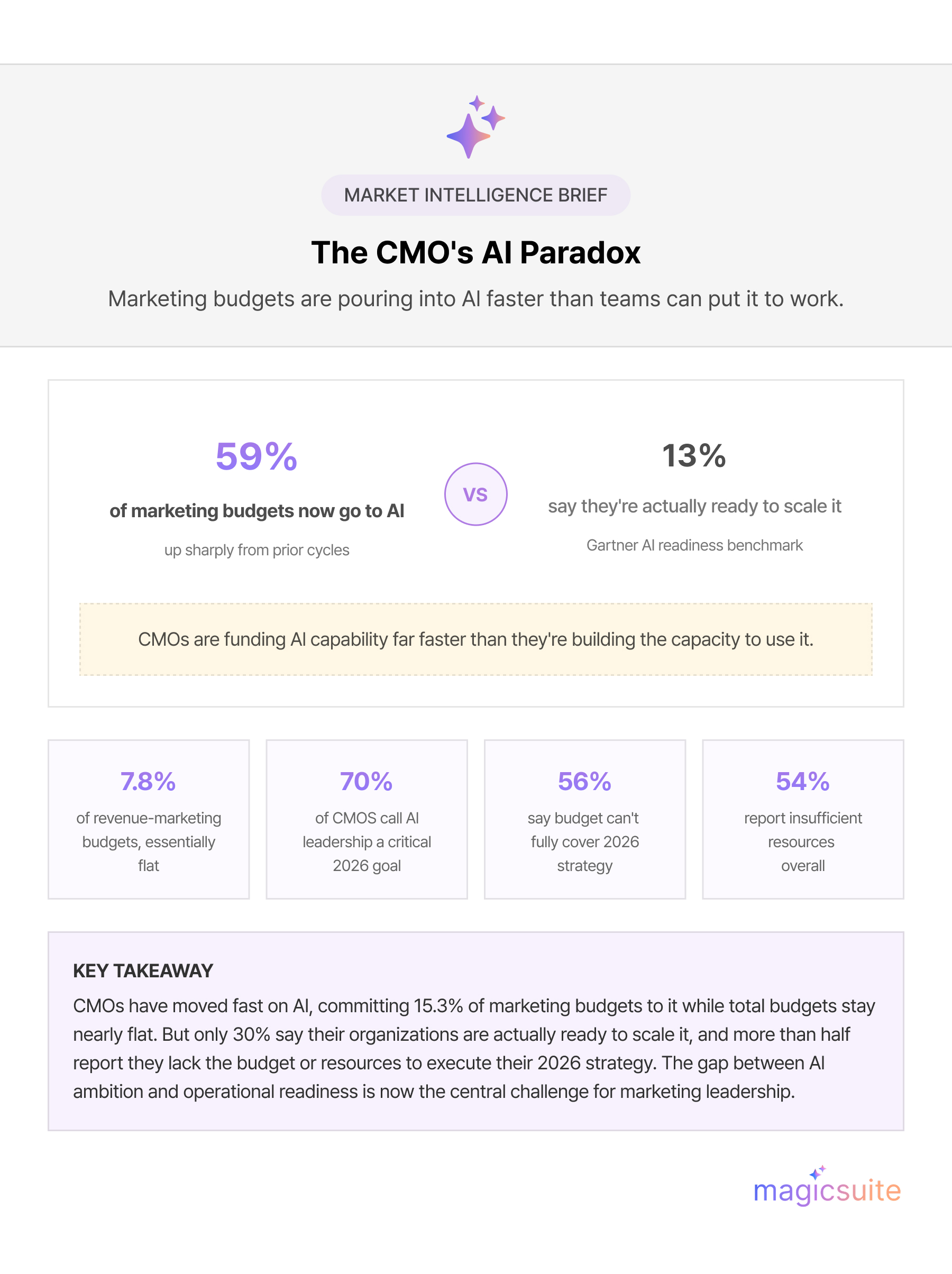
The numbers show it clearly. Gartner's 2026 CMO Spend Survey, based on 401 CMOs and marketing leaders across North America, the UK, and Europe, found AI takes up an average of 15.3% of marketing budgets, and 70% see becoming an AI leader as a critical 2026 goal. Yet total marketing budgets have barely moved, rising only to 7.8% of revenue from 7.7% the year before.
That gap tells the real story behind AI marketing investment. CMOs are not getting new money; they are pulling it from media spending, staff, or old marketing tools. Gartner found that 56% of CMOs say their teams lack the budget to carry out their 2026 strategy, and 54% say they lack the resources. AI is funded through internal cuts, not fresh investment.
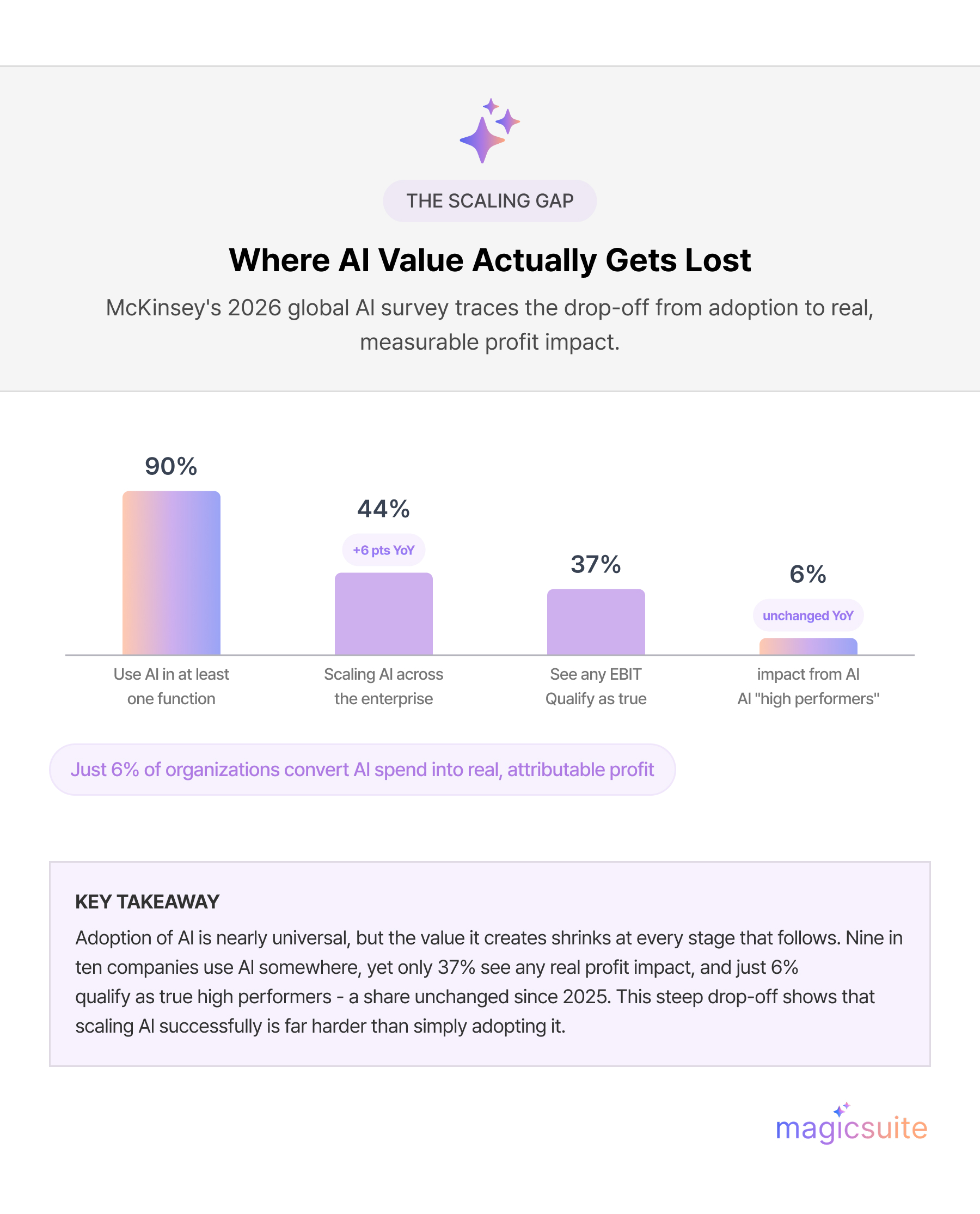
This spending has not led to matching results. McKinsey's 2026 State of AI survey, fielded May to June 2026 among 1,719 people across 97 countries, found that nearly nine in ten companies now use AI somewhere in the business, and 44% say AI is scaling across the whole company, up from 38% the year before. Yet only 37% say AI has made any real difference to profit, about the same as last year, and just 6% count as true "high performers," a share unchanged since 2025.
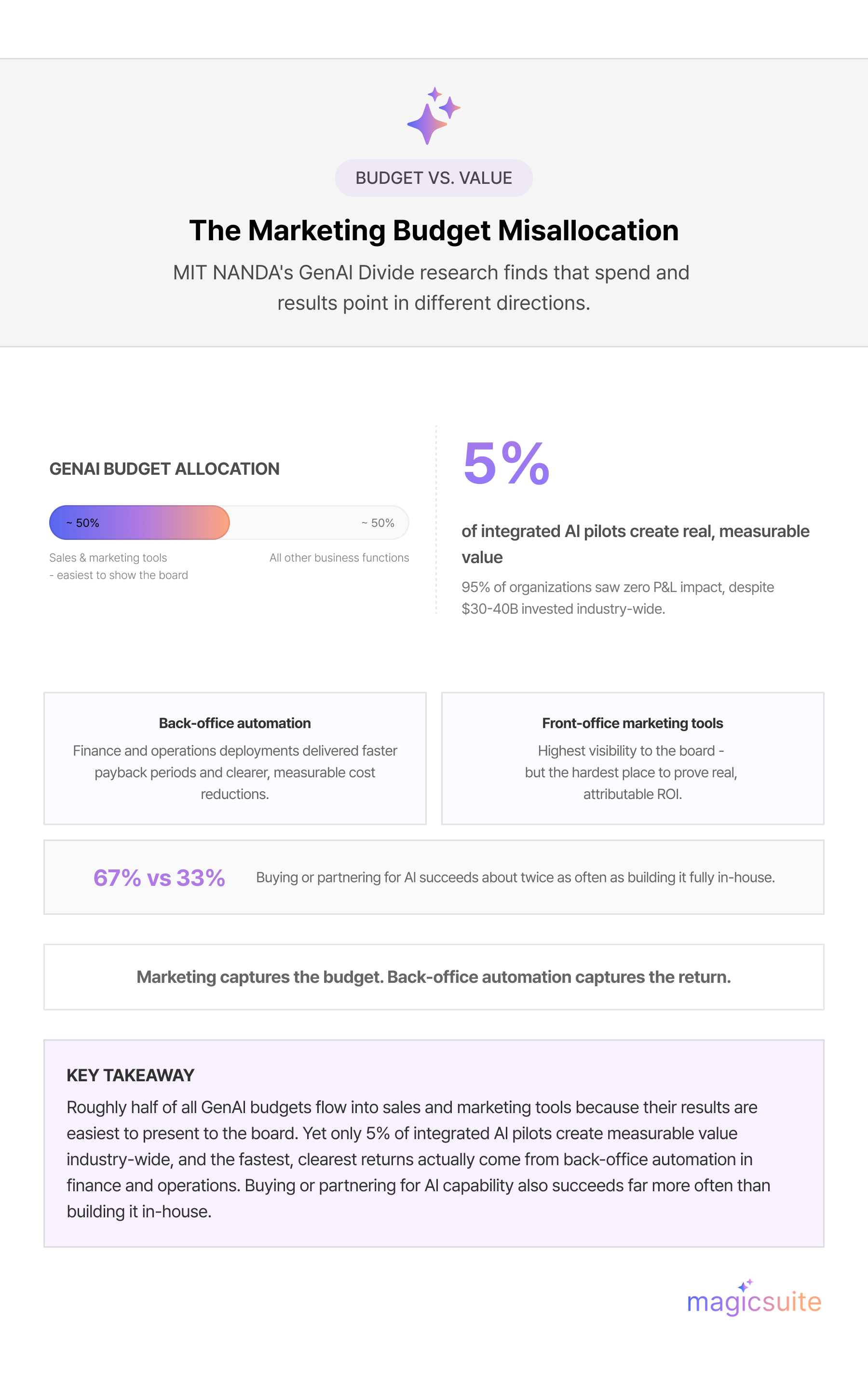
MIT NANDA's GenAI Divide: State of AI in Business 2025 report sharpens the picture, based on 300-plus public AI projects, 52 company interviews, and 153 leader surveys. Even with $30 billion to $40 billion spent on enterprise GenAI, 95% of companies got no real return, and only 5% of integrated pilots created value. The detail that matters most for marketing leaders: roughly half of all GenAI budgets go toward sales and marketing tools, mainly because results are easier to show the board. But the biggest, fastest cost savings came from back office automation, a clear sign that AI marketing investment often chases visibility over value.
Marketing feels this gap most for two reasons: results are hard to measure, and teams are not ready. AI adoption in marketing has outpaced almost every function, raising the pressure on both problems.
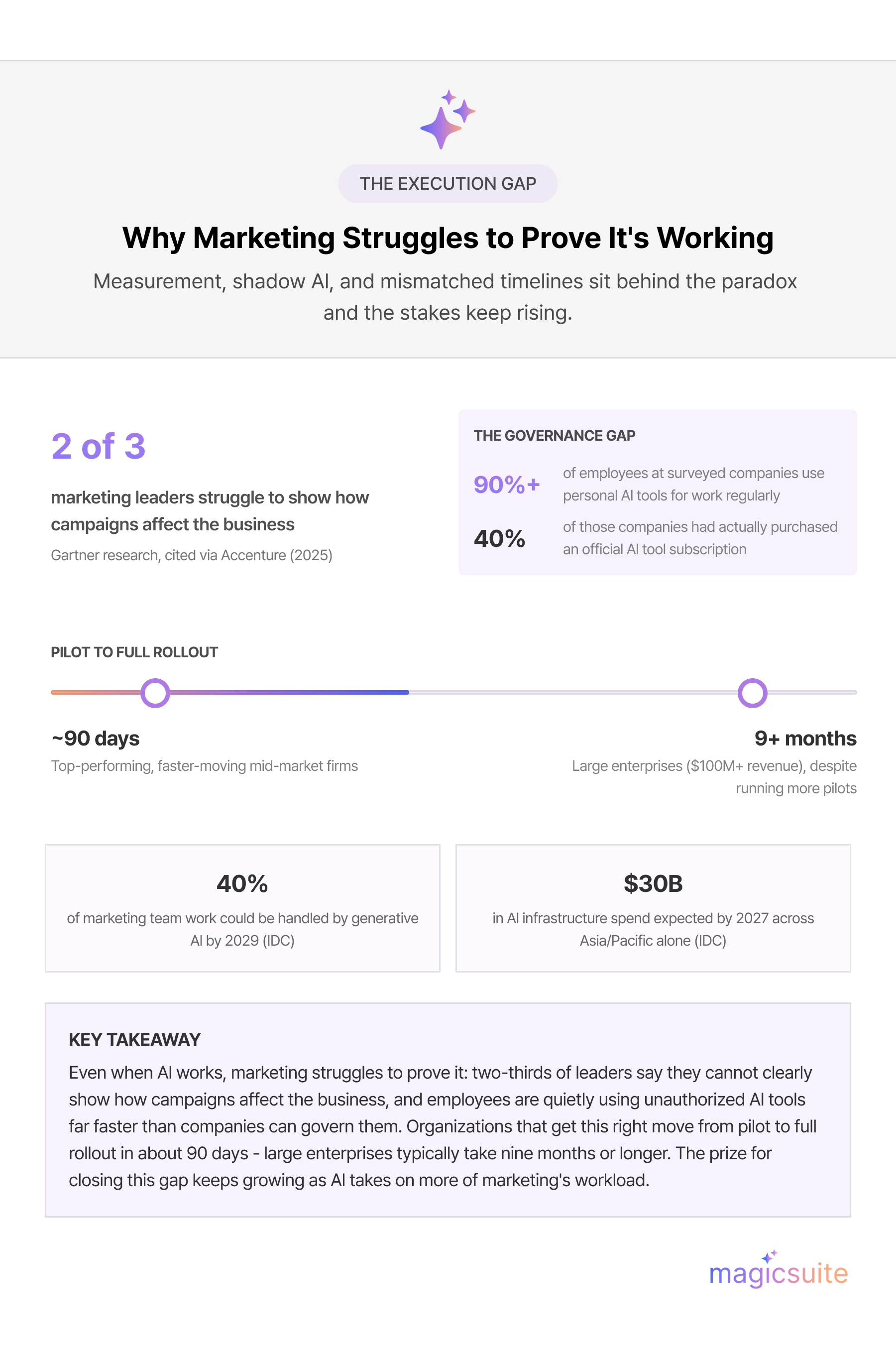
Proving AI marketing ROI has always been harder than proving something like supply chain automation, since results get mixed up with branding, timing, and channel effects, a problem AI has made worse. Gartner research, shared in Accenture's own announcement about marketing measurement, found that two out of three marketing leaders struggle to show how their campaigns affect the business. If a CMO already struggles to prove normal marketing spend, proving a new AI marketing automation tool is harder still, which is why AI budgets keep growing while proof of payoff stays thin.
Most companies are simply not ready. Gartner found that while 70% of CMOs see becoming an AI leader as a critical 2026 goal, that same 70% admit their internal marketing processes are not mature enough to scale AI. Only 30% say they have strong AI readiness. This gap between ambition and maturity explains the paradox: budgets get approved from urgency, while work such as data systems, governance, and workflow redesign lags behind.
This paradox is not universal. A small group of companies turn AI marketing investment into real advantage, a pattern that repeats across every major study.
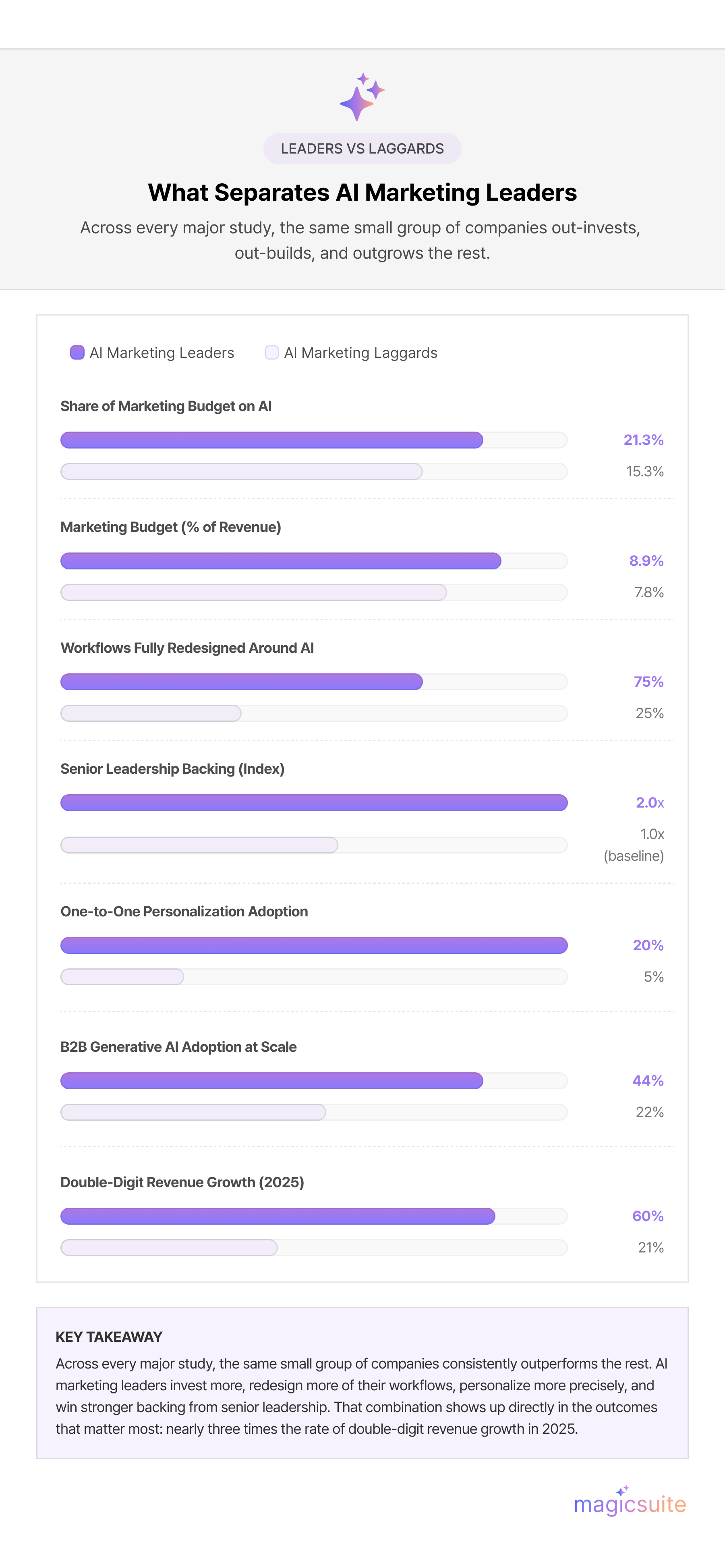
Gartner found that AI-ready marketing teams put 21.3% of budgets into AI, above the 15.3% average, and run bigger budgets (8.9% of revenue versus 7.8%). McKinsey's 2026 data shows a similar split among AI "high performers": nearly three out of four have fully redesigned their workflows around AI, versus one in four others, and are twice as likely to have strong senior leadership backing. McKinsey's 2026 Global B2B Pulse Survey, of almost 4,000 B2B decision makers across 13 countries adds a revenue angle: leaders were four times more likely to use one to one personalization (20% versus 5%), twice as likely to have adopted generative AI (44% versus 22%), more likely to put sales in charge of account based marketing, and nearly three times more likely to post double digit revenue growth in 2025 than laggards: 60% versus 21%.
Sources: Gartner 2026 CMO Spend Survey; McKinsey State of AI 2026; McKinsey 2026 Global B2B Pulse Survey.
A mix of technical and organizational factors decides which side companies land on.
Even well-intentioned companies hit the same problems trying to scale past a small pilot.
Closing this gap is not about spending more, but spending smarter. Companies closing it tend to follow the same steps: organize data before rolling out any new tool, redesign the workflow a project sits inside instead of automating one step, and lean on trusted vendors and partners instead of building everything themselves for customer facing work.
They also attach a clear revenue or efficiency goal to every AI marketing strategy project before it leaves the test phase. None of this means giving up on big goals; it means putting operational readiness ahead of ambition, exactly what Gartner's most mature CMOs already do.
The CMO's AI paradox does not mean AI marketing transformation is hype. It means the industry is shifting from buying technology to building the skill to use it well. IDC estimates that generative AI could handle more than 40% of marketing team work by 2029, and its research on Asia Pacific alone expects regional companies to spend more than $30 billion by 2027 on the AI systems needed for personalized customer experience.
Those numbers point to real upside, but the companies that capture it will not be the ones spending most today. They will be the ones pairing spending with clean data, redesigned workflows, and clear leadership accountability. For CMOs, the real test ahead is not how much money goes toward AI, but whether marketing has built the structure to turn spending into real, measurable value.
Ready to move beyond the AI readiness gap?
CMOs are spending 15.3% of their budgets on AI. Only 30% have the infrastructure to make it work. The gap isn't a budget problem. It's a readiness problem. MagicSuite helps you close that gap: clean data pipelines, redesigned workflows, and AI-powered marketing built to scale from day one, not stuck in pilot mode.

Joseph is a Technical Communications Specialist responsible for translating complex technical concepts into clear, engaging, and accessible content for diverse audiences. He collaborates closely with technical teams, product experts, and stakeholders to develop documentation, reports, knowledge resources, and communication materials that support business objectives and enhance user understanding.