How Hybrid RAG Is Transforming Enterprise Knowledge Search
July 23, 2026
8
mins
Vector search fails on SKUs and codes - Hybrid RAG closes the gap McKinsey traces to retrieval.
Key Takeaways
01Enterprise AI adoption is widespread, but measurable value remains concentrated
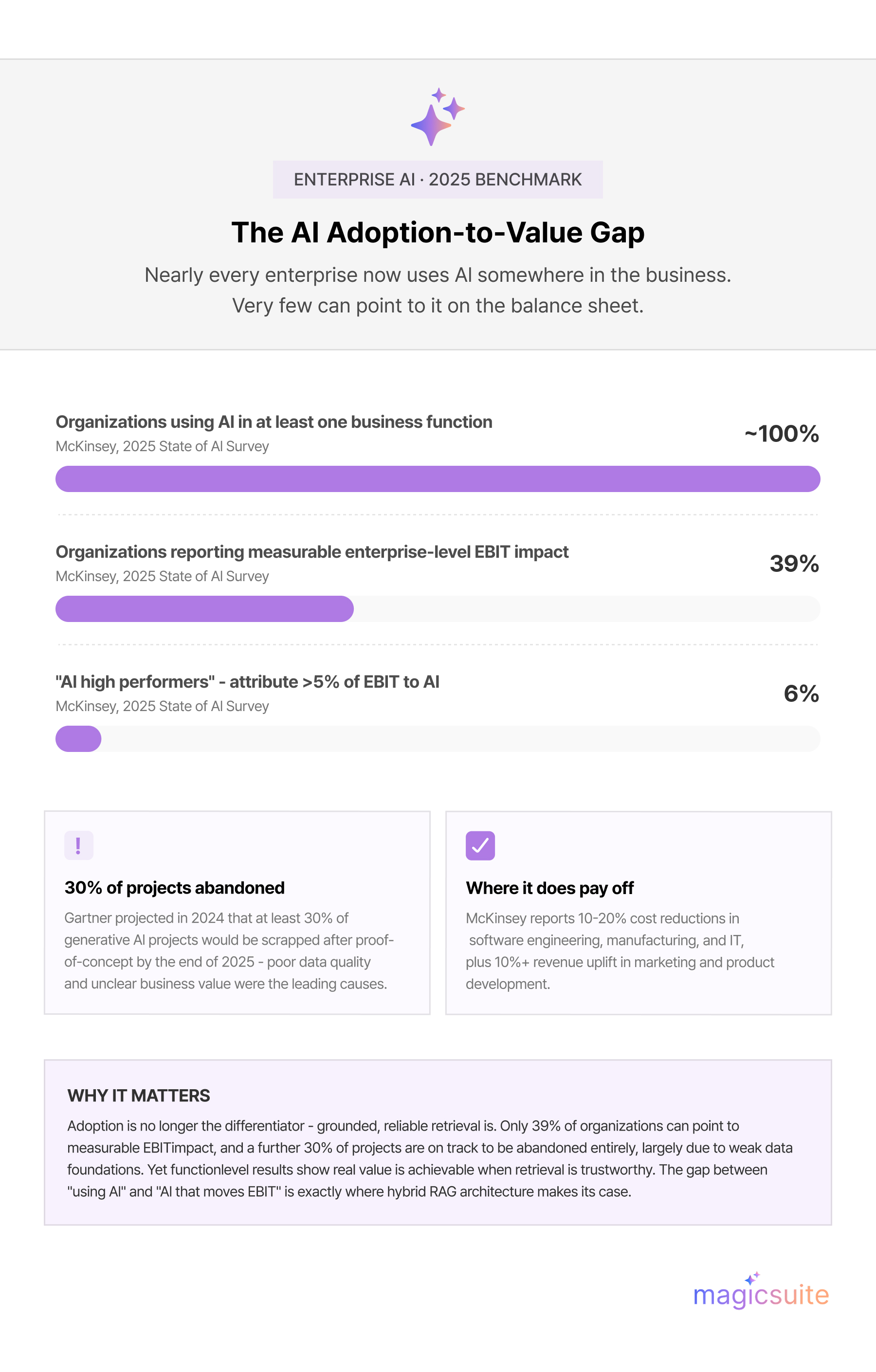
— only about 39% of organizations report enterprise-level EBIT impact, while just 6% qualify as AI high performers.
02Neither vector search nor keyword search is sufficient alone
— vector retrieval can miss exact identifiers, while keyword search often fails to understand semantic intent.
03Hybrid RAG closes the retrieval gap
— combining dense vector search with keyword-based retrieval improves coverage across product codes, technical language, proper nouns, and conceptual queries.
04Enterprise retrieval is moving toward richer hybrid architectures
— Gartner projects that 40% of enterprises will adopt GraphRAG-style techniques by 2029 to strengthen factual accuracy and multi-step reasoning.
05Retrieval architecture alone does not guarantee ROI
— organizations capturing durable value pair Hybrid RAG with workflow redesign, governance, measurable KPIs, and senior leadership ownership.
Introduction
Generative AI has crossed the adoption threshold inside the enterprise. What it hasn't crossed, for most organizations, is the value threshold. Search remains the quiet bottleneck behind that gap: large language models are only as reliable as the information they retrieve, and enterprise knowledge is messy - scattered across product codes, legal clauses, support tickets, and free-form documentation that neither pure semantic search nor pure keyword search handles well alone. Hybrid RAG, the fusion of dense vector retrieval with traditional keyword-based (sparse) search, has emerged as the architecture enterprises are converging on to solve this. This article examines what the latest research from McKinsey, Gartner, Deloitte, and independent benchmark studies says about enterprise RAG performance, why hybrid architectures are outperforming single-method retrieval, and what separates organizations capturing real ROI from those still stuck running pilots.
The Widening Gap Between AI Adoption and AI Value
Generative AI adoption is no longer the story. McKinsey's 2025 State of AI survey, fielded across nearly 2,000 organizations in 105 countries, found that the overwhelming majority of enterprises now use AI in at least one business function. The harder number is what happens after adoption: only about 39% of organizations report any measurable enterprise-level EBIT impact, and just 6% - a cohort of roughly 109 companies McKinsey calls "AI high performers" - attribute more than 5% of EBIT to AI. That divide is not primarily a model-quality problem.
Gartner projected in 2024 that at least 30% of generative AI projects would be abandoned after proof of concept by the end of 2025, citing poor data quality, inadequate risk controls, escalating costs, and unclear business value as the leading causes.
Function-level results tell a more encouraging story than enterprise-wide averages: McKinsey reports 10–20% cost reductions in software engineering, manufacturing, and IT, and revenue uplift above 10% in marketing and product development.
The common thread across underperforming deployments is retrieval quality - generative systems that cannot reliably find and ground answers in the right internal data.
This is precisely where enterprise knowledge search becomes a strategic, not merely technical, decision.
What Is Hybrid RAG, and Why Pure Vector Search Falls Short
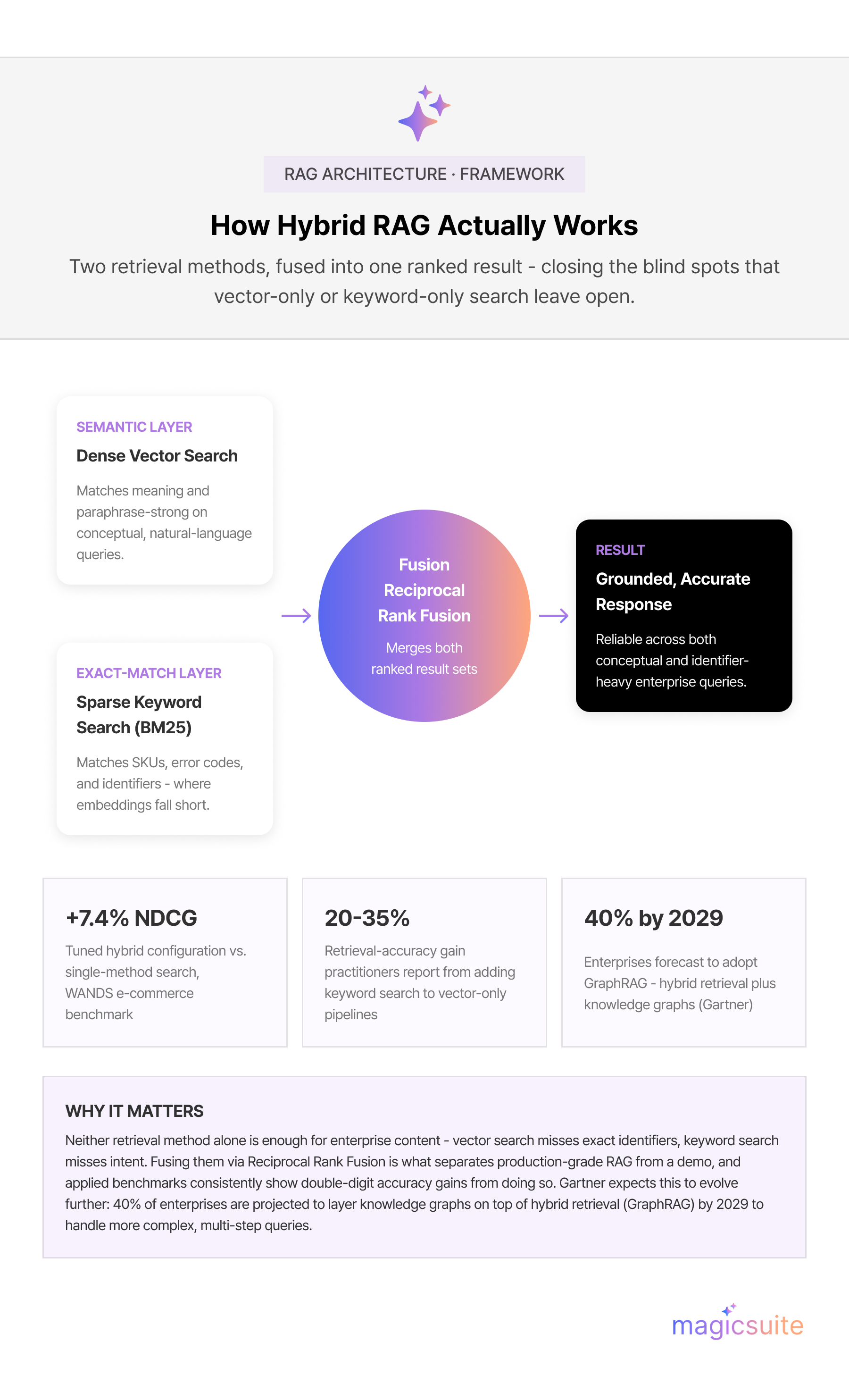
Retrieval-Augmented Generation (RAG) grounds a language model's output in retrieved, verified source content rather than relying solely on what the model memorized during training. Traditional RAG implementations lean on dense vector embeddings, which excel at matching meaning and paraphrase - connecting "how do I reset my credentials" with a document titled "password recovery process." But vector search has a well-documented blind spot: it struggles with exact-match content such as SKUs, error codes, regulatory clause numbers, and rare technical terms, because these tokens are underrepresented in the semantic space embeddings were trained on.
Hybrid RAG addresses this by running dense vector search and sparse keyword search (commonly BM25) in parallel, then fusing the results - typically through Reciprocal Rank Fusion - into a single ranked output. Microsoft's own Azure AI Search documentation notes that scenarios involving product codes, specialized jargon, and precise identifiers consistently perform better under keyword-aware retrieval than under vector search alone, which is exactly why combining the two produces more reliable results across query types.
Where the Retrieval Gains Actually Show Up
Applied retrieval benchmarks back this up directionally, though these come from vendor and practitioner testing rather than consulting-firm research, and should be read as illustrative rather than definitive:
A tuned hybrid configuration tested on the public WANDS e-commerce benchmark reportedly achieved meaningfully higher ranking quality (NDCG) than either BM25 or dense vector search used alone.
Vendor-reported testing on financial-document retrieval found a hybrid-plus-reranking pipeline substantially outperforming dense-only retrieval on Recall@5 - the system's ability to surface the correct document in its top results.
Practitioners building productionRAG architecture commonly report retrieval-accuracy gains in the range of 20–35% simply from adding keyword search back into vector-only pipelines, though this figure comes from applied engineering write-ups rather than formal benchmark studies.
Gartner's data and analytics research extends this further, forecasting that 40% of enterprises will adopt GraphRAG - which layers knowledge graphs on top of hybrid retrieval - by 2029, specifically to improve factual accuracy and multi-step reasoning for complex enterprise queries that neither keyword nor vector search can resolve alone.
The Business Case: What the Data Shows About Knowledge Search ROI
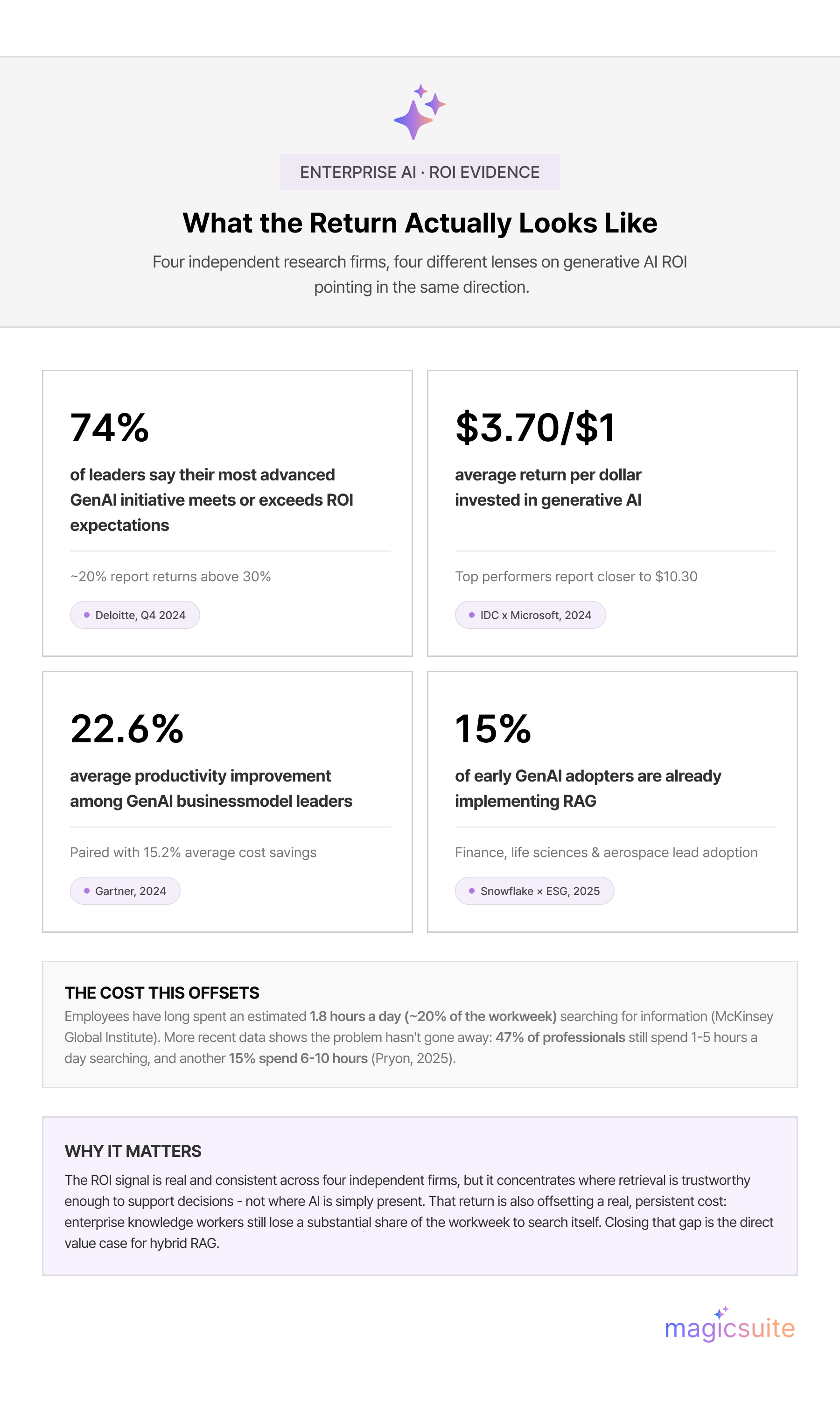
The financial argument for betterknowledge retrieval starts with a simple, persistent cost: time. The baseline figure the industry still leans on - employees spending roughly 1.8 hours a day, or about 20% of the workweek, searching for and gathering information - traces back to McKinsey Global Institute's 2012 research on knowledge work. It's a legacy benchmark rather than a fresh 2025 data point, but more recent survey data suggests the underlying problem hasn't gone away: Pryon's 2025 knowledge-work research found 47% of professionals still spend one to five hours a day searching for specific information, with another 15% spending six to ten hours. At enterprise scale, even the more conservative end of that range represents a substantial, recurring productivity drain.
AI enterprise search built on hybrid retrieval directly targets that waste, and the returns are measurable at the deployment level even where enterprise-wide EBIT impact is still catching up:
An IDC study of 4,000 business leaders, commissioned by Microsoft, puts the average return at approximately $3.70 for every dollar invested in generative AI, with top-performing organizations reporting closer to $10.30. As a vendor-sponsored study, this figure hasn't been independently externally validated, but it's directionally consistent with the performance gap other research firms describe.
Snowflake's "Radical ROI of Gen AI" report, produced with Enterprise Strategy Group (1,900 early adopters surveyed), found 71% of early generative AI adopters were already implementing RAG to ground model outputs, with finance, life sciences, and aerospace - sectors with strict audit and accuracy requirements - leading adoption.
The pattern across these findings is consistent: value concentrates where retrieval is trustworthy enough to support real decisions, not just demo-quality answers.
Why Some Enterprises Win - and Others Stall
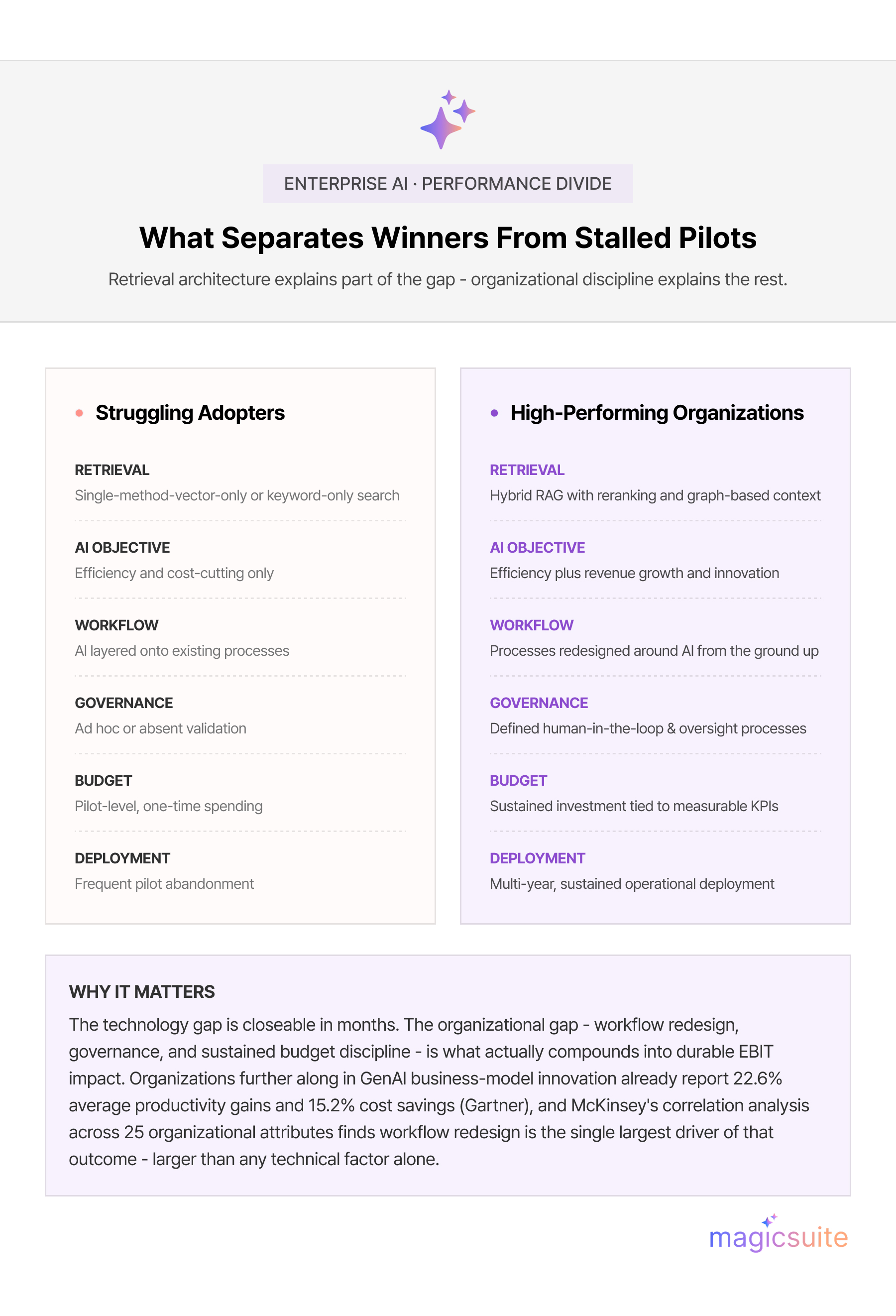
Retrieval architecture explains part of the performance gap, but not all of it. McKinsey's correlation analysis across 25 organizational attributes found that workflow redesign - rebuilding how a process works around AI rather than bolting AI onto the old process - has the single largest measurable effect on EBIT impact from generative AI. A separate Gartner survey of 822 business leaders reinforces this from a different angle: organizations further along in GenAI business model innovation reported average productivity improvements of 22.6% and cost savings of 15.2%, well ahead of organizations still confined to early piloting.
Enterprise AI success, in other words, is a combination of technical and organizational choices:
Technical factors: retrieval architecture (hybrid vs. single-method), data quality and freshness, chunking and indexing strategy, and reranking discipline.
Organizational factors: senior leadership ownership, dedicated adoption teams, clearly defined KPIs tied to retrieval accuracy and business outcomes, and budget commitment well beyond pilot-stage spending.
Governance factors: human-in-the-loop validation for high-stakes queries and centralized oversight - McKinsey found high performers are markedly more likely to have formal validation processes in place than the rest of the market.
Enterprise Use Cases: Where Hybrid RAG Delivers Measurable Impact
Hybrid RAG's advantages show up most clearly in domains where both precision and semantic understanding matter simultaneously:
Customer support and CX: Grounding responses in current policy documents and product manuals so agents (human or AI) resolve issues on the first try rather than escalating, directly addressing the satisfaction gains McKinsey links to AI-enabled service functions.
Financial services and compliance: Retrieving exact regulatory clauses alongside conceptually related guidance, where hybrid-plus-reranking pipelines have shown meaningfully stronger Recall@5 than dense-only approaches in benchmark testing.
Legal and life sciences research: Combining exact citation lookup with semantic case or literature search, sectors that Snowflake-backed research identifies among the earliest and heaviest RAG adopters due to audit and accuracy requirements.
Common Challenges in Scaling Hybrid RAG
Even well-designed hybrid systems run into predictable friction points as they scale beyond a single use case:
Fusion complexity: Vector and keyword search scores come from different distributions, so naively merging results without proper rank fusion (such as Reciprocal Rank Fusion) can degrade rather than improve relevance.
Data readiness: Gartner's research consistently ties abandoned generative AI projects back to poor underlying data quality - a hybrid retrieval layer cannot compensate for source content that is outdated, duplicated, or ungoverned.
Query-type imbalance: Static 50/50 weighting between keyword and vector results underperforms; production systems generally need query classification to route identifier-heavy queries toward keyword weighting and conceptual queries toward vector weighting.
Measurement gaps: Many organizations track model-level metrics but not retrieval-level ones, making it difficult to isolate whether weak outputs stem from generation or from the underlying search layer.
A Practical Framework for Implementation
Enterprises moving from pilot to scaled deployment tend to converge on a similar sequence:
Audit retrieval performance before touching the model. Most quality problems in enterprise generative AI trace back to retrieval, not generation.
Adopt hybrid retrieval as the default, reserving single-method search only for narrowly scoped, low-complexity use cases.
Redesign the surrounding workflow, not just the interface - McKinsey's data shows this single factor has the largest measurable effect on EBIT impact.
Establish human-in-the-loop governance for any high-stakes or customer-facing use case before scaling beyond pilot.
Fund it like a program, not a project - high performers commit sustained budget rather than one-time pilot spend, and track KPIs tied to retrieval accuracy alongside business outcomes.
Conclusion
The enterprise AI conversation is shifting from "are we using it?" to "is it actually working?" - and the answer increasingly depends on what happens underneath the model, not inside it.AI knowledge management built on hybrid retrieval gives enterprises a defensible way to close the gap between broad AI adoption and the narrow slice of organizations currently capturing measurable EBIT impact. It won't substitute for workflow redesign, governance, or leadership commitment - the organizational factors that McKinsey, Gartner, and Deloitte all identify as decisive. But as a technical foundation, hybrid RAG addresses the specific failure mode - ungrounded, imprecise retrieval - that quietly undermines a large share of stalled generative AI initiatives. Enterprises that treat retrieval architecture as a first-order strategic decision, not an implementation detail, are the ones most likely to move from pilot to durable, compounding value.
Enterprise Hybrid RAG
Turn enterprise knowledge into accurate, grounded AI answers.
MagicSuite helps enterprises combine semantic vector retrieval with precise keyword search, enabling more reliable knowledge discovery, stronger answer accuracy, and scalable Retrieval-Augmented Generation across complex business workflows.
Production-ready AI search and knowledge retrieval
Frequently Asked Questions6 questions
Traditional RAG often relies primarily on dense vector search. Hybrid RAG combines vector retrieval with sparse keyword search, commonly BM25, so the system can capture semantic meaning and exact-match precision at the same time.
Dense vector search is optimized for semantic similarity, but it can miss exact-match information such as product codes, error IDs, regulatory clause numbers, rare technical terms, and proper nouns. Keyword retrieval is often more reliable for those query types.
Running vector and keyword retrieval in parallel adds some query-stage overhead, but the increase is generally small compared with the relevance gains. Production systems can also limit latency by retrieving a focused candidate set before reranking.
GraphRAG extends hybrid retrieval by adding knowledge-graph context. This allows a system to connect related entities, relationships, and documents when answering multi-step questions that cannot be resolved through isolated chunks alone.
Financial services, legal, life sciences, manufacturing, engineering, and customer support are strong use cases because they require both exact retrieval and semantic understanding, often under strict accuracy or audit requirements.
Enterprises should track retrieval metrics such as recall, precision, ranking quality, and query reformulation alongside business outcomes such as resolution time, cost per case, employee search time, conversion, and revenue impact.
Joseph is a Technical Communications Specialist responsible for translating complex technical concepts into clear, engaging, and accessible content for diverse audiences. He collaborates closely with technical teams, product experts, and stakeholders to develop documentation, reports, knowledge resources, and communication materials that support business objectives and enhance user understanding.