

AI spend hit $582B in 2025. Only 6% of companies profit from it. Why readiness scores are falling.

More money went into AI in 2025 than in any year before. Yet by mid-2026, many business leaders feel less prepared, not more. Accenture's Pulse of Change research, which surveyed 3,000 executives and 3,000 employees between April and June 2026, found that leaders' preparedness to handle disruption fell by seven percentage points on average. Meanwhile, 82% of those executives are increasing their AI investment.
This is the AI readiness paradox: the further a company gets with AI implementation, the less ready it feels. A pilot can hide problems. A company-wide rollout cannot.
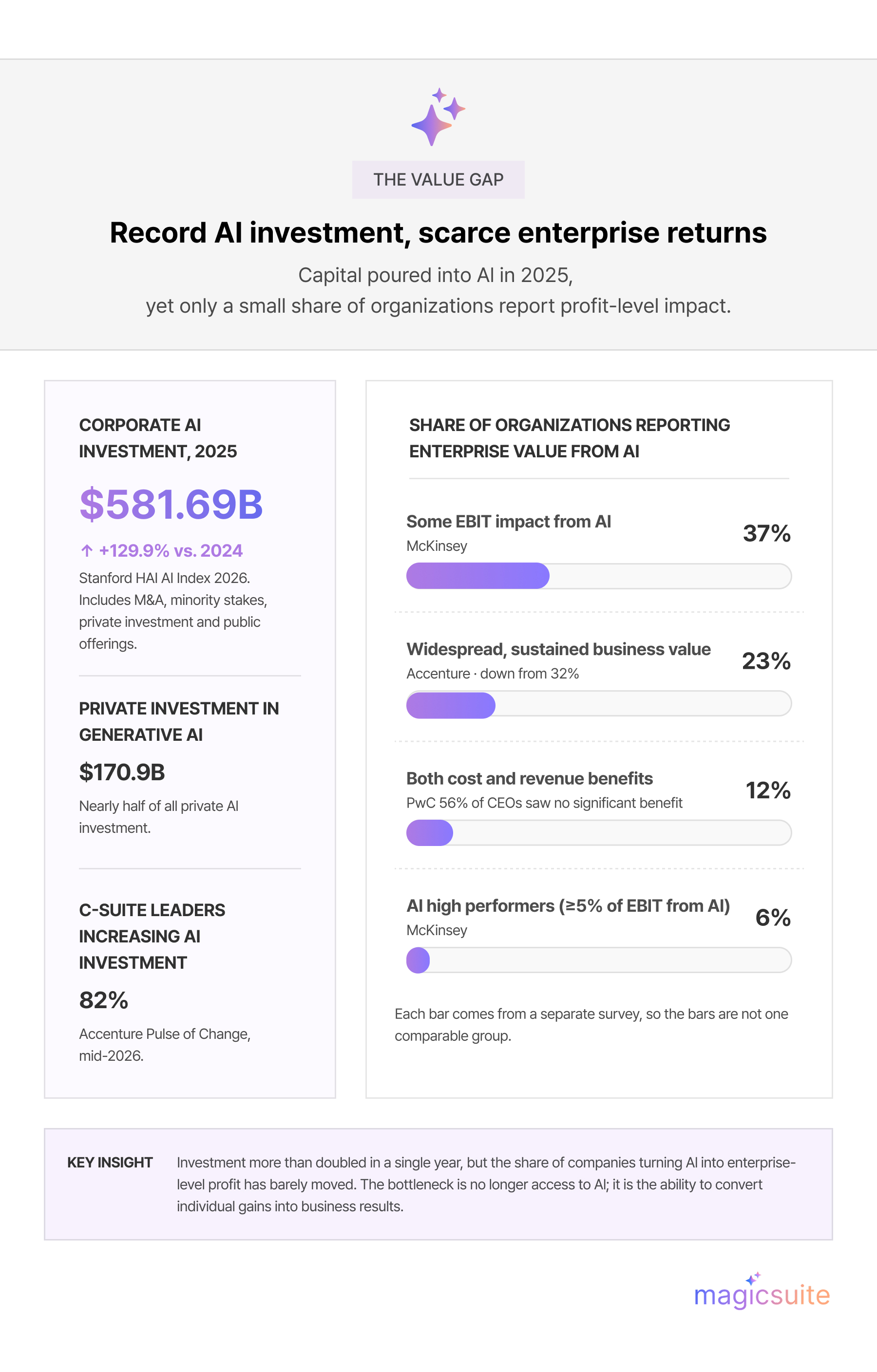
Spending is at record levels. The Stanford HAI AI Index 2026 reports that corporate investment in AI reached $581.69 billion in 2025, up 129.9%. Generative AI companies drew $170.9 billion, almost half of all private AI investment. Enterprise AI adoption is now normal: in McKinsey's 2026 State of AI survey, nearly nine in ten respondents say their organization regularly uses AI.
Profits lag behind. Only 37% of McKinsey's 1,719 respondents say AI has added any value to EBIT (earnings before interest and taxes), barely changed since 2025. Other surveys agree:
Individual gains are real. Stanford's review of productivity studies found that support agents using a conversational AI assistant solved 14–15% more issues per hour. But those wins are not yet adding up to company profit.
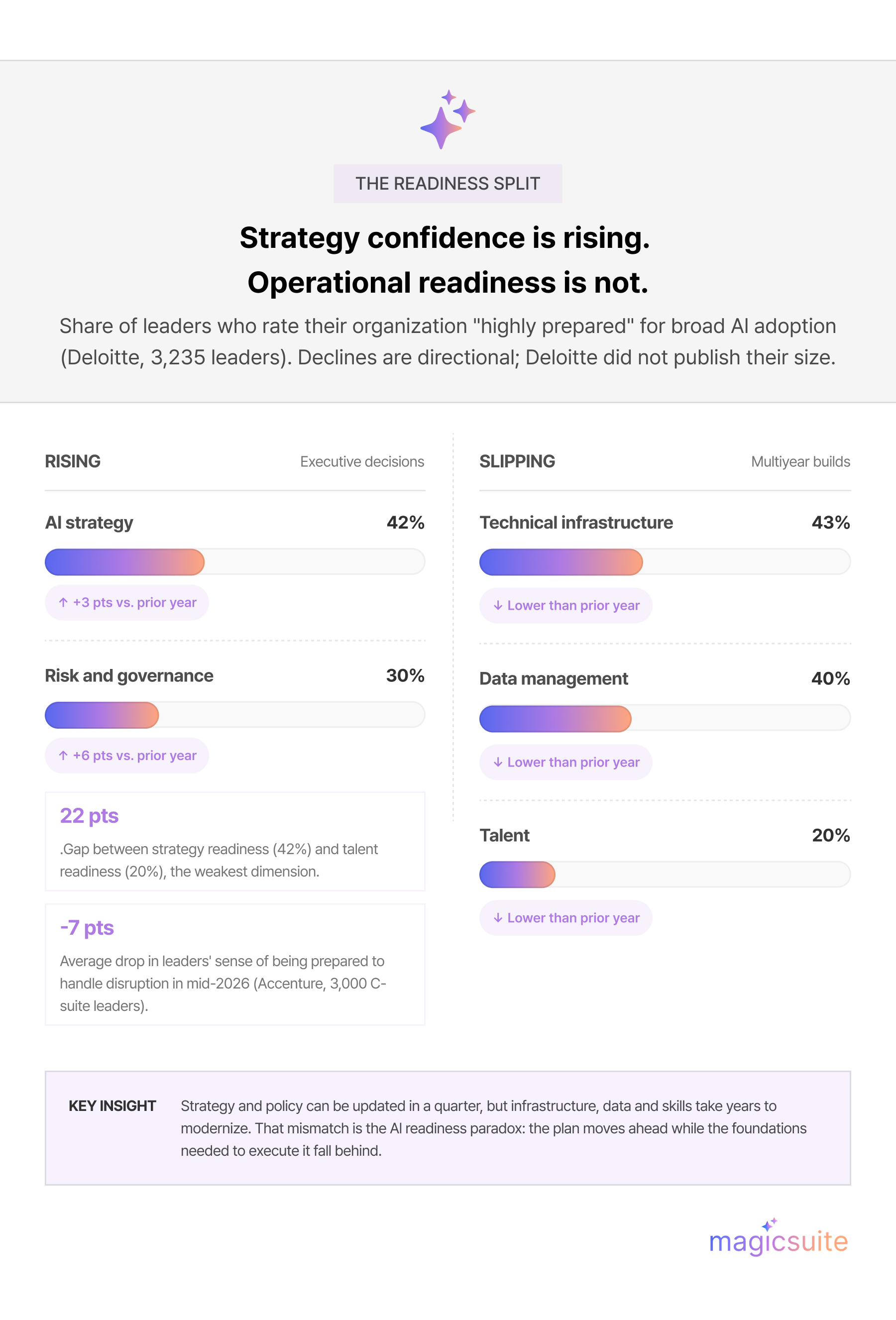
Plans move faster than foundations. Deloitte's State of AI in the Enterprise report, a survey of 3,235 leaders, found that 42% feel their AI strategy is highly prepared, up 3 points. Fewer felt highly prepared on infrastructure (43%), data (40%) and talent (20%). Strategy takes months; systems and skills take years. So an enterprise AI strategy can easily move faster than the company that has to carry it out.
The finish line keeps moving. A European bank's head of AI strategy told Deloitte that many companies built infrastructure and governance for older AI models, only to see Large Language Model (LLM) technology change what they needed. Companies had "prepared, but for a different future." Now agentic AI, AI that acts on its own, is raising the bar again: 74% of companies plan to use it within two years, but only 21% have a mature governance model for it.
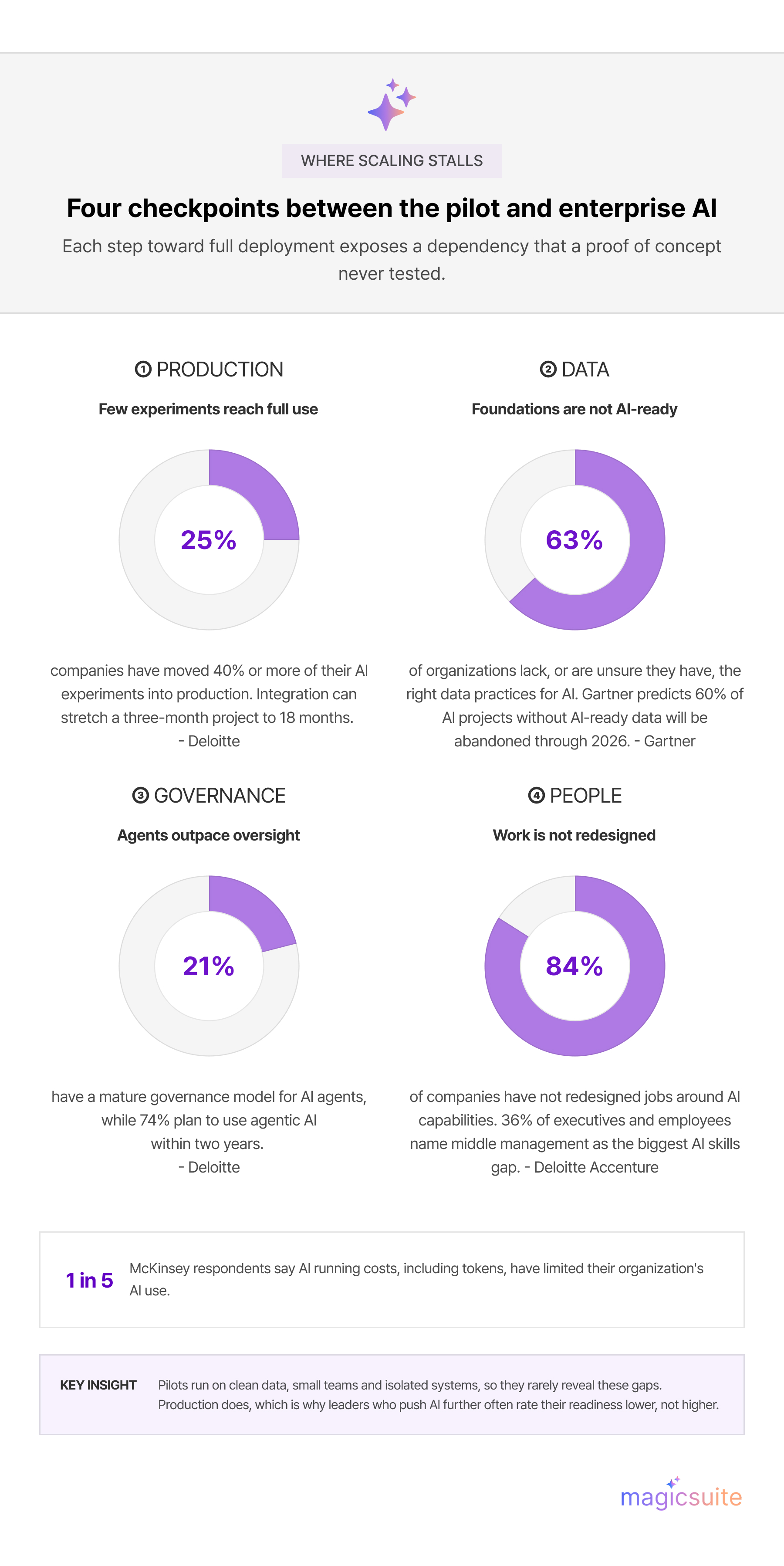
Real rollouts reveal hidden problems. Only 25% of companies have moved 40% or more of their AI experiments into production. Deloitte notes that integration can stretch a three-month project to 18 months, and about one in five McKinsey respondents say AI running costs have limited their AI use. Since these surveys are self-ratings, falling scores may partly reflect more honest self-assessment.
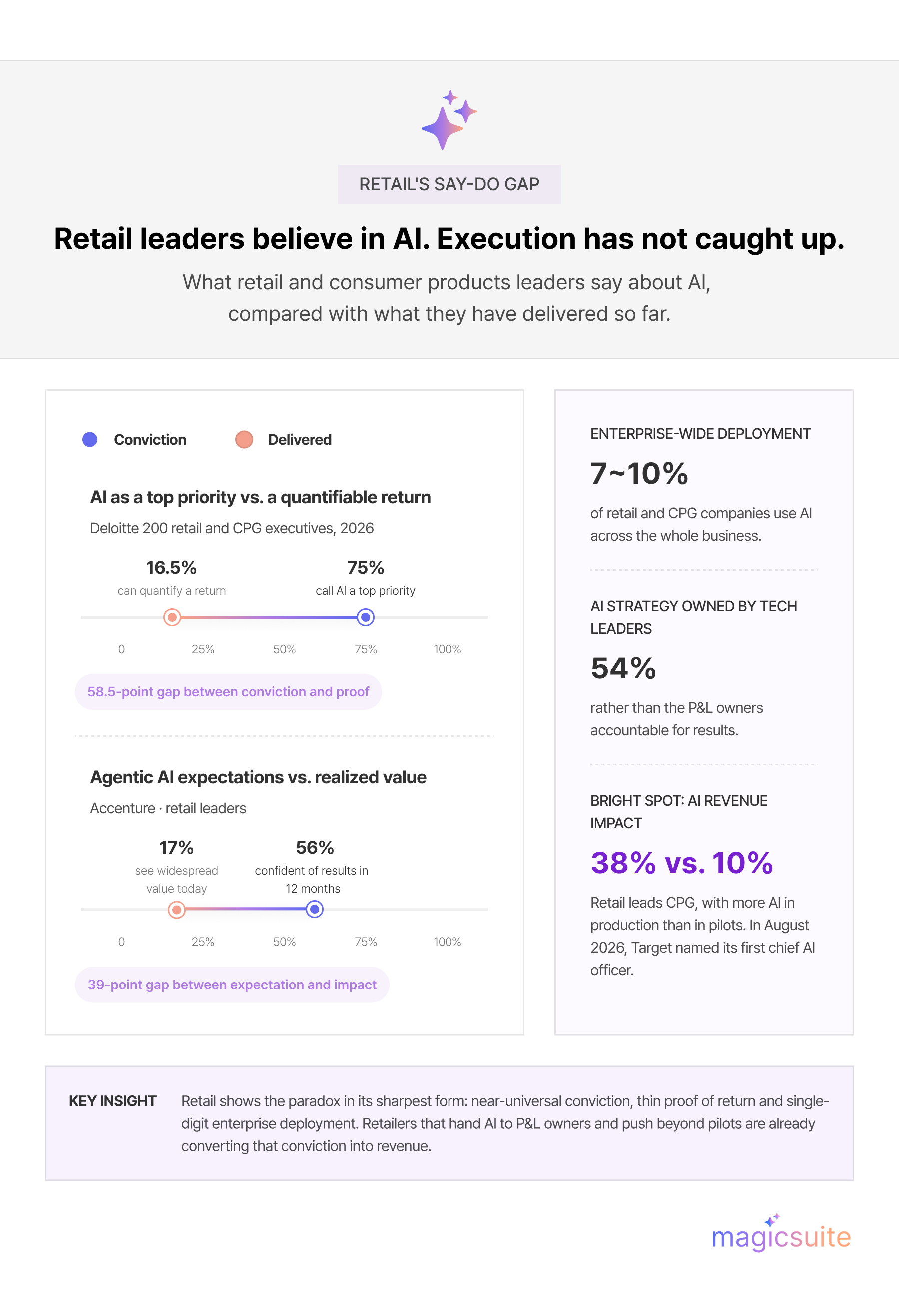
Deloitte's survey of 200 retail and consumer packaged goods (CPG) executives found strong belief in AI but weak follow-through:
Accenture data, reported in Forbes by Jill Standish, shows the same gap: 56% of retail leaders are confident agentic AI will deliver measurable results within a year, yet only 17% already see widespread value. Still, retail leads CPG on AI's revenue impact, 38% versus 10%, and in August 2026 Target named Chandhu Nair its first chief AI officer.
McKinsey's AI high performers, companies crediting AI with at least 5% of EBIT and significant impact, make up only about 6% of respondents. The biggest difference is how they treat their workflows. They see AI transformation as a chance to rebuild work, a mark of higher AI maturity.
According to McKinsey's 2026 findings, nearly three in four high performers have fundamentally redesigned their workflows, compared with about one in four other companies. High performers are also twice as likely to have senior leaders who show commitment to AI and defined processes for measuring its impact, and more than twice as likely to put over 15% of their ICT budget into AI.
PwC agrees: CEOs with strong AI foundations, such as responsible AI rules and company-wide technology, are three times more likely to report meaningful financial returns. These are correlations, not proof of cause, but the pattern is consistent.
Data comes first. Gartner found that 63% of organizations lack, or are unsure they have, the right data practices for AI, and predicted in February 2025 that through 2026, organizations will abandon 60% of AI projects without AI-ready data. It recommends adding tools such as retrieval-augmented generation (RAG), which helps Large Language Model (LLM) systems find the right company information. Deloitte adds that integration, security and monitoring turn a demo into reliable enterprise AI.
People come next. 84% of companies have not redesigned jobs around AI, and 36% of executives and employees name middle management as the biggest AI skills gap. When middle managers struggle, AI transformation stalls. Many companies also keep funding low-risk pilots instead of scaling winners.
Raising AI maturity depends more on how a company is run than on which tools it buys:
The AI readiness paradox does not mean enterprise AI is failing. It means the easy part is over. Most companies have AI tools and see workers become more productive. What is rare is an operating model that turns those gains into profit.
The Stanford AI Index 2026 notes that US productivity grew 2.7% in 2025, nearly double the prior decade's 1.4% average, and cites Erik Brynjolfsson's view that this may be an early "J-curve," with costs first and gains later, though the evidence is still mixed. The winners will be companies that rebuild workflows, ownership and data around AI, not those that keep adding tools to old habits.
Feeling less ready the deeper you invest in AI? That is not a setback. It means you have gone far enough to see your real gaps.
The data is consistent across McKinsey, Deloitte, PwC, and Accenture: nearly nine in ten companies use AI, but only 6% are turning it into real profit growth. The difference is not the technology. It is whether workflows, data, and ownership have been rebuilt around AI, or whether the tools are simply running on top of old habits.
MagicSuite is built for the companies that are serious about closing that gap. Clean data pipelines, deeply integrated workflows, AI that actually takes action inside your systems, and the governance foundations that let you scale with confidence, not just pilot with hope. Whether you are just starting to move beyond the pilot stage or looking to accelerate what is already working, MagicSuite gives your team the infrastructure to turn AI investment into outcomes that show up on the balance sheet.

Hanna is an industry trend analyst dedicated to tracking the latest advancements and shifts in the market. With a strong background in research and forecasting, she identifies key patterns and emerging opportunities that drive business growth. Hanna’s work helps organizations stay ahead of the curve by providing data-driven insights into evolving industry landscapes.