

Only 6% of firms see real AI marketing ROI - PwC links responsible AI governance to 3.5% higher revenue.

Marketing organizations have never adopted a technology this fast - and never struggled this hard to prove it's working. Generative AI now touches nearly every corner of the marketing function, from campaign ideation to customer segmentation, yet the enterprises pouring the most money into it are, on average, the ones seeing the least financial return. That paradox is not a technology problem. It is a governance problem, and the data behind it has become too large to ignore.
Across McKinsey, MIT, Gartner, Deloitte, and PwC research published between 2025 and mid-2026, a consistent pattern emerges: the marketing teams capturing measurable value from AI-powered marketing are not simply the ones using the most tools. They are the ones that paired adoption with structured AI governance - clear ownership, workflow redesign, and disciplined risk management - long before the ROI conversation started.
This article breaks down what the latest enterprise research actually shows about AI investment performance, why responsible AI in marketing is emerging as a financial differentiator rather than a compliance checkbox, and what separates the organizations turning AI spend into growth from those still waiting for a return.
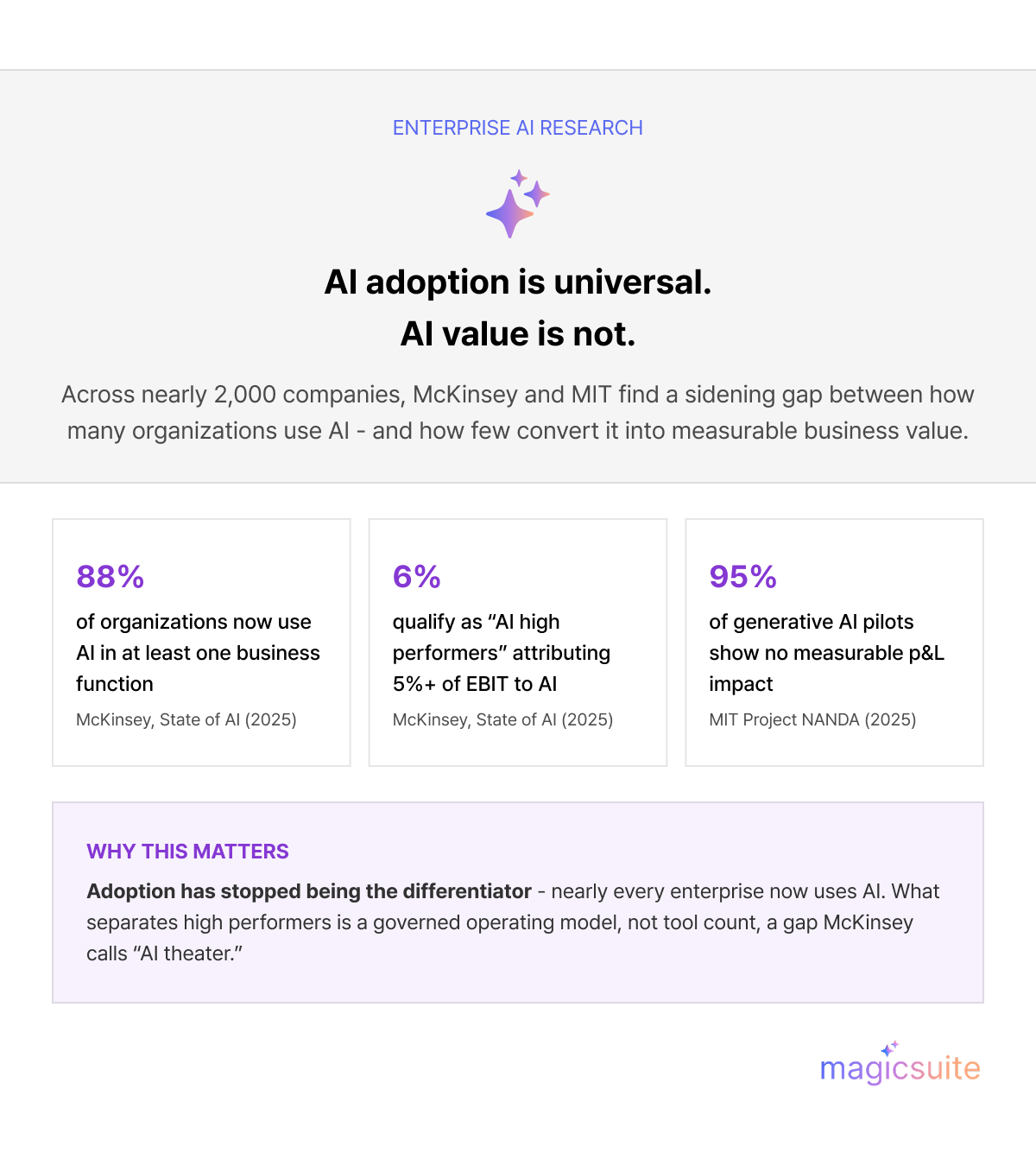
For most of 2023 and 2024, the enterprise AI conversation centered on a single question: how fast can we adopt? By 2025, that question had been answered - enterprise AI adoption is nearly universal. McKinsey's most recent global survey found that 88% of organizations now use AI in at least one business function, with generative AI use surging even faster across marketing, product development, service operations, and IT.
But adoption and value creation have turned out to be two very different metrics. Out of nearly 2,000 companies McKinsey surveyed, only about 6% qualified as "AI high performers" - organizations attributing 5% or more of EBIT to AI use and reporting genuinely significant value from it. McKinsey researchers describe the more common outcome as "AI theater": widespread usage without the operating-model changes needed to convert that usage into bottom-line results.
Marketing sits at the center of this gap. It is one of the functions where generative AI in marketing adoption has grown fastest - McKinsey has tracked marketing and sales as one of the two or three most common functions for AI use in every wave of this survey, with reported adoption in that function more than doubling during the 2023-to-2024 stretch alone - yet it is also where a separate MIT study found spend and return are most misaligned today.
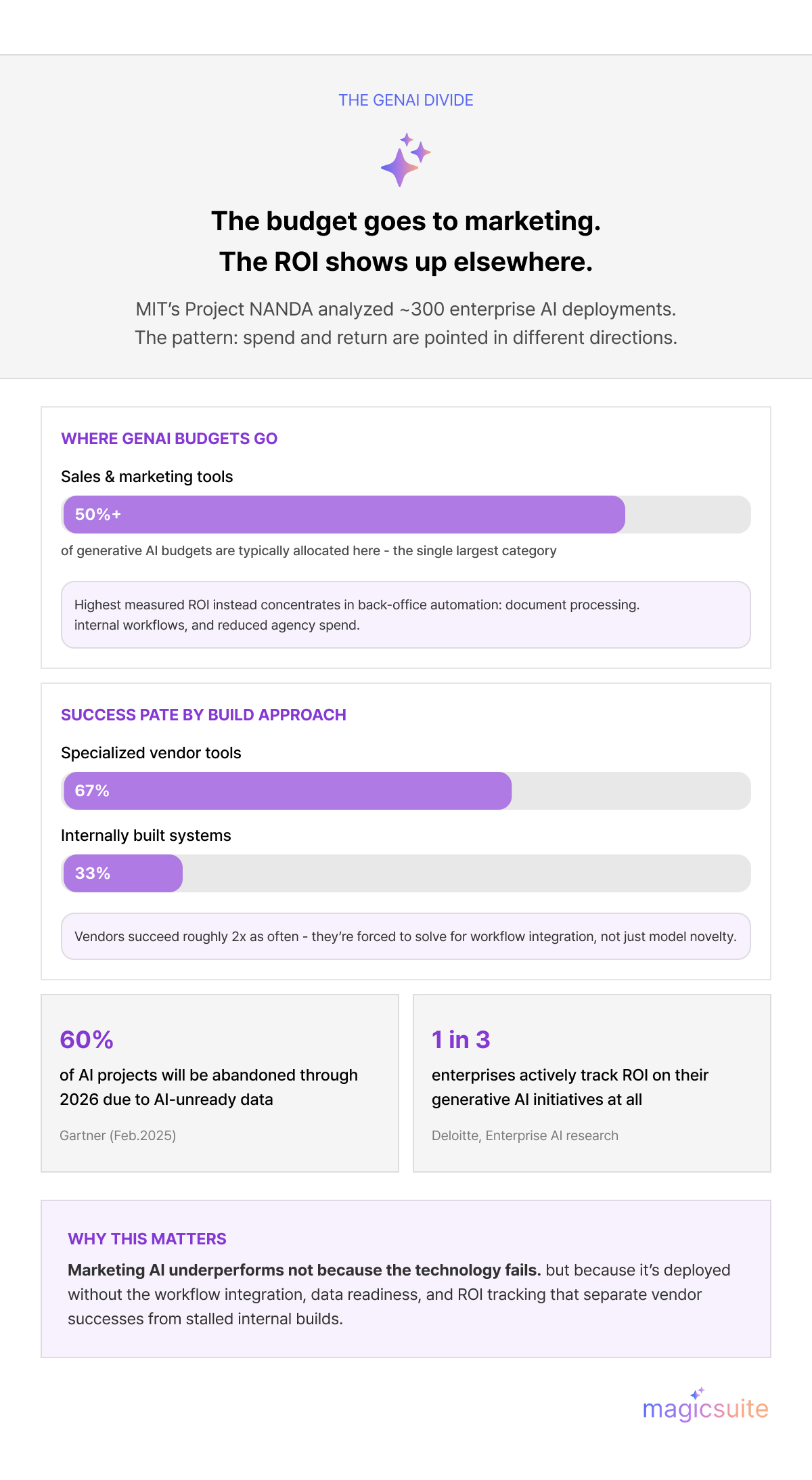
MIT's Project NANDA published one of the most widely cited enterprise AI findings of the past year: across roughly 300 public AI deployments and more than 150 executive interviews, about 95% of generative AI pilots failed to produce a measurable profit-and-loss impact. Only a small minority - the researchers put the figure near 5% - generated meaningful, scalable returns.
The detail that matters most for marketing leaders is where the money went versus where the value showed up:
This is not evidence that marketing AI doesn't work. It's evidence that marketing AI deployed without governance, workflow redesign, or a clear accountability structure tends to stall in what MIT calls the "learning gap" - tools that look impressive in a demo but never adapt to real campaigns, real data, or real approval processes.
If adoption alone doesn't explain the performance gap, governance increasingly does. Several 2025 and 2026 studies - including MagicSuite's own analysis of global AI investment trends - now attempt to quantify what responsible AI actually contributes to business outcomes — and the numbers are large enough to reframe governance as a growth lever rather than a constraint.
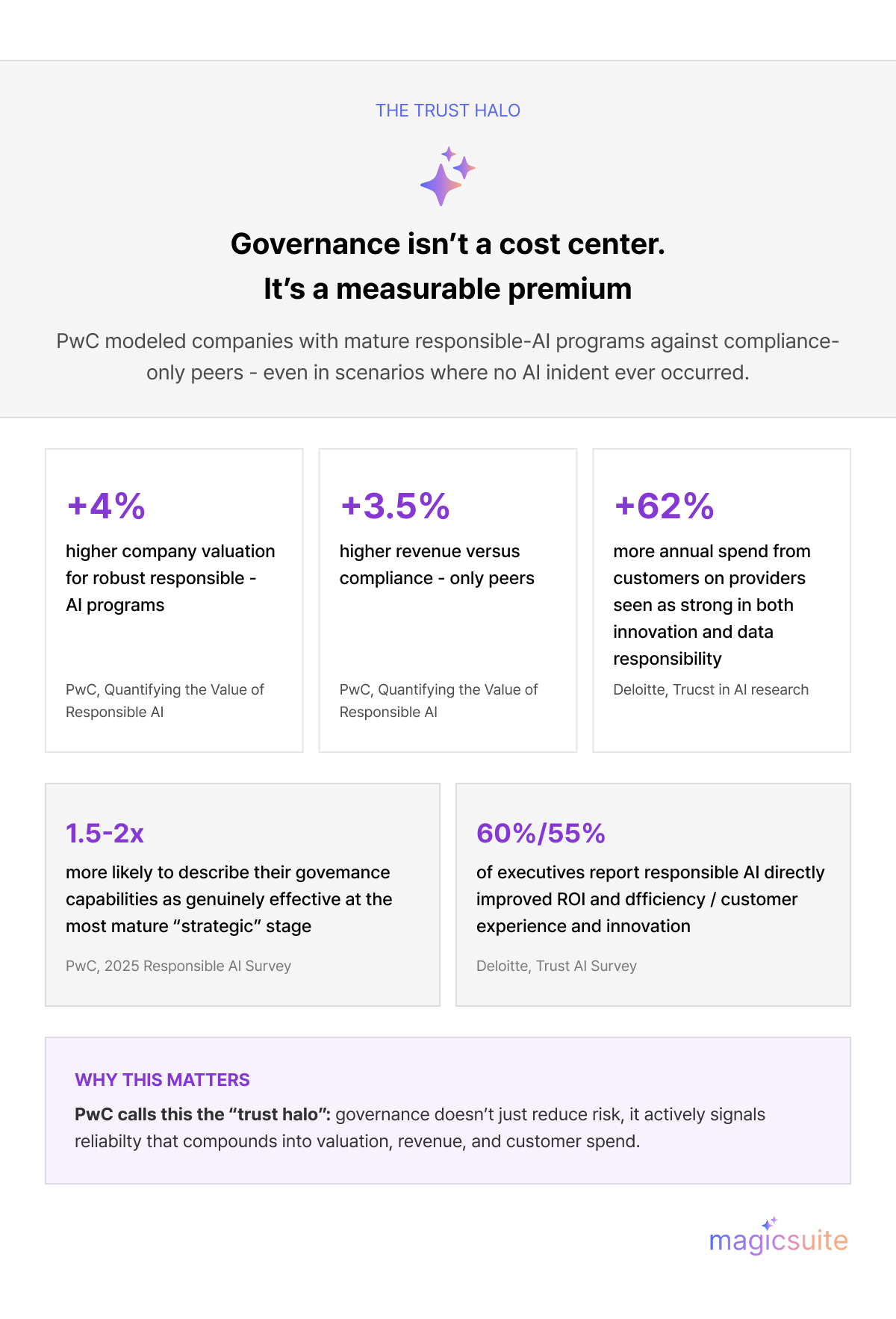
PwC built a system dynamics model comparing companies that invest meaningfully in AI safeguards against companies that spend only enough to meet minimum compliance requirements. The simulation found that robust responsible AI programs were associated with valuations up to 4% higher and revenues up to 3.5% higher than compliance-only peers - even in scenarios where no AI-related incident ever occurred. PwC attributes this to a "trust halo": governance doesn't just prevent downside risk, it actively signals reliability to customers, employees, and investors, which compounds into performance.
PwC's separate 2025 Responsible AI Survey adds an execution layer to that finding. Companies operating at the most mature "strategic" governance stage were roughly 1.5 to 2 times more likely to describe their governance capabilities - model documentation, AI inventorying, priority communication - as genuinely effective compared with organizations still in early training stages. Nearly 60% of surveyed executives said responsible AI practices improved ROI and operational efficiency directly, while 55% reported improvements in customer experience and innovation output.
Deloitte's enterprise AI research reached a parallel conclusion using a different method - a multivariate analysis of more than 100 trust-related actions organizations reported taking around their generative AI deployments. Companies that implemented a high number of trust-by-design actions were substantially more likely to report that two-thirds or more of their expected AI benefits had actually materialized, compared with organizations that skipped those steps.
The pattern across PwC and Deloitte is consistent: AI compliance and AI risk management are not simply defensive functions. They appear to function as leading indicators of whether an AI investment converts into realized business value at all.
Governance matters more for marketing than for almost any other business function, because marketing sits closest to the customer relationship - and customer trust in AI is currently under real strain.
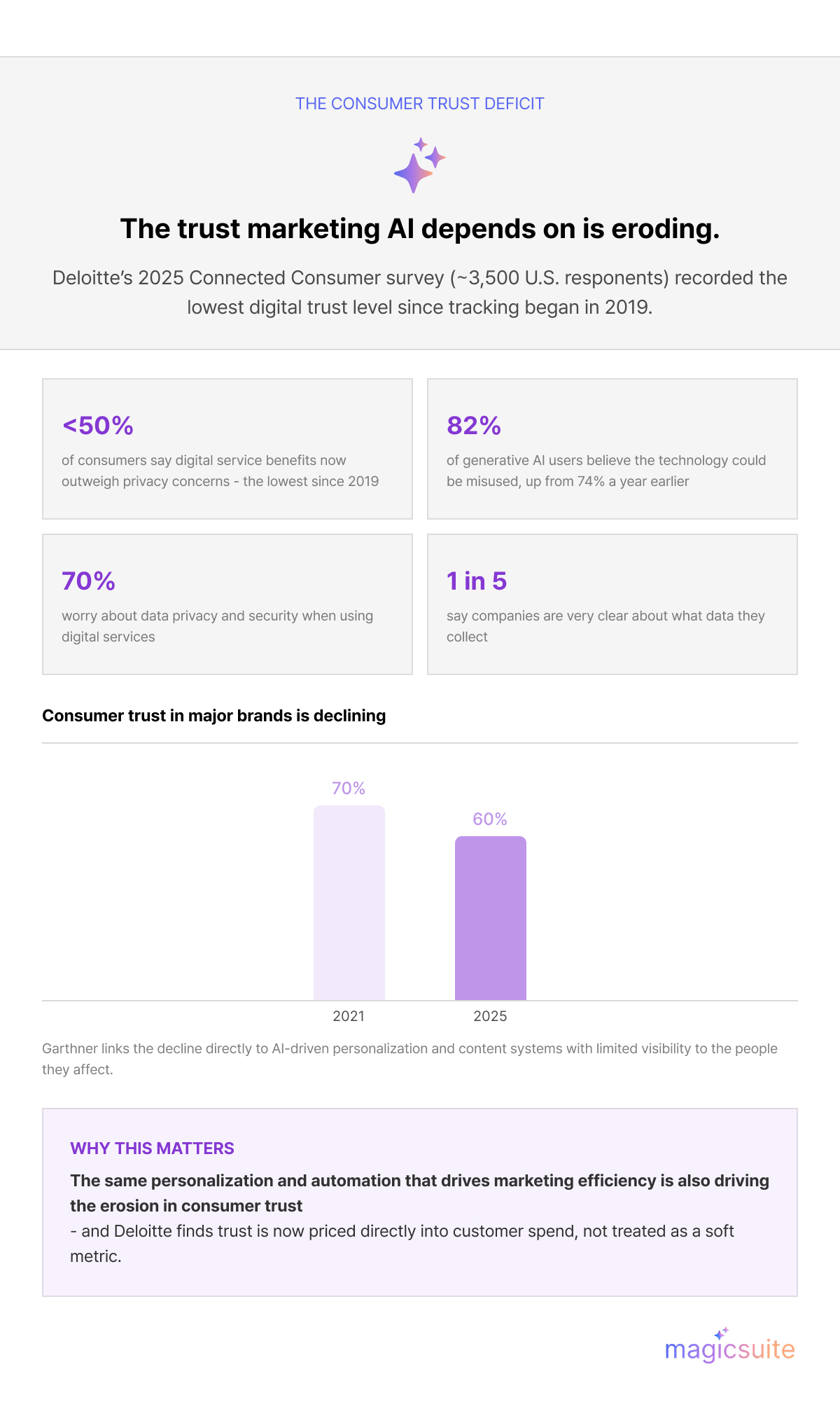
Deloitte's 2025 Connected Consumer survey, based on roughly 3,500 U.S. consumers, found that fewer than half of respondents now believe the benefits of digital services outweigh their privacy concerns - the lowest level Deloitte has recorded since it began tracking the question in 2019. The same survey found:
Separately, Gartner's late-2025 consumer research - a survey of more than 1,000 UK consumers - found that only 60% trust major brands, down from 70% in 2021, a decline Gartner links directly to the expansion of AI-driven personalization, recommendation, and content systems that operate with limited visibility to the people they affect. While that specific figure is UK-based, Gartner frames the underlying trust-erosion dynamic as a broader pattern accompanying AI-driven discovery and buying experiences globally.
For marketing organizations, this creates a straightforward commercial argument for ethical AI in marketing: the same personalization and automation capabilities that drive efficiency also raise the stakes on transparency. Deloitte's research on tech-sector consumers found that people who view a company as excelling in both innovation and data responsibility spend roughly 62% more annually than those who see their providers as lagging on both. Trust, in other words, is no longer a soft metric sitting outside the P&L - it is increasingly priced into customer spend.
The research consistently points to two categories of factors separating high performers from everyone else: how AI is built and deployed technically, and how the organization around it is structured.
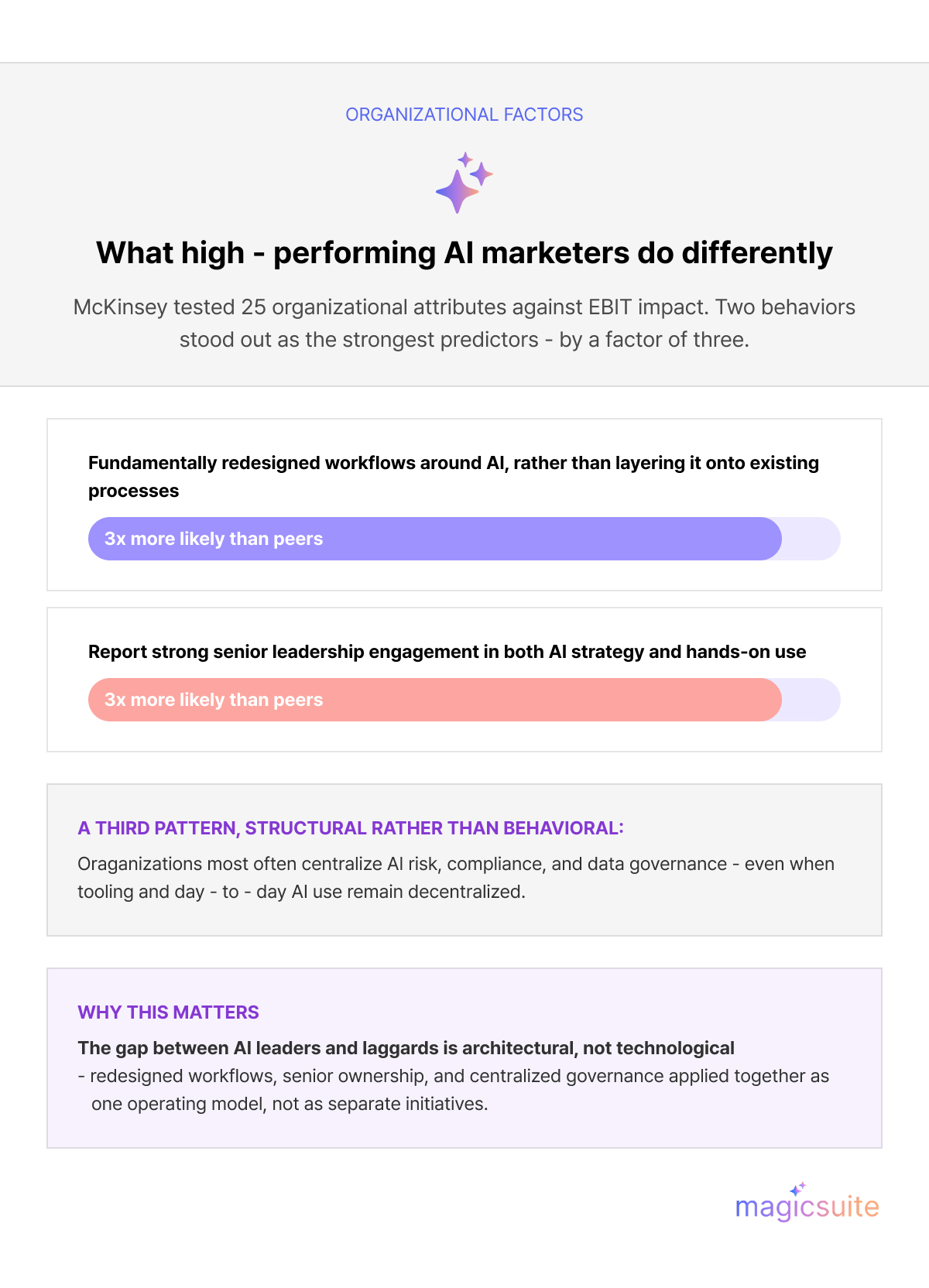
Taken together, these factors describe less a technology strategy and more an operating model - one where AI governance isn't a separate track running alongside marketing execution, but a structural precondition for it.
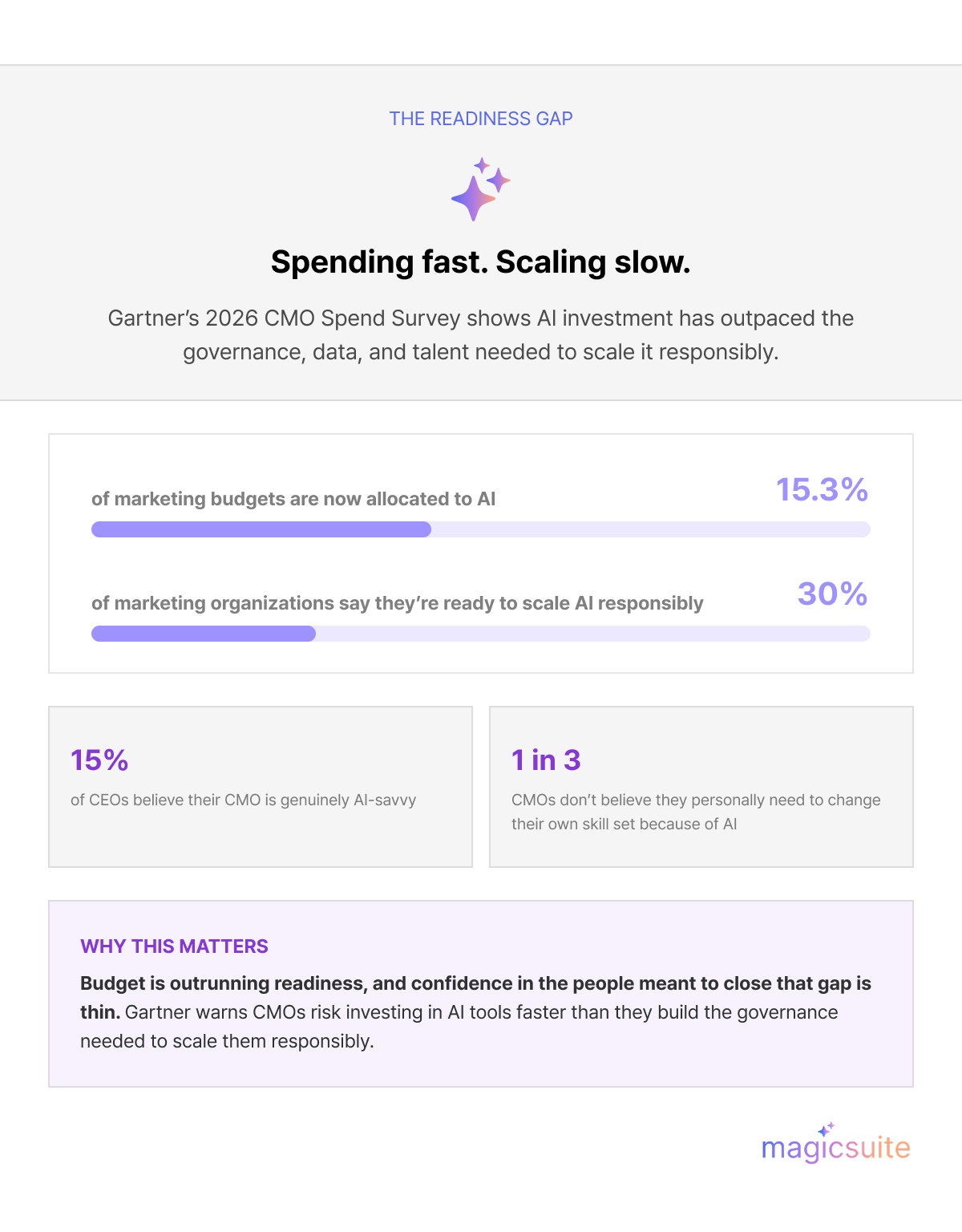
Even organizations with strong AI ambitions are running into a consistent set of scaling obstacles:
Comparing the research across McKinsey, MIT, Gartner, PwC, and Deloitte, a repeatable pattern distinguishes AI leaders from AI laggards in marketing specifically:
High-performing organizations tend to:
Struggling organizations tend to:
Deloitte's survey data reinforces this divide directly: only about a third of organizations in its late-2024 enterprise AI research reported actively tracking ROI on their generative AI initiatives at all - meaning a meaningful share of enterprises can't yet answer the basic question of whether their AI investment is working, let alone govern it well.
Translating this research into practice doesn't require marketing teams to become compliance departments. Effective AI governance for marketing comes down to a small number of structural commitments, consistently applied:
The enterprise data accumulated across 2025 and into 2026 tells a consistent story: marketing AI adoption is no longer the differentiator it once was - nearly every organization has it. What separates the small group of high performers from the much larger group still waiting for a return is whether AI was deployed inside a governed, redesigned, accountable operating model or simply layered on top of an old one.
Responsible AI in marketing is increasingly inseparable from AI performance itself. PwC's modeling puts a number on the "trust halo" effect; Deloitte's data links trust-building actions to benefit realization; McKinsey's high-performer research ties workflow redesign and leadership ownership directly to EBIT impact; and consumer research from Deloitte and Gartner shows that trust, once eroded, is expensive to rebuild. For marketing leaders evaluating where to invest next, the research increasingly points to the same conclusion: AI governance isn't the thing standing between marketing and AI's return on investment. It's the mechanism that produces it.
Enterprises that treat governance as a parallel, lower-priority track will likely keep contributing to the majority still failing to show measurable AI value. Those that build governance into the foundation of their AI strategy - ownership, transparency, measurement, and workflow redesign - are the ones positioned to capture the value pool that McKinsey, PwC, and MIT all agree is still largely unclaimed.

Hanna is an industry trend analyst dedicated to tracking the latest advancements and shifts in the market. With a strong background in research and forecasting, she identifies key patterns and emerging opportunities that drive business growth. Hanna’s work helps organizations stay ahead of the curve by providing data-driven insights into evolving industry landscapes.