

73% of customers now feel treated as individuals - AI personalization leaders earn 40% more revenue.

Every brand today is sitting on a goldmine - and most have no idea how to extract it.
Customer data is being generated at unprecedented velocity: every click, scroll, purchase, support ticket, and abandoned cart carries a signal. The problem has never been data scarcity. It has always been the gap between raw data and meaningful action. Traditional analytics approaches - descriptive dashboards, quarterly reports, human-reviewed segments - simply cannot process signals at the speed modern marketing demands.
This is where AI-powered marketing has fundamentally changed the equation. By combining machine learning, natural language processing, and predictive modeling, artificial intelligence enables brands to transform fragmented customer data into real-time, actionable intelligence - at a scale and precision no human team can replicate.
In 2025 and 2026, the brands winning on this front are not just those with the most data. They are the ones that have built AI systems capable of making sense of it continuously, and acting on it decisively. This article examines how leading enterprises are doing exactly that - and what separates them from the majority still struggling to move beyond the pilot stage.
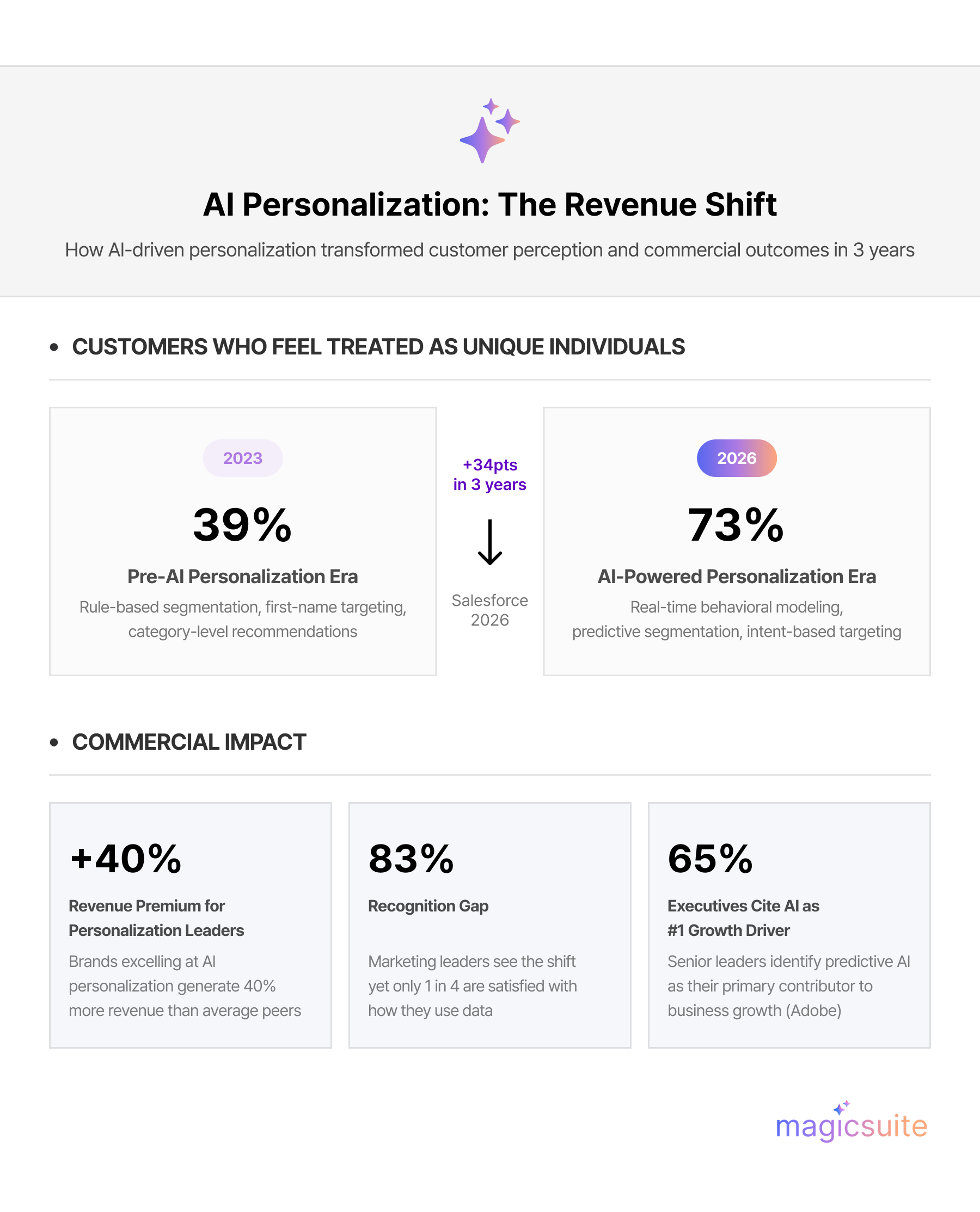
The scale of the gap is visible in survey data. The Salesforce State of Marketing report - drawn from nearly 4,500 marketers worldwide - found that 83% of marketing leaders recognize the shift toward personalized, two-way customer engagement, yet only one in four are satisfied with how they currently use data to power those interactions. That is not a budget gap. It is an intelligence gap.
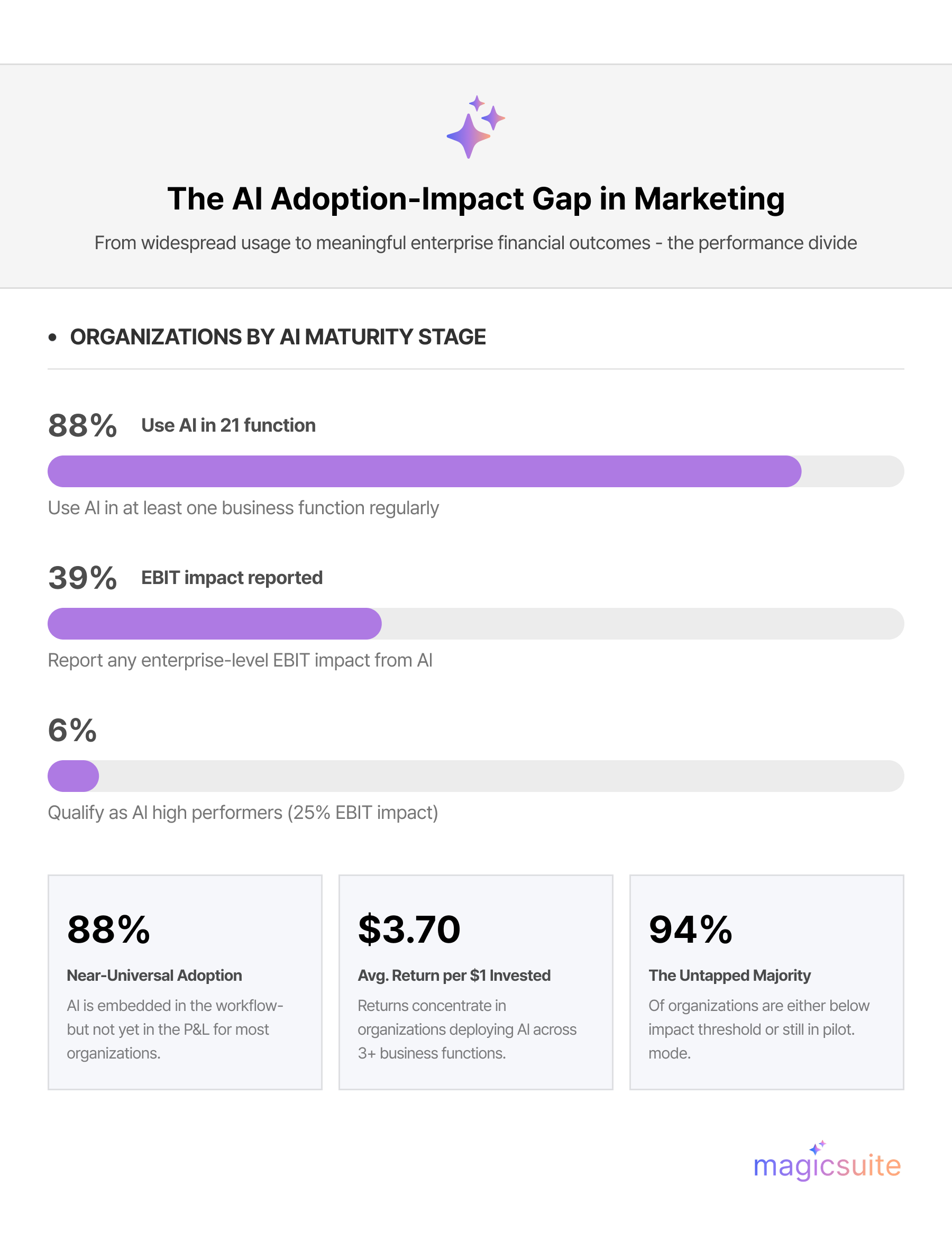
According to McKinsey's State of AI 2025 survey survey of 1,993 respondents across 105 countries, 88% of organizations now regularly use AI in at least one business function - up from 78% the prior year. The Global AI Market Size 2025 Report further contextualizes this growth, projecting AI spending to reach $2.5 trillion by 2026 as enterprise adoption accelerates across every major sector. Yet the more revealing finding is what comes next: nearly two-thirds of those organizations are still in the experimenting or piloting stage. Marketing and sales consistently rank among the top two functions where revenue benefits from AI are reported, yet the gap between usage and meaningful enterprise financial impact remains wide.
AI marketing insights platforms are designed precisely to close this gap. They replace the static, backward-looking view of historical reports with dynamic models that learn from continuous behavioral data. The result is a shift from describing what happened to predicting what will happen next - and, increasingly, triggering what should happen automatically.
The mechanics of customer data analytics powered by AI involve several interconnected capabilities that work together to produce actionable intelligence.
Behavioral pattern recognition allows AI models to identify non-obvious signals in purchase history, browsing sequences, and engagement patterns. Unlike rule-based systems that respond to predefined triggers, machine learning models surface emergent patterns - for example, detecting that a specific sequence of content interactions predicts churn before any traditional metric would flag it.
Predictive customer analytics extends this further by producing forward-looking scores: likelihood to purchase, likelihood to churn, lifetime value estimates, and next-best-action recommendations. According to Adobe's Digital Trends research, 65% of senior executives now identify AI and predictive analytics as the primary contributor to business growth - a finding that reflects how central these capabilities have become to strategic decision-making.
AI customer insights also enable real-time segmentation that would be computationally impossible through manual methods. Instead of static audience segments built quarterly, AI systems continuously update customer profiles based on live behavioral signals, allowing marketers to respond to intent as it forms rather than after it has faded.
Perhaps the most visible outcome of AI-driven marketing is the radical improvement in personalization quality. For years, marketing personalization meant addressing customers by first name and recommending products from the same category they last purchased. AI has made that level of personalization look rudimentary.
Predictive segmentation now factors in dozens of behavioral dimensions simultaneously - not just what a customer purchased, but when, through what channel, after what content sequence, at what price sensitivity, and in what emotional context (inferred from message tone and engagement patterns). The outcome is a level of individual relevance that genuinely shifts customer perception.
Salesforce's 2026 marketing benchmark survey reveals a striking result: 73% of customers now feel that brands treat them as unique individuals. In 2023, that figure was 39% - a gain of 34 percentage points in just three years. Research into what consumers actually expect from AI-powered interactions shows that this shift is not just about technology - it is about trust, relevance, and the perception that a brand genuinely understands individual needs. This shift matters commercially. McKinsey's research consistently shows that personalization leaders generate 40% more revenue from their efforts than average performers, with the gap widening as AI capabilities mature.
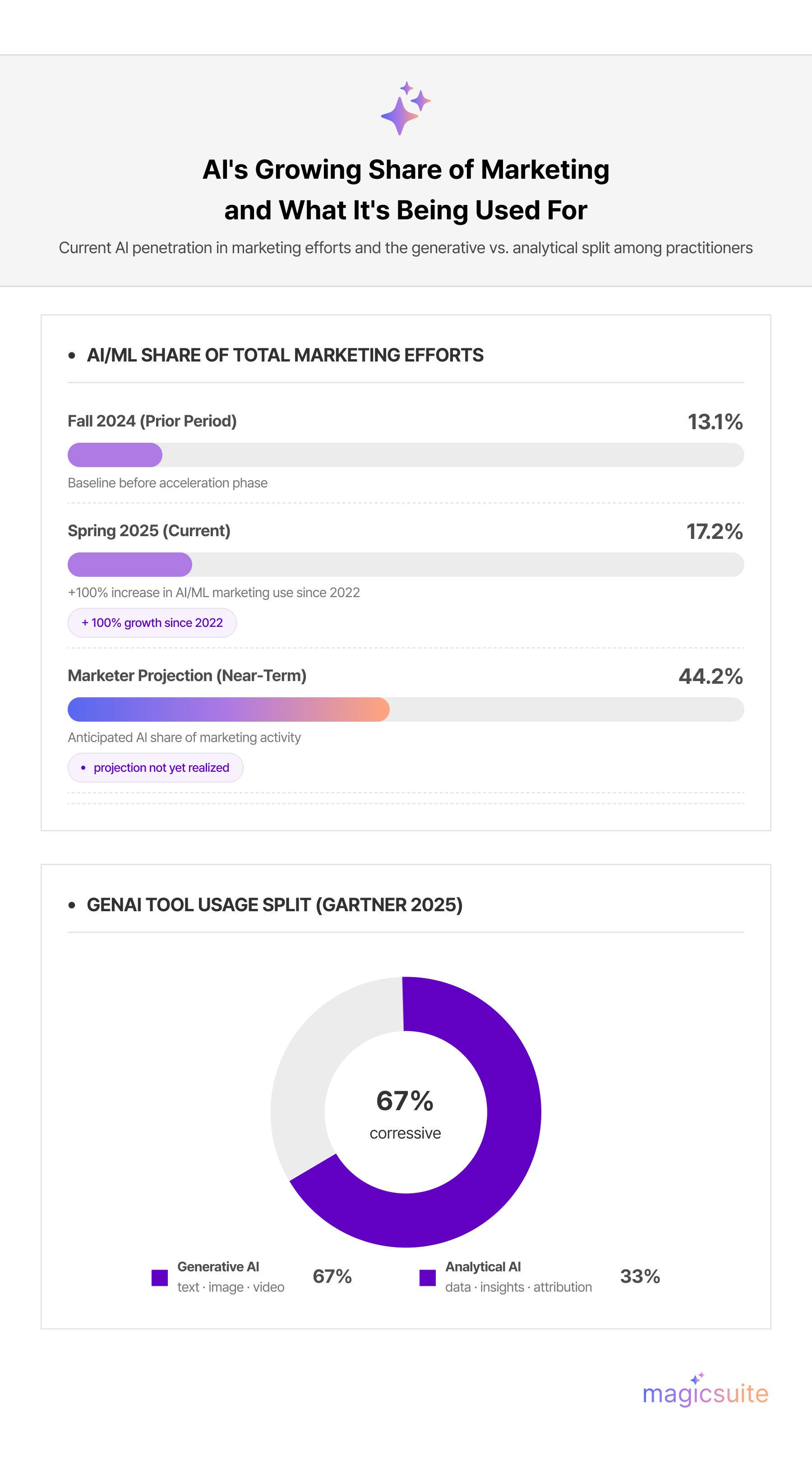
A separate but increasingly integrated dimension of AI-powered marketing is the rise of Generative AI in marketing - applied to content, messaging, and campaign execution at scale. Gartner's 2025 research found that 67% of AI tool usage among marketers is now generative - producing text, images, and video - while 33% serves analytical functions. By 2025, more than 60% of marketing leaders had used generative AI for content creation (Salesforce).
The strategic value of generative AI in this context is not simply speed, though content creation timelines have shortened dramatically (some teams report 80% reductions in manual production time). The deeper value is insight-to-execution velocity: the ability to act on a behavioral signal and deploy a personalized message within minutes rather than days.
Consider the practical workflow: an AI model identifies a segment of high-value customers showing early-stage churn signals, generates personalized retention offers calibrated to each customer's purchase history and sensitivity profile, and deploys them across the highest-converting channel - all without requiring a campaign build cycle or manual creative review. This is what data-driven marketing looks like when AI is fully integrated into the execution layer, not just the analysis layer. As explored in our guide to AI agents for business, the shift toward agentic AI infrastructure means that brands deploying autonomous execution systems today are building capabilities that competitors will spend years trying to replicate.
Accenture's 2025 investment in Alembic - a causal AI platform purpose-built for marketing measurement - reflects the industry's growing recognition that correlation-based analytics are no longer sufficient. As Accenture CEO Julie Sweet noted at the time, enterprise reinvention now hinges on "verifiable, cause-and-effect insights" that allow leaders to act with decisive speed. Causal AI goes beyond identifying that two variables correlate; it establishes directional influence, enabling marketers to understand exactly which campaign investments drove which business outcomes.
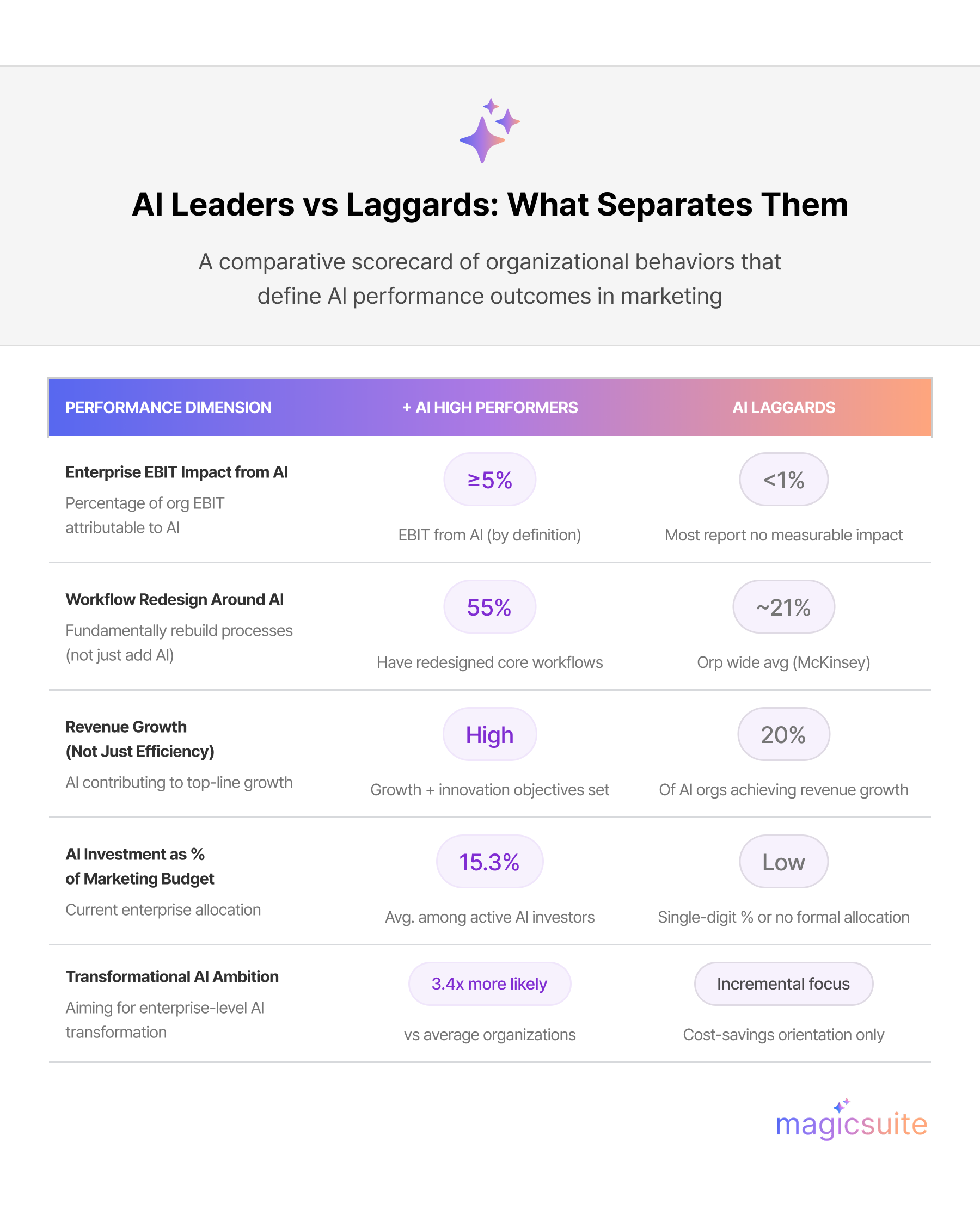
The clearest financial validation comes from ROI data: industry research tracking generative AI investment performance finds companies generating an average return of $3.70 for every dollar invested in AI, with financial services leaders seeing returns as high as $4.20 per dollar (AmplifAI/NVIDIA research, 2025). But averages mask the real story. The elite 6% of AI high performers - those with EBIT attributable to AI exceeding 10% - report returns of approximately $10.30 per dollar invested, nearly three times the market average. These organizations share three defining characteristics: they deploy AI across three or more business functions simultaneously, 55% have fundamentally redesigned their core workflows around AI, and they are 3.6 times more likely than average organizations to be pursuing enterprise-wide AI transformation as a strategic objective.
McKinsey's 2025 State of AI survey confirms that only 6% of organizations qualify as genuine AI high performers. Thirty-nine percent report any enterprise-level financial impact at all, while the remaining majority are using AI - including marketing analytics AI tools - but not generating the systemic returns that justify the investment narrative. In effect, 94% of organizations remain either below the meaningful impact threshold or still in pilot mode - a stark illustration of how wide the gap is between AI activity and AI value.
Several factors consistently separate high performers from the rest.
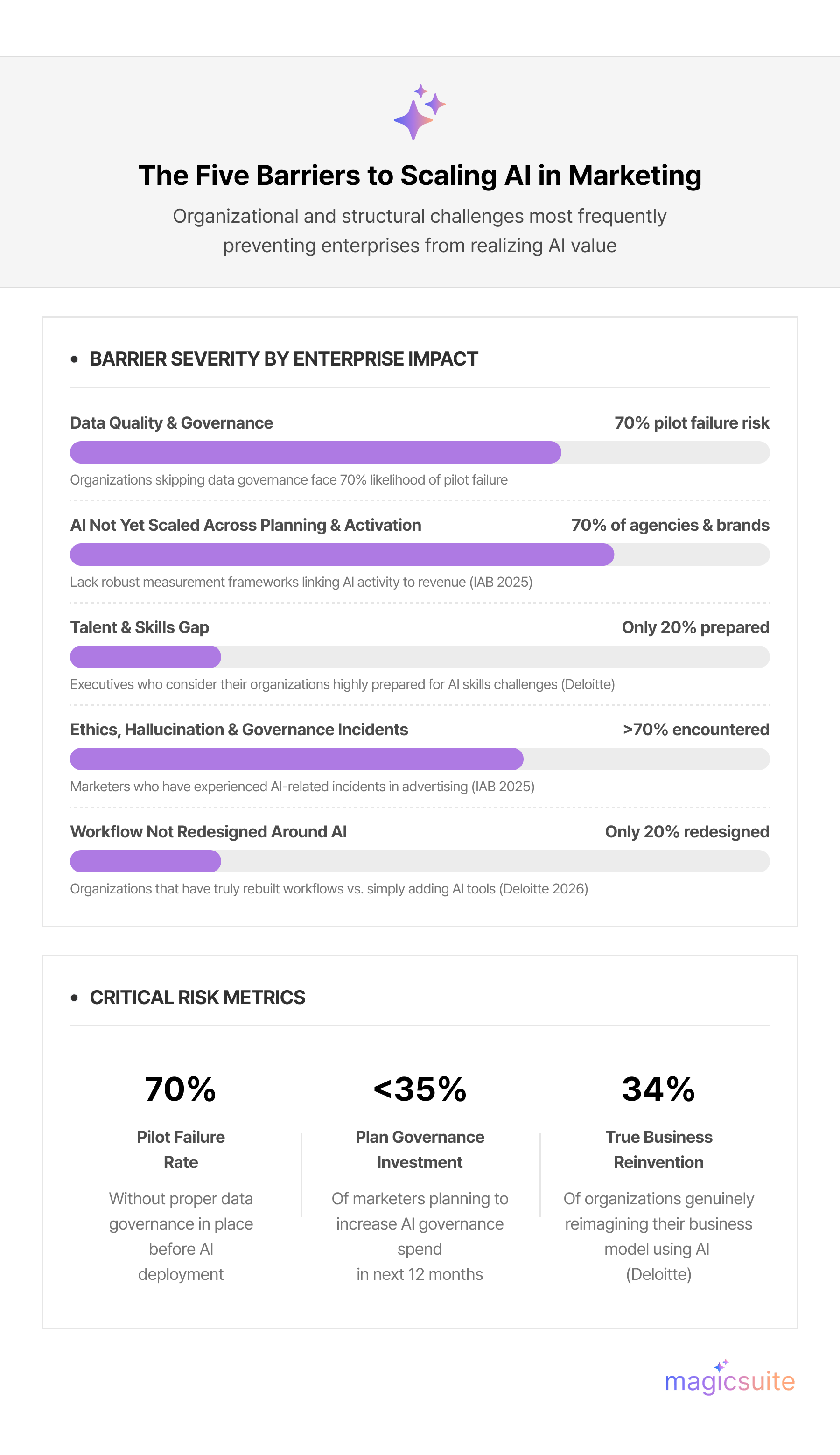
Strategic integration versus feature adoption. High-performing organizations do not deploy AI tools as point solutions. They rebuild processes around AI capabilities - redesigning sales playbooks, customer journey models, and content pipelines so that AI functions as a systemic capability rather than an add-on. McKinsey finds that 21% of organizations have fundamentally redesigned at least some workflows in conjunction with generative AI deployment. Among AI leaders, that figure rises to 55% - and these same organizations are 3.6 times more likely to be pursuing enterprise-wide AI transformation rather than incremental cost-savings objectives.
Data infrastructure investment. Organizations that skip foundational data governance and quality work before deploying AI models face a 70% likelihood of pilot failure, according to enterprise AI research compiled in 2025. Customer intelligence systems are only as good as the data flowing into them. Fragmented, siloed, or inconsistently formatted customer data produces unreliable models - and unreliable models produce worse decisions than no model at all.
Revenue versus efficiency orientation. Deloitte's 2026 State of AI in the Enterprise survey of 3,235 global leaders found that 66% of organizations have achieved productivity and efficiency gains from AI. However, only 20% are already achieving revenue growth - while 74% still aspire to it. The distinction is critical: efficiency gains from AI are relatively accessible. Revenue growth from AI requires deeper integration into customer-facing systems and a willingness to redesign commercial processes around AI-generated intelligence.
The clearest evidence of AI's impact on customer data insights comes from examining enterprise use cases that have moved beyond pilot into production.
Customer churn prediction and retention. Retail and financial services organizations are using AI-driven churn models to identify at-risk customers weeks or months before they would exhibit obvious signals. In banking, McKinsey reports that 46% of financial institutions using AI achieved significant gains in customer satisfaction - a direct result of proactive, AI-triggered engagement rather than reactive response.
AI-powered audience segmentation. The CMO Survey (Spring 2025) tracks AI and ML usage for marketing optimization across a longitudinal panel. AI and ML now power 17.2% of marketing efforts - up from 13.1% in Fall 2024 and representing a 100% increase since 2022 - with marketers projecting this share will rise to 44.2% within the next few years. This acceleration reflects how central AI customer insights have become to audience strategy, replacing quarterly manual segmentation with continuous, model-driven profiling.
Marketing attribution and spend optimization. One of the historically most challenging problems in marketing - determining which investment caused which outcome - is being addressed by causal AI platforms. These tools surface customer data insights that reveal precise cause-and-effect relationships between spend decisions and revenue outcomes. Predictive models now help teams cut unnecessary spend, with companies reporting 15–20% reductions in wasted media costs. CMOs are responding: average AI investment as a share of total marketing budgets now stands at 15.3%, up from low single-digit shares just three years ago (SQ Magazine, 2026).
Real-time journey personalization. Enterprise platforms now enable AI to adapt customer journeys dynamically based on live behavioral signals. For a detailed breakdown of the tools powering this shift, see our comparison of top customer service automation platforms in 2026. A customer who abandons a cart after viewing a specific product page, engages with a retargeting message, and then visits the site during a sale period triggers a different AI-generated response sequence than one following a different path - all without human intervention.
For every enterprise seeing measurable returns, there are several more navigating implementation challenges that constrain value realization. Understanding these barriers is as strategically important as understanding the opportunities.
The trajectory of AI-driven marketing points toward an environment where customer intelligence becomes a primary source of competitive differentiation - not as a tactical tool, but as a strategic infrastructure asset. Generative AI in marketing, combined with real-time predictive analytics, is accelerating this shift by collapsing the time between signal and action from days to seconds.
Decision intelligence practices - including the systematic logging of decisions for subsequent analysis and optimization - are projected to become standard practice among leading enterprises by 2026. This projection aligns with a broader pattern visible in 2025 data: organizations that have successfully scaled AI in marketing are not simply achieving incremental efficiency gains. They are building compound competitive advantages - their models improve continuously as more behavioral data flows through them, while competitors still in the pilot phase fall further behind.
The widening gap between AI leaders and laggards is not merely a technology story. It is a strategic execution story. The organizations generating the highest returns from AI in marketing share a common characteristic: they started with business outcomes, built the data infrastructure necessary to pursue those outcomes, and deployed AI as the execution layer for decisions that would otherwise be too complex or too fast to make manually.
For enterprises still in early stages, the implication is directional: the window for establishing AI advantage in marketing is not closing, but it is compressing. As AI marketing capabilities commoditize - driven by the rapid proliferation of enterprise AI platforms and falling deployment costs - the differentiating factor will shift from having AI to having built the organizational competencies, data assets, and integration architectures that allow AI to operate at its full potential.
The premise of data-driven marketing has been around for decades. What has changed in 2025 and 2026 is the speed, precision, and scale at which that premise can actually be realized. AI marketing insights are no longer theoretical - they are embedded in the workflows of the world's most competitive brands, driving decisions at a pace and granularity that human analysis cannot match.
The 6% of organizations McKinsey identifies as AI high performers are not outliers because they have access to better data or superior technology. They are outliers because they made deliberate structural choices: investing in data foundations, redesigning workflows, setting outcome-based targets, and treating AI as an organizational capability rather than a software deployment. Those choices are replicable, but not automatic.
For marketing leaders, the strategic imperative is clear. Predictive customer analytics, generative AI, and customer intelligence platforms are transitioning from competitive advantages into competitive prerequisites. The organizations that act now to build the infrastructure, skills, and integration architectures that allow AI to function at its full potential will be the ones writing the performance benchmarks that everyone else will be chasing in 2027 and beyond.
The customer data already exists. The question is whether your organization has built the intelligence layer capable of transforming it into action.
Your customers are generating signals right now. The question is whether your marketing stack can read them — and act before the moment passes.
MagicSuite transforms raw customer data into real-time intelligence, powering personalization, predictive segmentation, and campaign execution that moves at the speed your customers do.

Hanna is an industry trend analyst dedicated to tracking the latest advancements and shifts in the market. With a strong background in research and forecasting, she identifies key patterns and emerging opportunities that drive business growth. Hanna’s work helps organizations stay ahead of the curve by providing data-driven insights into evolving industry landscapes.