

Zuckerberg is building a personal AI agent for Meta. Here's what it signals for every business ready to deploy a personal AI agent in 2026.

When Mark Zuckerberg starts building a tool for himself, the technology is no longer experimental, it's operational. Reports emerged this week that the Meta CEO is developing a personal AI agent to help him manage his duties running a company with more than 3.5 billion daily users. For any business owner still treating a personal AI agent for business as a future concern, that signal demands a rethink. This article breaks down what Zuckerberg's move reveals about the state of AI agents, and why businesses of every size can — and should — deploy their own today.

There is a version of this story that reads as a curiosity, the world's richest executives playing with cutting-edge toys. That reading misses the point entirely.
Zuckerberg has been explicit about why he is building this tool. During Meta's Q4 2025 earnings call, he told investors that AI systems are beginning to understand personal context — history, interests, relationships — in ways that make them genuinely useful co-pilots rather than query machines. He described 2026 as "a big year for delivering personal superintelligence." That framing is not marketing. It is a product roadmap.
The personal AI agent Zuckerberg is building is designed to help him retrieve information faster and cut through the cognitive load of leading one of the world's largest companies. The fact that he is building it for himself , not as a product demo, but as a daily working tool, confirms that the underlying technology has crossed a threshold. It is reliable enough to trust at the highest level of decision-making. For business owners, that confirmation matters more than any benchmark or analyst report.
A decade ago, Zuckerberg set himself a personal challenge to code a home AI system he called Jarvis. It was an impressive engineering exercise. It was not a business tool. The gap between that project and what he is building now reflects exactly how much the underlying technology has shifted.
Meta's chief AI officer Alexandr Wang, installed after Meta's $14.3 billion investment in data-labeling firm Scale AI, has stated publicly that the company sees enormous opportunity to bring a more powerful version of AI to every individual through personal agents. That is not a vision for a distant future. Meta acquired AI agent startup Manus for more than $2 billion in late 2025, and more recently acquired AI-agent social platform Moltbook, assembling the infrastructure for agent-driven experiences across its entire product surface.
The Jarvis experiment was about ambition. The 2026 personal AI agent is about execution. That distinction should inform how businesses approach their own AI adoption decisions right now.
Agentic AI and generative AI are often conflated, but the distinction matters enormously here. An AI agent is not a chatbot. It is not a search bar with a conversational interface. A personal AI agent is a system that understands the context, the specific history, relationships, preferences, and goals of the person or organization it serves, and uses that context to take action, surface information, and reduce the cognitive work required to operate at a high level of performance.
For Zuckerberg, that means faster information retrieval across a company of tens of thousands of employees. For a business with a team of five or fifty, it means something equally transformative: customer conversations that never stall, support that never sleeps, and institutional knowledge that is always accessible.
Meta's internal data on AI adoption provides a concrete benchmark for what businesses should expect from well-deployed AI agents. The Global AI Investment Report 2025 confirms this is not an isolated trend — global AI investment hit $211 billion in 2025, surging 85 percent year-over-year, with productivity infrastructure driving a significant share of that capital.
According to Axios reporting, AI coding tools at Meta have already increased engineers' productivity by 30 percent on average, with top users reporting gains of up to 80 percent. That data point is instructive for two reasons.
This is the compounding context problem. Businesses that deploy AI agents now begin building the data foundation, conversation history, customer context, workflow patterns, that make those agents more effective over time. Businesses that wait start from zero when they eventually do adopt. The gap widens with every passing month. Measuring that gap starts with tracking the right metrics, specifically, AI deflection rates to understand exactly how much value AI agents are generating compared with human-handled interactions.
Zuckerberg's framing of the personal AI agent centers on one concept: context. He told investors that what makes agents valuable is the unique context they can see — history, interests, relationships. Meta's scale gives it access to enormous amounts of that context. But the principle applies directly to any business that interacts with customers.
A business that knows its customers, their past purchases, common questions, preferences, and complaints, has always had a service advantage. AI agents operationalize that advantage at scale. Instead of a team member manually reviewing account history before a call, an AI agent surfaces it instantly. Instead of a customer waiting in a queue, MagicVoice handles the inquiry in real time. Instead of knowledge living in the heads of senior employees, MagicTeams makes it accessible to everyone. Understanding how machine learning models learn customer intent is what makes this context layer so powerful. It is not static data retrieval, but a continuously improving pattern recognition built on every interaction.
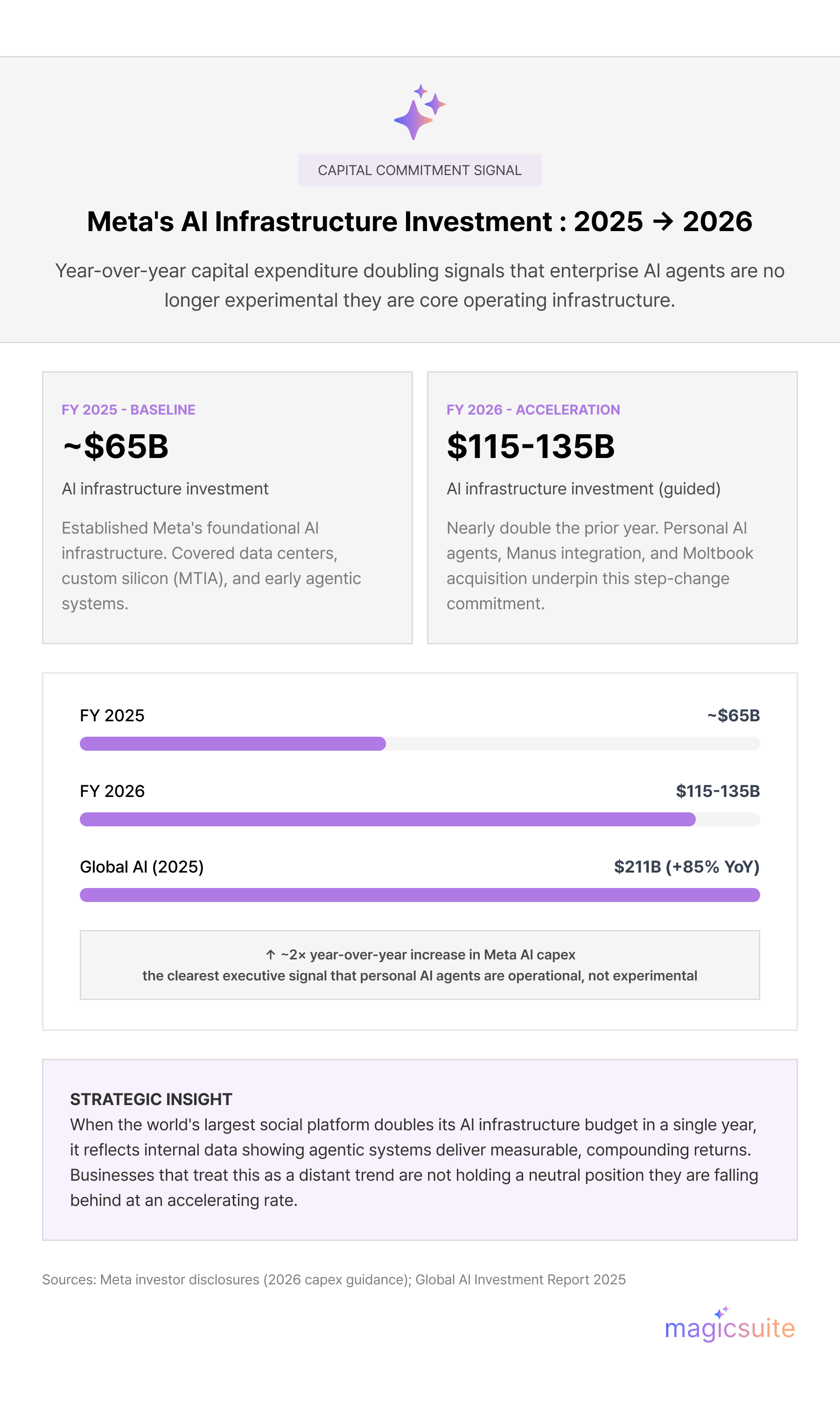
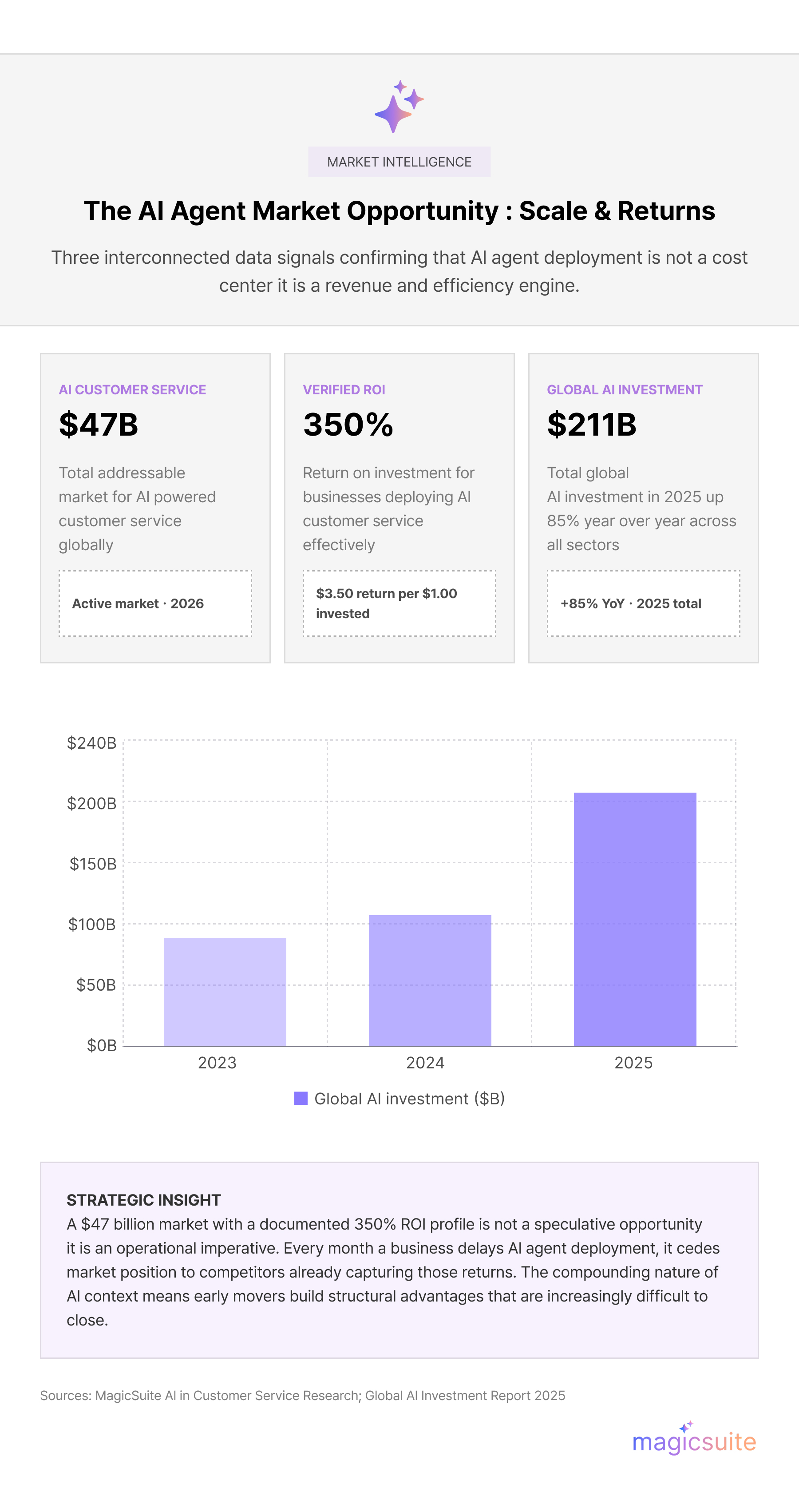
Meta is spending $115-$135 billion on AI infrastructure in 2026. That investment signals where the competitive environment is heading, not in five years, but now. Businesses that operate without AI agents are not holding a neutral position. They are falling behind competitors who are compressing response times, reducing support costs, and building customer relationships that scale. The AI in the customer service market represents a $47 billion opportunity, with data indicating a 350 percent return on investment for businesses that deploy AI effectively.
MagicSuite customers like Woori Bank Capital have already made this transition, deploying MagicTalk to power AI-driven customer service and enable smarter, scalable support across their operations. For businesses evaluating where to begin, the Ultimate Guide to Building an AI Support Stack in 2026 provides a practical starting framework. The barrier to entry is not capital expenditure at the Meta scale. It is a decision to start.
The most important insight from Zuckerberg's personal AI agent project is not what it does. It is what it signals: the technology is mature, the productivity gains are real, and the executives who understand this best are already using it themselves.

Hanna is an industry trend analyst dedicated to tracking the latest advancements and shifts in the market. With a strong background in research and forecasting, she identifies key patterns and emerging opportunities that drive business growth. Hanna’s work helps organizations stay ahead of the curve by providing data-driven insights into evolving industry landscapes.