

Build a powerful AI support stack with MagicTalk for FAQs, routing, and knowledge bases. Step-by-step setup, integrations, ROI metrics, SEO tips for Singapore & global teams.

Building an AI support stack means setting up a simple, modular system to help you answer customer questions quickly and accurately. You combine three core pieces: data ingestion (pulling in your docs, FAQs, tickets), an LLM (like GPT‑4o) to generate answers, and automated workflows to route and resolve requests.
The main components are a centralized, clean knowledge base (often a vector database for RAG search), powerful LLM models, and integrations with your help desk, chat, and CRM tools.
For best results, centralize all support data in one place; start with basic workflows, such as FAQ automation, before scaling to complex flows. Use clear monitoring to track accuracy, speed, and resolution rates. This creates an AI support stack that’s fast, reliable, and easy to grow. Let’s go through them one by one below.
Building a stack is like building a house. If your foundation (data) is shaky, your roof (the chatbot) will leak. A high-performing AI stack comprises three primary layers that work in tandem.
Why "Stacking" Beats "All-in-One"
While many platforms claim to do everything, the best support teams often use a modular approach. This allows you to swap out a specific AI model as technology improves without rebuilding your entire workflow.
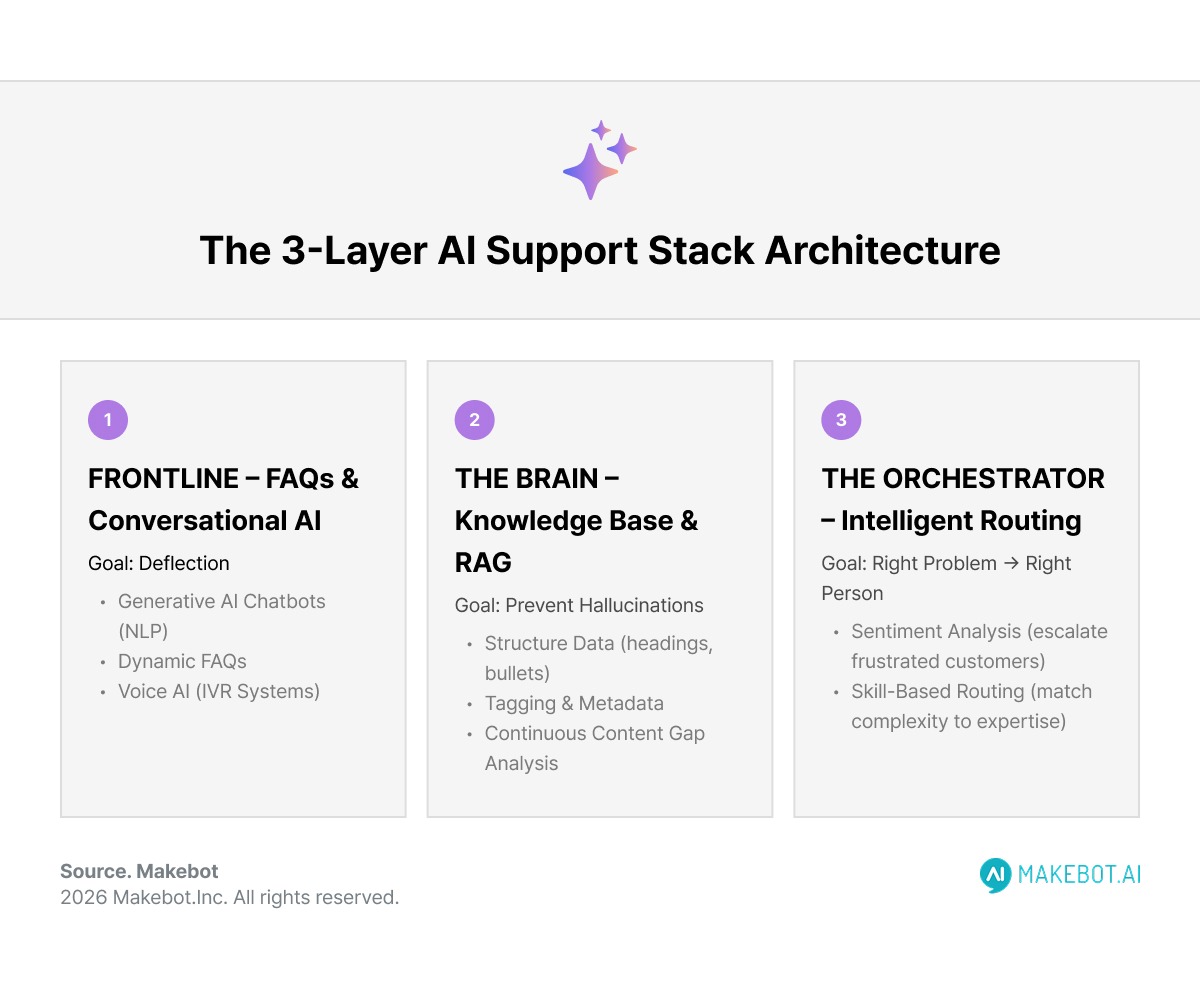
The frontline is where your customers live. The goal here is Deflection—resolving queries before they ever reach a human inbox.
Pro-Tip: Your frontline AI should have a "personality guardrail." It needs to be helpful and brand-aligned, but it must always offer a clear path to a human agent if it gets stuck.
The biggest mistake companies make is letting AI "hallucinate" answers. To prevent this, we use Retrieval-Augmented Generation (RAG). To make your knowledge base AI-ready, you must:
Not every ticket is created equal. AI-driven routing ensures the right problem goes to the right person (or bot).
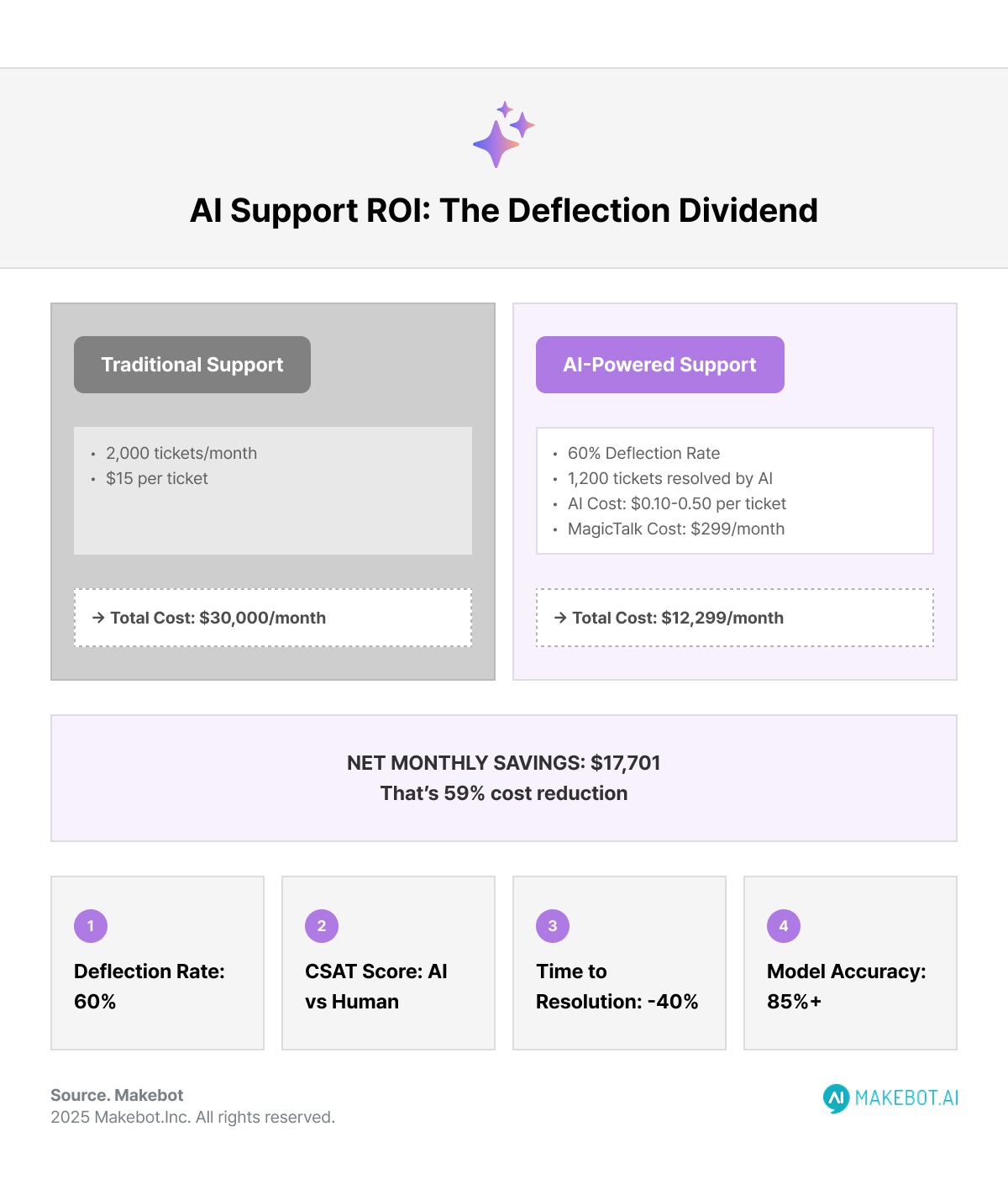
If you can’t measure it, you can’t justify the budget. Shift your focus from "Tickets Closed" to these AI-centric KPIs:
A support stack is only as strong as its integrations. If your AI chatbot doesn’t know what’s in your CRM, it’s just a fancy FAQ page. True "stacking" involves creating a circular flow of data.
Choose based on scale, budget, integrations, and geo-needs. MagicTalk leads for AI-native automation.
When choosing a frontline AI agent, speed of deployment is often the deciding factor. This is where MagicTalk differentiates itself. While legacy enterprise tools can take months to configure, MagicTalk is designed for a zero-code setup, enabling teams to integrate AI into their existing help desks in minutes.
Why MagicTalk is a Stack Essential:
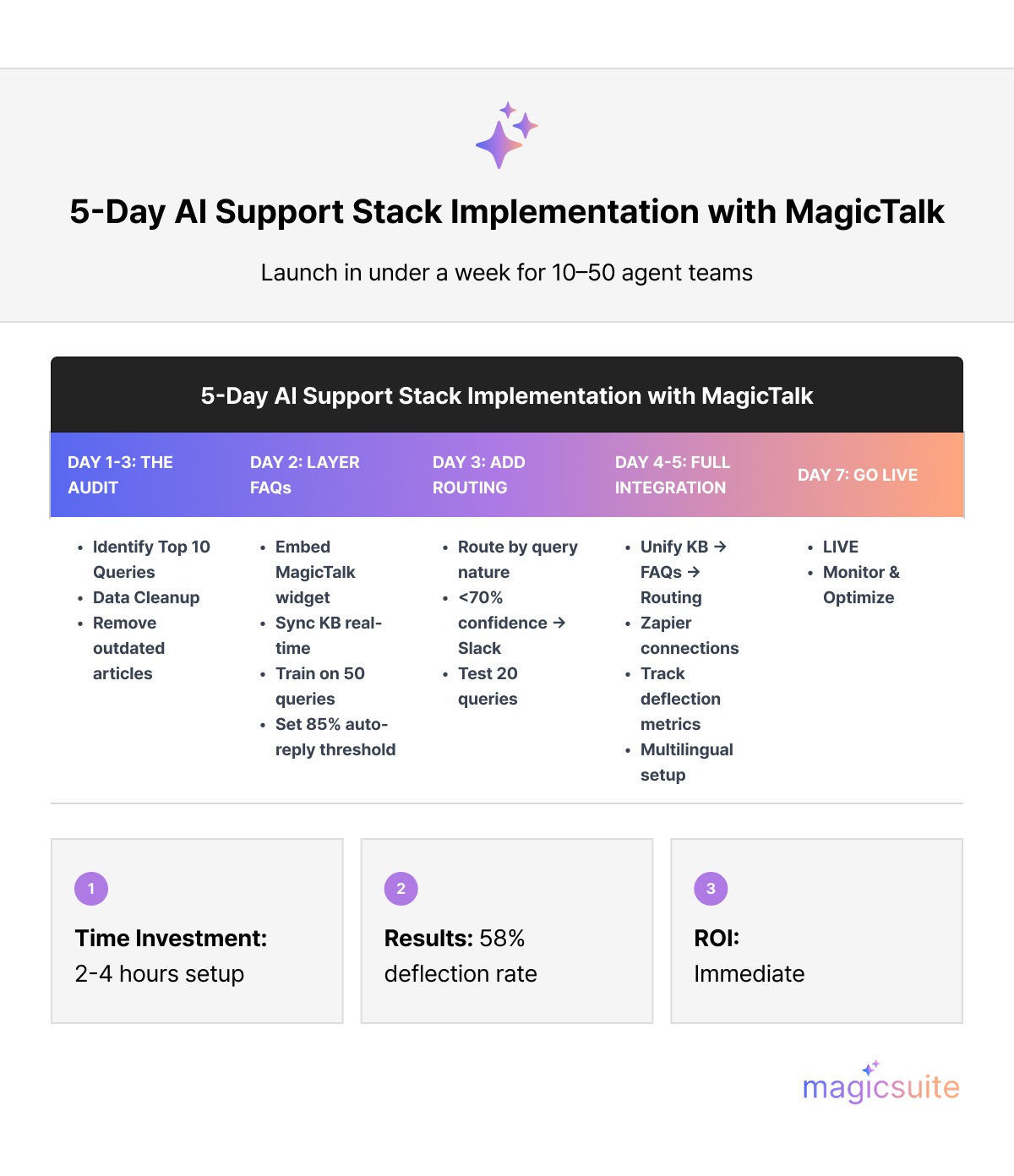
Here is how you deploy your AI stack without breaking your current workflows. Launch in under a week for 10-50 agent teams.
Don't automate a broken process.
Start with a "shadow" deployment.
Embed MagicTalk widget on site/Shopify via a simple script.
Deploy live in minutes—handles repetitive tasks instantly.
MagicTalk core strength: Route by query nature to agents/depts.
Rules: <70% confidence → Slack ping. Test 20 queries.
Fallback: Zendesk for advanced rules.
Unify:
Multilingual: DeepL API for English-Korean. Webhooks ensure zero-delay syncs.
Pro Tip: MagicTalk expands rep power with AI suggestions, freeing humans to focus on high-value work.
Core pairs for stacking:
API flow: Trigger → MagicTalk → Layers. AWS Sydney for SG latency <100ms. OAuth2 security standard.
As we look toward 2026, the biggest trend in AI support isn't "smarter" bots—it's safer ones. Modern stacks must prioritize Data Sovereignty. Using a privacy-first tool ensures that customer interactions are encrypted and compliant with GDPR or CCPA. When building your stack, always ask: “Does this tool own my data, or do I?” A future-proof stack allows you to export your "Learned Knowledge" if you ever decide to switch providers.
An AI support stack isn't about replacing humans; it’s about Agent Empowerment. When you deflect 58% of routine inquiries (the current industry average for high-performing bots), your human agents are finally free to handle the high-value, high-empathy cases that build lifelong brand loyalty.
Final ROI Checklist for Your Stack:
The most common question from stakeholders is: "When will this pay for itself?" In the world of AI stacking, ROI isn't just about reducing headcount; it’s about cost avoidance and revenue protection.
To understand your savings, you first need to know what a human ticket costs you today. On average, a human-handled Tier-1 ticket costs between $5 and $15. In contrast, an AI interaction handled by a good AI costs roughly $0.10 to $0.50, depending on your volume and plan.
Deflection is the percentage of queries the AI resolves without a human ever touching the ticket. If you handle 2,000 tickets a month at $15/ticket, your baseline is $30,000.
The Impact Scenario:
While the CFO reviews the spreadsheet, the Support Manager reviews the "Burnout Index."
Agent Satisfaction (ASAT): When AI handles the "I forgot my password" tickets, humans get to solve the "I have a complex technical puzzle" tickets. This reduces churn among your best employees.
24/7 Global Presence: For companies with customers in different time zones, the "ROI" includes the revenue saved by not losing a lead at 3:00 AM because nobody was there to answer.
In 2026, "Global" is the default. Modern stacks allow you to support 80+ languages instantly. This is a massive GEO-optimization win. Instead of hiring a French-speaking agent for 5 tickets a week, your AI "Brain" translates the knowledge base on the fly.
A "shipping delay" in London means something different from one in New York. A sophisticated AI stack uses Geographical Intent Tagging to:
Before you hit "Go," ensure your stack meets these four criteria:
Building an Ultimate AI Support Stack doesn't mean replacing your entire team overnight. It means giving your team the tools to be superhuman. Start with a frontline defender like MagicTalk, connect it to a structured knowledge base, and monitor your ROI metrics, and you transform support from a "cost center" into a "competitive advantage."

Luke is a technical market researcher with a deep passion for analyzing emerging technologies and their market impact. With a keen eye for data and trends, Luke provides valuable insights that help shape strategic decisions and product innovations. His expertise lies in evaluating industry developments and uncovering key opportunities in the ever-evolving tech landscape.