Scale your support without increasing headcount. Compare the top 10 customer service automation tools for 2026, from Agentic AI to help desk bots. Find your fit now.
Key Takeaways: Customer Service Automation
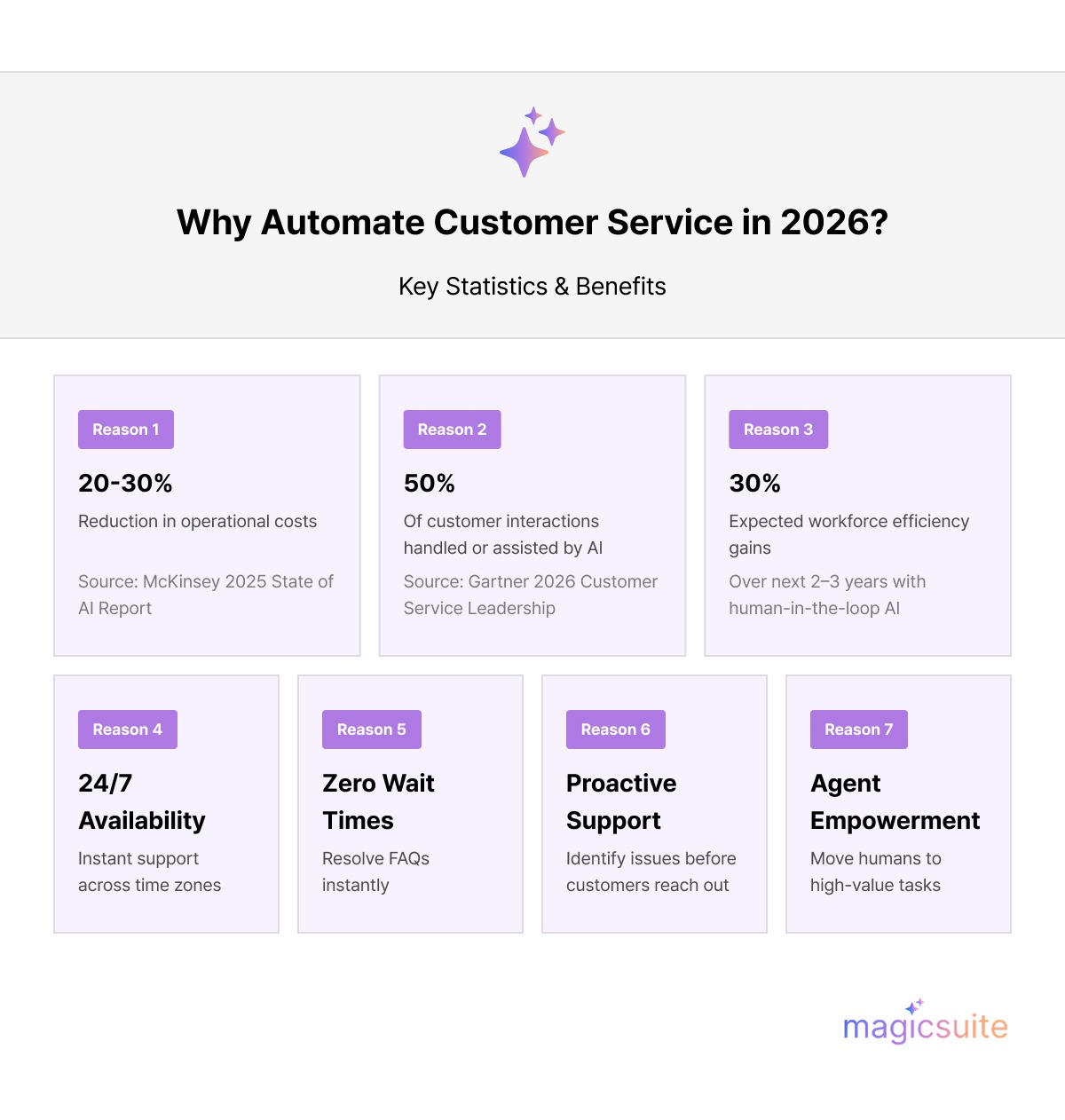
•Economic Impact: Companies integrating generative AI are seeing operational cost reductions of 20–30% and workforce efficiency gains of roughly 30%.
•Automation Scale: By 2026, AI-driven tools are projected to handle or assist in nearly 50% of all customer interactions.
•Core Benefits: Automation provides 24/7 availability and instant resolution for FAQs like order tracking while moving human agents to high-value problem solving.
•Tool Selection: Choice depends on your workflow, such as Gorgias for e-commerce, Salesforce or Zendesk for global corporations, and MagicTalk for rapid AI performance with zero setup friction.
•Implementation Strategy: Success involves a 10-minute audit of repetitive tickets, a 14-day pilot, and measuring the deflection rate to calculate ROI.
In 2026, customer service is no longer about just "answering tickets." It’s about anticipating needs. With the rise of Agentic AI and seamless omnichannel workflows, businesses are using automation to slash response times from hours to seconds. If you are looking to scale your support without ballooning your headcount, choosing the right tech stack is critical. This comprehensive guide reviews the top 10 customer service automation tools for 2026, categorized by their unique strengths.
Why Automate Customer Service in 2026?
Why Businesses Should Automate Customer Service in 2026
In their 2025 "State of AI" and "Contact Center Crossroads" reports, McKinsey noted that companies integrating generative AI into business processes are reducing operational costs by 20–30%. They specifically highlighted that even with a focus on "human-in-the-loop," workforce efficiencies of around 30% are expected over the next 2-3 years. Gartner’s 2026 Customer Service Leadership research also indicates that AI-driven "Agent Assist" and "Auto-Triage" tools are projected to handle or assist in nearly 50% of customer interactions.
The primary benefits of customer service automation include:
24/7 Availability: Instant support across time zones without graveyard shifts.
Zero Wait Times: Resolving FAQs (order tracking, password resets) instantly.
Proactive Support: Identifying friction points before the customer even reaches out.
Agent Empowerment: Moving humans from repetitive "copy-paste" tasks to high-value problem solving.
Quick Comparison: Which Customer Service Automation Tool Fits You?
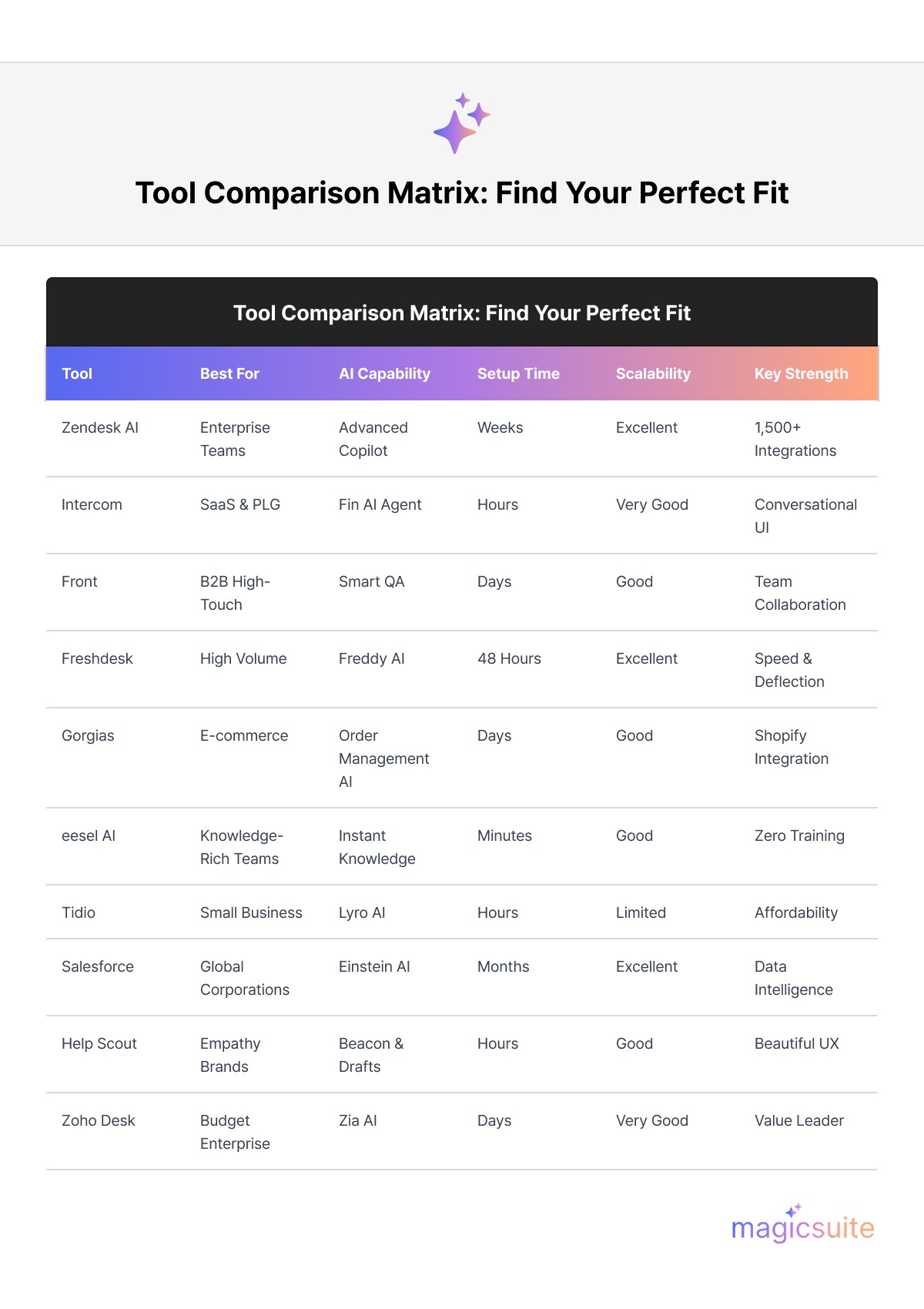
AI Automation Tools Comparison
1. Zendesk AI: The Enterprise Powerhouse
Zendesk remains the "Gold Standard" for large-scale operations. In 2026, it has moved beyond simple "if/then" triggers into a fully Agentic AI ecosystem.
The Core Intelligence: Advanced AI & Copilot
Zendesk’s 2026 update introduced the AI Expert layer. It doesn't just route tickets; it understands the "vibe" of your customer base.
Intelligent Triage: Automatically tags tickets with "Intent" (e.g., Refund Request), "Sentiment" (e.g., Angry), and "Language." This ensures your senior agents only handle the high-stakes, frustrated customers while the AI handles the rest.
Agent Copilot: This is a sidebar for your human agents. It proactively suggests the next best action, summarizes long email chains into three bullet points, and can even change its tone to match the customer’s mood.
Pricing Breakdown
Zendesk pricing is "modular," meaning you pay for the seat and then for the AI power.
Base Plan: Starts at $19/agent/month (Support Team), but most enterprises use the Suite Professional ($115) or Enterprise ($169).
The "AI Tax": To unlock the full Copilot and Advanced AI features, expect to add $50 per agent/month.
Usage Fees: You get a set number of "Automated Resolutions" (AR) included. Additional resolutions cost roughly $1.50 each.
Pros & Cons
Pros: Incredible scalability; integrates with over 1,500 apps; robust HIPAA and SOC2 compliance; powerful "Explore" analytics.
Cons: The "Zendesk Fatigue"—the UI can feel clunky and "ticket-heavy"; setup requires a dedicated admin; costs can skyrocket with add-ons.
Potential Dealbreaker: To truly unlock Zendesk’s power, you often need a dedicated "Zendesk Admin" or expensive consultants. For a lean startup, the administrative overhead can be a major bottleneck.
2. Intercom: The Conversational Leader
If Zendesk is a filing cabinet, Intercom is a living room. Intercom is built for SaaS and Product-Led Growth (PLG) companies that want to talk to customers inside their app.
The Core Intelligence: Fin AI Agent (V3)
Intercom’s AI, Fin, is widely considered the most "human-like" bot in 2026.
AI Procedures: You can give Fin a "Manual" (e.g., "How to process a warranty claim"). Fin will follow those steps strictly, asking for photos or order numbers, and only handing off to a human if the policy is met.
Proactive Messaging: Instead of waiting for a user to get stuck, Intercom uses "Banners" and "Tooltips." If a user stays on the "Billing" page for 2 minutes without clicking anything, Fin pops up: "Need help updating your card?"
Pricing Breakdown
Intercom uses a hybrid pricing model (Seats + Performance).
Base Plan: Starts at $29/seat/month (Essential) or $99/seat/month (Advanced).
Fin AI Cost: Intercom charges $0.99 per successful resolution. If Fin doesn't solve it and the customer asks for a human, you don't pay.
Proactive Support Plus: To use product tours and banners, there is a flat $99/month add-on fee.
Pros & Cons
Pros: Best-in-class UI/UX; setup takes hours, not weeks; turns support into a sales/marketing engine; "Fin" requires very little training.
Cons: Unpredictable monthly bills (if you have a viral day, your Fin fees will spike); "Lite" seats for non-support staff can add up; focus is heavily on chat, less on complex legacy email.
Potential Dealbreaker: Intercom charges for "successful resolutions." If your bot is configured poorly and "resolves" a ticket that actually frustrated the customer, you still pay. Bills can become highly unpredictable during viral growth spikes.
3. Front: The "Human-First" Automation Engine
Front is unique because it doesn't try to hide the fact that a human is involved. Instead, it uses AI to make those humans faster, smarter, and more collaborative. It is the premier choice for High-Touch B2B (Logistics, SaaS, Finance) where a "bot-only" experience would frustrate clients.
The Core Intelligence: Smart QA & Collaboration AI
Front’s 2026 automation suite focuses on the "behind-the-scenes" work that usually bogs down a team.
Smart Quality Assurance (Smart QA): Unlike traditional QA that samples 2% of tickets, Front's AI reviews 100% of conversations. it scores agents on empathy, professionalism, and compliance, flagging high-risk interactions for managers before a client churns.
AI Copilot & Summarizer: When an agent jumps into a thread with 50+ messages, the AI provides a 3-sentence summary of the current state of play. It also drafts replies that sound like the specific agent, not a generic robot.
Workflow Autopilot: It can automatically move a WhatsApp message about a "Urgent Quote" to a specific Slack channel and notify the Account Executive instantly.
Pricing Breakdown (2026)
Front’s pricing shifted in late 2025 to a more modular "AI add-on" structure.
Starter:$19/seat/month (Basic shared inbox, limited to 10 seats).
Professional:$59/seat/month (The sweet spot for most; includes omnichannel support).
Enterprise:$99/seat/month (Includes advanced security and custom reporting).
The AI Add-ons: * AI Autopilot: ~$0.89 per successful resolution.
Smart QA Bundle: ~$20/seat/month extra for full team coaching.
Pros & Cons
Pros: Feels exactly like an email inbox (zero learning curve); best-in-class collaboration (agents can chat internally inside a customer thread); great for SMS and WhatsApp.
Cons: No built-in phone support (requires integration); the "per-resolution" AI costs can become unpredictable during peak seasons.
Potential Dealbreaker: Not a "Deflection" Specialist. If your goal is to have 90% of your tickets handled by a bot so humans never see them, Front isn't for you. It’s built for teams that want to be involved in the conversation.
4. Freshdesk: The Scalable "Speed" Platform
Freshdesk is built for teams that need to handle high volumes with extreme efficiency. Its AI, Freddy, is one of the most mature on the market, focused on "Deflection"—solving the problem before an agent even sees it.
The Core Intelligence: Freddy AI (Agent & Copilot)
Freddy AI is split into two distinct roles:
Freddy AI Agent: A customer-facing bot that uses "Vertical AI." It doesn't just chat; it performs tasks (e.g., "Freddy, can you extend my trial by 7 days?"). It integrates natively with tools like Stripe and Shopify to execute these changes.
Auto-Suggestion & Triage: As an agent reads a ticket, Freddy scans your entire knowledge base and says, "I'm 92% sure this article solves the problem." The agent clicks one button to send a perfectly formatted response.
Predictive Insights: Freddy alerts managers if it detects a "SLA Breach" risk (e.g., "This ticket has been idle for 2 hours and the customer is growing frustrated").
Pricing Breakdown (2026)
Freshdesk offers a very accessible entry point but scales up for power users.
Growth:$15/agent/month (Basic automation and Freddy's suggested replies).
Pro:$49/agent/month (Adds omnichannel support and 500 free AI Agent sessions).
Enterprise:$79/agent/month (Adds skill-based routing and "Freddy Insights").
The AI Add-ons:
Freddy Copilot:$29/agent/month (Includes summarization and drafting).
Freddy AI Agent:$100 per 1,000 sessions (A "session" is a 24-hour window of conversation).
Pros & Cons
Pros: Extremely fast to set up (under 48 hours for basic teams); the "Free for 2 agents" tier is great for startups; highly customizable "Customer Portals."
Cons: Can feel "traditional" compared to Intercom's modern chat interface; higher tiers get expensive quickly if you have many agents.
Potential Dealbreaker: Shopify Lock-in. Gorgias is built specifically for e-commerce. If you move away from Shopify or BigCommerce, or if you run a non-retail business (like a service agency), 80% of the tool's value disappears.
5. Gorgias: The E-commerce Specialist
Gorgias is widely considered the "OS" for Shopify support. In 2026, it has transitioned from a help desk into a revenue-generating platform that treats every support ticket as a potential sale.
The Core Intelligence: AI Agent for E-com
Gorgias’s AI doesn't just "talk"; it has deep permissions within your store's backend.
Automated Order Management: The AI can independently handle the "big three" of e-commerce: Track, Refund, and Cancel. If a customer asks for a refund, the AI checks your policy, verifies the item status in Shopify, and can issue the credit instantly.
Sentiment-Based Triage: It identifies "Urgent" tickets—like a customer asking to change a shipping address before a package leaves the warehouse—and moves them to the top of the queue.
Pricing Breakdown
Gorgias uses a ticket-based model rather than a per-user model.
Starter:$10/month (up to 50 tickets).
Basic:$60/month (300 tickets).
Pro:$360/month (2,000 tickets).
AI Agent Cost: Billed at $0.75 – $1.00 per resolution. If the AI solves the ticket without a human, you pay the fee; if it escalates to an agent, you don't.
Pros & Cons
Pros: Deepest Shopify/BigCommerce integration; allows agents to see customer lifetime value (LTV) right next to the ticket.
Cons: Costs can spike during holiday sales (Black Friday/Cyber Monday) due to ticket-based pricing.
Potential Dealbreaker: Shopify Lock-in. Gorgias is built specifically for e-commerce. If you move away from Shopify or BigCommerce, or if you run a non-retail business (like a service agency), 80% of the tool's value disappears.
6. eesel AI: The "Instant Knowledge" Brain
eesel AI is the 2026 solution for teams that are "documentation rich but time poor." It is a plug-and-play AI layer that sits on top of your existing tools.
The Core Intelligence: Knowledge Integration
Zero-Training Setup: You don't "program" eesel. You point it at your Slack, Google Drive, Notion, and Confluence. Within minutes, it indexes that data to answer questions.
Internal Copilot: In 2026, eesel is most popular as an internal tool. When an agent is confused about a complex company policy, they ask the eesel bot in Slack, and it cites the exact internal document for them.
Pricing Breakdown (2026)
Team Plan:$299/month flat rate. Includes up to 1,000 AI interactions.
Business Plan:$799/month. Includes 3,000 interactions and advanced "AI Actions" (like the ability for the bot to check a database via API).
Pros & Cons
Pros: Setup takes minutes; flat-rate pricing is great for large teams with high agent counts but moderate ticket volume.
Cons: Not a standalone helpdesk; you still need a tool like Zendesk or Front to "house" the conversations.
Potential Dealbreaker:. eesel AI is a "layer." You still need an actual inbox (like Zendesk or Gmail) to receive Not a Standalone Helpdesk the messages. It adds to your tech stack rather than replacing a part of it.
7. Tidio: The Small Business Powerhouse
Tidio is the go-to for startups that need to look bigger than they are. In 2026, its AI agent, Lyro, became remarkably accessible.
The Core Intelligence: Lyro AI & Visual Flows
Visual Chatbot Builder: A drag-and-drop canvas that lets you build "Logic Trees." For example: If a visitor is on the Pricing Page -> Wait 10 seconds -> Ask if they want a discount code.
Lyro AI: Unlike "Flows," Lyro uses LLMs to answer open-ended questions based on your website content.
Pricing Breakdown
Free:$0 (50 conversations/month).
Starter:$29/month (100 conversations).
Growth:$59/month (Up to 2,000 conversations).
Lyro AI Add-on: Starts at $39/month for 50 AI-resolved conversations.
Pros & Cons
Pros: Extremely affordable; very easy-to-use mobile app for owners on the go.
Cons: Branding ("Powered by Tidio") is hard to remove on lower tiers; limits on "unique visitors" can be restrictive for growing sites.
Potential Dealbreaker: Limited Enterprise Features. While great for SMBs, Tidio lacks the deep "Skill-Based Routing" and "Global Sandbox Environments" that large corporations require for security and compliance.
8. Salesforce Service Cloud: The Data Giant
For massive organizations, support doesn't exist in a vacuum—it exists in a CRM. Salesforce is the heavy hitter for data-driven enterprises.
The Core Intelligence: Einstein AI & Agentforce
Account Intelligence: Einstein analyzes the entire history of a customer—not just support tickets, but their past purchases and marketing interactions.
Predictive Churn: It flags customers who are "at risk" based on the frustration levels detected in their messages.
Pricing Breakdown (2026)
Enterprise:$165/user/month.
Unlimited:$330/user/month (Includes full Einstein AI features).
Einstein 1 Edition:$500/user/month (Everything included: Data Cloud, Slack, and Advanced AI).
Pros & Cons
Pros: Unrivaled data reporting; connects support to the sales pipeline.
Cons: Requires a certified Salesforce Admin to manage; extremely high "Total Cost of Ownership."
Potential Dealbreaker: The "Salesforce Tax." Beyond the high license cost, the "total cost of ownership" is massive. You usually need a certified developer just to make minor changes to your automation flows.
9. Help Scout: The "Human-Centric" Inbox
Help Scout is designed for brands that hate the "feel" of a ticket. It uses automation to hide the machinery and keep the experience personal.
The Core Intelligence: Beacon & AI Drafts
Beacon: A smart widget that suggests the right Help Center article based on which page the user is currently browsing.
AI Summarize: If a customer sends a 1,000-word email, the AI provides a 3-bullet point summary for the agent instantly.
Pricing Breakdown (2026)
Help Scout recently moved to a contact-based model to encourage team collaboration.
Standard:$50/month (includes 100 contacts/month).
Plus:$75/month (includes advanced permissions and 100 contacts).
AI Answers (Add-on):$0.75 per resolution.
Pros & Cons
Pros: The most beautiful and simple UI in the industry; great for creative and "empathy-first" brands.
Cons: Lacks the complex "If/Then" routing power of Zendesk or Salesforce.
Potential Dealbreaker: Simplicity is a Ceiling. If you need complex conditional logic (e.g., "If a customer is from France AND spent >$1,000 AND it's a Tuesday, route to VIP"), Help Scout’s simplicity will frustrate you.
10. Zoho Desk: The Value Leader
Zoho Desk is the "budget enterprise" option. It provides 90% of the features of Salesforce at 20% of the cost.
The Core Intelligence: Zia & Blueprint
Blueprint: A visual tool that forces agents to follow a specific "process." For a hardware return, an agent cannot close the ticket until the AI verifies a tracking number has been entered.
Zia AI: An assistant that performs "Anomaly Detection"—it will alert you if you suddenly get 50 tickets about a "Server Down" issue in 5 minutes.
Pricing Breakdown (2026)
Standard:$14/agent/month (billed annually).
Professional:$23/agent/month.
Enterprise:$40/agent/month (This is where Zia AI is unlocked).
Pros & Cons
Pros: Best "feature-to-dollar" ratio; integrates perfectly with the Zoho ecosystem (Books, CRM, Projects).
Cons: The interface can feel cluttered and dated compared to modern "clean" tools like Front or Help Scout.
Potential Dealbreaker: Ecosystem Inertia. Zoho works best when you use all Zoho apps (Zoho CRM, Zoho Books). If you try to mix it with high-end tools like HubSpot or Jira, the integrations can be finicky.
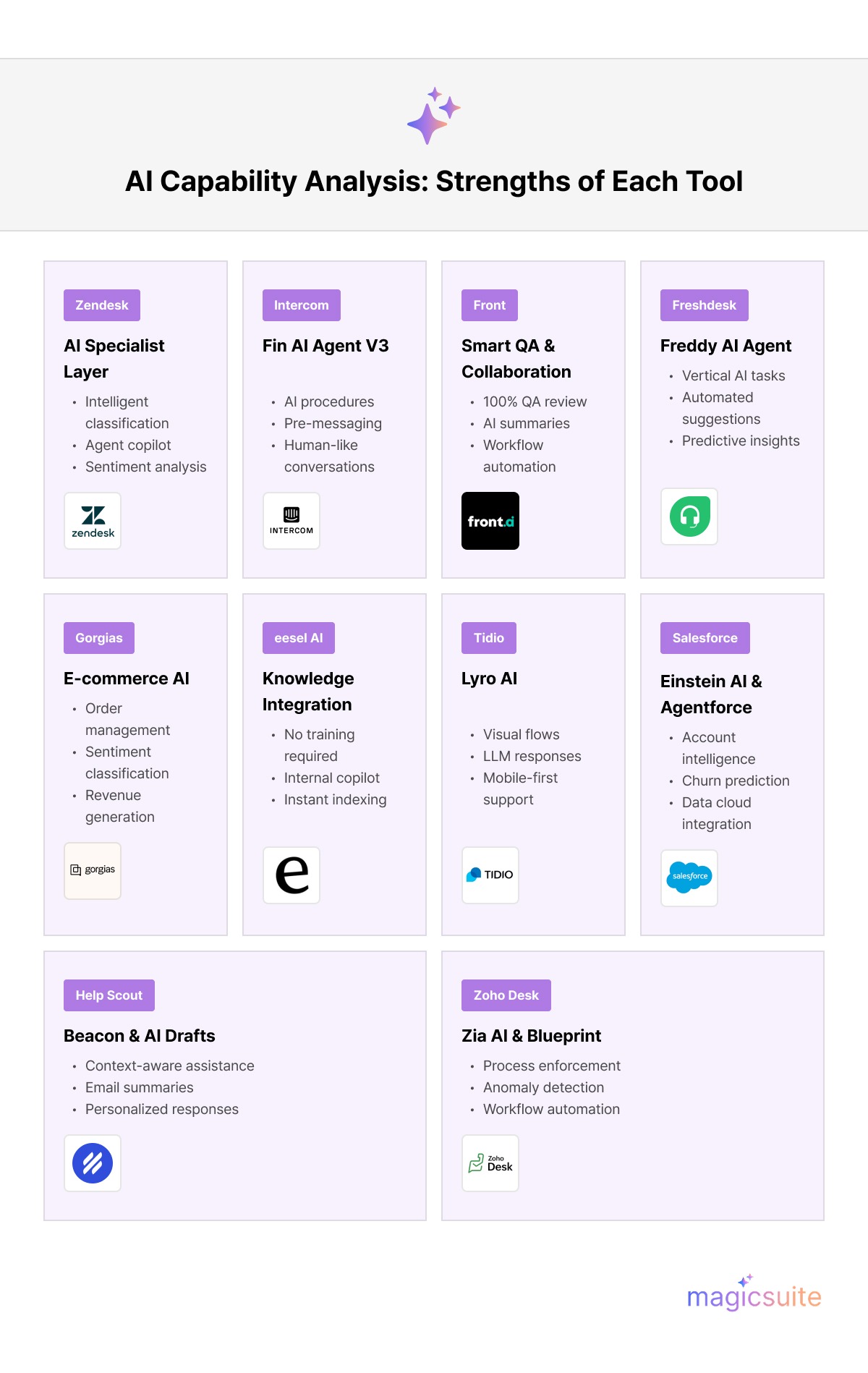
Key Strengths of AI Automation Tools
Special Mention: MagicSuite.ai (MagicTalk)
Best for: Rapid AI Deployment & Multi-Agent Productivity
While Zendesk and Salesforce require months of architecture, MagicTalk (the flagship customer service tool from MagicSuite) is built for the "plug-and-play" era. It is specifically designed to allow small teams to punch way above their weight class by using a "Human-AI Partnership" model.
The Core Intelligence: MagicAI & Zero-Code Knowledge
The standout feature of MagicTalk is its ability to turn one human agent into a "Super-Agent."
MagicAI & Zero-Code Knowledge
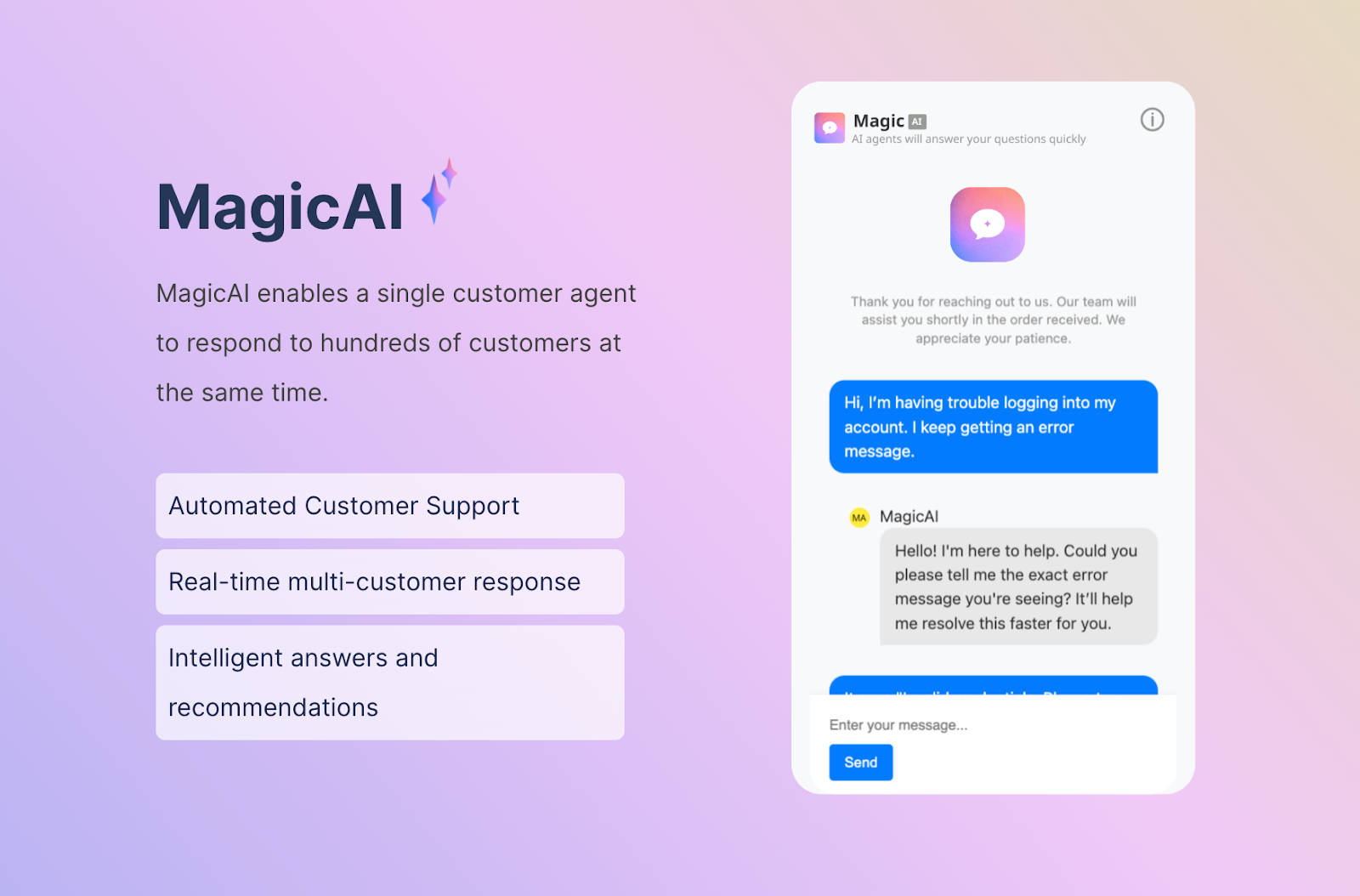
MagicAI (The Multi-Response Engine): This is a game-changer for high-volume periods. MagicAI allows a single human agent to monitor and respond to hundreds of customers simultaneously. It drafts real-time suggestions based on your data, so the human only needs to "approve" or "tweak" rather than type from scratch.
Instant Knowledge Sync: Unlike bots that require manual "intent training," MagicTalk ingests your existing FAQs, PDF manuals, and past resolved tickets to build a brain in minutes.
Seamless Escalation: If the AI hits a wall, it transfers the customer to a human with a full context summary, ensuring the customer never has to repeat themselves.
Pricing Breakdown
MagicTalk offers one of the most transparent and scalable pricing structures on this list:
Free Plan:$0/month (20 chats, 1 chatbot—perfect for testing).
Starter:$45/month (1,000 chats, 3 active chatbots).
Team:$119/month (5,000 chats, 5 members included).
Pros:Privacy-first (GDPR/HIPAA compliant); 92% accuracy rate out of the box; setup takes 3–5 days vs. weeks for competitors.
Cons: Fewer native integrations with legacy enterprise CRMs compared to Salesforce; best suited for web and messaging channels rather than complex voice-only setups.
Which Tool is Right for You?
How to Decide the best Customer Service Automation Tool for You
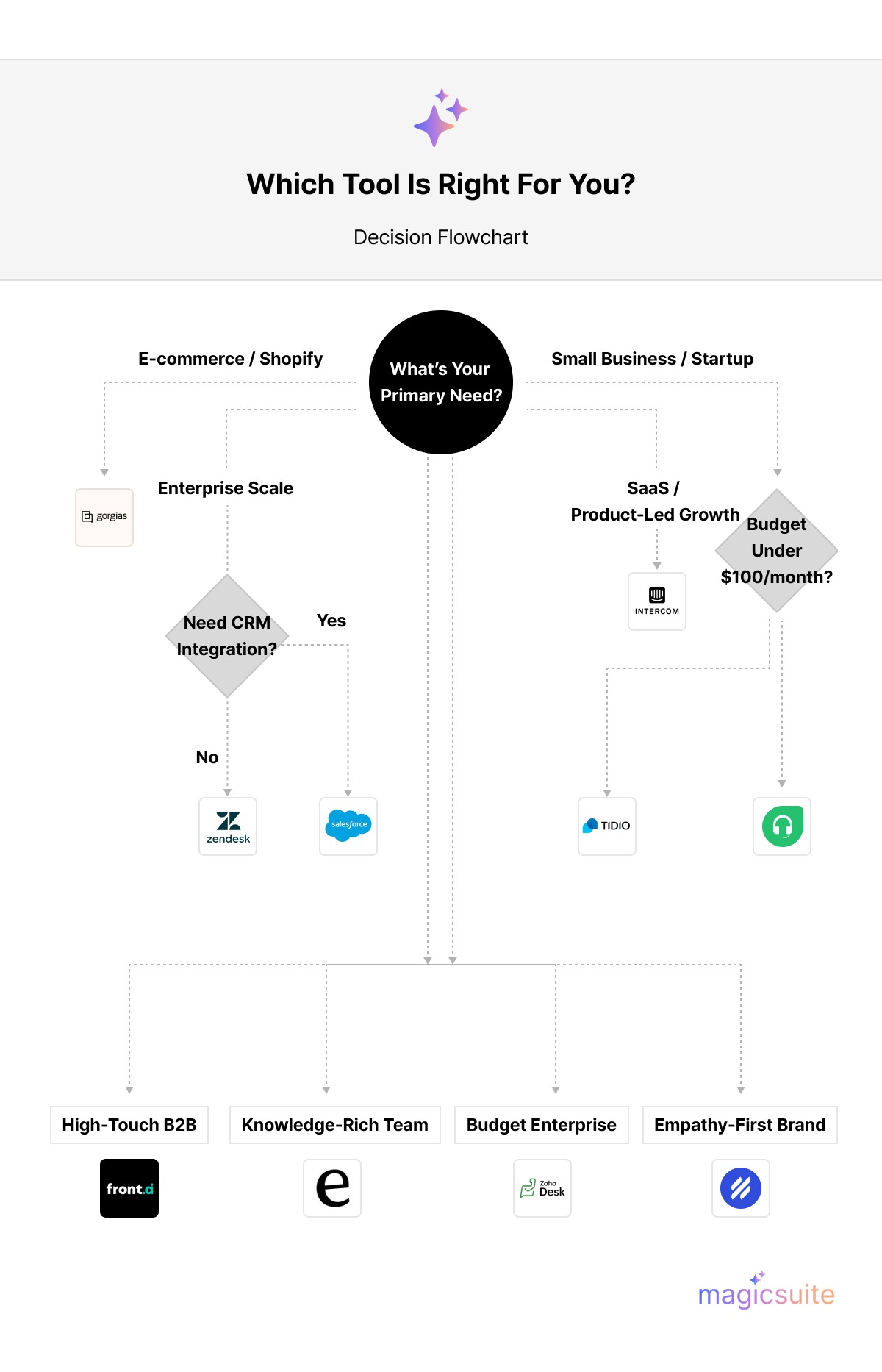
Choosing the right customer service automation tool comes down to your Data Source and your Team's Workflow:
If your knowledge is in Google Docs/Notion: Go with eesel AI.
If you sell on Shopify/Amazon: Go with Gorgias.
If you want Maximum AI Performance with zero setup friction: Go with MagicTalk.
If you are a Global Corporation: Go with Salesforce or Zendesk.
Ready to Transform Your Support?
3-Step Execution Plan to Automate Your Customer Service Strategy
The "perfect" tool doesn't exist, but the perfect tool for your workflow does. Don't let another quarter pass with rising ticket volumes and stagnant CSAT scores.
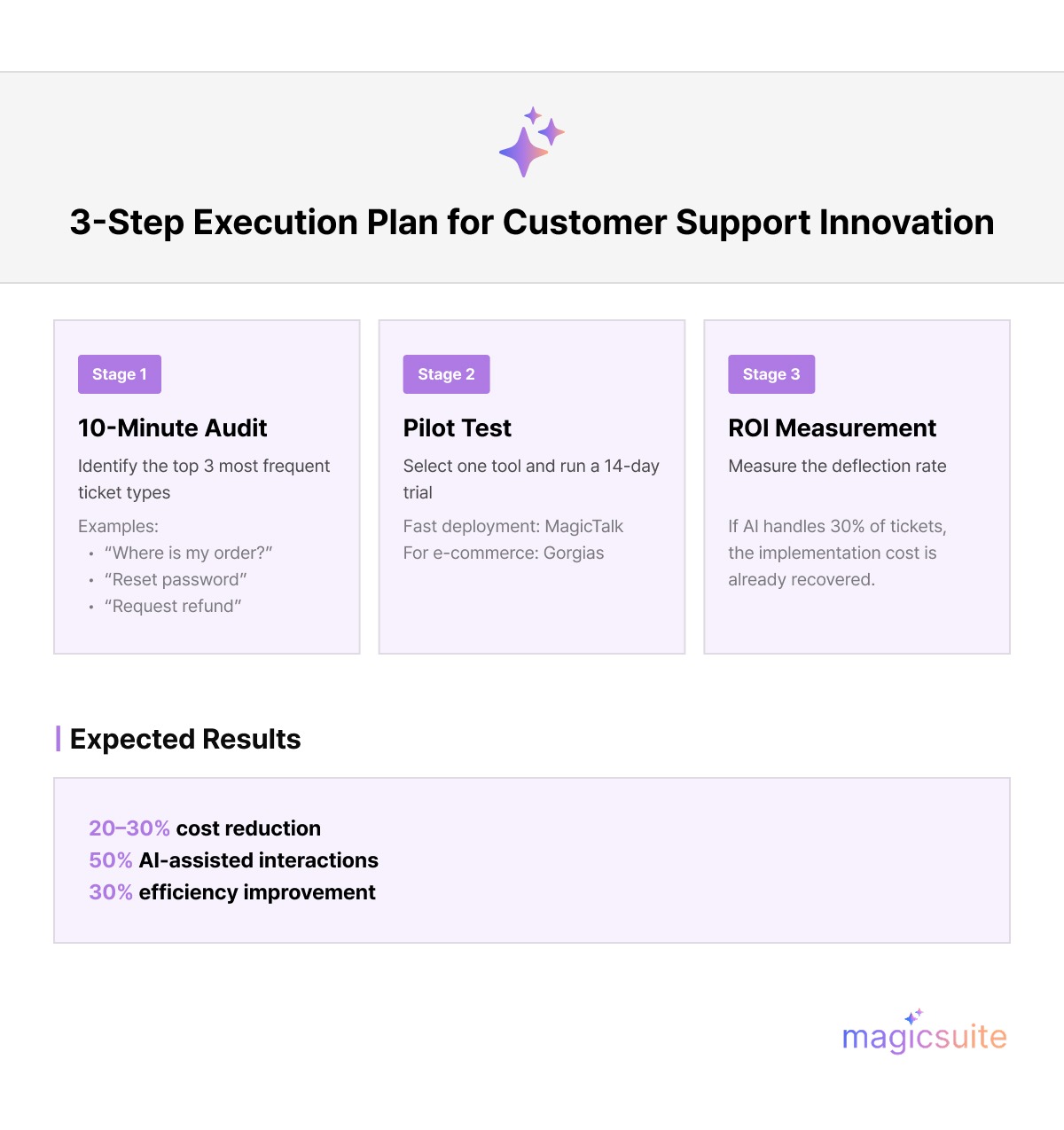
Your 3-Step Action Plan:
The 10-Minute Audit: Identify your top 3 most repetitive tickets (e.g., "Where is my order?").
The Pilot Test: Pick one tool from this list—like MagicTalk for rapid deployment or Gorgias for E-com—and run a 14-day trial.
The ROI Calculation: Measure the "Deflection Rate." If the AI handles even 30% of those tickets, you’ve already paid for the software.
Top Agile Pick for 2026
Get Started with our Top Agile Pick
Deploy your first agent in minutes with maximum AI performance and zero setup friction.
Start testing with a 100% free plan today.
Hanna is an industry trend analyst dedicated to tracking the latest advancements and shifts in the market. With a strong background in research and forecasting, she identifies key patterns and emerging opportunities that drive business growth. Hanna’s work helps organizations stay ahead of the curve by providing data-driven insights into evolving industry landscapes.