

AI agents are reshaping digital commerce, raising the stakes for enterprise readiness now.

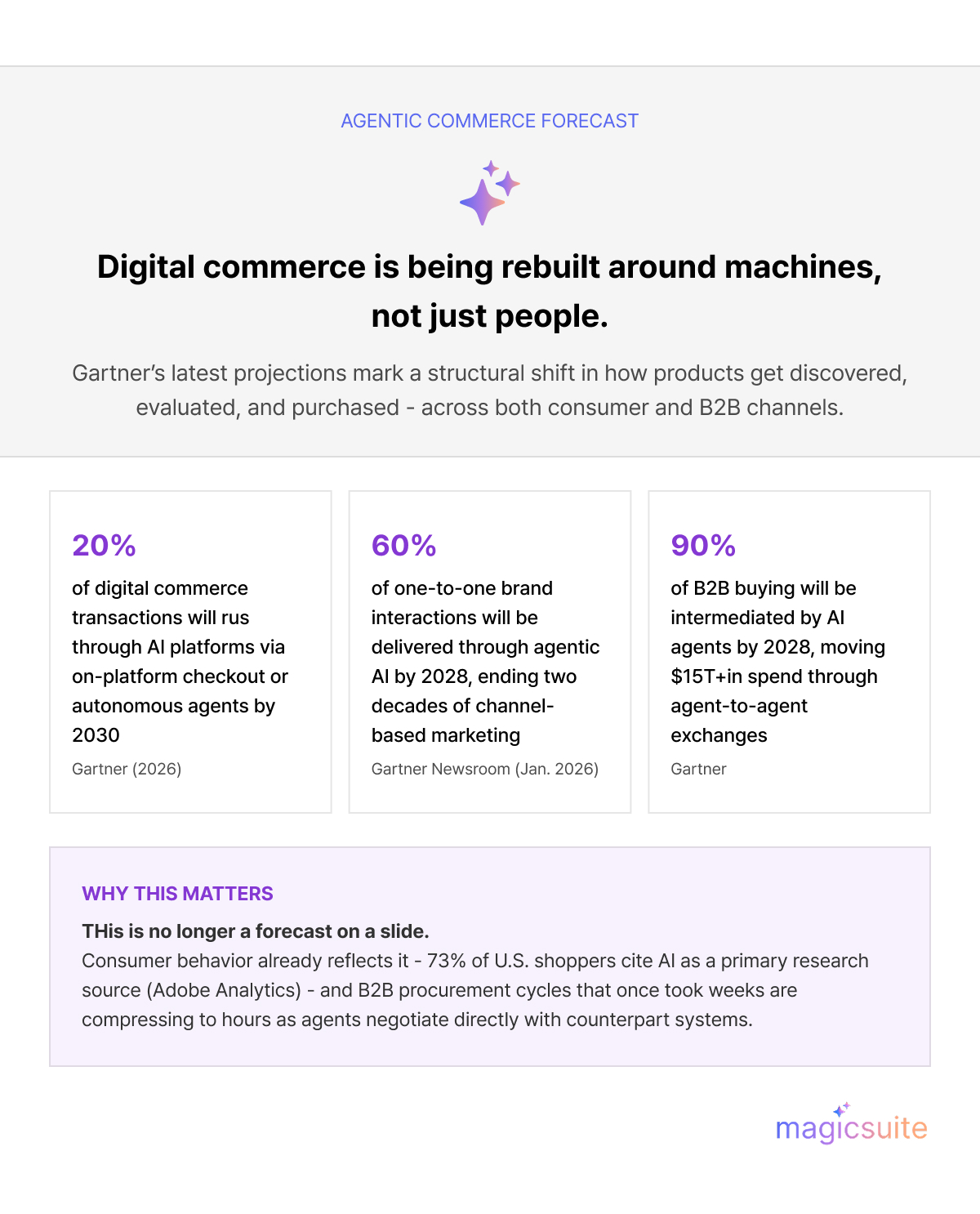
A shopper no longer has to visit your homepage to buy from you. Increasingly, they don't visit at all - an AI agent does it for them, comparing prices, reading return policies, and completing checkout on their behalf. Gartner projects that by 2030, 20% of digital commerce transactions will run through AI platforms via on-platform checkout or autonomous agents. That shift is no longer a forecast on a slide - it is already rewriting how products get discovered, evaluated, and purchased.
For enterprise leaders, this raises an uncomfortable question: your storefront, your product data, and your customer experience were built for people. Are they built for machines, too?
This article breaks down what the latest research from Gartner, McKinsey, MIT, IDC, and Bain actually shows about AI agents in digital commerce - where the real returns are coming from, why some organizations are pulling far ahead of others, and what separates enterprises capturing measurable value from those burning budget on pilots that never scale.
Digital commerce has always been designed around a human decision-maker: someone scrolling, comparing tabs, reading reviews, and eventually clicking "buy." Agentic commerce breaks that assumption. Instead of a person navigating a storefront, a semi-autonomous software agent - acting on a shopper's or a company's behalf - perceives available options, evaluates them against stated goals, and executes the purchase.
Gartner defines agentic AI as autonomous or semiautonomous software entities that use AI techniques to perceive, decide, act, and achieve goals without step-by-step human direction. In a commerce context, that means an agent might:
The scale of this shift is already visible in consumer behavior. Adobe Analytics reports that 73% of US consumers now cite AI as a primary source for product research, and 38% have already used generative AI tools for online shopping, with over half planning to. In Europe, McKinsey's research finds 63% of shoppers now use AI to compare brands, models, and prices, and 55% use it simply to learn about a product category before buying. Kearney's research puts near-term intent even higher: 60% of shoppers expect to use an AI agent for shopping within the next 12 months, and 73% already say they're familiar with the tools.
On the B2B side, the numbers are even more dramatic. Gartner forecasts that by 2028, 90% of B2B buying will be intermediated by AI agents, pushing more than $15 trillion in B2B spend through agent-to-agent exchanges. Procurement cycles that once took weeks of human negotiation are being compressed to hours - or minutes - as agents evaluate vendors, check compliance, and negotiate pricing directly with counterpart systems.
It's tempting to file agentic commerce under the same category as the chatbot boom of the late 2010s. That comparison undersells what's happening. Conversational bots answered questions; commerce agents take actions with financial and operational consequences - authorizing payments, committing to contracts, and adjusting supply orders without a human clicking "approve" each time.
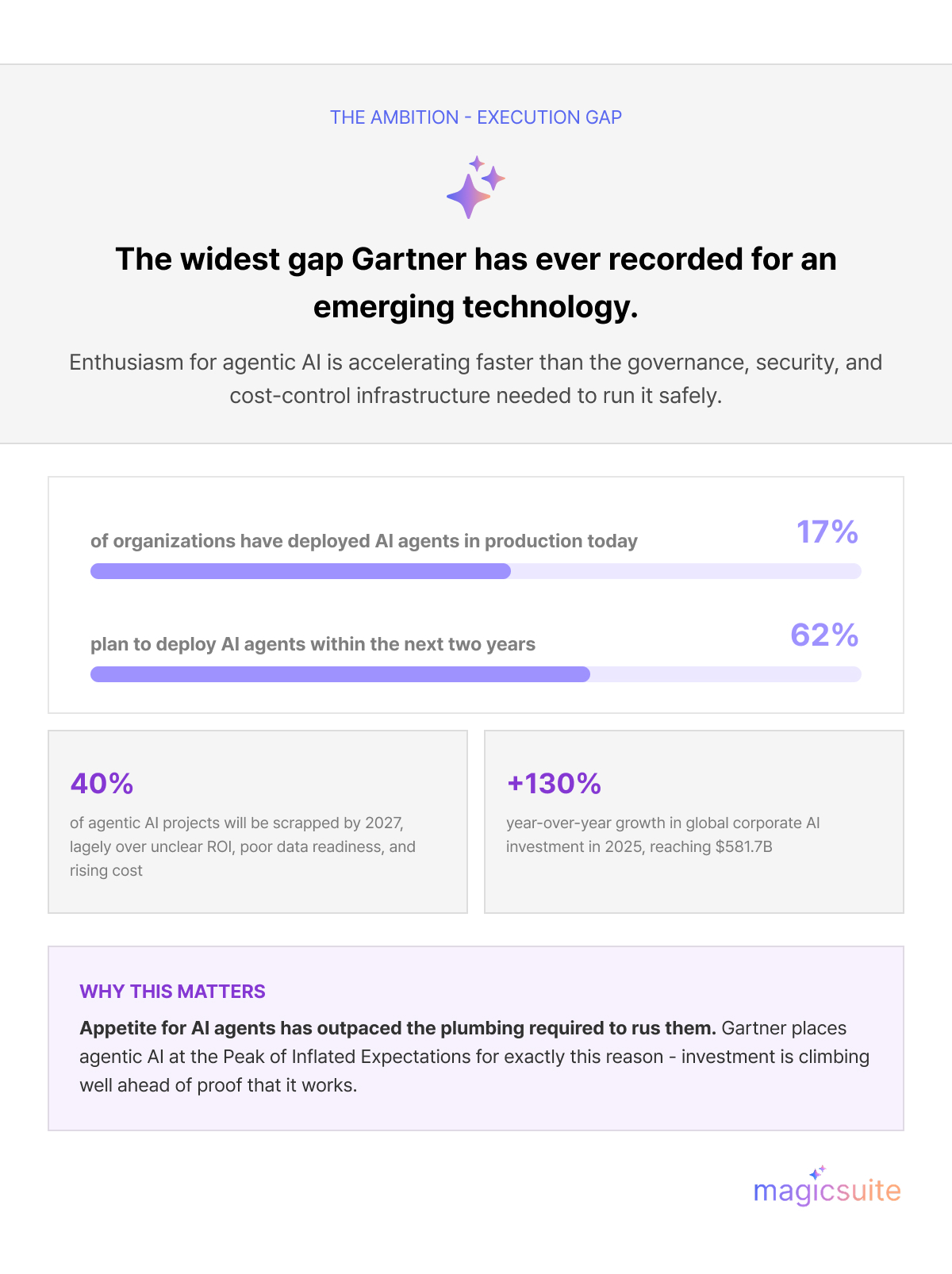
That distinction is exactly why Gartner places agentic AI at the Peak of Inflated Expectations in its 2026 Hype Cycle. Enthusiasm and adoption intent are accelerating faster than the governance, security, and cost-control infrastructure needed to support autonomous decision-making at scale. Put simply: the appetite for enterprise AI agents has outpaced the plumbing required to run them safely. It also marks a broader inflection point: generative AI in e-commerce started as a tool for writing product descriptions and personalizing recommendations, and is now being asked to make and execute purchasing decisions outright.
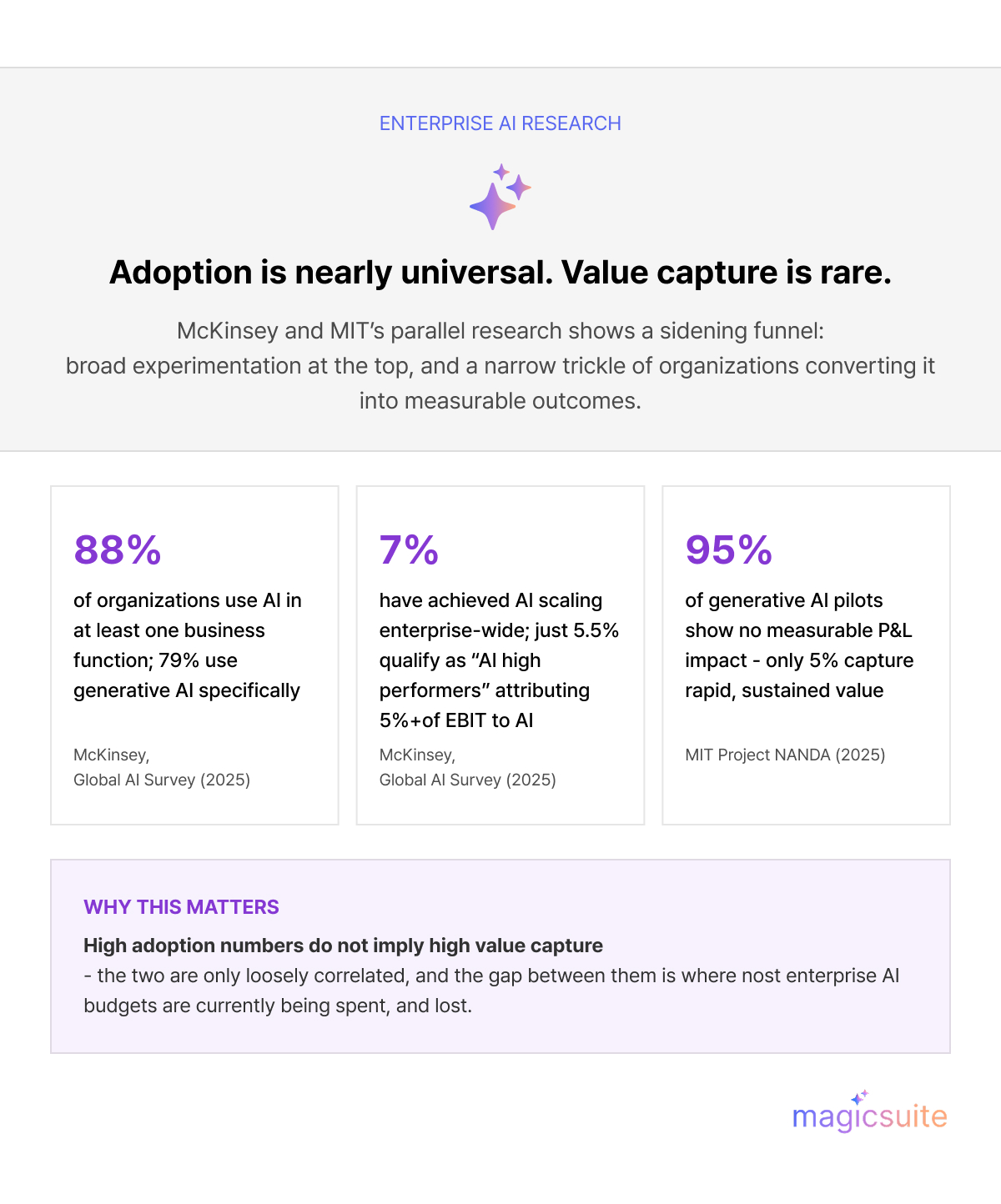
Enterprise AI adoption headlines can be misleading if read in isolation. The real story is a widening funnel - broad experimentation at the top, and a narrow trickle of organizations converting that experimentation into measurable business outcomes.
Adoption is nearly universal, but shallow:
Investment is climbing regardless of proof of ROI:
The ROI story is genuinely bifurcated:
That last figure deserves emphasis, because it directly shapes how leaders should read every other statistic in this article: high adoption numbers do not imply high value capture. The two are only loosely correlated, and the gap between them is where most enterprise AI budgets are currently being spent - and lost.
If deploying AI agents guaranteed returns, adoption curves and ROI curves would move together. They don't. MIT's research and McKinsey's parallel survey work point to a consistent, almost mechanical explanation: the differentiator is rarely the model. It's the organization around it.
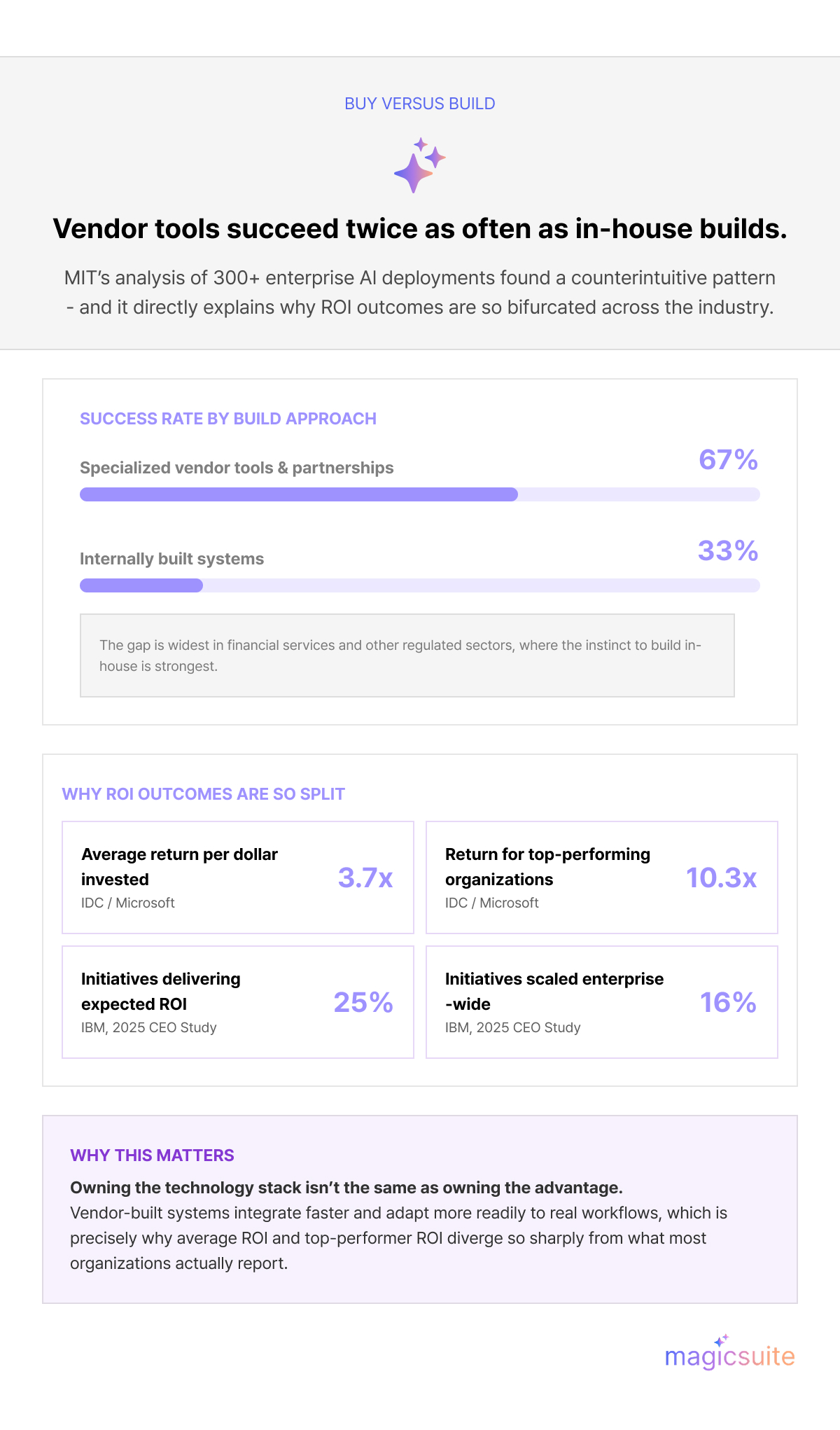
One of the more counterintuitive findings from MIT's analysis: enterprises that purchase AI tools from specialized vendors and form partnerships succeed at roughly 67%, compared with roughly one-third that rate for organizations that build proprietary systems internally. Financial services and other regulated sectors - where the instinct to build in-house is strongest - showed some of the widest gaps between attempted builds and delivered value.
This runs counter to a common enterprise assumption that owning the technology stack equals owning the advantage. In practice, vendor-built systems tend to integrate faster, adapt more readily to real workflows, and carry a shorter path from pilot to production.
McKinsey's correlation analysis across 25 organizational attributes found that redesigning workflows had the single largest measurable effect on whether an organization captured EBIT impact from generative AI. Simply layering an AI agent on top of an unchanged process rarely moves the needle - the value shows up when the underlying workflow itself is restructured around what the agent can now do.
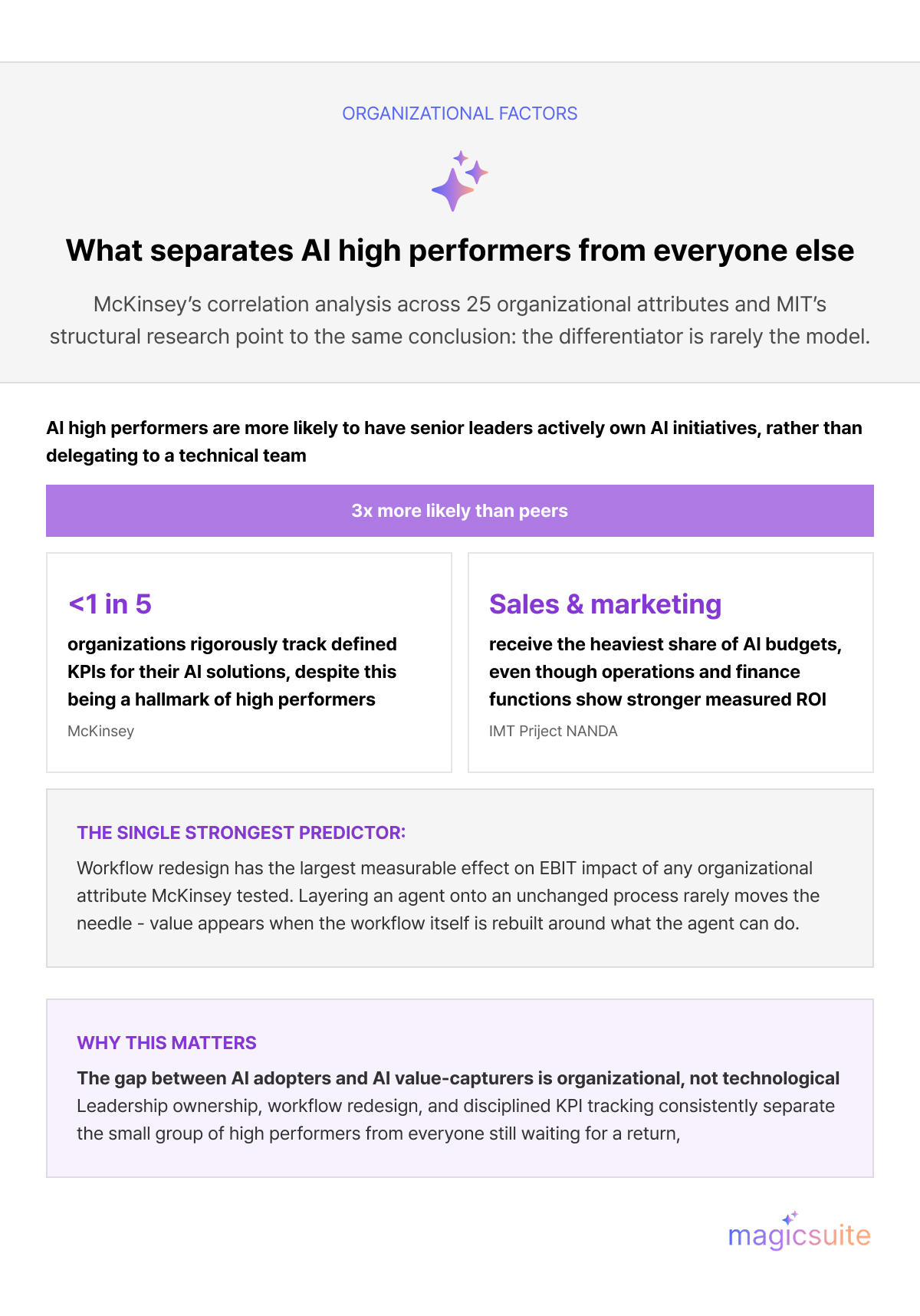
AI high performers - the 5.5% of organizations seeing material EBIT impact - are roughly three times more likely than their peers to report that senior leaders actively demonstrate ownership of AI initiatives, rather than delegating the effort entirely to a technical team. High performers also more consistently track defined KPIs for AI solutions; fewer than one in five organizations overall report doing this rigorously, according to McKinsey.
MIT's report isolates four structural patterns behind what it calls the "GenAI Divide":
Underneath all four patterns sits what MIT calls the "learning gap" - the inability of many enterprise AI tools to retain context, adapt to feedback, or integrate meaningfully into daily workflows. Executives interviewed for the study described AI systems that performed well in polished demos but collapsed once exposed to the friction of real operations: inconsistent data, shifting compliance requirements, and long-standing informal processes that a rigid tool simply couldn't accommodate.
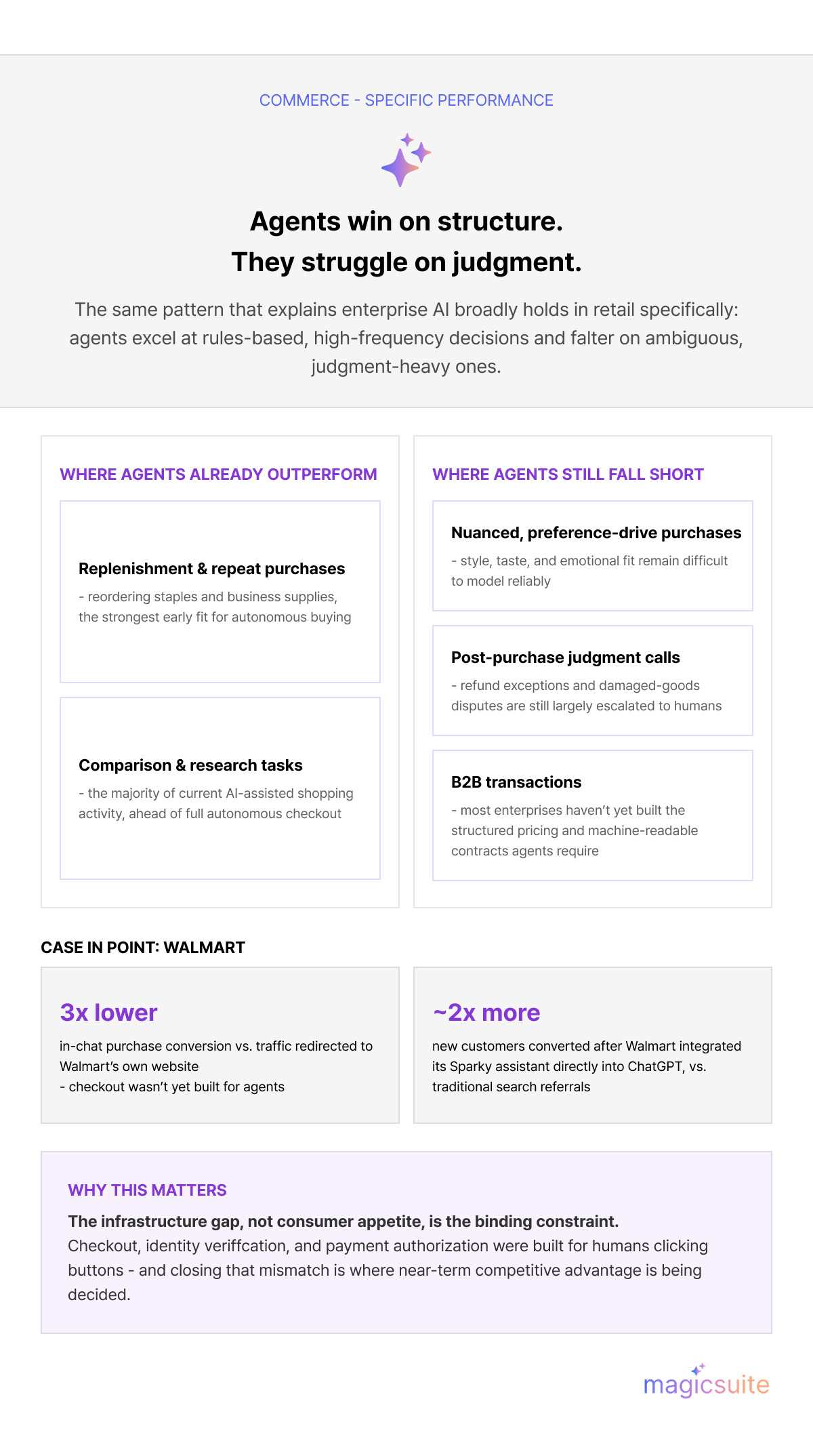
Despite the sobering ROI statistics, agentic commerce is not uniformly stalled. The pattern that separates success from failure in retail and e-commerce specifically mirrors the broader enterprise findings: agents perform well in structured, rules-based, high-frequency decisions, and poorly in ambiguous, judgment-heavy ones.
Where agents are already outperforming traditional channels:
That example captures the current reality of AI-powered commerce well: the infrastructure gap, not consumer appetite, is the binding constraint. Checkout flows, identity verification, and payment authorization were built for humans clicking buttons, not for agents executing API calls - and that mismatch is exactly where near-term competitive advantage is being decided.
Where agents are still struggling:
Gartner's guidance to enterprise leaders on digital commerce AI consistently returns to one theme: agents can only act on data they can actually read and trust. Product catalogs, pricing logic, and inventory feeds built for human shoppers browsing a webpage are frequently unusable by an autonomous agent parsing structured data via an API.
Enterprises preparing to compete for AI shopping agents' attention - and trust - should prioritize:
The common thread across every credible research source here is that agentic commerce rewards infrastructure discipline over speed of deployment. Enterprises racing to launch an agent-facing storefront without first solving the underlying data and governance problem are the ones most likely to end up inside Gartner's projected 40% cancellation rate. The enterprises pulling ahead treat AI commerce readiness as infrastructure work first and feature work second.
As AI agents intermediate more of the buying journey, the definition of "customer experience" itself is shifting. When an agent - not a person - is evaluating your product listing, the criteria for a persuasive storefront change substantially. Visual design, emotional brand storytelling, and traditional on-page SEO carry less weight when the "reader" is an algorithm parsing structured attributes.
This has real implications for AI-powered customer experience strategy:
Gartner's marketing research reinforces this shift at scale: by 2028, the firm expects 60% of brands to use agentic AI to deliver streamlined, one-to-one customer interactions, effectively ending the channel-based marketing model that has defined digital commerce for two decades.
The research converges on an uncomfortable but useful conclusion: AI agents in digital commerce are not a distant, speculative trend - they're already influencing how a meaningful share of consumers research, compare, and buy. But the enterprises actually capturing value from that shift remain a small minority, separated from the majority not by access to better models, but by cleaner data, redesigned workflows, disciplined governance, and leadership that treats AI as an operational transformation rather than a bolt-on feature.
That divide is precisely where the opportunity sits. Gartner's own numbers show the gap between ambition and execution is wider for agentic AI than for any other emerging technology it tracks - which means the enterprises that close that gap first will be operating with less competition than the adoption headlines suggest. The question worth asking isn't whether AI agents will reshape digital commerce. The data already answers that. The real question is whether your product data, checkout infrastructure, and organizational structure will be ready when the agents show up - because they already have.

Hanna is an industry trend analyst dedicated to tracking the latest advancements and shifts in the market. With a strong background in research and forecasting, she identifies key patterns and emerging opportunities that drive business growth. Hanna’s work helps organizations stay ahead of the curve by providing data-driven insights into evolving industry landscapes.