

Only 5.5% of firms get real AI marketing ROI - Deloitte 2026 reveals what separates leaders.

Marketing has always been a discipline that lives in the tension between creativity and accountability. But in 2026, a third force has entered the equation - artificial intelligence - and it is fundamentally reshaping how CMOs build the bridge between marketing activity and business outcomes.
This is not hype. The data is now clear. Deloitte's inaugural 2026 Growth Signals + Standards pulse survey, conducted with 50 senior marketing clients, captures a moment when AI adoption in marketing has become practically universal - yet meaningful AI business growth remains concentrated among a small cohort of organizations that have approached transformation differently. Understanding what separates those leaders from the rest is not merely an academic exercise. It is the central strategic challenge facing every CMO today.
This article draws on findings from Deloitte, Gartner, McKinsey, and Duke University's Fuqua School of Business to examine where AI-driven marketing is delivering measurable growth, why most enterprises are falling short, and what the path forward looks like for organizations determined to close the gap.
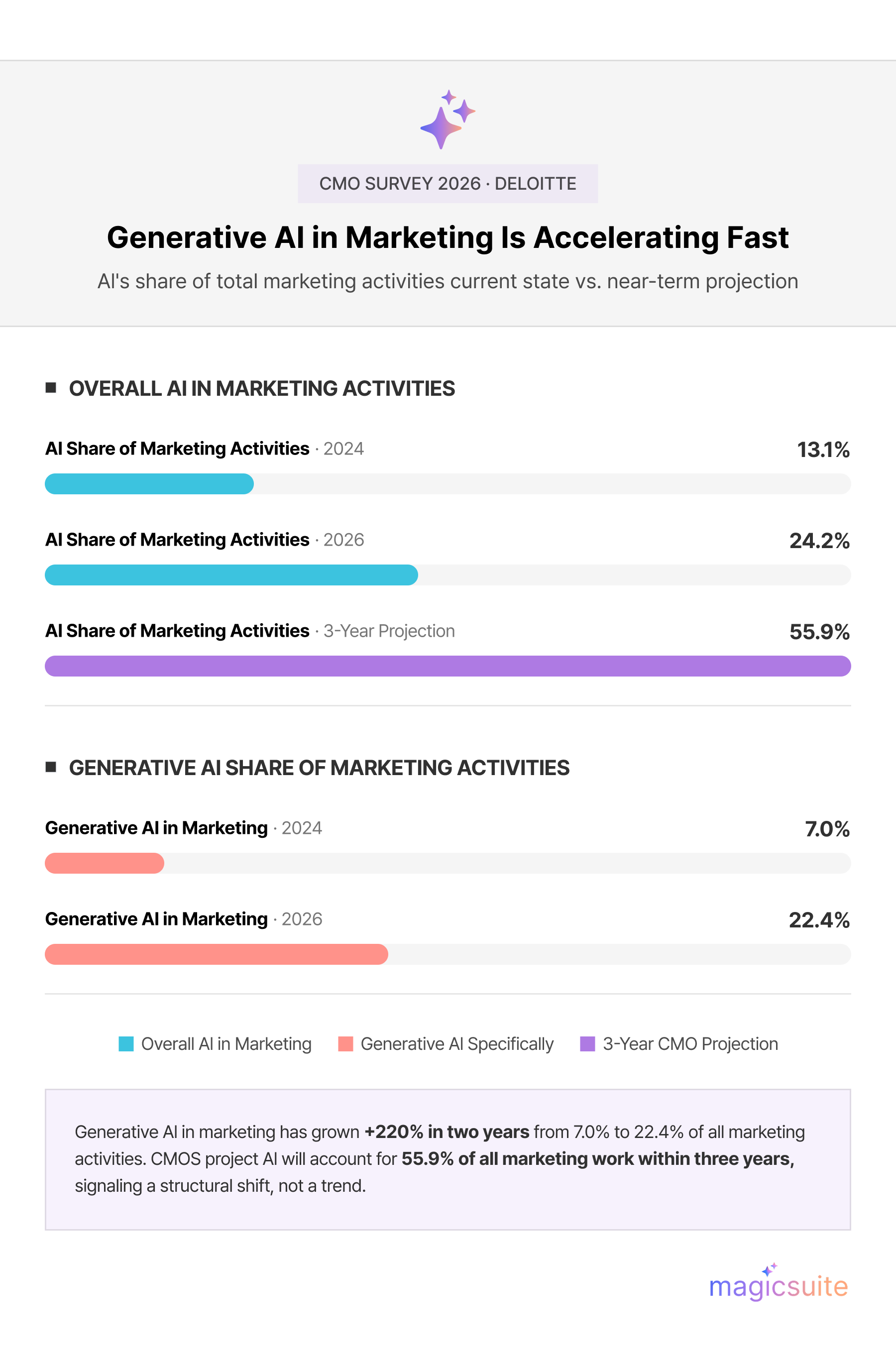
The headline numbers from the 2026 CMO Survey, co-sponsored by Deloitte and the American Marketing Association, tell a story of accelerating transformation. AI use in marketing has more than tripled since 2022. Generative AI in marketing has expanded at a remarkable pace - growing 220% in just two years, from 7.0% of marketing activities in 2024 to 22.4% in early 2026. CMOs project that AI will account for 55.9% of all marketing activities within three years.
Yet a paradox defines the current moment. Near-universal adoption is producing rare business impact.
McKinsey's 2025 State of AI report, drawing on responses from nearly 2,000 companies, found that:
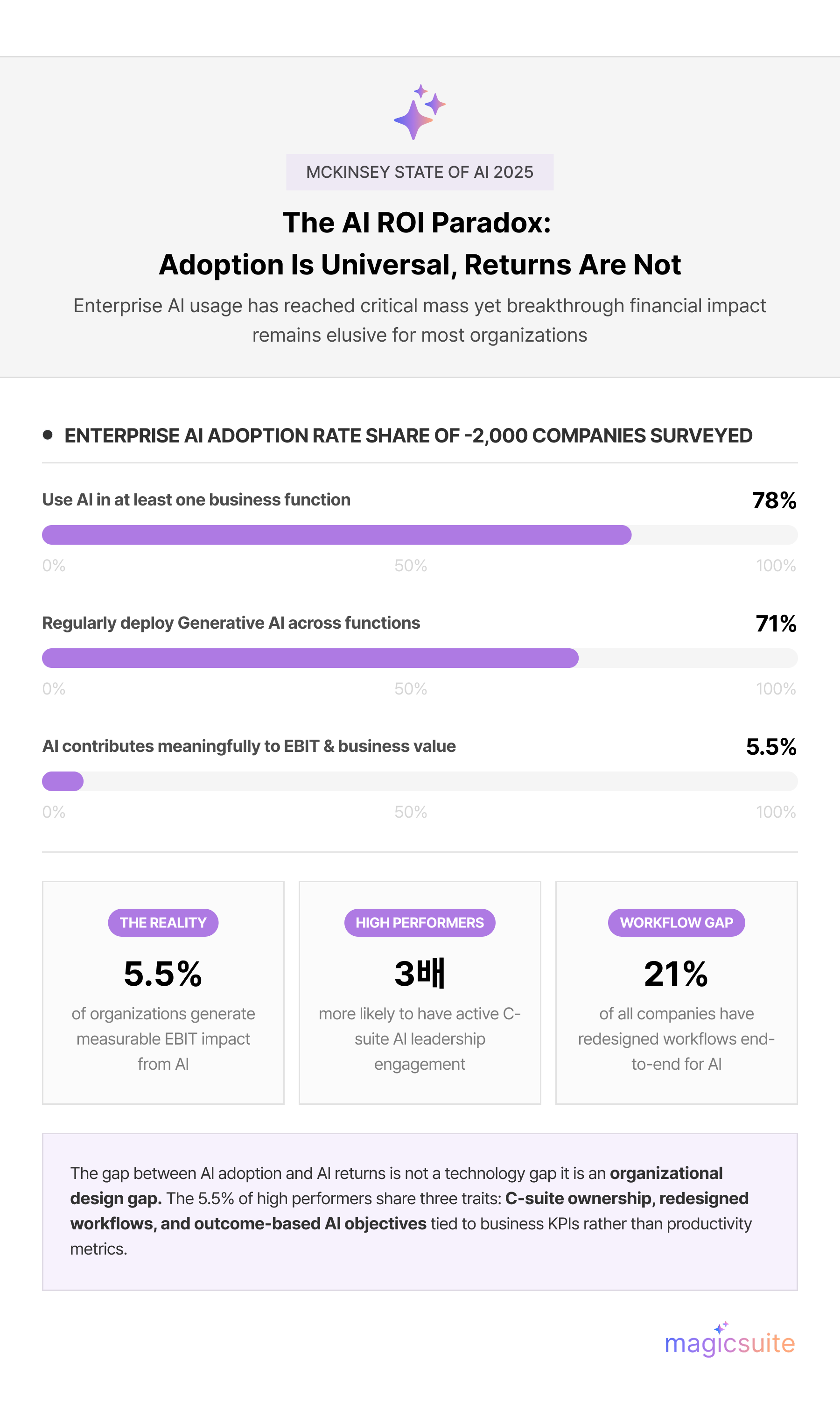
The gap between those who are experimenting with AI-powered marketing and those who are extracting real commercial returns is not a gap in technology access. It is a gap in organizational design, marketing performance measurement discipline, and leadership intent.
Deloitte's 2026 Growth Signals + Standards pulse survey provides one of the most targeted views available into how marketing leaders are navigating the transition from AI experimentation to AI enrichment. Surveying 50 clients in late 2025 to recap their 2025 AI investments and outlook for 2026, the report focuses on which use cases are gaining growth momentum, where foundational barriers persist, and how to run AI pilots more effectively.
Several findings stand out:
This framing matters because it shifts the conversation from "are we using AI" to "is our AI creating measurable commercial outcomes" - a distinction that defines the gap between AI marketing optimization and mere AI adoption.
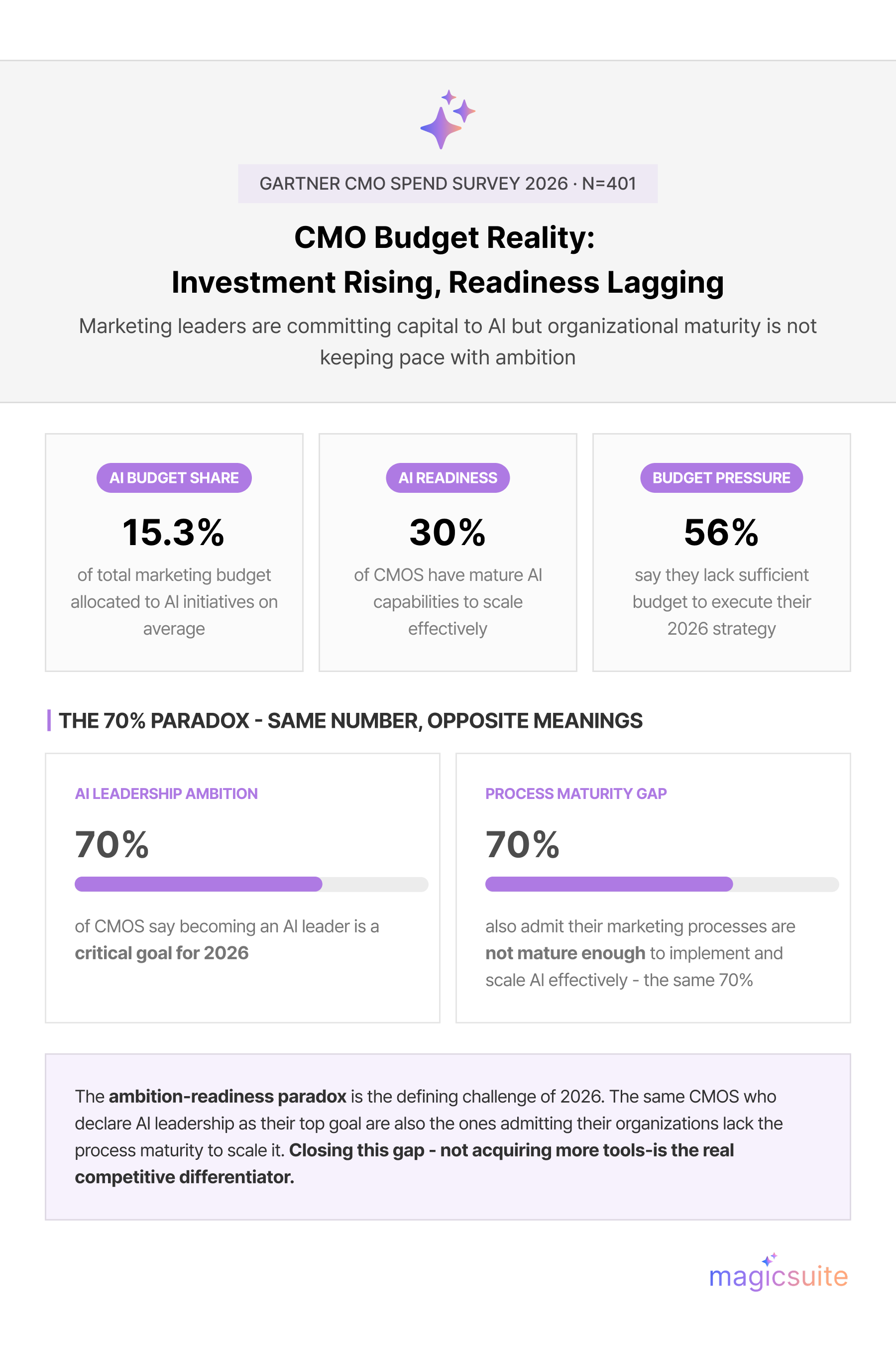
One of the most telling findings of 2026 comes from Gartner's annual CMO Spend Survey, conducted between January and March 2026 among 401 marketing leaders at organizations with annual revenues exceeding $1 billion. The numbers reveal a widening gap between financial commitment and organizational capability.
CMOs are now directing an average of 15.3% of their marketing budgets to AI initiatives. At the same time, 70% of CMOs say becoming an AI leader is a critical goal for 2026. Yet that ambition is not matched by internal preparedness: 70% also acknowledge that their marketing processes are not yet mature enough to implement and scale AI effectively, and only 30% report having fully developed AI readiness capabilities.
The broader budget context intensifies this challenge. Marketing budgets have remained effectively flat, rising only marginally to 7.8% of company revenue in 2026 from 7.7% in 2025. A majority - 56% of CMOs - say they do not have sufficient budget to execute their 2026 strategy. With growth funding constrained, AI-driven marketing is increasingly expected to do more than automate tasks. It is expected to multiply the marketing ROI on every dollar spent.
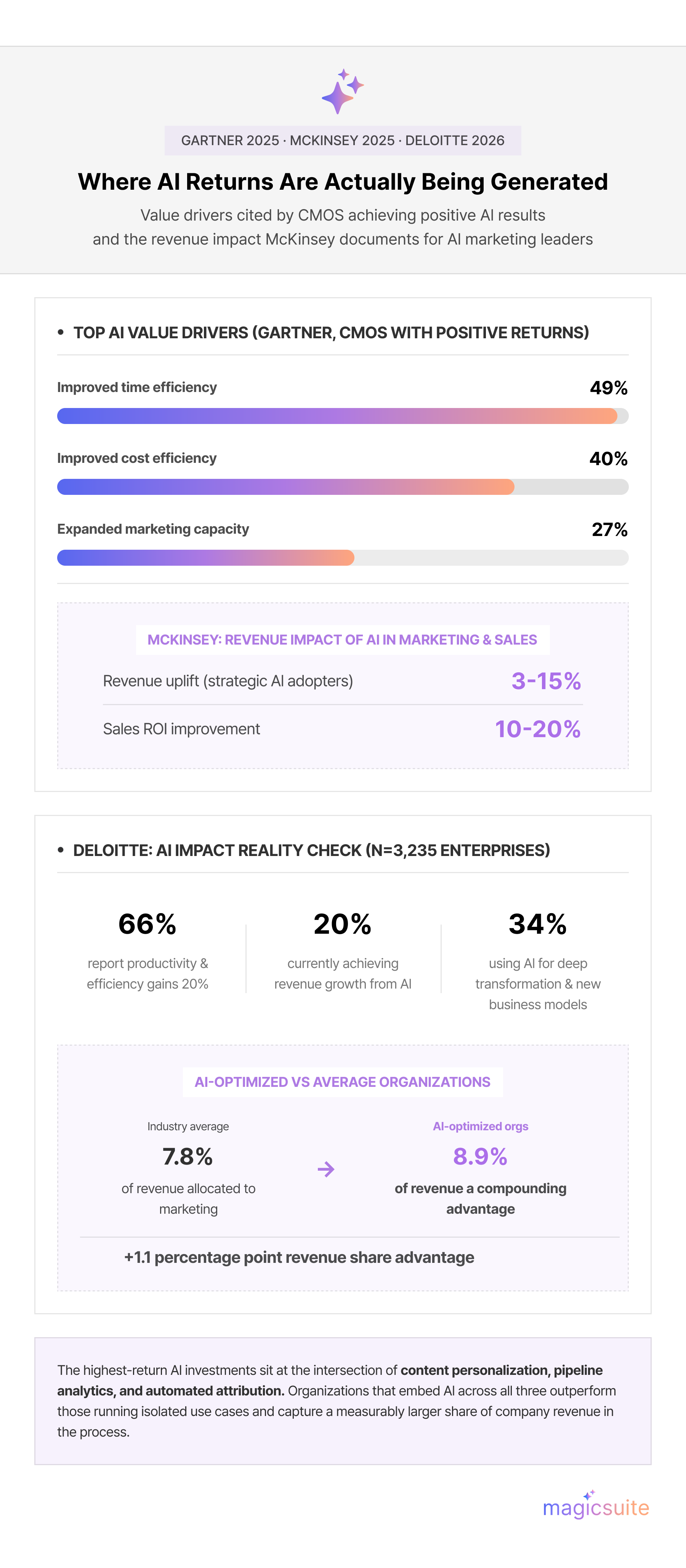
Here, a meaningful divergence emerges. Gartner's data shows that organizations with optimized AI programs capture a higher share of company revenue for marketing - averaging 8.9% versus the 7.8% industry median. The implication is not subtle: AI marketing optimization, when executed with process maturity and measurable intent, produces a compounding budget advantage that less-prepared competitors cannot easily replicate.
The question every CMO is being asked by their CEO and CFO is not "are you using AI" - it is "what is AI actually delivering?" The evidence from multiple research sources in 2025 and 2026 points to a consistent pattern: returns are concentrated in organizations that have redesigned workflows, set outcome-based objectives, and invested in measurement infrastructure.
McKinsey's research on AI-driven marketing and sales identifies the highest-return use cases:
McKinsey's data on AI marketing performance is particularly instructive. Organizations that invest strategically in AI across their marketing and sales functions are seeing revenue uplift of 3 to 15 percent and sales ROI improvements of 10 to 20 percent. These are not marginal gains. For a mid-market enterprise spending $50 million annually on marketing, a 10% improvement in marketing ROI represents $5 million in recaptured value.
The Gartner 2025 CMO Spend Survey adds texture to this picture. CMOs who reported positive returns from generative AI investments cited three primary value drivers:
Critically, just 1% of CMOs said generative AI was not a current priority - an extraordinary consensus for a technology that has been mainstream in enterprise marketing for less than three years.
The performance divide in AI business growth is not random. It follows a recognizable pattern that Deloitte, McKinsey, and Gartner have each documented independently, and the findings converge on the same set of organizational factors.
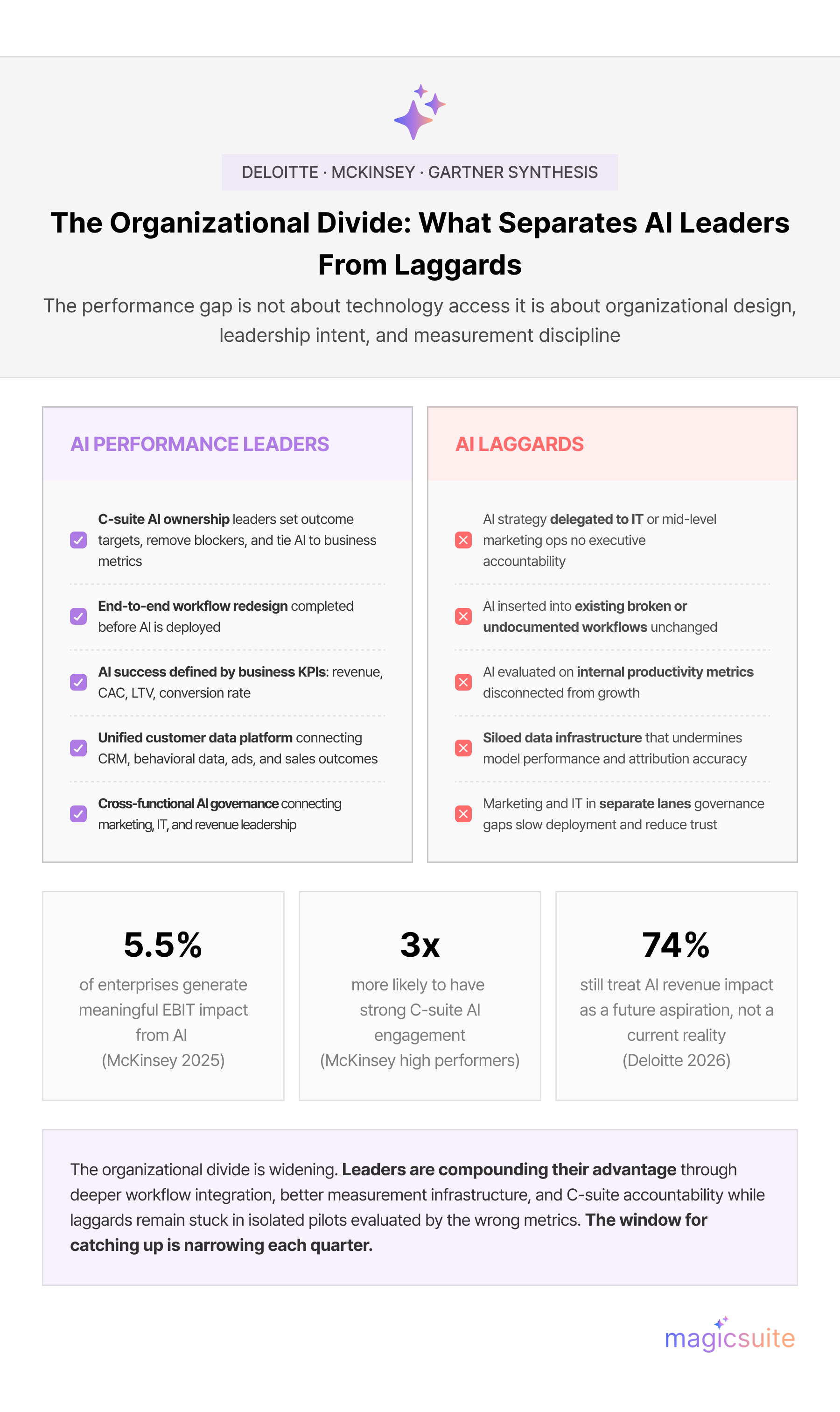
Organizations achieving strong AI marketing performance consistently share the following characteristics:
Organizations struggling to see returns tend to share a different set of conditions:
Deloitte's 2026 enterprise AI report found that two-thirds of organizations report productivity and efficiency gains from AI, but only 20% are already seeing revenue growth - with 74% still treating revenue impact as a future aspiration rather than a current reality. This mismatch is precisely the challenge CMOs must close: an AI-driven marketing strategy that stops at efficiency will never satisfy the boardroom.
Deloitte's State of AI in the Enterprise research reveals that 34% of organizations are beginning to use AI for deep transformation — creating new products, services, and business models rather than automating existing tasks. This is the inflection point that separates incremental AI adoption from genuinely strategic AI deployment. Global enterprises that are deploying enterprise marketing AI at scale are increasingly treating it as infrastructure rather than a standalone tool.
For CMOs, closing the organizational readiness gap requires movement on several simultaneous fronts:
Data foundation: Marketing analytics AI systems are only as good as the data they process. Organizations that have invested in clean, unified customer data platforms - connecting CRM, behavioral analytics, advertising data, and sales outcomes - are consistently better positioned to generate actionable AI insights. Data quality is not a technical issue. It is a strategic prerequisite.
Talent and fluency: Gartner's research found that while nearly two-thirds of marketers believe AI will change their roles fundamentally, only 32% believe they need to update their skills. This is a dangerous mismatch. AI-driven marketing does not eliminate the need for strategic judgment - it amplifies it. Teams that understand how to interrogate model outputs, identify bias, and connect AI recommendations to customer reality will consistently outperform teams that treat AI as an autonomous decision-maker.
Process architecture: The CMO AI strategy that produces results is built on documented, measurable processes that AI can optimize, not loosely defined workflows that AI is expected to interpret. Before deploying generative AI in marketing campaign development or marketing analytics AI for attribution modeling, leading organizations invest in the process clarity that makes optimization meaningful.
Governance and accountability: Deloitte's pulse survey findings reinforce the importance of governance structures that connect AI investment to business accountability. When AI initiatives are owned by marketing operations in isolation from revenue leadership, the feedback loops that drive improvement rarely close.
The 35th edition of the CMO Survey, directed by Professor Christine Moorman of Duke University's Fuqua School of Business and co-sponsored by Deloitte, polled 308 VP-level or higher marketing leaders between January and March 2026. The findings paint a complex picture: rising strategic importance for marketing colliding with economic pressure and constrained headcount.
More than half of respondents report being less optimistic about the economic environment than the previous quarter - the highest pessimism reading since mid-2020. Training budgets have declined to 3.8% of marketing spend. Headcount growth has slowed by 50% year over year.
Yet against this backdrop, digital marketing's contribution to company performance has improved meaningfully, with nearly three quarters of surveyed companies rating its impact as strong. And measurable improvements in sales productivity, customer satisfaction, and marketing overhead costs have all risen year over year among organizations that have embedded AI systematically.
This is the emerging CMO imperative: build an AI-powered marketing organization that can demonstrate business impact during a period of resource constraint, economic uncertainty, and rising expectations. The organizations that succeed will not be those that simply deploy AI tools - they will be those that build the analytical infrastructure, CMO AI strategy, and measurement discipline to connect AI marketing performance directly to the metrics that matter most to the enterprise.
The 2026 landscape presents CMOs with a defining strategic choice. AI-powered marketing adoption has become near-universal. The technology is available. The use cases are proven. The data exists. What separates the 5.5% of organizations generating real AI returns from the 94.5% that are not is not access to better models - it is the organizational architecture, marketing performance measurement discipline, and leadership intent to convert AI investment into demonstrable AI business growth.
Deloitte's 2026 pulse survey documents a profession in transition — from experimentation toward enrichment, from pilot programs toward scaled transformation. The CMOs who will define the next era of marketing leadership are not those who deployed AI-driven marketing the fastest. They are those who built the infrastructure, the processes, and the accountability structures to answer a question that boards and CEOs will continue to ask with increasing urgency: what exactly is AI marketing performance doing for the business?
The answer is becoming measurable. The gap between those who can answer it confidently and those who cannot is growing wider every quarter.
Only 5.5% of organizations are generating real financial returns from AI marketing. The difference isn't the technology - it's the infrastructure behind it. MagicSuite gives marketing teams the AI-powered platform to connect campaigns to outcomes, personalize at scale, and turn marketing spend into measurable business growth. Explore MagicSuite →

Luke is a technical market researcher with a deep passion for analyzing emerging technologies and their market impact. With a keen eye for data and trends, Luke provides valuable insights that help shape strategic decisions and product innovations. His expertise lies in evaluating industry developments and uncovering key opportunities in the ever-evolving tech landscape.