

Google rank no longer guarantees AI citation - GEO-cited brands get 5x higher conversion rates.

The rules of digital visibility are being rewritten - not gradually, but at a pace that is catching many marketing teams off guard. For two decades, search engine optimization defined how brands competed for online attention. The playbook was well established: optimize for keywords, build backlinks, chase rankings on Google's results pages. That playbook is now insufficient.
Generative AI platforms - ChatGPT, Google AI Overviews, Perplexity, Gemini - are fundamentally changing how people find information. Instead of returning ten ranked links, these systems synthesize a direct answer, cite a handful of sources, and move on. If your brand is not among those cited sources, it is effectively invisible to a growing segment of high-intent users.
This is the strategic premise behind Generative Engine Optimization (GEO): the practice of structuring content, brand signals, and digital authority so that AI systems select your brand as a trustworthy source when generating answers. GEO marketing is no longer a forward-looking experiment - for the brands paying attention, it is an active competitive front.
To understand why GEO matters, it helps to understand the underlying mechanics of how search behavior is changing. Traditional search engines return ranked lists. Users scan, click, and browse. Generative AI search engines do something fundamentally different - they synthesize answers from multiple sources and present a single, conversational response. The shift from link-based retrieval to synthesized answers is what separates AI search engines like ChatGPT, Perplexity, and Google AI Overviews from everything that came before them - and why the generative AI market is scaling at an unprecedented pace.
This creates what analysts call a "winner-takes-all" dynamic for AI citations. When a user asks ChatGPT which enterprise chatbot platform best fits a mid-market B2B company, the model selects two or three brands to recommend. Every other brand that does not appear in that response loses the discovery moment entirely.
According to data compiled across major AI platforms, the behavioral evidence is already clear:
The implication for marketing teams is significant. The channel that reliably delivered discovery traffic for years is contracting - not because people are searching less, but because AI is answering more.
.png)
One of the most common misconceptions in early GEO discussions is framing it as a replacement for SEO. It is not. The SEO vs GEO debate often generates more heat than light - the accurate framing, as Search Engine Land analyst coverage describes it, is a hierarchy: SEO builds the foundation; GEO builds the visibility layer on top of it. Both disciplines are necessary, but they serve different masters: traditional SEO serves the algorithm that ranks pages; GEO serves the model that synthesizes answers in AI-powered search.
Strong domain authority, technical crawlability, quality backlinks, and structured content all remain valuable - because AI systems depend on these same signals when deciding which sources to trust and cite. The difference lies in what is being optimized for.
.png)
As EMARKETER principal analyst Kelsey Voss put it: "SEO is about ranking. GEO is about being selected as a source in synthesized answers." The distinction is structural - and it demands a different set of strategies, measurements, and content frameworks.
The data on AI-driven search growth is striking, but the conversion quality data is what should most compel marketers to act. The surging global investment in AI infrastructure - which hit $211 billion in 2025 - explains why AI platforms are scaling fast enough to fundamentally reshape discovery behavior.
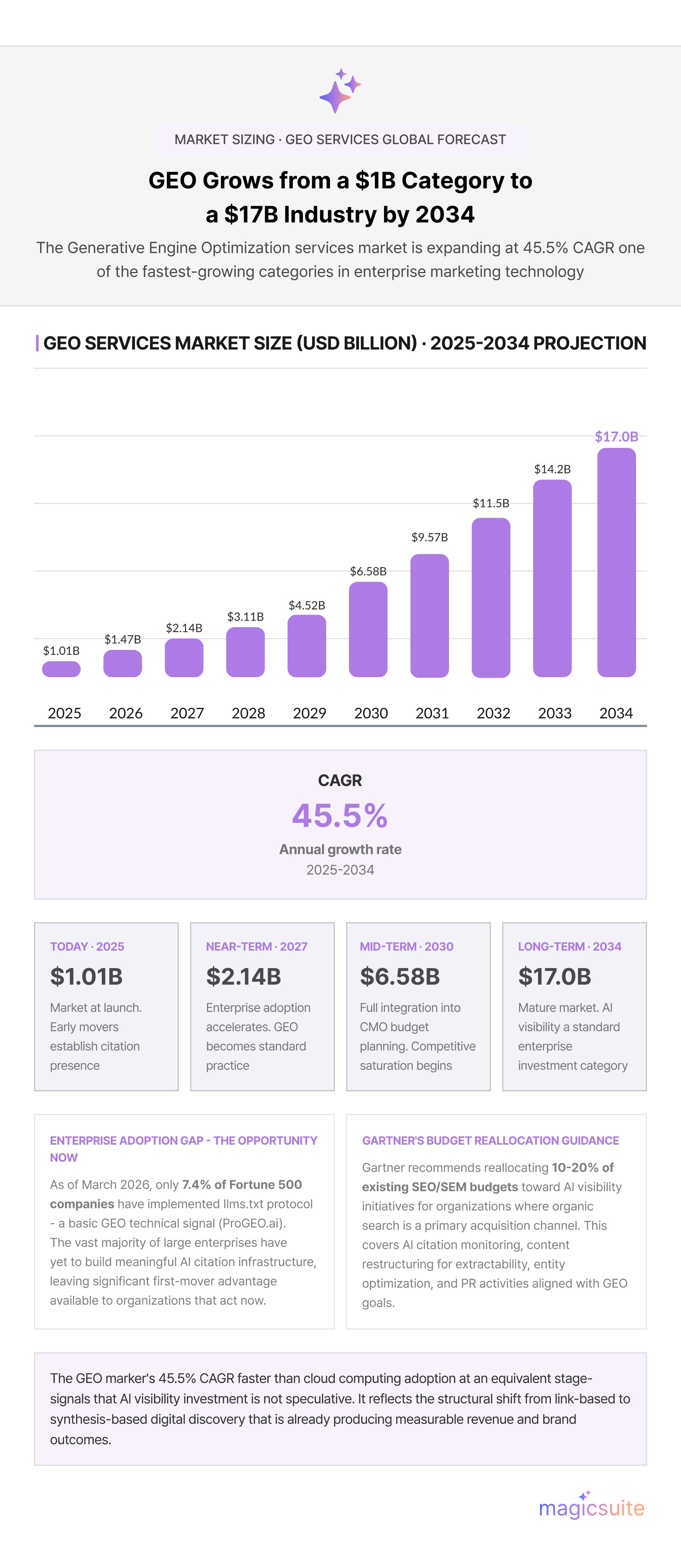
On volume: AI platforms generated 1.13 billion referral visits in June 2025 alone - a 357% increase from June 2024. AI-sourced sessions surged 527% year-over-year in the first half of 2025. The GEO services market, valued at approximately $1 billion in 2025, is projected to reach $17 billion by 2034, growing at a CAGR of 45.5%.
On quality: Studies across B2B technology and IT services find AI search traffic converts at roughly 14% compared to Google organic's 2.8% - approximately a 5x premium (Opollo/Superprompt, 312 IT brands and 12M website visits respectively). ChatGPT visitors specifically convert at 15.9% in this segment. It is worth noting that conversion rate advantages are strongest in research-heavy B2B verticals (legal, finance, healthcare, IT) and less pronounced in impulse-purchase e-commerce contexts. Ahrefs' own site data showed AI search drove 12.1% of signups while representing only 0.5% of visitors - a significant quality signal regardless of industry.
On brand impact: Research from Seer Interactive (53 brands, 5.47 million tracked queries) found that brands cited in Google AI Overviews earn 35% more organic clicks and 91% more paid clicks compared to non-cited brands on the same queries. Separately, a 5WPR/Brandlight study published May 2026 found the overlap between top Google results and AI-cited sources has collapsed from 70% to below 20%, confirming that citation presence and search ranking are now two distinct competitive assets.
These numbers reframe the conversation. GEO is not just a traffic play - it is a brand equity and revenue conversion play. The organizations that secure AI citation share now are building compounding advantages in brand recognition that will become increasingly difficult to displace.
.png)
Understanding what drives AI citations is the technical foundation of any GEO strategy. Unlike traditional search algorithms, which weight keyword density and backlink profiles heavily, large language models evaluate content along different dimensions. This is why AI content optimization - structuring, sourcing, and formatting content specifically for AI extractability - is a discipline distinct from conventional on-page SEO. Broader AI search optimization encompasses both the content layer and the off-site authority signals that determine whether a brand is recognized and trusted by AI systems in the first place.
.png)
Research and platform behavior analysis consistently highlight several factors that improve AI citation rates:
Critically, brand search volume has emerged as the top predictor of AI citations, according to research by Previsible analyzing 1.96 million sessions. This elevates traditional PR, earned media, and thought leadership investment from brand-building activities to direct AI visibility infrastructure.
Early GEO strategy discussions often focus on a single platform, typically ChatGPT. But the reality of 2025 and 2026 is a fragmented AI-powered search landscape where each platform applies its own citation logic - and where how AI retrieves and synthesizes reliable answers directly determines which brands get cited.
ChatGPT dominates AI referral traffic with approximately 84–87% of all AI-driven clicks across tracked domains, processing roughly 2 billion queries daily with 800 million weekly active users. However, Perplexity - growing at 370% year-over-year and processing 780 million monthly queries by mid-2025 - operates on a transparent inline citation model that creates different optimization requirements. Google AI Overviews, embedded directly in the world's most-used search engine and covering more than 200 countries in over 40 languages, operates with yet another set of selection criteria.
Each platform selects citations based on its own LLM training data and retrieval logic. This creates a multi-platform GEO challenge that requires:
Adobe research illustrates the pace of this shift: from July 2024 to February 2025, web traffic from generative AI-driven referrals increased more than 10x in the United States. The rapid enterprise adoption of AI agents is accelerating this trajectory - expanding the number of AI-powered surfaces where brands need citation presence.
The enterprise response to GEO is moving from experimentation to strategic commitment. A widely circulated market intelligence figure cites 67% of Fortune 500 CMOs identifying GEO as a top-three digital priority for FY2026, though this figure originates from aggregator sources and has not been independently verified by a named research firm. What is verifiable and consistent across sources is the directional signal: only 7.4% of Fortune 500 companies had implemented the llms.txt protocol as of March 2026 (ProGEO.ai), indicating that most large enterprises are still in early-stage adoption - which means the competitive window for early movers remains open.
Several organizational patterns distinguish early GEO leaders from laggards:
Budget reallocation toward AI visibility. Gartner's advisory guidance following its 25% search volume decline prediction recommended reallocating 10–20% of SEO/SEM budgets toward AI visibility initiatives - including source seeding, entity optimization, and cross-engine monitoring. Brands reallocating proactively are building citation share while competitors wait.
PR and earned media as GEO infrastructure. Gartner has explicitly noted that AI search could reshape marketing budgets toward PR and earned media, since the trust signals AI systems use to evaluate brands are overwhelmingly sourced from third-party mentions and independent coverage - not from the brand's own website. This elevates earned media from a supporting tactic to a core GEO lever.
New measurement frameworks. Traditional SEO metrics - rankings, CTR, organic traffic - are insufficient in a synthesis-first environment. Leading organizations are building separate KPI dashboards tracking citation frequency, share of AI voice, and AI-generated referral quality. Citation presence rate across Google AI Overviews, Bing Copilot Search, ChatGPT, and Perplexity is increasingly treated as its own performance category.
Content architecture overhauls. GEO leaders are auditing and restructuring existing content libraries for extractability - shortening paragraphs, adding answer-first structures, embedding attribution for all data claims, and implementing FAQ and entity schema markup across high-value pages.
Despite the urgency, a significant execution gap exists in how most marketing teams currently measure AI visibility. GA4 does not create default channel groupings for AI traffic, meaning most organizations are systematically underreporting the influence of AI-powered search on their pipeline.
Creating a custom channel definition in GA4 that classifies sessions from ChatGPT, Perplexity, Claude, Gemini, and other AI platforms as a distinct channel takes less than an hour - and provides the data foundation that all GEO strategy depends on. Without this baseline measurement, teams cannot assess citation share, track AI referral quality, or build the business case for GEO investment.
Beyond traffic measurement, sophisticated GEO programs are tracking:
If a domain appears in fewer than 5% of AI-generated responses for its core topic cluster, industry benchmarks suggest it is significantly underperforming relative to category leaders. This benchmark is becoming the new baseline against which AI content optimization programs are evaluated - as organizations shift from measuring traffic volume to measuring citation quality and AI-generated referral conversion.
The practical transition from traditional SEO to a dual-track SEO + GEO strategy involves deliberate changes to content architecture, publishing workflow, and performance measurement. Based on platform behavior analysis and emerging best practices, the following strategic framework applies across B2B and B2C contexts:
1. Conduct an AI citation audit. Run manual prompts across ChatGPT, Perplexity, and Google AI Overviews using queries relevant to your product category. Document which competitors appear, how your brand is described when it does appear, and which content assets are being cited.
2. Restructure high-value content for extractability. Prioritize answer-first openings, short paragraphs, and sourced data claims on your highest-traffic pages. These structural changes improve citation likelihood without requiring new content creation.
3. Invest in topical authority depth, not breadth. AI systems favor sources with demonstrable expertise in a specific topic cluster. A brand with 30 deeply researched articles on enterprise chatbot implementation will likely outperform a brand with 200 shallow articles across disconnected topics.
4. Build a cross-engine monitoring workflow. Track citation presence, sentiment, and competitor comparison across major AI platforms monthly. Treat AI citation share as a standalone KPI with dedicated reporting.
5. Align PR and earned media with GEO goals. Every analyst mention, third-party review, industry report citation, and media coverage placement becomes a GEO asset. Coordinate PR outputs with content topics where AI citation share is being actively built.
The structural transformation driving Generative Engine Optimization is not speculative. It is already producing measurable changes in how brands are discovered, evaluated, and chosen. Traditional search engine volume is declining, AI-powered search platforms are scaling rapidly, and the correlation between Google rankings and AI citations is weakening - from 70% overlap to below 20% per 5WPR/Brandlight research published May 2026.
For marketing leaders, the strategic implication is clear. AI visibility is not a future-state concern - it is a present-state competitive differentiator. The organizations building AI citation share now, while the discipline is still emerging and competitive saturation remains low, are positioning themselves for compounding advantages as AI-driven search continues to expand - fueled by the accelerating deployment of AI agents across enterprise environments.
The shift from SEO to a dual-track SEO and GEO strategy does not require abandoning existing frameworks. It requires extending them - adding answer-first content structures, sourced data practices, entity optimization, and cross-platform citation monitoring to the disciplines that already drive organic growth. The brands that move first will not just be easier to find on AI platforms. They will be the brands that AI recommends.
If AI can't find your brand, your customers won't either. MagicSuite helps you build the content authority and AI visibility infrastructure to ensure your brand gets cited - not just ranked - across ChatGPT, Perplexity, and Google AI Overviews. Explore MagicSuite →

Joseph is a Technical Communications Specialist responsible for translating complex technical concepts into clear, engaging, and accessible content for diverse audiences. He collaborates closely with technical teams, product experts, and stakeholders to develop documentation, reports, knowledge resources, and communication materials that support business objectives and enhance user understanding.