

Explore the 2025 global AI market, valued at up to $391B. Discover key growth drivers, Gartner’s $2.5T spending forecast for 2026, and deep dives into Generative AI, healthcare adoption, and the rise of Sovereign AI.

The global Artificial Intelligence (AI) market is undergoing unprecedented growth and transformation, driven by significant advances in generative AI, increased enterprise adoption, and substantial investments in AI infrastructure. This report provides a comprehensive analysis of the global AI market size for 2025, with projections and strategic insights extending to 2026 and beyond.
The market is valued at approximately $244-$391 billion in 2025, with forecasts indicating a surge to $347-$376 billion in 2026. Gartner's analysis presents an even more aggressive growth trajectory, with total AI spending projected to reach $2.527 trillion in 2026, a 44% increase from 2025. This growth is fueled by a convergence of factors, including the democratization of AI tools, the expanding capabilities of large language models (LLMs, and the strategic imperative for businesses to leverage AI for competitive advantage.
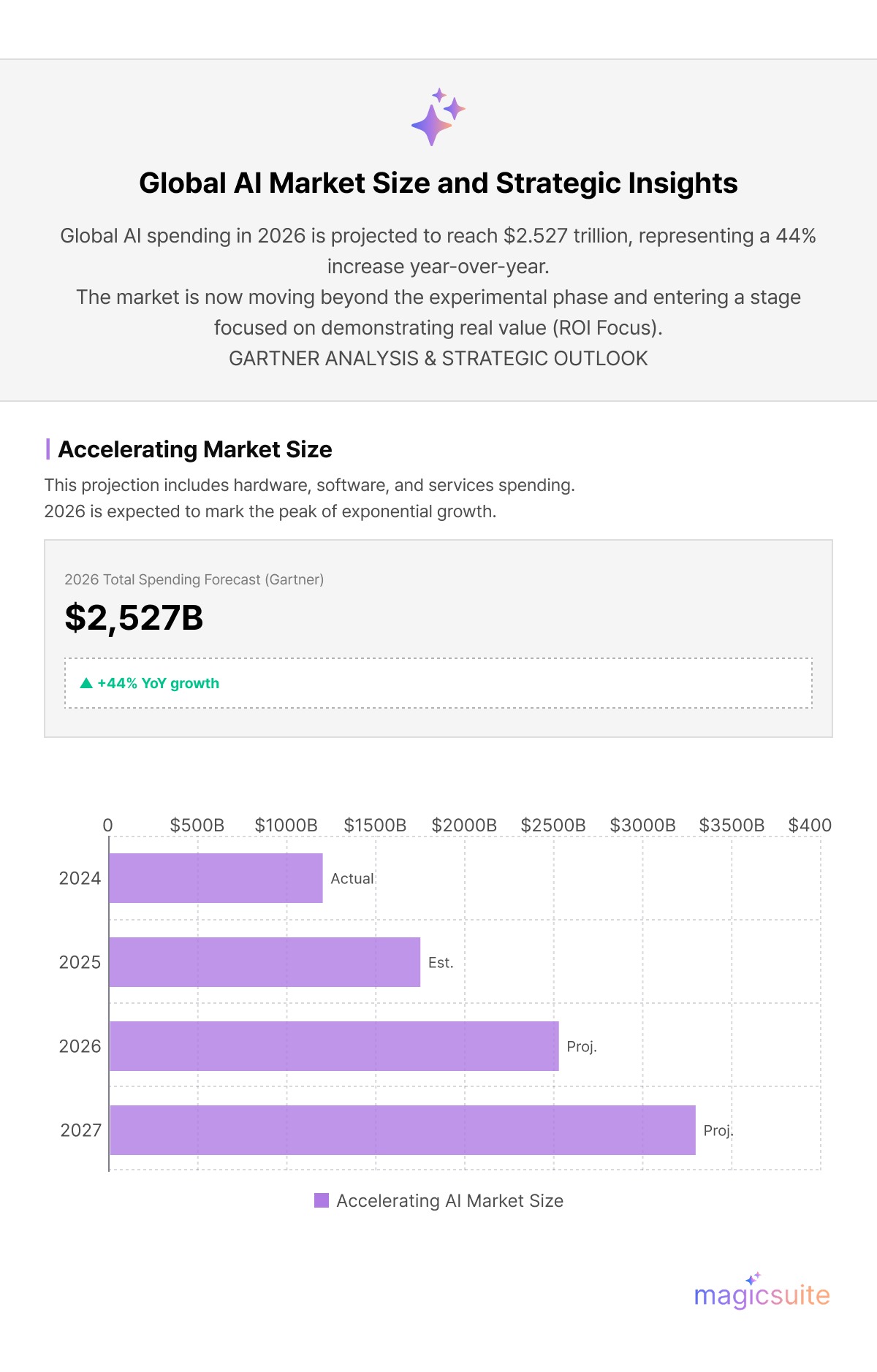
While there are discrepancies in the exact figures, the overall trend points towards exponential growth. The table below summarizes the market size estimates from leading sources. Gartner's AI spending forecast, the most comprehensive, includes AI-specific hardware, software, and services, providing a comprehensive view of the market. The significant year-over-year growth of 44% underscores the substantial investments in AI infrastructure and solutions.
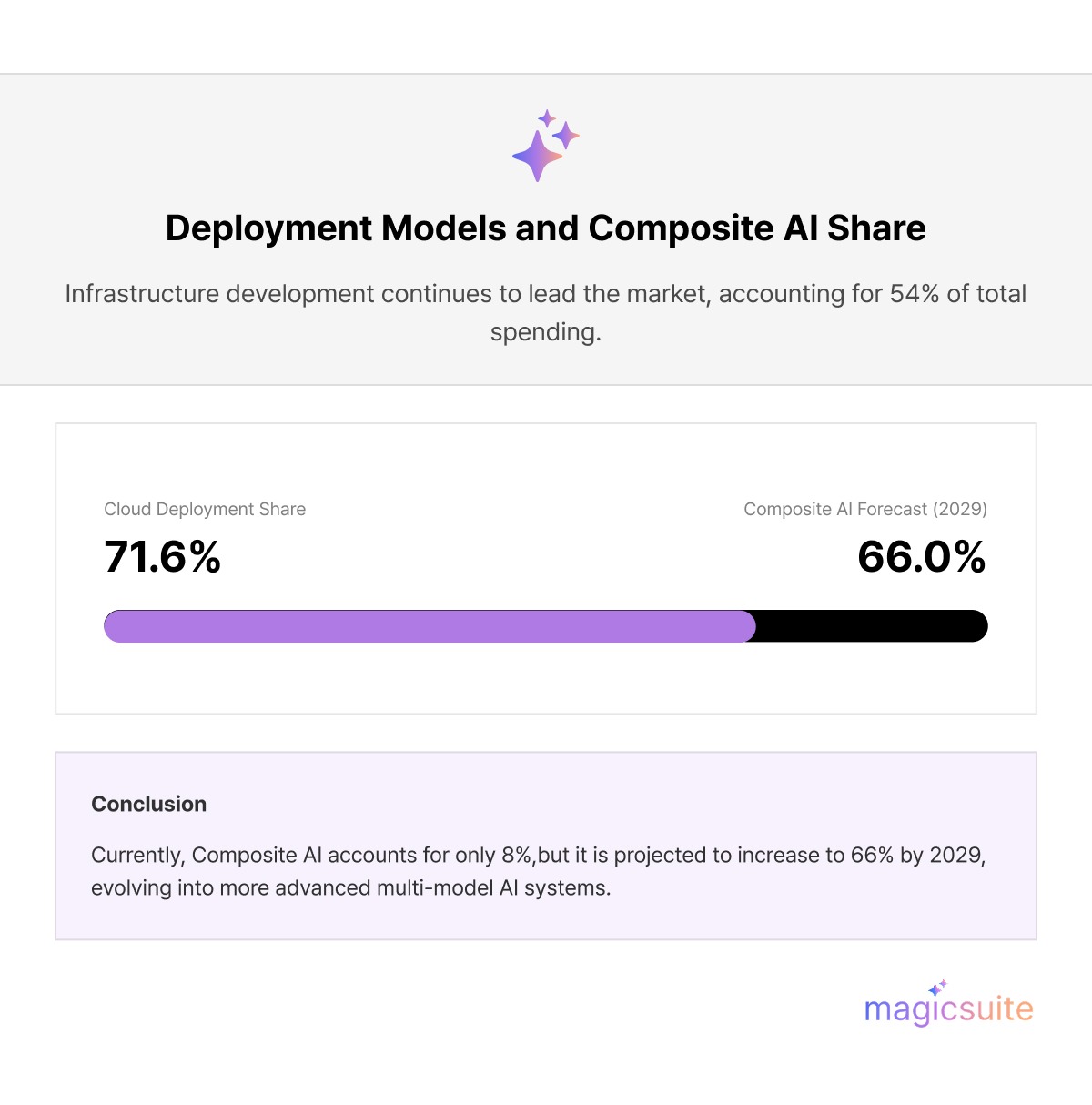
The AI market can be segmented by offering, technology, and deployment model, each with distinct growth dynamics.
AI adoption is accelerating across all industries, with Healthcare, BFSI, and Marketing emerging as the top three adopters.
The healthcare industry is projected to have the highest AI adoption CAGR of 36.50%. AI is transforming healthcare through applications in drug discovery, diagnostic imaging, and personalized medicine. In 2025, AI spending in healthcare reached $1.4 billion, nearly tripling year over year.
The BFSI sector was the dominant adopter of AI in 2024, leveraging the technology for fraud detection, algorithmic trading, and personalized customer service. The generative AI market in BFSI is expected to grow at a CAGR of 32.5% from 2024 to 2032, reaching $13.57 billion
Read How Bank of America’s Erica Boosted Earnings by 19% Using AI
AI is revolutionizing the marketing landscape by enabling hyper-personalization, predictive analytics, and automated content creation. The retail sector, a key component of the marketing industry, is outpacing both finance and healthcare in AI adoption in the EMEA region.
North America, the Asia Pacific, and Europe are the three major geographic markets for AI.
The AI market is dominated by a few large technology companies, often referred to as the "Big Five," along with a growing number of innovative startups.
The explosive growth of the AI market is driven by several interconnected factors. The increasing availability of big data provides the foundation for AI algorithms to learn and improve, while advancements in cloud computing infrastructure enable efficient processing of complex AI workloads.
Organizations across industries are recognizing the strategic imperative to adopt AI for automation, optimization, and competitive differentiation. The democratization of AI tools through platforms like OpenAI's APIs and open-source frameworks has lowered barriers to entry, enabling even smaller organizations to leverage AI capabilities. Additionally, substantial government investments and public-private partnerships are accelerating AI innovation and infrastructure development globally.
Despite the optimistic growth outlook, the AI market faces several challenges. Geopolitical tensions and trade restrictions, particularly between the United States and China, are creating supply chain disruptions and tariff-related cost increases for AI hardware. The specialized nature of AI chips and components makes sourcing complex, as companies must navigate alternative suppliers and vendor requalification processes.
Regulatory uncertainty around AI governance, data privacy, and algorithmic transparency is creating compliance challenges for enterprises. Furthermore, the "Trough of Disillusionment" phase identified by Gartner suggests that some organizations may experience disappointing ROI from their initial AI investments, potentially tempering near-term growth.
Read more on What is Data Privacy in AI Customer Service?
The year 2026 is poised to be a pivotal year for the AI industry, with several key trends shaping its trajectory.
Edge AI, which involves running machine learning algorithms directly on local devices—such as smartphones, IoT sensors, or cameras—rather than relying on centralized cloud servers. This trend is driven by the need for lower latency, improved privacy, and reduced bandwidth consumption. According to International Data Corporation (IDC) data, the market for GenAI-capable smartphones is experiencing rapid growth, with shipments projected to increase by over 360% year over year in 2024, reaching approximately 234 million units.
Sovereign AI is a growing movement among nations to develop their own AI capabilities and reduce their reliance on foreign technology. This trend is driven by geopolitical concerns, data privacy regulations, and the desire to foster domestic innovation. In February 2026, India is expected to launch its own sovereign large language model, highlighting the growing importance of this trend.
As AI moves from proof of concept to production deployment, organizations are increasingly focused on optimizing their compute strategies. The shift from training-heavy workloads to inference-heavy deployments is reshaping infrastructure requirements. IDC forecasts that by 2029, AI infrastructure spending will reach $758 billion, with accelerated servers accounting for 94.3% of the market. This represents a fundamental shift in how organizations architect their AI systems, with greater emphasis on distributed computing, edge deployment, and hybrid cloud-edge architectures.
Composite AI, which combines multiple AI techniques and models to solve complex problems, is expected to account for 66% of AI spending by 2029, up from just 8% in 2025. This trend reflects the maturation of the AI market, in which organizations are moving beyond single-use-case implementations to more sophisticated, multi-model AI systems that integrate generative AI, machine learning, and symbolic AI approaches.
Gartner's analysis indicates that AI is currently in the "Trough of Disillusionment" phase of the technology adoption curve throughout 2026. This means that while the hype around AI remains high, organizations are increasingly focused on demonstrating tangible return on investment (ROI) rather than pursuing speculative projects. This shift is reflected in the observation that AI is now more likely to be sold to enterprises by their incumbent software providers than to be purchased as part of new, high-risk moonshot projects.
To provide a more granular view of the AI market, the following table presents Gartner's comprehensive breakdown of AI spending across different market segments for 2025-2027.
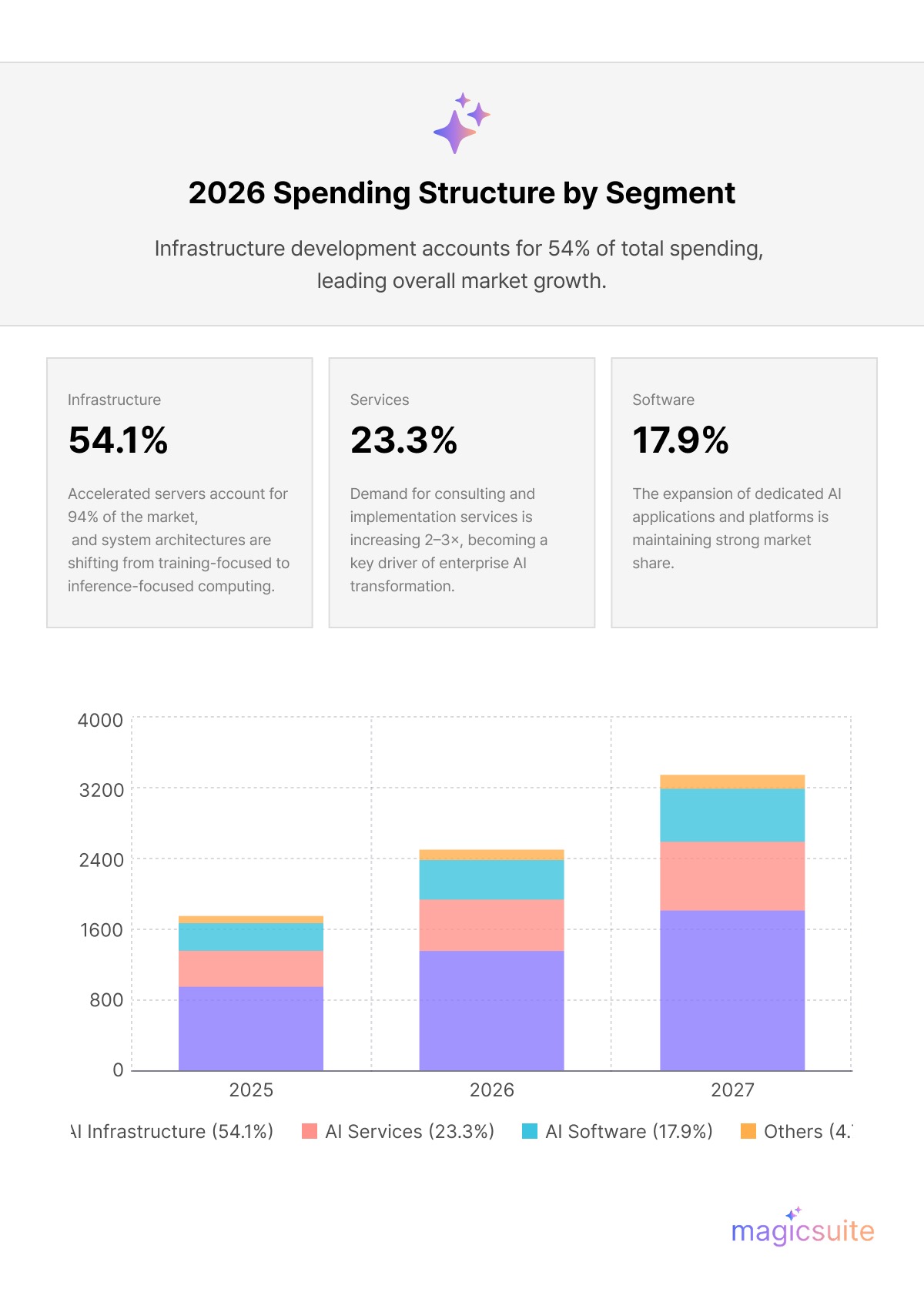
The data reveals that AI infrastructure dominates the market, accounting for over 54% of total spending in 2026. This reflects the substantial capital investments by technology providers to build AI foundations and support the rapid growth in AI workloads. AI services, including consulting, implementation, and managed services, constitute the second-largest segment at 23.3%, underscoring the critical role of professional services in enabling enterprise AI adoption.
The global AI market is at a turning point. Big opportunities sit beside real challenges. Advances in technology, substantial investments, and broader adoption in businesses are fueling rapid innovation. If organizations prove real value with practical AI, they’ll ride AI’s long-term growth.
Key priorities for 2026:

Hanna is an industry trend analyst dedicated to tracking the latest advancements and shifts in the market. With a strong background in research and forecasting, she identifies key patterns and emerging opportunities that drive business growth. Hanna’s work helps organizations stay ahead of the curve by providing data-driven insights into evolving industry landscapes.