

Voice AI vs Text AI: Compare speed, cost, and ROI. Learn why a hybrid multimodal strategy is the key to future-proof customer service in 2026. Read more!

In 2026, the question is no longer if you should use AI in customer service, but which form will drive the highest ROI and customer satisfaction. With the global conversational AI market projected to hit $14.29 billion this year, businesses are choosing between the tactile speed of Text AI and the empathetic, hands-free depth of Voice AI. This comprehensive guide breaks down the Voice AI vs. Text AI debate to help you build a future-proof customer experience (CX) strategy.

Voice AI refers to artificial intelligence systems that can understand, interpret, and respond to spoken language. These systems use technologies like Natural Language Processing (NLP), Automatic Speech Recognition (ASR), and Text-to-Speech (TTS) to facilitate seamless voice interactions between humans and machines.
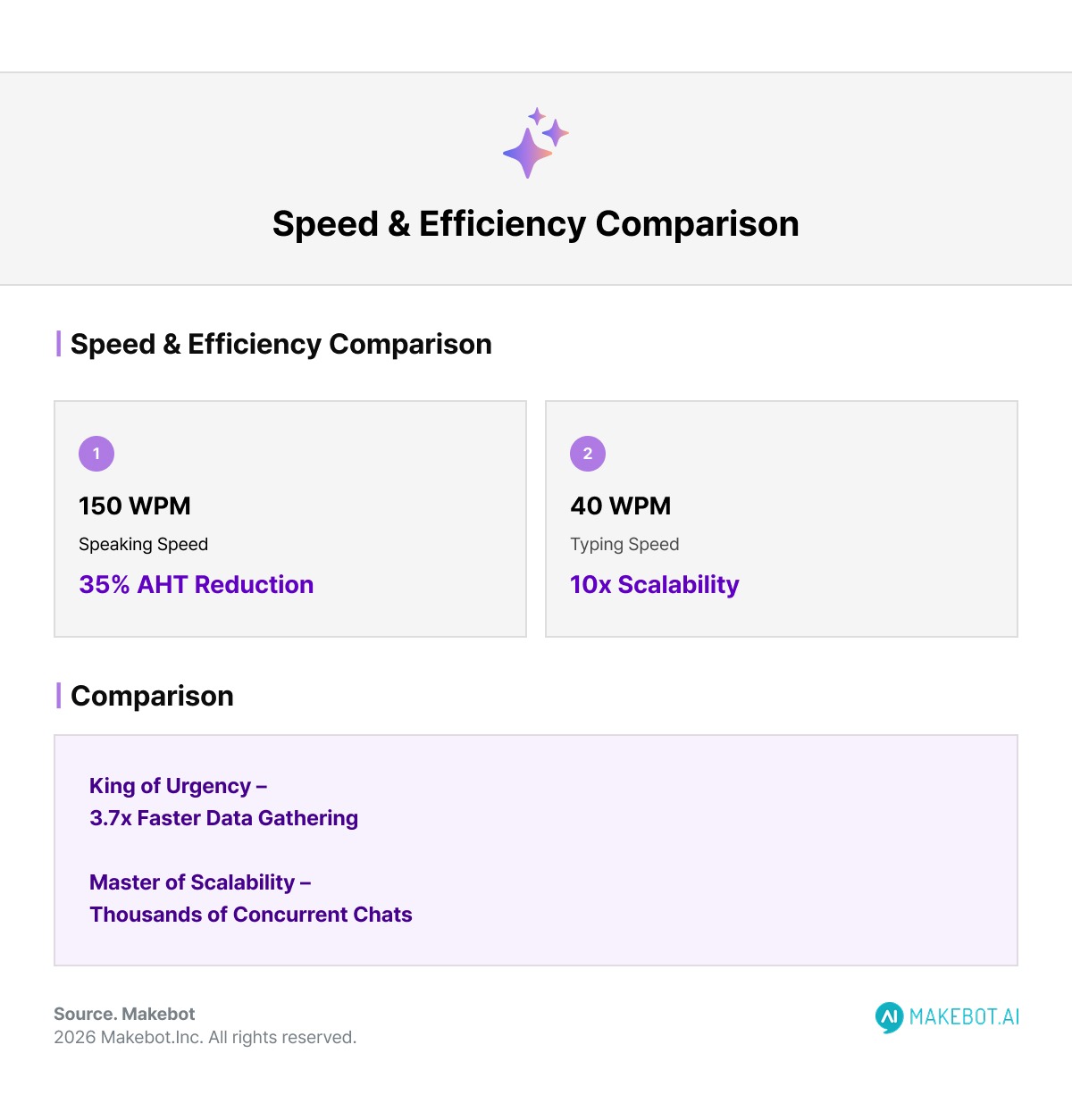
Most people speak at ~150 words per minute but type at only ~40. Voice AI resolves issues significantly faster, reducing Average Handle Time (AHT) by up to 35%.
Voice AI can detect a customer's "sentiment shift." If a caller sounds distressed, the AI can immediately escalate the call to a human manager with a full transcript already prepared.
For elderly users or those with visual impairments, Voice AI is the most inclusive channel. It removes the friction of navigating small screens and complex menus.
For industries like Healthcare (scheduling) or Finance (reporting a lost card), voice remains the "human default" for trust and urgency.
Text AI, on the other hand, focuses on understanding and generating human-like responses in written form. It leverages machine learning, deep learning, and NLP to interpret user queries and provide accurate, contextually relevant answers.
Chatbots can send images, PDF guides, and interactive "rich bubbles" (like seat selectors or date pickers) that voice cannot.
Customers often prefer text when they are in public spaces, offices, or commuting where they cannot speak aloud.
Text AI provides an instant, searchable paper trail for both the customer and the business, making it ideal for compliance-heavy industries.
A single Text AI instance can handle thousands of concurrent conversations at a fraction of the cost of a voice-enabled line.
To determine which technology is more suitable for your business, let’s compare them across several critical dimensions.
Voice AI processes spoken language, enabling real-time verbal interactions, while Text AI handles written communication via chat or messaging platforms. Both use NLP but differ in input and output modes.
Speed and Efficiency: The "Immediacy vs. Multi-tasking" Divide
Speed is measured by Resolution Velocity, which is how quickly a customer moves from "I have a problem" to "It’s fixed."
Voice AI is the king of urgency; Text AI is the master of high-volume scalability.
User Preference and Accessibility
Accessibility is no longer a "nice-to-have", it is a legal and ethical standard.
Use Voice for inclusivity and "high-touch" feel; use Text for privacy and documentation.
Complexity: Tactical vs. Emotional Intelligence
The biggest breakthrough of 2026 is Sentiment Analysis.
Voice AI handles "emotional" complexity; Text AI handles "technical" complexity.
Yes, Voice AI typically requires more infrastructure, such as telephony integration and advanced hardware. Text AI is more cost-effective and easier to scale, especially for startups and SMEs.
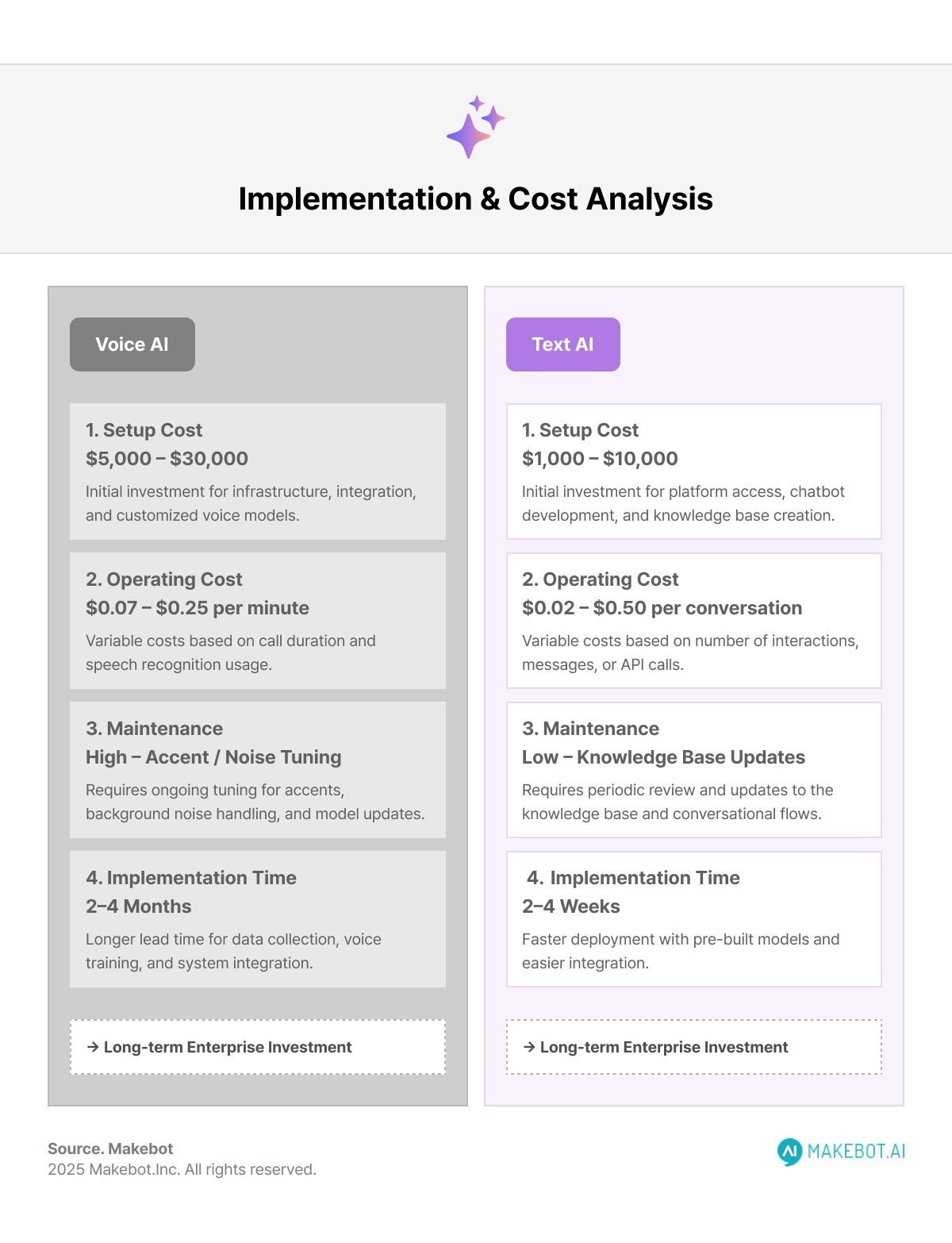
The "barrier to entry" has dropped, but the price structures remain distinct.
Voice AI
Text AI
Voice AI requires integration with SIP trunks and legacy telephony (IVR). Most companies use "usage-based" pricing ($0.09/min), which can get expensive for long, rambling calls.
Text AI is a "plug-and-play" solution for most websites. With OpenAI's GPT-4o and similar models, the cost per interaction has plummeted to fractions of a cent, making it the clear choice for Small to Medium-sized Businesses (SMBs).
Text AI offers the fastest ROI for smaller budgets; Voice AI is a long-term investment for enterprise-grade contact centers.
Absolutely. Many businesses use a hybrid AI approach to provide a seamless customer experience across channels. This strategy ensures that users can switch between voice and text based on context and preference.
The "Voice vs. Text" debate is increasingly being solved by Multimodal AI. This allows a customer to start a conversation via text (e.g., "I need help with my bill") and seamlessly transition to a voice call without losing context. By 2026, one in ten customer service interactions will be fully automated, with 40% of AI models blending voice, text, and visual inputs to create a "channel-less" experience.
When deciding where to invest your budget, consider these three factors:
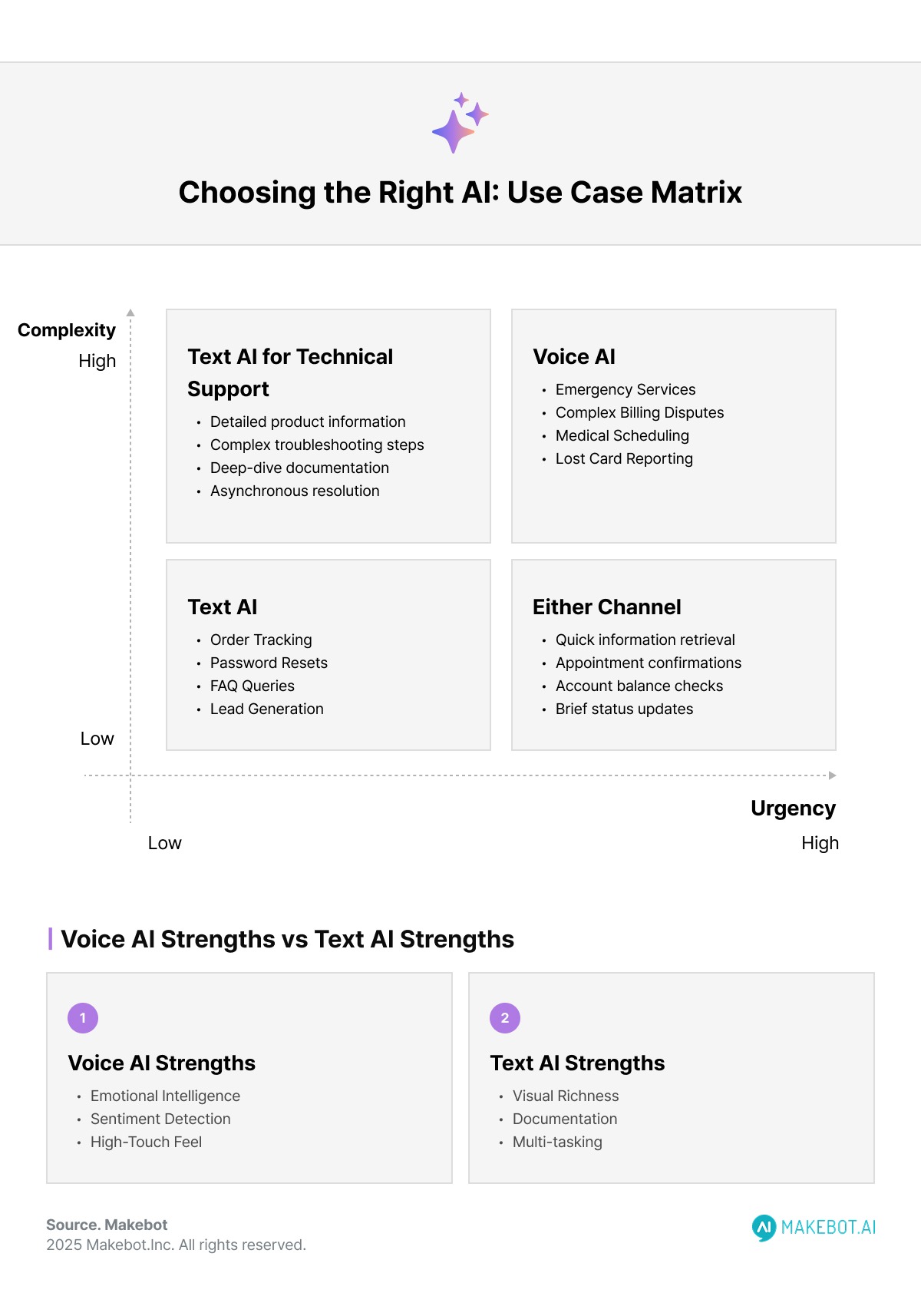
If your audience is Gen Z, they may prefer Text AI via WhatsApp or Instagram DM. If you serve a broader or older demographic, Voice AI is essential for lowering the barrier to entry.
While Voice AI costs more to implement due to speech-to-text (STT) and text-to-speech (TTS) requirements, it often yields a higher ROI in contact centers by reducing the need for expensive human "tier 1" phone agents.
The most successful brands do not choose one over the other. They use Text AI for the "front door" of their website to filter simple queries and Voice AI to handle the heavy lifting of phone-based support. Whether you choose Voice AI, Text AI, or both, the key lies in understanding your customers and aligning your technology strategy with their needs.
For more insights on AI in customer service, check out: Best AI Chatbot for Customer Support to Save Time & Money

Luke is a technical market researcher with a deep passion for analyzing emerging technologies and their market impact. With a keen eye for data and trends, Luke provides valuable insights that help shape strategic decisions and product innovations. His expertise lies in evaluating industry developments and uncovering key opportunities in the ever-evolving tech landscape.