

eBay's AI cut resolution time by 5x and drove 40%+ quality visit gains — a blueprint for enterprise.

When eBay's CEO Jamie Iannone told investors in July 2025 that AI "continues to fundamentally change" the company's customer experience, it wasn't a forward-looking promise — it was a performance report. The platform had already deployed generative AI across its CRM infrastructure, search systems, listing tools, and fraud detection stack, with measurable business outcomes to show for it.
For a marketplace connecting 134 million active buyers with millions of sellers globally, the challenge of delivering responsive, consistent, and personalized AI customer service at scale is formidable. eBay's answer has been a methodical, multi-layered customer experience automation program — one that reveals as much about the future of enterprise customer service as it does about the company itself.
This article examines how eBay built its AI-powered customer support infrastructure, what results it has produced, and what the broader enterprise landscape can learn from one of the most ambitious enterprise AI automation programs in modern retail.
Before understanding what eBay built, it helps to understand the scale at which it operates. As of Q1 2025, eBay reported approximately 134 million active buyers and millions of active sellers transacting across a global marketplace. Each transaction layer generates a continuous volume of AI customer service interactions that no human-staffed operation could efficiently process at scale:
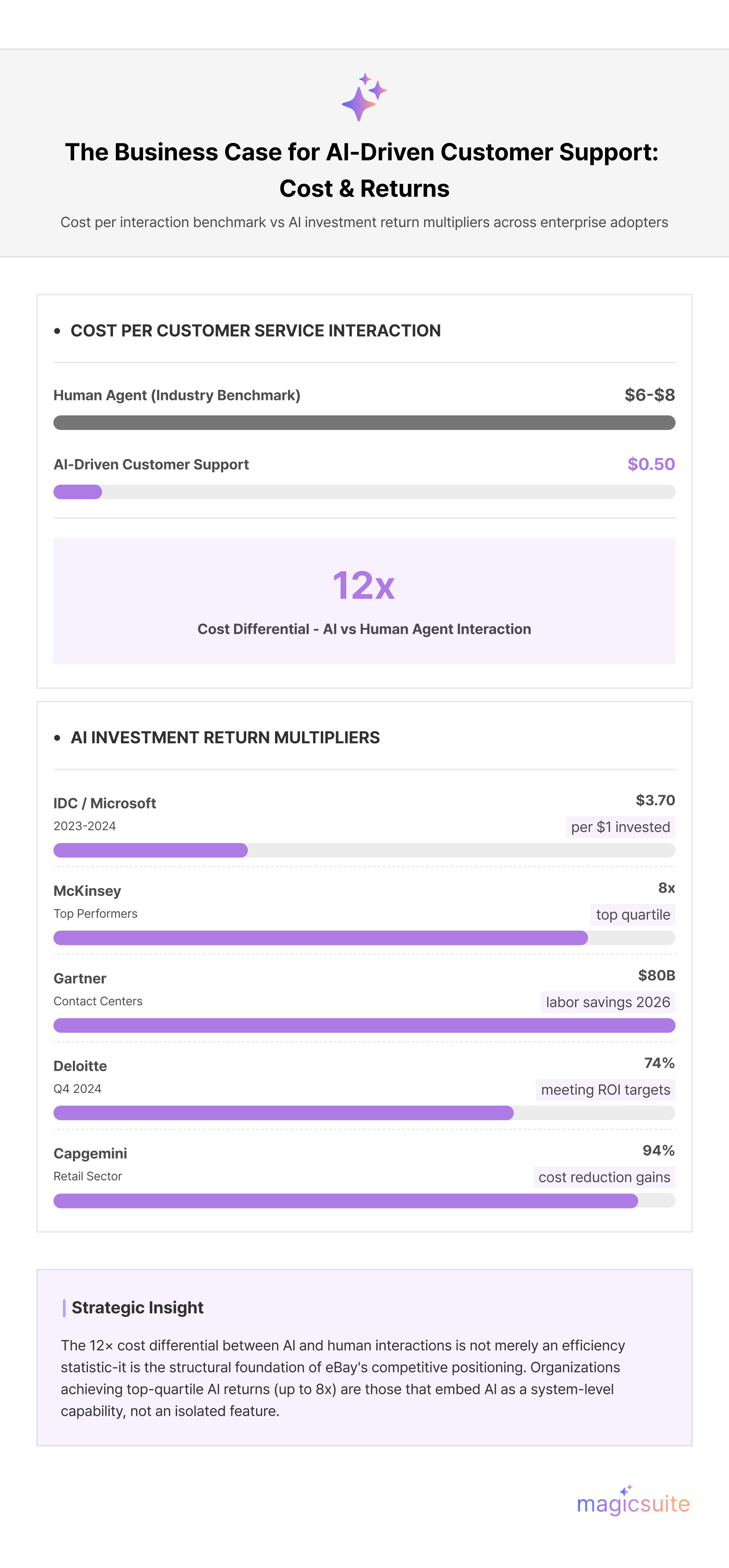
The economics made automation not just attractive but strategically necessary. Key cost benchmarks illustrate why:
This was the core business case that accelerated eBay's transition from a human-heavy support model to one increasingly managed by AI in customer service and automation. The shift, however, was never just about cost reduction. eBay's leadership framed the investment as a vehicle for simultaneously driving Gross Merchandise Volume (GMV), seller retention, and buyer satisfaction — a trifecta that defines genuine AI-powered customer support at platform scale.
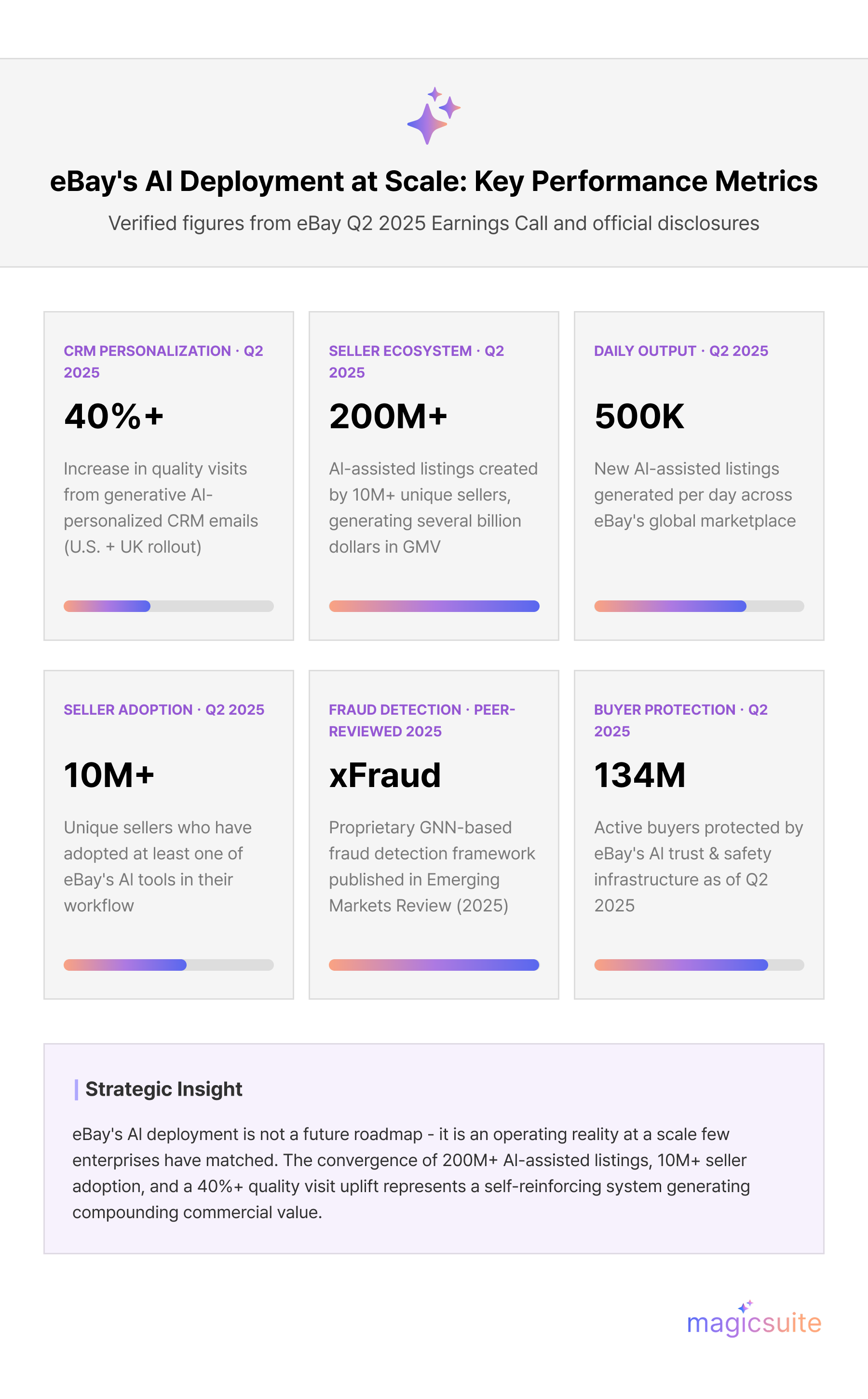
One of the most significant and verifiable outcomes of eBay's AI customer service strategy came from an unexpected channel: email marketing. In late 2024, eBay began using generative AI to produce personalized subject lines and pre-headers for CRM emails in the U.S. market. The results, disclosed publicly by CEO Iannone on eBay's Q2 2025 earnings call, were striking.
The AI-generated email approach drove a greater than 40% increase in quality visits compared to eBay's prior methodology. This metric — quality visits, as opposed to raw opens or clicks — represents buyers who engaged meaningfully with the platform after receiving the email, reflecting genuine personalization effectiveness rather than superficial click activity.
"We're already sending millions of these tailored emails each week and plan to continue leveraging generative AI to personalize more touch points of the customer experience through CRM channels," Iannone said.
Following the U.S. rollout, eBay rapidly expanded the program across multiple dimensions:
This result aligns closely with what McKinsey's research consistently identifies: companies that deploy personalization effectively in customer interactions see 5–15% increases in revenue and improved retention rates. eBay's outcome — driven by generative AI customer service personalization at scale — represents the high end of that range because personalization was applied at a layer where intent signals are strongest: the pre-visit email moment.
While the CRM story demonstrates AI's impact on buyer engagement, eBay's AI Assistant addresses a different but equally important friction layer: real-time seller-buyer communication.
eBay's AI Assistant, launched in late 2024 and progressively enhanced through 2025, generates suggested replies to buyer messages drawn exclusively from the seller's own live listings and order details. The tool currently covers the following inquiry types:
Critically, the tool operates with the seller fully in the loop: every AI-suggested response is visible only to the seller, who can choose to edit and send it or dismiss it entirely. eBay's official Seller Center documentation is explicit that sellers retain full control over what is sent to buyers — the AI assists, it does not act autonomously.
Third-party analysis of sellers using the system suggests meaningful time savings — with some estimates placing manual message handling reductions at 40–60% for active sellers — though eBay has not published a formal aggregate performance metric for the tool. What eBay's own VP of Seller Experience Xiaodi Zhang has confirmed is the platform's "virtuous flywheel" model: AI customer service tools reduce friction across the listing and communication workflow, which compounds into higher-quality buyer interactions and ultimately more GMV.
The flywheel model is critical to understanding eBay's AI customer service execution. The company is not deploying AI in isolated workstreams. It is designing a self-reinforcing system where each layer of customer service automation improves the inputs and outputs of every adjacent layer.
Perhaps the most forward-looking component of eBay's customer experience automation is its deployment of conversational and agentic AI directly within the shopping experience. In May 2025, eBay introduced an AI shopping agent designed to deliver real-time, hyper-personalized product recommendations and expert guidance based on individual users' shopping preferences.
The agent is capable of appearing inline on any page when requested or through predictive messaging — meaning it activates based on behavioral signals rather than waiting for explicit user prompts. This is a meaningful architectural shift. Traditional chatbots were reactive; eBay's agentic model is anticipatory.
"These agentic AI advancements help us to better serve our customers with efficiency and a deep understanding of their needs, while positioning eBay at the forefront of the futuristic, agent-powered ecommerce landscape," said Mazen Rawashdeh, eBay's SVP and CTO, in a company blog post.
eBay also collaborated with OpenAI to develop an Operator AI agent — a virtual shopping assistant that connects users directly to eBay's inventory and expands seller reach through conversational product discovery. At scale, these agentic tools reduce the cognitive friction of browsing and discovery, transforming what was once a search-and-scroll experience into a guided, intent-aware interaction.
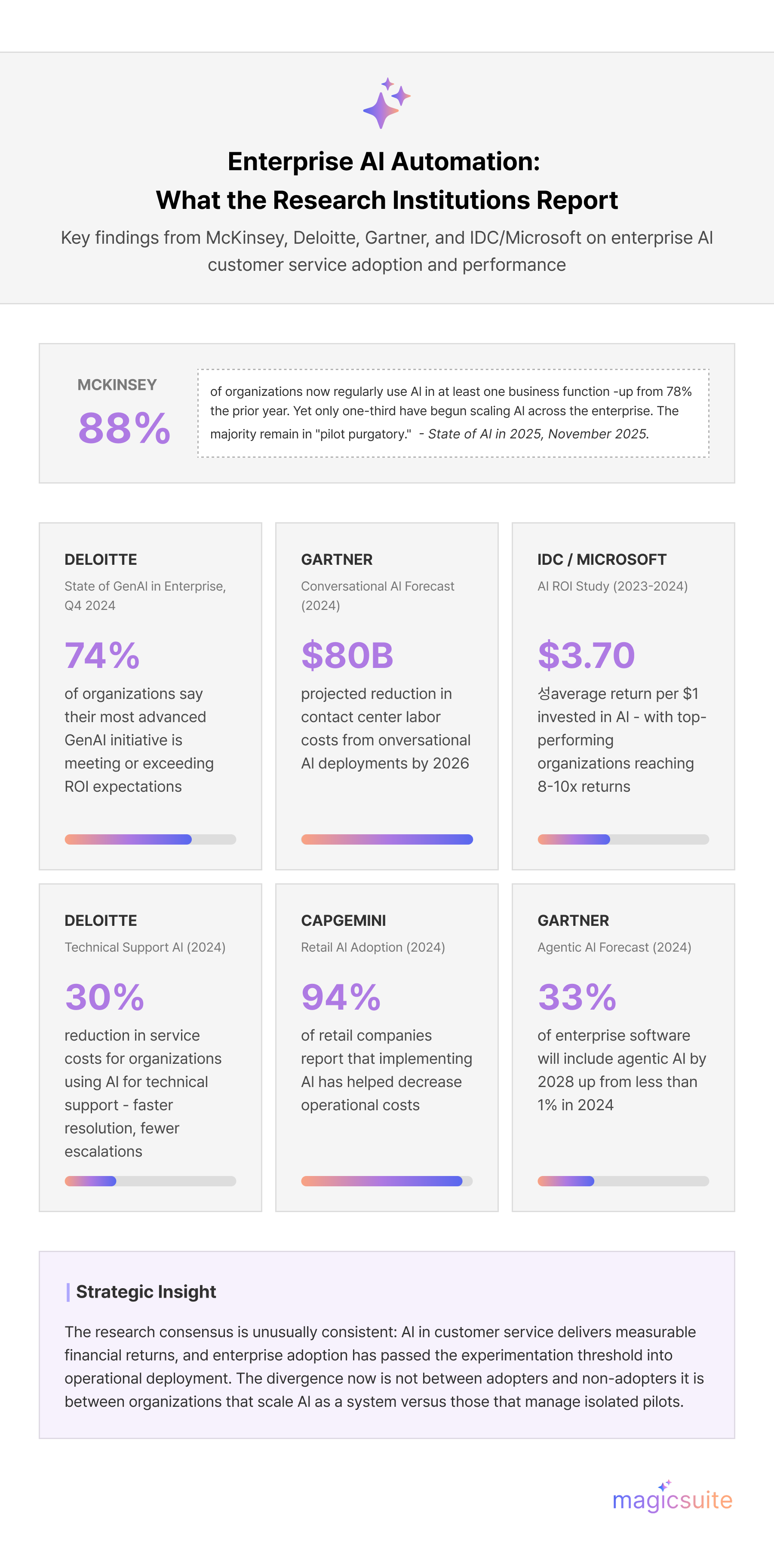
This positions eBay within a broader e-commerce AI trend that Gartner has defined with unusual specificity: by 2028, the research firm predicts that 33% of enterprise software will include agentic AI — up from less than 1% in 2024. eBay is not merely tracking this trend; it is actively building the organizational muscle to lead it.
No discussion of eBay's AI-driven customer support infrastructure is complete without examining its trust and safety stack. Fraud detection at a marketplace of eBay's scale is not an operational function — it is an existential requirement. A single wave of counterfeit goods, account takeovers, or payment fraud can erode buyer confidence in ways that persist long after the immediate incident is resolved.
eBay's response has been to build a sophisticated, multi-layer AI fraud detection infrastructure over several years. The company's internally developed xFraud framework uses Graph Neural Networks (GNNs) to analyze heterogeneous transaction data at scale, identifying fraudulent patterns across multiple signals simultaneously:
eBay published detailed findings on the xFraud system in a 2025 edition of the Emerging Markets Review — one of the few times a major e-commerce platform has submitted its fraud detection methodology to peer-reviewed academic scrutiny.
eBay also acquired AI fraud detection company 3PM Shield to bring specialized anti-counterfeiting capabilities in-house. The acquisition reflected a deliberate strategy: rather than relying solely on third-party vendors for trust infrastructure, eBay is building proprietary AI capabilities that can be continuously tuned to its specific marketplace dynamics.
"It is a top priority to help ensure that eBay remains a safe and trusted environment for our global community of sellers and buyers," said Zhi Zhou, eBay's Chief Risk Officer, in a statement following the acquisition.
These investments serve a dual purpose. They protect buyers from fraud and protect sellers from false counterfeiting claims — a balance that, when struck correctly, strengthens both the long-term credibility of eBay's AI-driven customer support ecosystem and the platform's overall health.
Customer service transformation at eBay extends beyond the buyer experience. A significant share of eBay's AI investment targets sellers — the supply-side participants whose listing quality, responsiveness, and product accuracy directly determine buyer satisfaction.
The scale of this deployment is notable. According to data disclosed by eBay's CEO on the Q2 2025 earnings call, approximately 500,000 listings per day are created with the assistance of AI tools. As of that same call, more than 10 million unique sellers had used AI features to create over 200 million listings, which Iannone stated had generated "several billion dollars" in gross merchandise volume. This is not a pilot program or a feature in beta; it is a core operational capability embedded in the standard seller workflow.
eBay's seller-facing AI toolkit includes:
Sellers using eBay's advanced business tools — including promoted listings, automated repricing, and listing automation — report 30–35% higher revenue growth on average than sellers who manage listings manually, according to platform analytics reported by eBay statistics aggregators. While this figure is not directly published in an official eBay press release, it is consistent with the directional outcomes eBay's own leadership has cited in attributing GMV growth to AI tool adoption. This is the commercial argument for e-commerce AI made concrete: automation is not merely reducing cost; it is directly expanding seller revenue outcomes.
eBay's transformation does not exist in isolation. It unfolds against a backdrop of accelerating enterprise AI automation that is reshaping competitive expectations across all customer-facing industries.
Key industry benchmarks provide essential context for evaluating eBay's AI customer service strategy:
What separates companies achieving outsized results from AI in customer service from those that struggle? Research from Gartner identifies a clear organizing factor: organizations with a targeted customer service automation strategy aligned to specific business objectives are consistently better positioned to realize the full potential of their AI deployments. eBay's architecture — where AI serves seller growth, buyer personalization, fraud prevention, and operational efficiency simultaneously — exemplifies this alignment.
By contrast, the 42% of companies that abandoned most AI initiatives in 2025 (up dramatically from 17% in 2024, per Gartner) tend to share a common pattern: AI deployed as a discrete experiment rather than as a connected system embedded in core business workflows.
A credible analysis of eBay's AI customer service program requires acknowledging where the model encounters friction. Despite the platform's substantial progress, users and sellers have reported specific failure modes that illustrate the persistent challenges of AI deployment at scale.
eBay's AI-driven policy violation detection has faced criticism from sellers who report legitimate items being incorrectly flagged as counterfeit or prohibited. The challenge is structural: AI models trained on historical violation patterns can produce false positives when applied to edge cases or niche product categories where the boundary between legitimate and prohibited items is contextually nuanced.
As the Digital Trust and Safety Partnership's 2024 best practices report notes, even highly accurate models generate significant over- or under-enforcement at the scale of major digital platforms. This challenge is not unique to eBay — it is a systemic tension in every large-scale AI customer service deployment. Three consistent failure patterns emerge:
The lesson for enterprise AI practitioners is clear: automation scales speed and reduces costs, but it also scales errors. Designing AI systems with robust escalation paths, human-in-the-loop review for high-stakes decisions, and continuous feedback mechanisms is as important as the initial deployment itself.
The gap between AI leaders and AI laggards in customer service is widening — and eBay's trajectory illustrates why catching up becomes progressively more difficult.
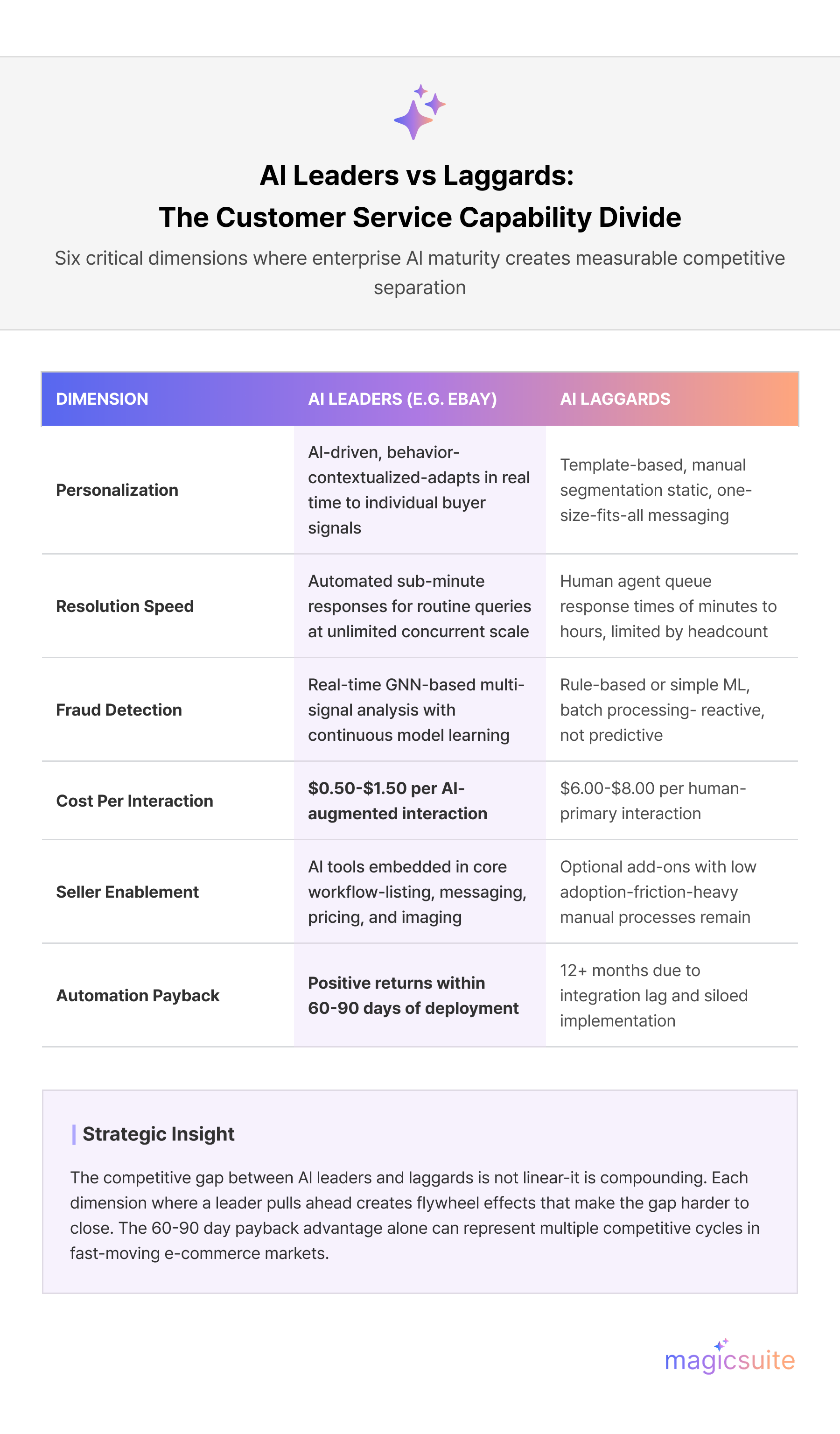
Companies deploying AI-powered customer support in integrated, workflow-embedded ways — as eBay has — are achieving positive returns within 60 to 90 days of implementation according to 2025 industry benchmarks. Those treating AI chatbots for customer service as a standalone product layer see integration delays stretch that timeline by six months or more, compounding competitive disadvantage in a market where customer expectations are rising in parallel.
eBay's AI-powered customer support transformation offers a practical framework for enterprise AI automation that goes beyond the platform's specific product choices. Several strategic principles emerge from its execution:
1. Build toward system integration, not feature accumulation. eBay's AI in customer service investments compound because each deployment — CRM, listing AI, fraud detection, agentic shopping — reinforces the others. Enterprises that deploy isolated AI chatbots for customer service without integrating them into broader workflows capture a fraction of the available value.
2. Measure outcomes, not deployments. eBay tracks quality visits, GMV growth, and seller revenue outcomes — not the number of AI features deployed. This orientation toward business outcomes over technical milestones is what makes customer service automation measurable and defensible to leadership.
3. Use the flywheel model to sustain momentum. eBay's "virtuous flywheel" — where AI improves listing quality, which improves buyer experience, which drives more GMV, which justifies more AI investment — is a model any enterprise can adapt. The key is identifying which business outcome generates the clearest feedback signal.
4. Retain human oversight in high-stakes AI decisions. Automation scales both efficiency and errors. Designing escalation paths and maintaining human review for contextually complex decisions is not a hedge against AI capability — it is a prerequisite for sustained trust, especially in AI-driven customer support applications.
5. Invest in proprietary AI capabilities where platform trust is at stake. eBay's acquisition of 3PM Shield and the development of xFraud reflect a strategic conviction: when e-commerce AI directly governs marketplace trust, relying on generic third-party tools is insufficient. Proprietary models trained on platform-specific data produce meaningfully better outcomes.
eBay's AI customer service transformation is neither a singular product launch nor a headline-chasing experiment. It is the result of a multi-year customer experience automation program built around a coherent architectural vision: an adaptive, AI-managed marketplace where every layer of the customer experience — from the pre-visit email to the post-transaction dispute — is progressively automated, personalized, and improved.
The outcomes are verifiable and significant:
For enterprise decision-makers assessing their own enterprise AI automation priorities, eBay's playbook offers a compelling signal: the return on AI in customer service is real, measurable, and compounding — but only for organizations that build AI into their core workflows rather than bolting it onto the edges. The companies achieving up to 8x returns, as McKinsey's research on top-performing organizations identifies, are those where AI-powered customer support is a system, not a feature. eBay, for all its operational complexity and ongoing challenges, is building that system — and the distance between it and less AI-mature competitors is growing with every model update.

Joseph is a Technical Communications Specialist responsible for translating complex technical concepts into clear, engaging, and accessible content for diverse audiences. He collaborates closely with technical teams, product experts, and stakeholders to develop documentation, reports, knowledge resources, and communication materials that support business objectives and enhance user understanding.