

Predictive AI resolves customer issues before they escalate — cutting costs 20–30% in e-commerce.

Most e-commerce brands still run customer support the same way they did a decade ago: wait for a complaint, assign a ticket, resolve the issue, and close the loop. It barely works. But in an era where customer expectations for initial response speed have increased by 63% between 2023 and 2024 alone, reactive support is no longer a competitive strategy. It is a liability.
The shift happening right now across the e-commerce landscape is not just technological-it is philosophical. The most forward-thinking brands are no longer asking how fast they can respond to problems. They are asking how to prevent those problems from ever reaching a customer in the first place. That is the promise of predictive customer support: an AI-powered customer service model that anticipates friction, detects failure signals in advance, and intervenes before the support ticket ever gets created.
This article examines how predictive analytics in customer service works inside e-commerce environments, what the latest research reveals about its measurable business impact, where implementations are succeeding or stalling, and how organizations can build a proactive customer service architecture that delivers durable, compounding value.
Traditional support systems are built around response-structured queues, escalation trees, and ticketing workflows designed to handle demand that has already arrived. Predictive customer support inverts this model entirely.
At its core, AI customer support powered by predictive intelligence uses a convergence of technologies working in concert:
The result is a system that does not wait for customers to signal distress. It reads the signals they have not articulated yet. According to a Gartner report released in June 2025, service organizations that embed e-commerce AI into their products for proactive issue detection will fundamentally reduce reliance on reactive external support, repositioning the support function from demand management to customer experience AI orchestration.
This is not a distant vision. It is already underway in e-commerce at a meaningful scale.
The business case for predictive AI for customer support has moved well past the proof-of-concept phase. The numbers across multiple credible research bodies now tell a consistent and compelling story about AI-powered customer service outcomes and the measurable returns on proactive customer service programs.
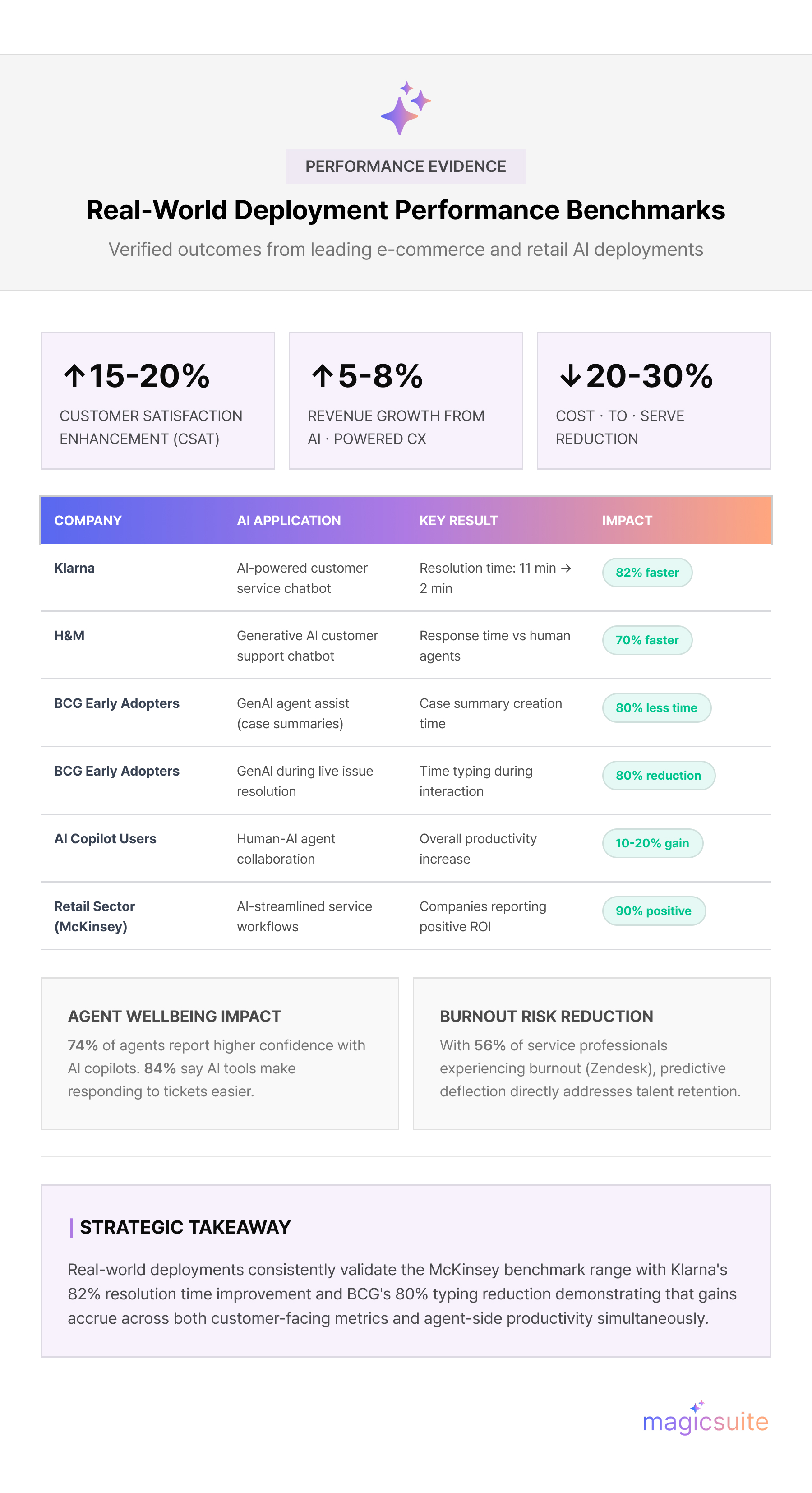
According to McKinsey's October 2025 research on AI-powered next-best-experience capabilities, organizations that deploy predictive and personalized customer engagement can enhance customer satisfaction by 15–20%, increase revenue by 5–8%, and reduce cost-to-serve by 20–30%. These are not marginal gains-they represent a structural shift in how cost and experience are managed simultaneously.
.jpg)
The market reflects this momentum. The global AI customer support market was valued at $12.06 billion in 2024 and is projected to reach $47.82 billion by 2030 at a 25.8% CAGR (MarketsandMarkets). Within that figure, the retail and e-commerce AI segment stands out as the fastest-growing vertical, projected to expand at a 26% CAGR through 2033 (Grand View Research).
Key performance benchmarks from real-world deployments are equally striking:
.jpg)
Perhaps most revealing for e-commerce AI decision-makers: companies see an average return of $3.50 for every $1 invested in AI customer support. Top-performing organizations-those that deploy strategically rather than reactively-achieve up to 8x returns. The gap between the average and the excellent is not a matter of technology access. It is a matter of implementation rigor and organizational alignment.
Understanding the mechanics of predictive customer support requires looking at where the intelligence is generated-and how it gets applied.
In e-commerce, the number of behavioral and operational signals available before a customer contacts support is enormous. Browsing abandonment patterns, failed checkout attempts, unusual return rates, shipping exception codes, product review sentiment, and CRM interaction history all represent leading indicators of potential friction.
Predictive analytics in customer service synthesizes these inputs to identify at-risk customers, at-risk orders, and at-risk product lines before problems materialize. An AI customer support system monitoring fulfillment data, for instance, can detect a carrier delay pattern 48 hours before customers start asking where their orders are-and trigger proactive customer service outreach automatically.
This is what McKinsey describes as machine-triggered customer care: the product or logistics infrastructure itself becomes part of the support network, alerting teams and initiating customer communications without waiting for human initiation.
The customer reception to proactive customer service has been consistently positive, and Gartner's own research is instructive here. A Gartner survey of more than 6,000 customers found that proactive service results in a measurable uplift across net promoter scores, customer satisfaction scores, and customer effort scores. However, Gartner also cautions that poorly designed proactive outreach can backfire: two-thirds of customers who receive proactive outreach still contact the company afterward via assisted channels because they need additional information or confirmation. This underscores a critical design principle-predictive AI for customer support must deliver self-sufficient resolutions, not just notification triggers. When done correctly, it fundamentally changes the emotional experience of the interaction: frustration is replaced by appreciation.
This dynamic has direct loyalty implications. Seventy-three percent of consumers switch brands after repeated bad experiences (Zendesk), and 56% leave without ever lodging a complaint-meaning the damage is done silently, at scale. Predictive customer support intercepts exactly these scenarios by converting potential abandonment moments into trust-building touchpoints.
One of the most underutilized capabilities in customer experience AI architectures is the feedback loop between service intelligence and product or operations teams. According to an Economist Impact report, "the most successful companies direct relevant insights to customer service staff, and also back to product or innovation teams, who can then proactively work to improve upon existing systems and processes."
In practice, this means that a predictive analytics in customer service model identifying a surge in complaints about a specific product variant can automatically alert the inventory or product team-enabling a recall, a proactive replacement offer, or a supply chain correction-before the issue compounds into a reputational event.
The AI-powered customer service landscape presents a striking paradox. Eighty-eight percent of contact centers report using some form of customer support automation, yet only 25% have fully integrated it into daily operations (Zendesk/AmplifAI research). This implementation gap is where the most important competitive differentiation is occurring.
Organizations that achieve the highest value from predictive customer support share identifiable characteristics:
In retail specifically, 63% of companies now use e-commerce AI to streamline service workflows (McKinsey, 2024). Among those using AI copilots to assist human agents, 90% report a positive return-a figure that signals how even augmented, rather than fully automated, implementations deliver strong performance gains.
Enterprises that struggle to scale predictive analytics in customer service beyond the pilot phase tend to share a different set of characteristics:
A McKinsey study underscores this clearly, citing "scaling from pilot to production" as the number-one challenge for service leaders deploying AI-powered customer service-closely followed by maturity gaps and governance deficiencies.
The trajectory of predictive customer support is not linear. It is accelerating into genuinely autonomous territory. Gartner's landmark March 2025 prediction that agentic AI will autonomously resolve 80% of common customer service issues without human intervention by 2029 represents a fundamental architectural shift for e-commerce AI.
Unlike traditional AI customer support tools that assist users with information, agentic AI acts. It navigates websites, cancels memberships, renegotiates shipping rates, and resolves billing issues-all on behalf of customers who have delegated these interactions. Applied to predictive AI for customer support, agentic AI does not just flag an impending problem and alert a human agent. It detects the problem, executes a resolution, and notifies the customer that the issue has been handled.
For e-commerce brands, this capability could eliminate entire categories of support demand. Consider a scenario where an agentic AI-powered customer service system monitors every active order, detects a warehouse processing delay, identifies the 340 customers affected, applies the appropriate compensation, updates the delivery estimate, and sends personalized notifications-all before a single customer reaches out. This is not a speculative use case. It is the logical extension of the data integrations and predictive analytics in customer service that leading brands are building right now.
Gartner's June 2025 report on the future of customer service reinforces this direction explicitly, identifying "automation to proactively prevent issues" as one of three transformative trends reshaping the function by 2028. The report notes that service organizations will embed customer experience AI into products themselves-not just into the support infrastructure-to identify and respond to high-risk customer behaviors before escalation occurs.
Deploying predictive customer support does not eliminate the human dimension of customer service-it redefines it. McKinsey research confirms that 71% of Gen Z consumers are still likely to reach out via phone for service, and IDC data consistently places "comfort talking to a human" as the primary driver of agent-assisted channel preference, ahead of convenience or complexity.
The most resilient AI-powered customer service architectures recognize this. Customer support automation handles the detectable, the repeatable, and the preventable. Human agents-increasingly empowered by AI copilots-handle the emotional, the ambiguous, and the high-stakes. BCG's research on early generative AI customer support adopters shows agents spending 80% less time typing and gaining access to real-time case summaries, meaning the human interactions that do occur are higher-quality, better-informed, and more satisfying for both parties.
Agent satisfaction is also a meaningful factor. Seventy-four percent of customer service agents report that AI copilots helped them feel more confident resolving complex cases, and 84% say AI customer support tools make responding to tickets easier. In an environment where 77% of service agents report rising workloads and 56% experience burnout (Zendesk), predictive AI for customer support that deflects high volumes of routine and preventable inquiries directly addresses a talent retention and operational sustainability problem.
For e-commerce leaders evaluating their customer support automation roadmap, building a predictive customer support capability requires decisions across three intersecting dimensions: data, technology, and organizational design.
Data infrastructure is the non-negotiable foundation. Predictive analytics in customer service models are only as accurate as the data pipelines feeding them. Unified customer data platforms that consolidate behavioral, transactional, logistics, and support history data are the prerequisite for any meaningful prediction capability. Organizations that invest here first see faster model performance and more reliable intervention triggers.
Technology selection should follow use-case prioritization. The highest-value e-commerce AI support applications-order exception management, churn risk identification, return fraud detection, and post-purchase sentiment monitoring-each require different model architectures and data inputs. Leading vendors including Salesforce, ServiceNow, Zendesk, and Microsoft now offer purpose-built AI customer support toolkits that reduce implementation timelines significantly.
Organizational alignment is frequently underestimated. Proactive customer service that detects product defects, shipping failures, or payment issues only delivers full value when the intelligence it generates reaches the operational teams capable of acting on it-supply chain, product, finance, and marketing. According to Adobe's 2025 Digital Trends Report, 65% of senior e-commerce executives identify customer experience AI and predictive analytics as central to their growth strategies, yet the cross-functional governance structures needed to act on those insights remain underdeveloped at most organizations.
The brands achieving the highest returns are those treating AI-powered customer service not as a standalone support project but as an enterprise data strategy with the customer experience as its most visible and measurable output.
The e-commerce brands that will lead the next decade are not simply the ones deploying the most AI. They are the ones deploying AI-powered customer service with the clearest intent-using predictive analytics in customer service to move support upstream, from damage control to damage prevention.
The business case is well established. The technology is maturing rapidly. The market data-from Gartner's agentic AI prediction to McKinsey's customer experience benchmarks to the Klarna and H&M real-world deployment results-paints a coherent picture: organizations that operationalize predictive customer support now will compound their advantages in satisfaction, operational cost structure, and agent productivity in ways that reactive competitors will struggle to close.
The long-term implication of customer experience AI for e-commerce is structural, not cyclical. As agentic capabilities approach the point of resolving 80% of common issues autonomously, the support organizations that will remain most valuable are those that have already built the data foundations, the cross-functional governance structures, and the human-AI collaboration models to act on proactive customer service intelligence at scale.
The question for every e-commerce brand is not whether to build predictive customer support. It is whether to build it before competitors-or after.

Hanna is an industry trend analyst dedicated to tracking the latest advancements and shifts in the market. With a strong background in research and forecasting, she identifies key patterns and emerging opportunities that drive business growth. Hanna’s work helps organizations stay ahead of the curve by providing data-driven insights into evolving industry landscapes.