

AI personalization leaders earn 40% more revenue - McKinsey maps the $463B marketing opportunity.

The economics of marketing are being rewritten. According to McKinsey, generative AI could contribute between $2.6 trillion and $4.4 trillion in value annually to the global economy-and a disproportionate share of that opportunity sits within marketing and sales. For marketers, this isn't an abstract projection; it's a structural shift that is already reshaping how campaigns are planned, how customers are engaged, and how revenue is generated.
What makes this moment particularly consequential is the breadth of what generative AI can now do: drafting personalized content at scale, synthesizing consumer intelligence from disparate data sources, optimizing ad spend in real time, and enabling AI customer engagement that feels genuinely individual rather than algorithmically generic. The question for enterprise marketing leaders is no longer whether to adopt AI-powered marketing-it's how fast they can scale it before competitors do. This article examines the evidence behind those revenue claims, the specific capabilities unlocking value, and the organizational factors that separate AI leaders from those still stuck in pilot mode.
McKinsey's foundational analysis-examining 63 use cases across 16 business functions-found that about 75% of the total value generative AI could deliver falls across just four areas: customer operations, marketing and sales, software engineering, and R&D. The estimated annual productivity value by function breaks down as follows:
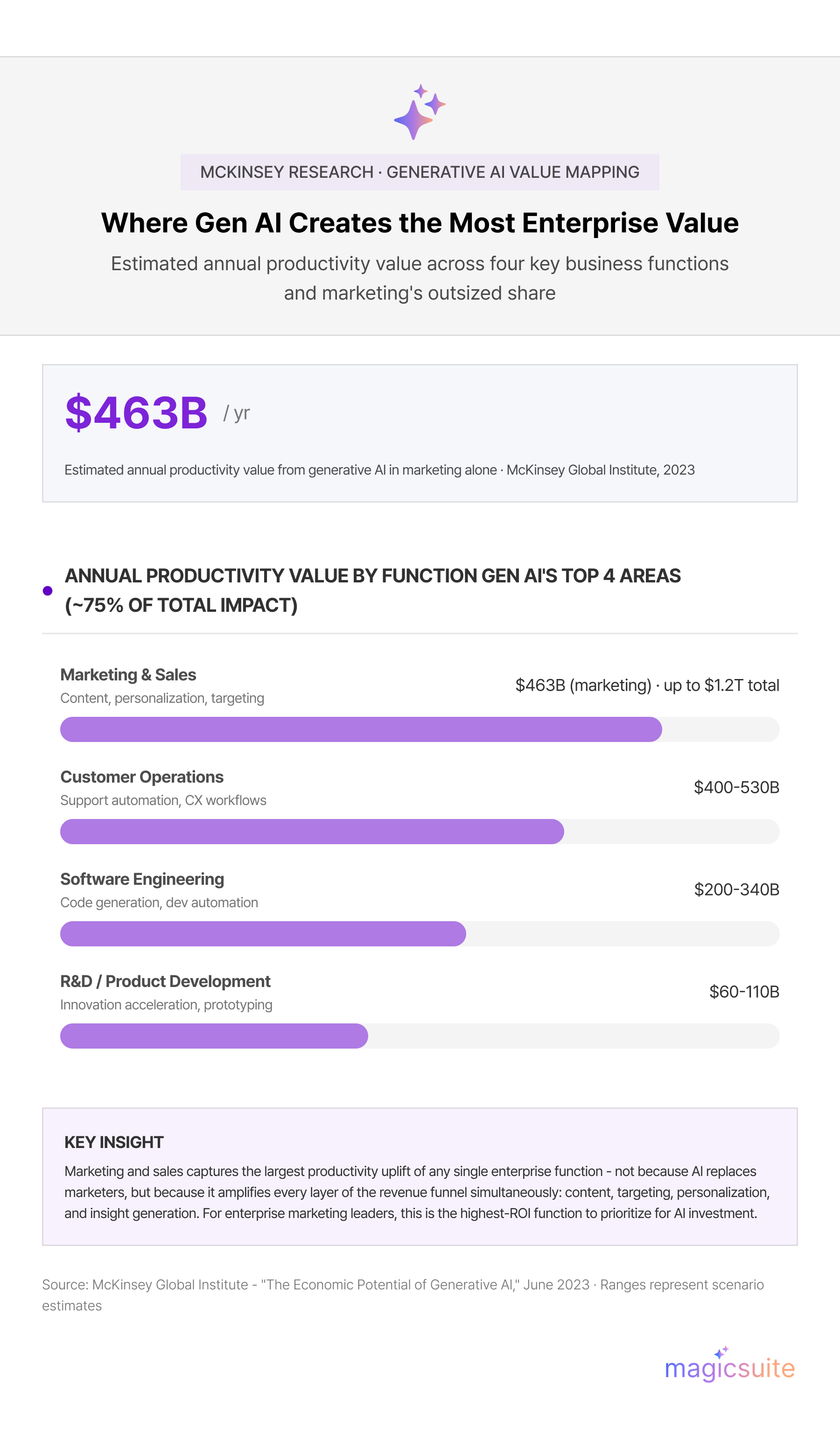
Within that cluster, marketing stands out as the single highest-value function, driven by gains in content production, campaign targeting, customer journey personalization, and insight generation.
These are not speculative figures. The research analyzed over 850 occupations and 2,100 detailed work activities across 47 countries-representing more than 80% of the global workforce-making it one of the most rigorous quantitative assessments of AI's economic impact to date.
For marketing leaders, several specific projections stand out:
What's particularly notable is that McKinsey's projections weren't just validated-they arrived ahead of schedule. McKinsey Global Institute (MGI) had previously identified 2027 as the earliest year when median human performance for natural-language understanding might be reached-but by the time of the 2023 report, that milestone had already been achieved, roughly four years ahead of earlier estimates.
If there's one capability where generative AI for marketers creates the most immediate and measurable revenue impact, it's personalization. Traditional marketing personalization relied on broad segmentation-grouping customers into demographic or behavioral clusters and serving them variations of the same message. Generative AI enables something fundamentally different: individualized content generation at scale.
McKinsey's research documents a clear performance differential between companies that lead in personalization and those that don't. Personalization leaders generate 40% more revenue from those activities than average performers-not because they have better products, but because they convert engagement into purchase decisions more effectively at every touchpoint. By contrast, companies still relying on traditional segment-based targeting typically achieve only 2–5% revenue lifts, as broad segmentation misses individual context and real-time behavioral signals that drive conversion.
Hyper-personalization-powered by AI models that process real-time behavioral signals, purchase history, contextual data, and predictive intent-goes further. McKinsey data shows hyper-personalization drives average revenue lifts of 10–15%, with company-specific outcomes ranging from 5% to 25% depending on implementation maturity.
The enterprise adoption data supports this shift. By 2025, 59% of enterprise marketers were using AI personalization to enhance their initiatives, applying it across content optimization, customer journey mapping, predictive analytics, and conversational interfaces. The rationale is straightforward: AI enables companies to simultaneously analyze and interpret text, image, and video data to surface innovation opportunities and craft individualized outreach that scales across millions of customer interactions without proportional increases in cost.
Real-world outcomes validate the model. Saks Global's AI-powered personalized homepages produced a 7% increase in revenue per visitor and nearly 10% higher conversion rates. These aren't marginal improvements-they compound across the entire customer base.
Before revenue can be unlocked, efficiency must be established. AI-driven marketing is proving its value first in the content production layer-one of marketing's most time-intensive and resource-heavy workflows. McKinsey identifies content generation as a domain where generative AI creates immediate, measurable impact through faster ideation, reduced drafting cycles, and consistency of brand voice across formats and channels.
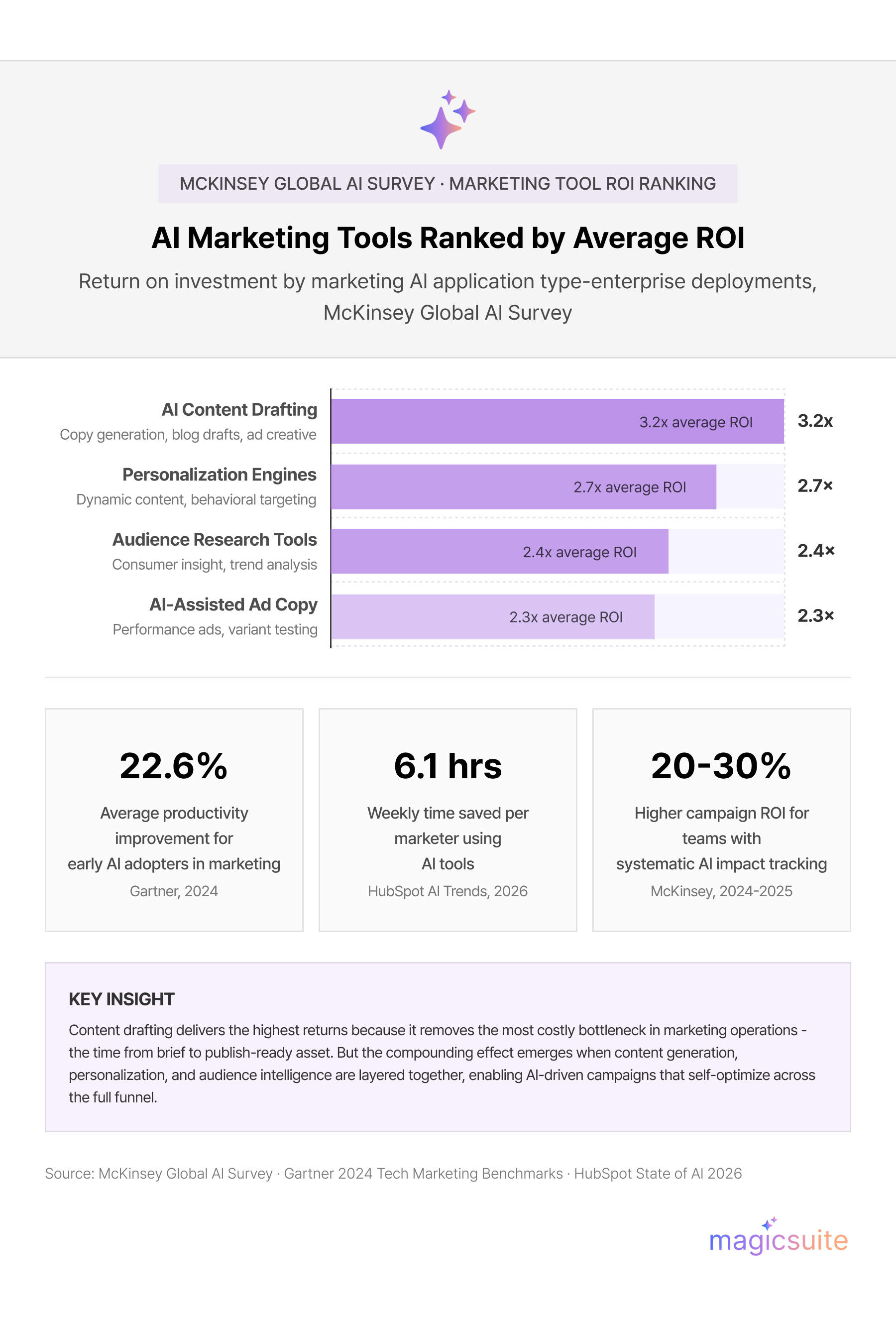
The efficiency gains are substantial. According to Gartner, early AI adopters in marketing report an average 22.6% productivity improvement, with some functions achieving gains between 15–30%. HubSpot's 2026 AI Trends data found that marketers using AI tools save an average of 6.1 hours per week-with senior practitioners recovering as many as 8–10 hours.
For campaign management, the transformation is even more pronounced. AI tools can now:
Companies that systematically track AI's marketing impact see 20–30% higher campaign ROI than those that don't-primarily because real-time measurement allows them to double down on what's working and cut what isn't before wasted spend accumulates.
AI content drafting delivers an average 3.2x ROI according to McKinsey's Global AI Survey, with personalization engines close behind at 2.7x. Audience research tools (2.4x) and AI-assisted ad copy (2.3x) round out the top-performing marketing AI applications by return.
Despite the compelling evidence for AI-powered revenue growth, enterprise adoption is highly uneven. McKinsey's data reveals a stark divide across four adoption tiers: 88% of organizations now use AI in at least one business function-but that broad adoption narrows sharply at every subsequent stage. While 65% of organizations regularly used generative AI as of early 2024-nearly double the rate from just ten months prior-only about one-third have begun scaling AI enterprise-wide as of 2025. Most critically, only 39% of organizations can link any EBIT impact to their AI investments, and the cohort achieving a 5% or greater EBIT contribution from AI represents just 6% of all organizations-the true high-performer tier.
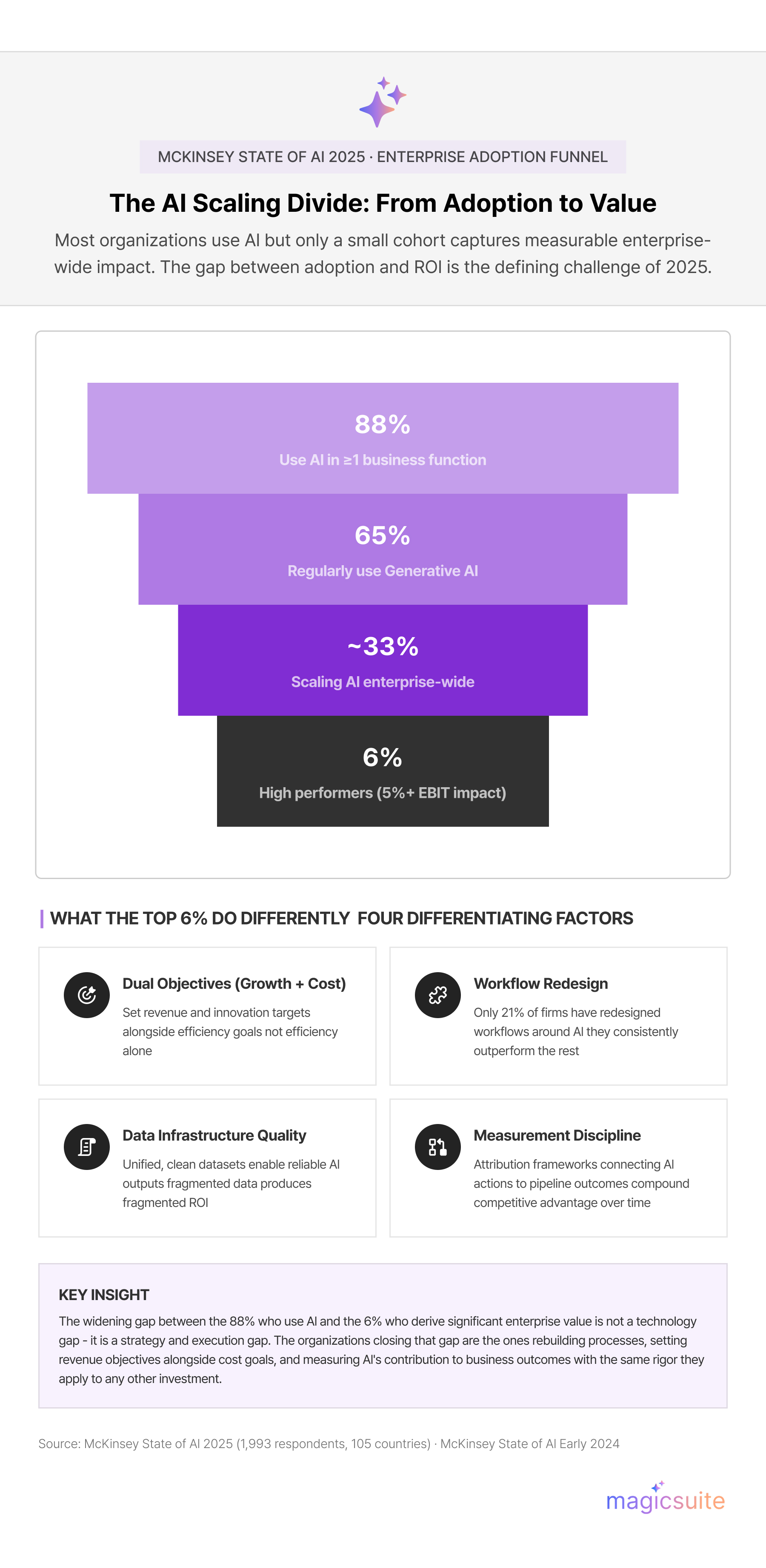
The data points to clear differentiators that separate high-performing AI adopters from those stuck in what researchers call "pilot purgatory":
Strategic framing matters. Organizations that achieve the highest AI ROI set growth and innovation objectives alongside cost reduction goals-not instead of them. McKinsey's State of AI 2025 report confirms that efficiency-only AI strategies produce only incremental gains. Companies that position AI as a revenue accelerator rather than purely a cost lever capture disproportionate value. Revenue gains are most concentrated in marketing and sales, strategy and finance, and product development.
Workflow redesign is non-negotiable. High performers don't bolt AI tools onto existing processes. They rebuild those processes around AI's capabilities-rewriting sales playbooks, restructuring content pipelines, and re-platforming customer knowledge so AI can act reliably rather than as an isolated add-on. McKinsey's survey data shows that 21% of organizations using gen AI have fundamentally redesigned at least some workflows-and that group consistently outperforms those that haven't.
Data quality is a prerequisite. Gartner's research identifies 66% of companies citing difficulty in establishing ROI on AI opportunities, while 56% struggle with integration into existing IT systems. The underlying issue in most cases isn't the AI model-it's the data infrastructure feeding it. Organizations with clean, unified datasets extract more reliable insights and achieve faster ROI.
Measurement discipline drives compounding returns. Companies that track AI's marketing impact systematically compound their advantage over time. Without attribution frameworks that connect AI-driven actions to pipeline outcomes, teams cannot make informed decisions about where to scale and where to cut.
The contrast is significant: Gartner notes that 71% of marketing leaders who adopted AI tools in 2024–2025 report positive ROI within six months-up from 48% just two years prior. Speed to value is improving, but only for organizations that approach implementation strategically.
The current wave of generative AI in marketing is already substantial, but the next frontier is beginning to take shape: agentic AI. Unlike conventional generative AI tools that respond to prompts and assist human decision-making, agentic systems can autonomously plan and execute multi-step workflows-scheduling campaigns, adjusting bids, personalizing outreach sequences, and resolving customer issues without per-step human intervention.
McKinsey's research shows 62% of organizations are experimenting with AI agents, but only 23% are actively scaling them. For marketing specifically, agentic capabilities promise to close the loop between customer intelligence and campaign execution in real time-enabling AI customer engagement systems that detect a customer's shift in purchase intent, adjust their content experience, trigger a targeted offer, and measure the outcome, all within a single automated workflow.
Enterprise adoption data corroborates the directional shift. As of 2025, 34% of enterprise marketing teams run at least one autonomous AI agent in production-more than double the 14% reported in Q4 2024. Salesforce research finds that 87% of marketers now use generative AI in at least one workflow, up from 51% in 2024, signaling an acceleration that extends from individual task assistance toward systemic marketing intelligence.
For B2B marketing specifically, McKinsey's analysis shows companies that have empowered sales teams with AI-driven marketing and sales tools report consistent efficiency gains of 10–15%, alongside measurable increases in time spent on high-value customer interactions and reductions in back-office and administrative tasks.
The revenue potential of AI marketing optimization is real, but so are the obstacles. Understanding where enterprises commonly stall is as important as understanding where the opportunity lies.
Several friction points consistently appear in enterprise AI deployments:
The BCG Build for the Future study reinforces this picture: 66% of organizations report difficulty establishing ROI on identified AI opportunities, while 59% struggle to prioritize use cases across competing organizational needs.
For enterprises serious about capturing AI-powered marketing value at scale, the strategic imperative is clear: move from pilot-stage experimentation to production-grade deployment with measurement built in from day one. A deliberate AI marketing strategy-one that connects technology investment to business outcomes from the outset-is what separates high performers from those indefinitely stuck in experimentation.
McKinsey's research suggests a practical path forward:
The evidence McKinsey has assembled is not a speculative outlook on what AI might do-it is a documented accounting of what AI-powered marketing is already doing, and a projection of how large the remaining opportunity still is. A $463 billion annual productivity opportunity in marketing. Revenue lifts of 10–15% through hyper-personalization. Content ROI of 3.2x. These are outcomes that enterprise marketing leaders can now benchmark against and plan toward.
What the data also makes clear is that the gap between AI leaders and laggards is widening. Companies that have moved from experimentation to scaled deployment are compounding their advantages in efficiency, personalization depth, and customer intelligence-advantages that translate directly to pipeline velocity and market share. Those still running isolated pilots without measurement infrastructure or workflow redesign are not simply moving slowly. They are falling behind against competitors who are not.
The window for capturing first-mover advantages in generative AI for marketers is not unlimited. McKinsey's projections represent a floor, not a ceiling-and the organizations building toward that ceiling today are the ones that will define the competitive landscape in the years ahead.
MagicSuite gives your team the AI-powered platform to deliver hyper-personalization at scale, optimize campaigns in real time, and turn marketing spend into compounding revenue growth.

Hanna is an industry trend analyst dedicated to tracking the latest advancements and shifts in the market. With a strong background in research and forecasting, she identifies key patterns and emerging opportunities that drive business growth. Hanna’s work helps organizations stay ahead of the curve by providing data-driven insights into evolving industry landscapes.