

80% of marketers use AI for content - brands using GenAI extensively beat revenue goals by 22%.

Something fundamental has shifted in how marketing teams produce content - and the numbers make it impossible to ignore. A few years ago, generative AI in marketing was a conversation about future potential. Today, it is operational reality. HubSpot's 2026 State of Marketing Report finds that 80% of marketers are already using AI for content creation, and 61% believe the industry is experiencing its most significant disruption in two decades.
But adoption alone does not tell the full story. The more important question - and the one that separates high-performing AI-powered content teams from organizations still running disconnected pilots - is whether AI is being embedded into the structure of how marketing work actually gets done. Research from McKinsey, Deloitte, and Gartner reveals a landscape where the tools are widely available, but meaningful transformation remains the exception rather than the rule. This article examines what the data actually shows: which teams are winning, why, and what it takes to convert marketing productivity gains into durable competitive advantage.
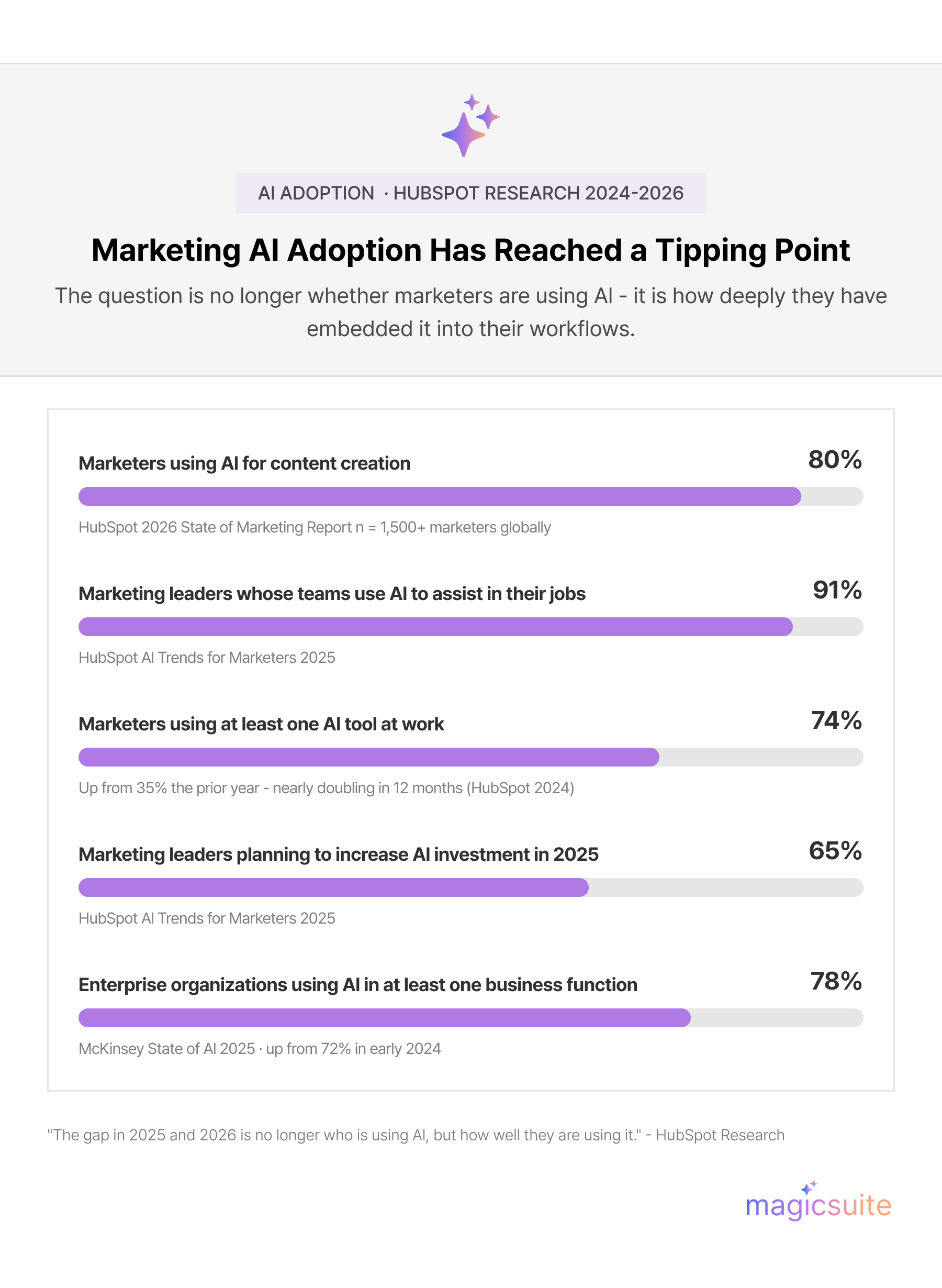
For most of 2023 and into 2024, the dominant narrative around generative AI in marketing was one of cautious experimentation. That phase is over. HubSpot's survey of over 1,500 marketers worldwide finds that AI is now table stakes - the gap in 2025 and 2026 is no longer who is using AI, but how well they are using it.
The numbers reflect a rapid normalization of AI-powered marketing tools:
What is driving this normalization is not just the power of standalone AI tools, but the embedding of AI marketing automation capabilities into platforms marketers already use daily. When AI becomes part of the CRM, the email platform, or the analytics dashboard, the adoption friction disappears - and usage scales accordingly. HubSpot's data shows this dynamic clearly: for many teams, AI adoption accelerated not because they sought out a new tool, but because their existing tools gained AI capabilities.
McKinsey's State of AI 2025 corroborates this at the enterprise level: 78% of organizations now use AI in at least one business function, up from 72% in early 2024, and 71% regularly deploy generative AI across marketing, product development, and service operations. For a broader view of where AI adoption in the enterprise stands globally, the 2025 AI market size data provides essential context.
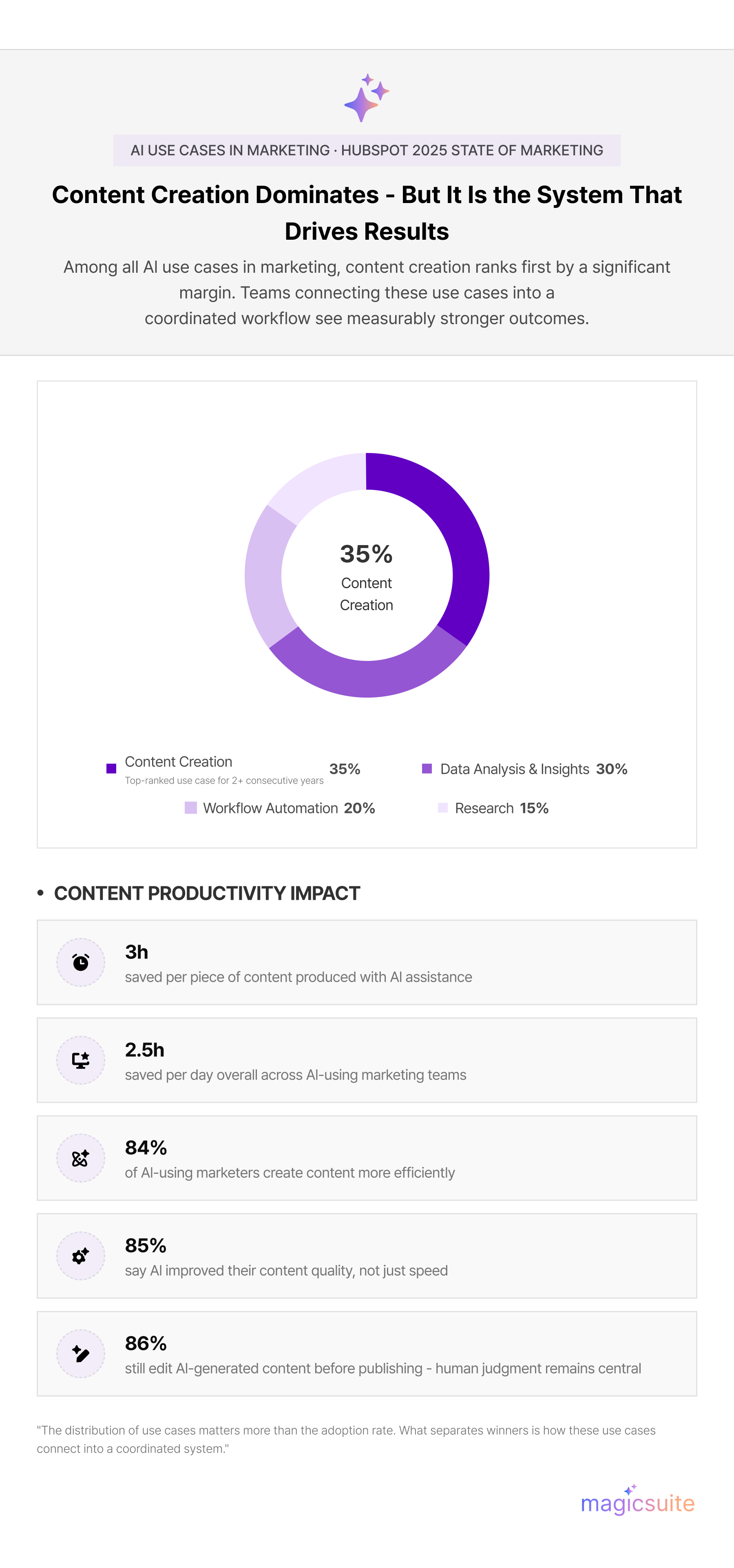
The most revealing insight from HubSpot's research is not the adoption rate - it is the distribution of use cases. Among marketers using AI, content creation tops every category at 35%, followed by data analysis and insights (30%), workflow automation (20%), and research (15%). But what separates organizations seeing measurable results from those still reporting underwhelming returns is how these use cases connect to a coordinated system rather than isolated tasks.
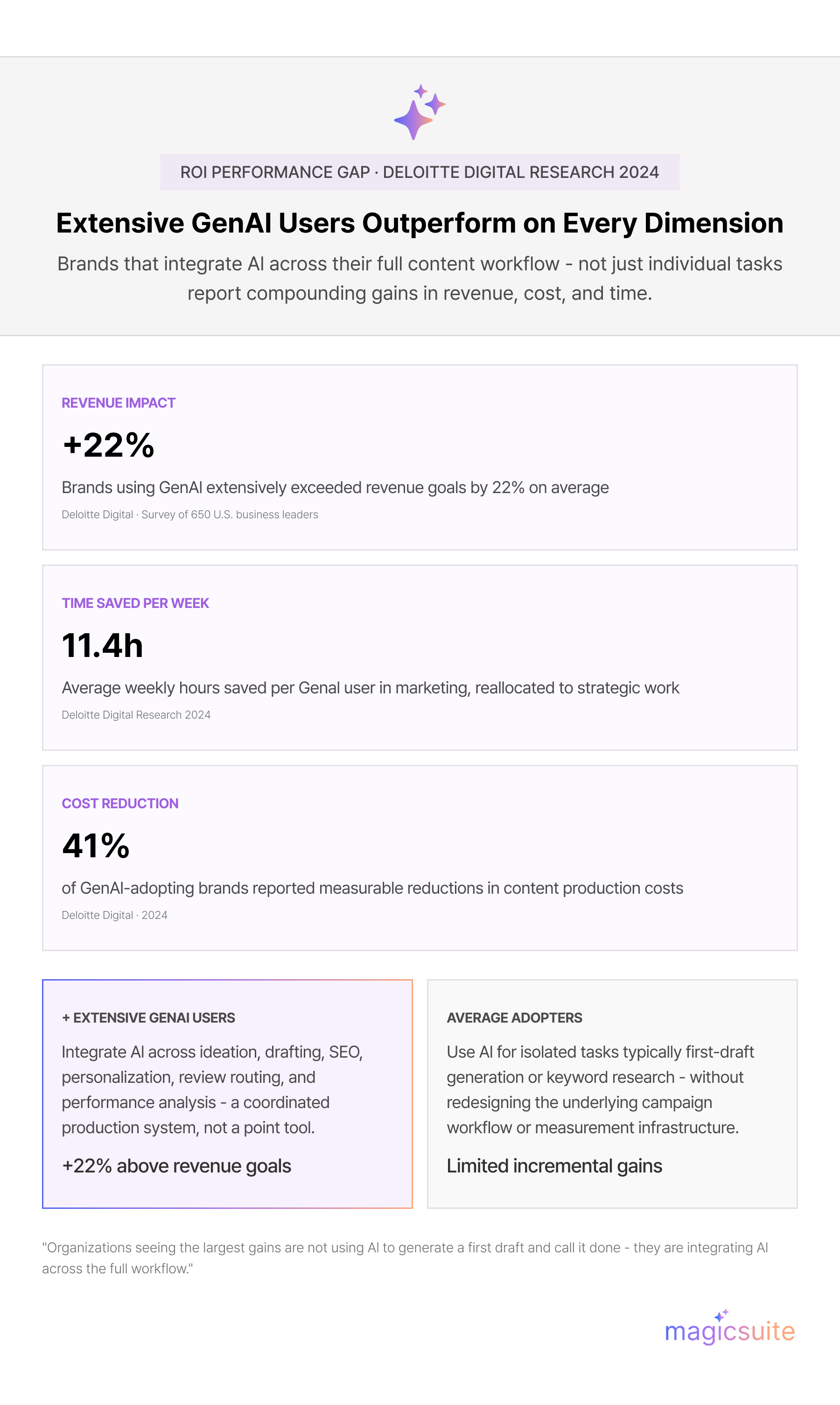
Deloitte Digital's research on GenAI in marketing content production draws a useful distinction here. Their survey of 650 U.S. business leaders found that:
The critical point in Deloitte's findings is the word "extensively." Organizations seeing the largest gains are not using AI to generate a first draft and call it done - they are integrating AI content creation across the full workflow: ideation, drafting, SEO optimization, personalization, review routing, and performance analysis. This is what AI-powered marketing looks like in practice - not a single-task shortcut, but a coordinated production system where AI operates at every stage. Teams operating this way are producing more content, faster, with higher relevance to target audiences.
HubSpot's own data supports this directionally: 84% of marketers using AI create content more efficiently, 85% say AI improved content quality, and marketers report saving an average of 3 hours per piece of content and 2.5 hours per day overall.
No institution has done more to quantify the economic stakes of AI-driven marketing than McKinsey & Company. Their landmark research on the economic potential of generative AI identifies marketing and sales as one of four business functions - alongside customer operations, software engineering, and R&D - that will collectively account for 75% of generative AI's total annual value creation across the global economy. The implication for marketing productivity is direct: no other enterprise function sits closer to the center of AI's value creation potential.
McKinsey's estimate: generative AI investment could add between $2.6 trillion and $4.4 trillion annually to the global economy across 63 use cases. By comparison, the UK's entire GDP in 2021 was $3.1 trillion. When the broader integration of generative AI into existing software systems is accounted for, that figure could roughly double - approaching $7.9 trillion annually.
For marketing leaders, the implication is strategic: AI content marketing is not a cost center efficiency play. It is a revenue growth lever with some of the highest economic potential of any enterprise function. McKinsey's State of AI 2025 adds an important nuance, however - only about 6% of respondents qualify as AI high performers, defined as organizations attributing 5% or more EBIT impact to AI use. What separates these organizations from the rest?
According to McKinsey's analysis, high performers share several traits:
The lesson for marketing AI practitioners is clear: deploying tools is not enough. Competitive advantage accrues to organizations that rebuild how their content teams operate.
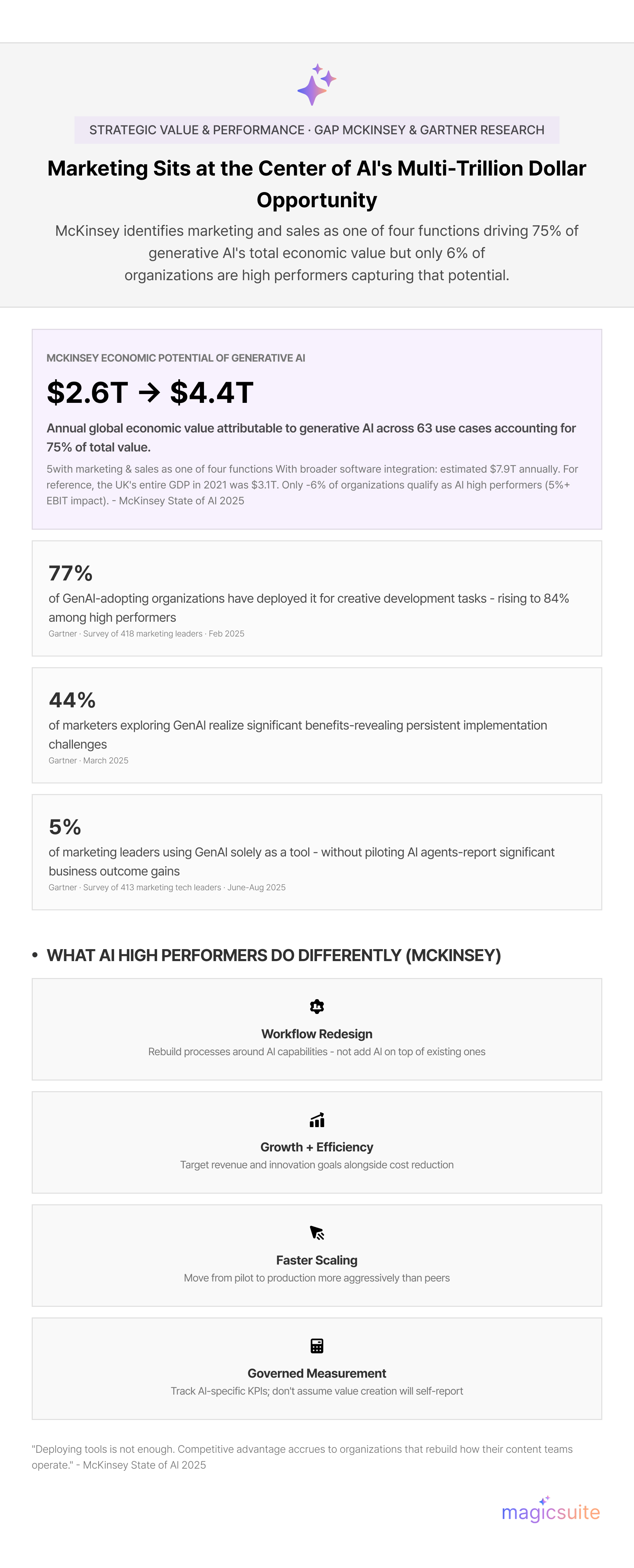
Gartner's research adds an important competitive dimension to the productivity conversation. A February 2025 Gartner survey of 418 marketing leaders found that while adoption is rising, outcomes remain highly uneven. Their data shows:
That last finding is the most consequential: using AI primarily as an efficiency tool captures limited value. The organizations unlocking outsized results are those using AI to reengineer strategies, processes, and talent models - not just automate existing tasks.
Gartner VP Analyst Nicole Greene articulates the progression clearly: most organizations are currently in "Stage 1" - AI as a tool for routine task automation. The next stage is agentic AI, capable of autonomous execution across campaign planning, content production, and performance optimization. By 2028, Gartner predicts that 60% of brands will use agentic AI to deliver streamlined, personalized one-to-one customer interactions.
For content marketing AI practitioners, this trajectory suggests that what feels like advanced AI adoption today - AI-assisted drafting and keyword research - will become the baseline, with the competitive frontier shifting rapidly toward autonomous, multi-step content operations. The leaders who treat generative AI in marketing as a foundation to build on - rather than a feature to switch on - will be best positioned when that frontier arrives. Ultimately, the organizations that close the gap between tool adoption and workflow redesign are the ones that will turn AI-driven marketing into a sustained performance advantage, not just a one-quarter productivity bump.
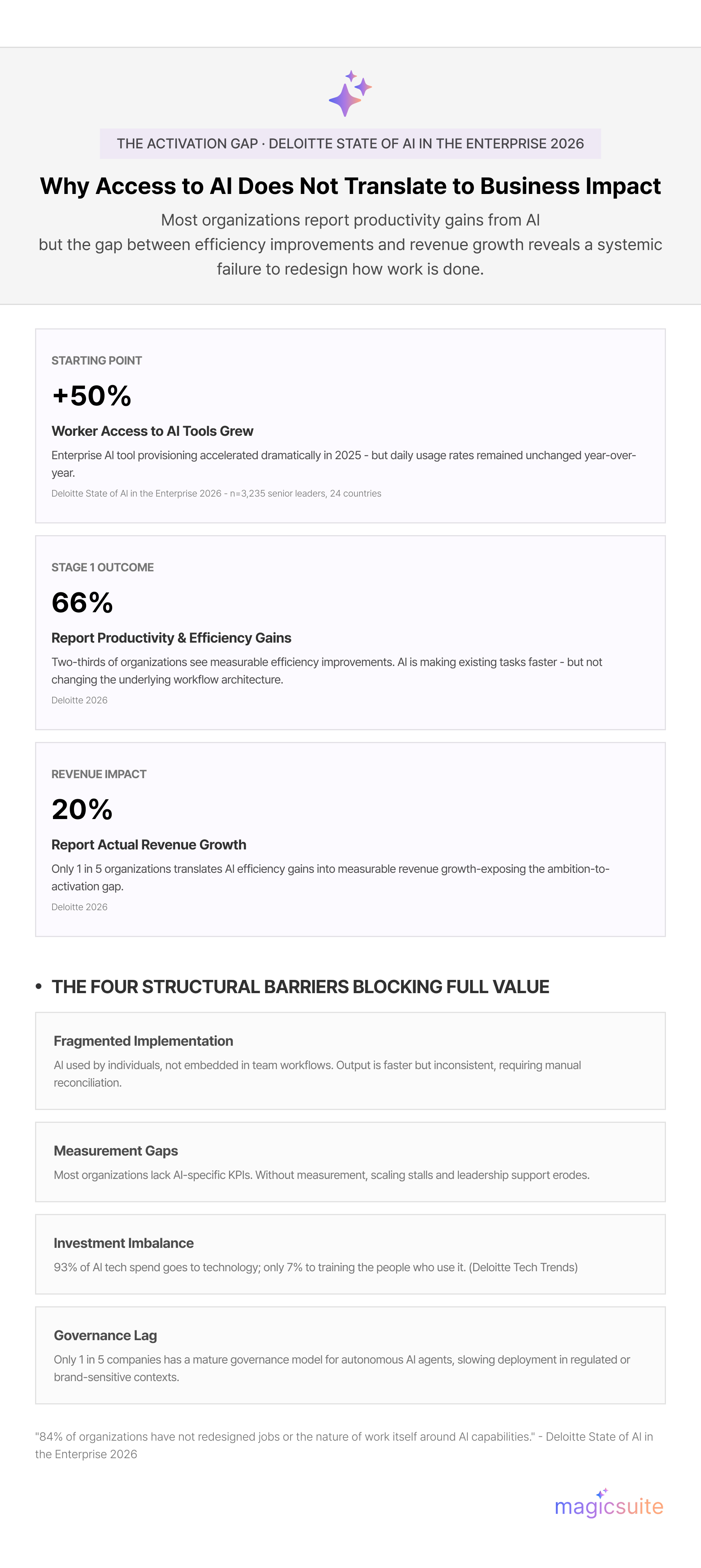
The data across HubSpot, McKinsey, Deloitte, and Gartner converges on an uncomfortable finding: most enterprises are not getting the AI returns they expect, and the reasons are more structural than technical.
Deloitte's State of AI in the Enterprise 2026, based on a survey of 3,235 senior leaders across 24 countries, identifies the core issue clearly:
Deloitte frames this as the "ambition to activation" problem. Organizations invest in tools, provision access, and run training programs - but they do not redesign the underlying campaign production workflow to operate differently. A marketing manager with excellent prompting skills still spends hours checking drafts against campaign briefs, ensuring cross-asset consistency, and verifying that CTAs align with conversion goals. AI made the first five minutes faster; it did not change the next five hours.
The organizational factors that consistently block full value realization include:
One data point from Deloitte Digital's earlier research on GenAI in content marketing deserves specific attention, because it clarifies why the urgency around AI content teams is not optional. Deloitte's survey found that:
This is the supply-demand gap that makes AI content marketing a structural necessity, not a trend. Content teams are being asked to produce more content, faster, across more channels and formats, with higher personalization requirements - while most organizations have not proportionally scaled their creative headcount. AI content creation fills this gap in a way that hiring alone cannot. The gains in marketing productivity that AI enables here are not incremental — for teams that integrate AI systematically, they are transformational. HubSpot's data shows that 63% of marketers believe most content in the near term will be created at least in part with generative AI's help, and 58% of marketers plan to increase their investments in generative AI tools.
The teams seeing the strongest returns are those that have stopped treating AI as a speed-up tool for individual contributors and started treating it as the production infrastructure for the entire content operation - from brief to publish.
Across the research, a consistent profile of high-performing AI-powered content teams emerges. These are not organizations with the most AI tools or the highest AI budgets - they are organizations that have made specific structural and cultural choices that most of their competitors have not. What unites them is a deliberate approach to marketing AI: they treat it as an operating model decision, not a software procurement one. Rather than adding AI marketing automation onto an unchanged workflow, they rebuild the workflow around what AI actually enables.
Key characteristics that distinguish them:
HubSpot's research reinforces the human-AI balance these teams maintain: 86% of marketers who use AI to write content make edits before publishing. The highest-performing teams are not removing humans from the process - they are repositioning human judgment toward higher-leverage decisions.
The data paints a picture of a market in the early stages of divergence. A relatively small cohort of organizations - McKinsey estimates around 6% - have cracked the code on enterprise AI value creation in marketing. A slightly larger group, roughly the third of Deloitte's respondents who are redesigning key processes around AI, are on a credible path to meaningful returns. The majority are still running experiments that have yet to graduate to production at scale.
This distribution matters because the advantage compounds. AI-powered content teams that are already producing content faster, with higher personalization and stronger performance data, are learning faster than their competitors. Their models improve, their workflows refine, and the gap between them and late movers widens with every campaign cycle.
Gartner's prediction captures the trajectory: 65% of CMOs believe advances in AI will dramatically transform their role within the next two years. At the same time, 82% of business leaders say their company's identity will need to significantly change to keep pace with AI's impact on markets. The organizations that treat AI as a bolt-on efficiency tool will find themselves competing on unequal footing with those that rebuilt their marketing operations around it.
The long-term implication is not that AI replaces marketing teams - HubSpot's data consistently shows that marketers want AI as a collaborator, not a replacement. The implication is that organizations that equip their teams to work fluidly with AI will do more, better, with fewer coordination costs - and that this operational advantage will translate into compounding gains in content quality, audience reach, and revenue.
The rise of AI-powered content teams is not a story about technology replacing creativity. It is a story about organizations choosing, deliberately and structurally, to compete in a different way. HubSpot's research makes the adoption reality undeniable: 80% of marketers use AI for content creation, and the majority plan to deepen that investment. McKinsey's research makes the economic stakes undeniable: marketing and sales sits at the center of generative AI's multi-trillion-dollar opportunity.
What is still being decided - by every marketing leader reading these numbers - is whether their organization will be in the small cohort extracting transformative value, or the majority capturing surface-level efficiency gains while the competitive gap widens.
The path forward is not ambiguous. Redesign the workflow, not just the tools. Invest in the people as proportionately as the platforms. Build toward AI as an agent in your content operations, not just an assistant to individual contributors. And measure from the start, so that every iteration produces organizational learning rather than just faster first drafts.
Marketing productivity in the AI era belongs to the teams that treat AI as infrastructure - not a shortcut.

Hanna is an industry trend analyst dedicated to tracking the latest advancements and shifts in the market. With a strong background in research and forecasting, she identifies key patterns and emerging opportunities that drive business growth. Hanna’s work helps organizations stay ahead of the curve by providing data-driven insights into evolving industry landscapes.