

Salesforce bought Fin for $3.6B. Its AI agent resolves 76% of support tickets without humans.

In September 2026, Salesforce finished buying Fin, the company once known as Intercom, for roughly $3.6 billion. CNBC called it a major bet on AI-powered customer service. On the surface, it looks like a big company buying a smaller one. Look closer, and it is really a sign that AI customer service companies are being bought up fast, because most businesses using AI still are not seeing the payoff they expected.
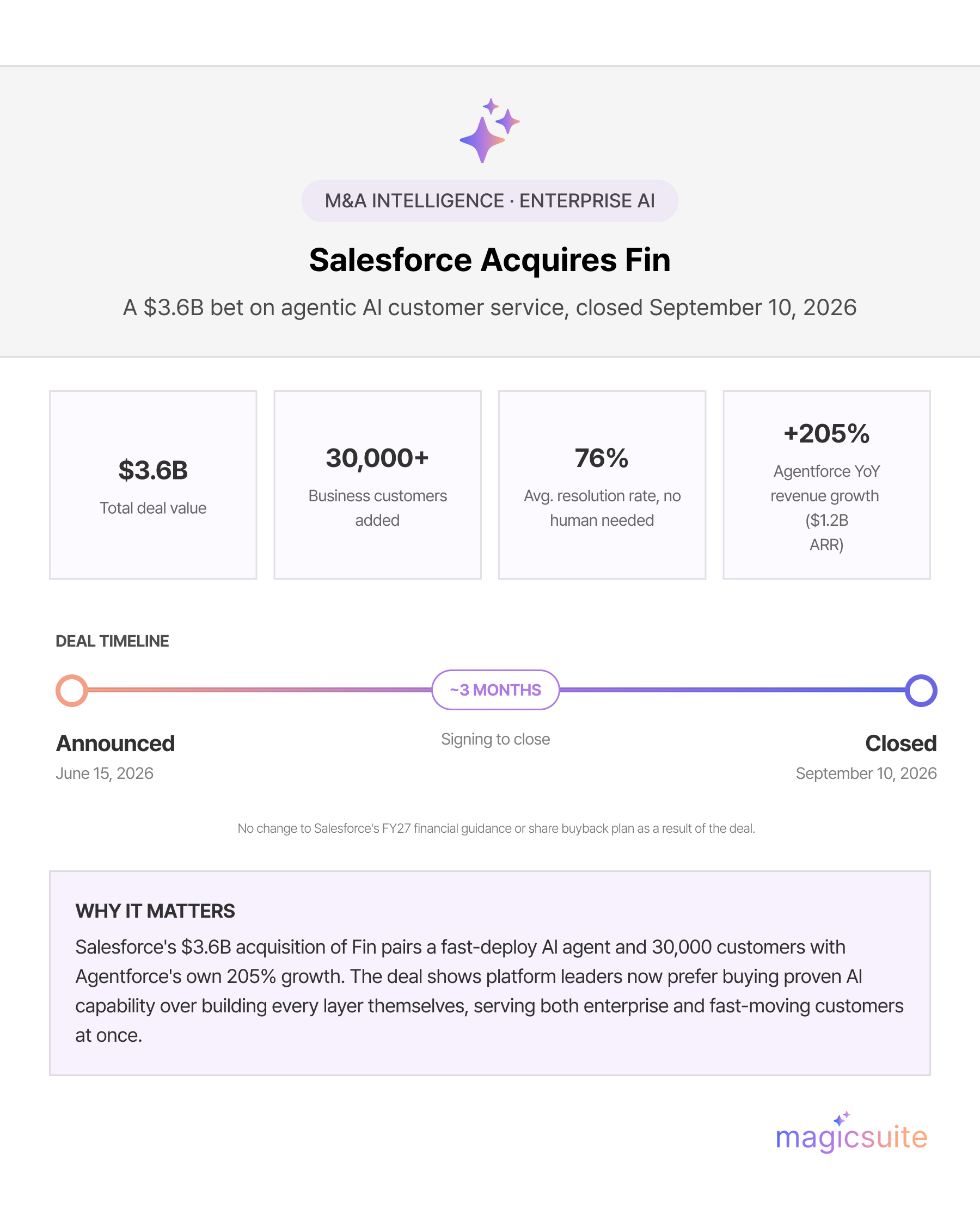
The deal was announced June 15, 2026, and closed September 10, 2026. Salesforce said the purchase would not change its financial targets or stock buyback plans, a sign the deal is strategically important but easily affordable.
What Fin brings:
CEO Marc Benioff said the deal lets companies of any size start using AI agents right away, an admission that Agentforce alone has not won over companies wanting something fast and ready.
Agentforce hit $1.2 billion in yearly revenue, up 205% year over year, a strong result by any measure. So why spend $3.6 billion on a rival instead of competing harder? The answer is audience. Agentforce serves deep, customizable enterprise AI agents built into a company's full customer database, which suits large companies with time to set it up. It is a poor fit for a smaller company wanting a working AI-powered customer support agent in weeks. Fin closes that gap instantly. This is also a talent grab: Salesforce points to outside reporting that Fin's model beats several general-purpose AI models on support tasks, reducing its reliance on outside AI providers for its highest-volume, most time-sensitive work.
The Fin deal is not happening alone. ServiceNow has spent more than $10 billion since late 2025 on AI, security, and data companies, aiming to rival Salesforce. Zendesk finished buying Forethought in March 2026, following an earlier 2024 purchase of Ultimate. Big software companies have decided buying proven agentic AI customer service technology is faster and safer than building it while racing dozens of startups. For buyers, that means today's small vendor could be tomorrow's acquired subsidiary, worth weighing before signing a long contract.
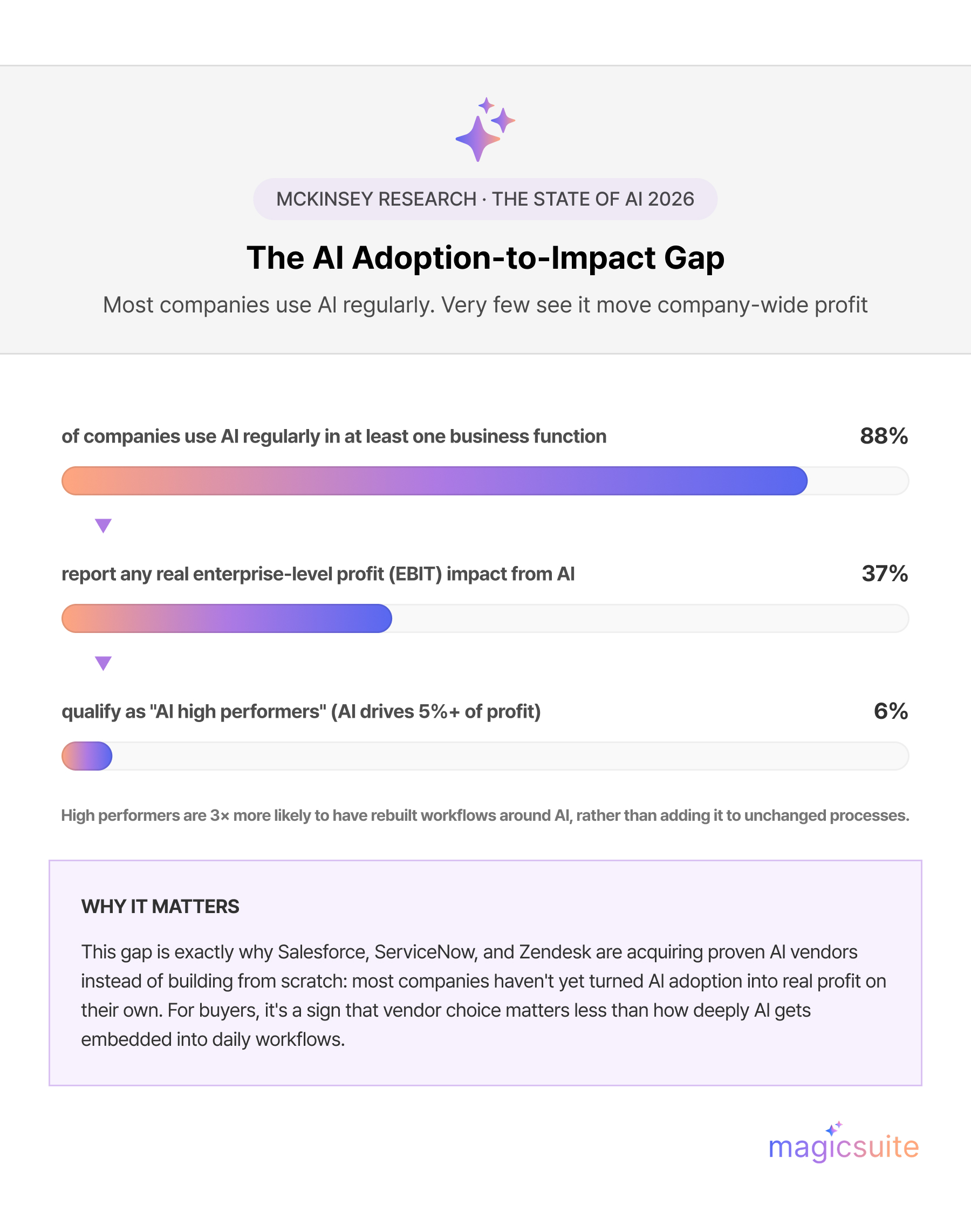
McKinsey found 88% of companies use AI regularly, but only 37% report any real profit gain, a figure that barely moved year over year. Just 6% count as McKinsey's "AI high performers," meaning AI drives at least 5% of profit, and these companies are three times more likely to have rebuilt their workflows around AI rather than bolting it on.
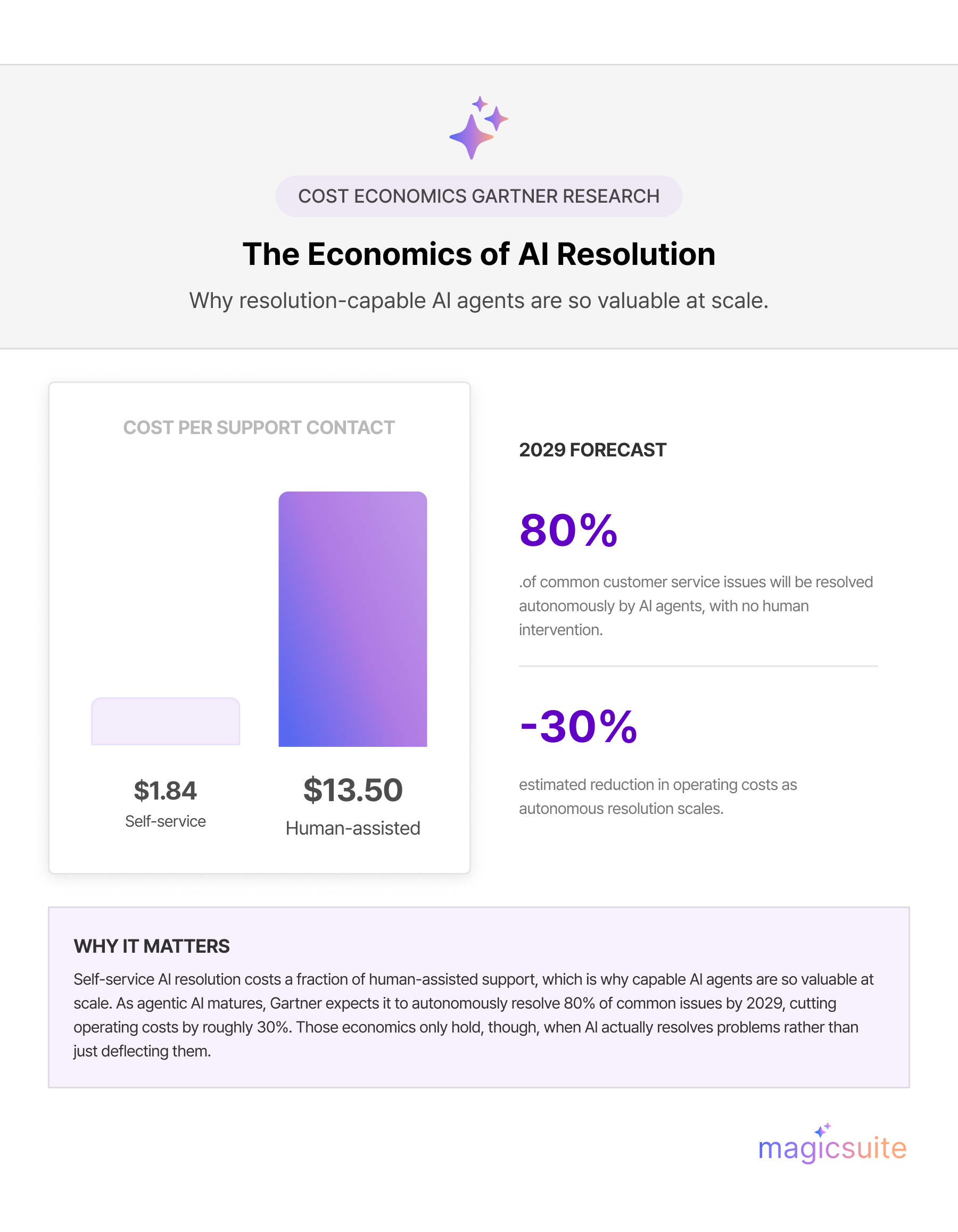
When companies get it right, savings are real. McKinsey's 2023 research found generative AI could cut human-handled support conversations by up to 50% and lift customer service productivity by 30% to 45%. Gartner puts the average cost of a self-service interaction at $1.84, versus $13.50 for a human-assisted one (Gartner, 2024), explaining why capable AI customer service agents are so valuable at scale. Gartner also expects AI agents to handle 80% of common issues by 2029, cutting operating costs by an estimated 30%.
Researchers disagree sharply, which itself is telling. PwC found 56% of CEOs saw neither higher revenue nor lower costs from AI, with only 12% seeing both. Deloitte found two-thirds of companies saw real productivity gains. These are not contradictions: PwC measures company-wide financial results, while Deloitte measures smaller, earlier wins. Together, they show results depend heavily on the company.
Every major vendor now sells solid conversational AI, so access is not the deciding factor. Execution is. Deloitte found companies split into thirds: 34% are truly transforming how they work, 30% are redesigning key processes, and 37% are using AI only on the surface. Only the first two groups see real value. PwC found CEOs seeing both revenue and cost gains had applied AI widely, not just in one pilot. On the technical side, results depend on integration depth (can the AI actually take action, not just answer questions) and whether the model was built specifically for support work rather than general use.
The gap between these two groups shows up clearly across several dimensions. On approach, companies getting real value from AI tend to have rebuilt their workflows around it, while struggling companies mostly use AI on the surface without changing much. On financial results, PwC found that 12% of CEOs report gains in both revenue and cost, while 56% report neither. On profit impact, McKinsey found AI drives more than 5% of profit at 6% of companies, while most companies see no real profit impact at all. And on system access, the winners give AI deep access to CRM, billing, and operations systems, while strugglers tend to limit access or keep it read-only.
Common failure points include cost overruns, unclear value, and weak risk controls, the leading reasons Gartner expects over 40% of agentic AI projects to be canceled by 2027. Gartner also warns that many vendors are relabeling older chatbots and automation tools as "agentic AI" without real independent decision-making ability.
For anyone evaluating AI agents for customer service, three lessons stand out for a broader AI customer experience strategy. First, vendor consolidation is now a real procurement risk: ask any standalone vendor how they would support their product if acquired, before signing a multi-year deal. Second, choose between a fast, packaged tool for quick wins and a deeply customizable platform for long-term value, since Salesforce and its rivals now offer both. Third, and most important, results depend more on your own company than on which vendor you pick. Businesses that rebuild workflows and connect AI deeply into their systems pull ahead of everyone using similar tools.
Salesforce's $3.6 billion Fin purchase is less about one company buying another than a signal of where value in AI customer service is heading. As customer service automation moves from experiment to necessity, Salesforce, ServiceNow, and Zendesk are choosing to buy proven technology rather than build everything themselves. Adoption is nearly universal, but real financial payoff remains limited to companies that changed how they actually work. The lesson is not which company wins the next deal. It is that real AI customer service returns keep going to companies that treat using the tool well, not just buying it, as their real advantage.
The AI customer service arms race is accelerating. The winners will not be the ones who bought the best tool.
Salesforce just spent $3.6 billion because proven AI customer service capability is hard to build fast. Meanwhile, only 37% of companies using AI report any real profit impact, and the gap between those who do and those who do not comes down to one thing: how deeply AI is built into how the work actually gets done.
MagicSuite gives your team a ready-to-deploy AI platform that handles real conversations, connects deeply to your systems, and delivers the kind of results that actually show up on the balance sheet. Not another pilot. Not another chatbot with a new label. A working AI customer service system built for the way your business operates.

Hanna is an industry trend analyst dedicated to tracking the latest advancements and shifts in the market. With a strong background in research and forecasting, she identifies key patterns and emerging opportunities that drive business growth. Hanna’s work helps organizations stay ahead of the curve by providing data-driven insights into evolving industry landscapes.