

91% of businesses use AI, yet 79% struggle to scale it — the real gap is integration, not adoption.

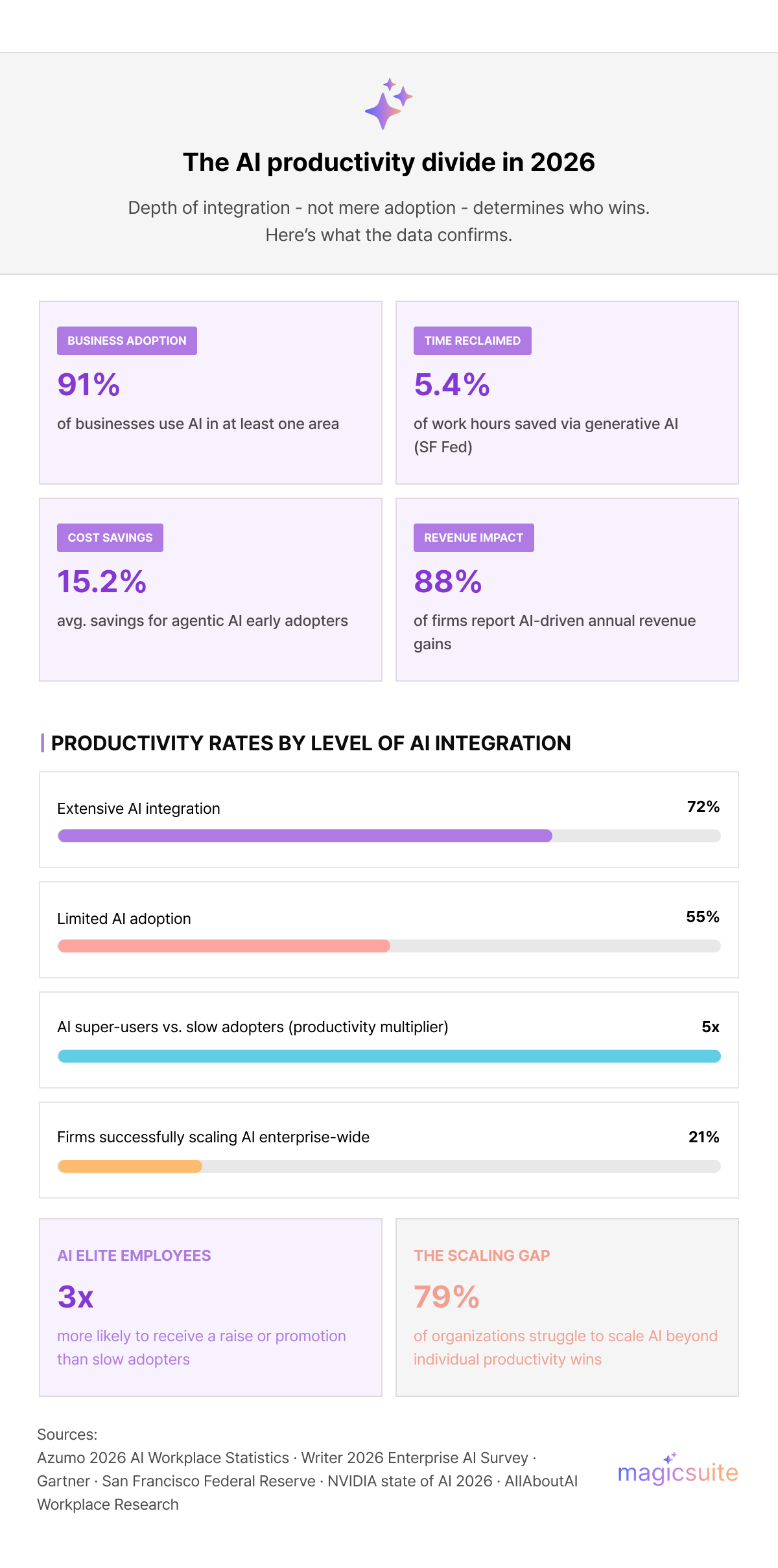
AI adoption has reached a near-universal threshold. According to Azumo's 2026 AI Workplace Statistics report, 91% of businesses now use AI in at least one capacity — up from 78% in 2024 and 55% in 2023. McKinsey's 2025 State of AI report reinforces this trajectory, with 92% of companies planning to increase AI investments over the next three years.
This is not incremental growth. In three years, AI has moved from an exploratory investment to core operational infrastructure, a shift that compresses what businesses once considered a multi-year transformation into an immediate execution challenge.
The data from AllAboutAI's 2026 workplace research confirms a performance gap that is difficult to ignore. Organizations with extensive AI solutions report productivity rates of 72%, compared to only 55% for those with limited or no integration. That 17-point gap represents a compounding competitive disadvantage — one that grows larger the longer organizations delay structured adoption.
Morgan Stanley's AI Adoption Survey validates the concentration of these gains: industries that have deeply embedded AI into their workflows see labor productivity grow 4.8 times faster than the global average. Surface-level tool deployment does not move the needle. Workflow redesign and systematic integration do.
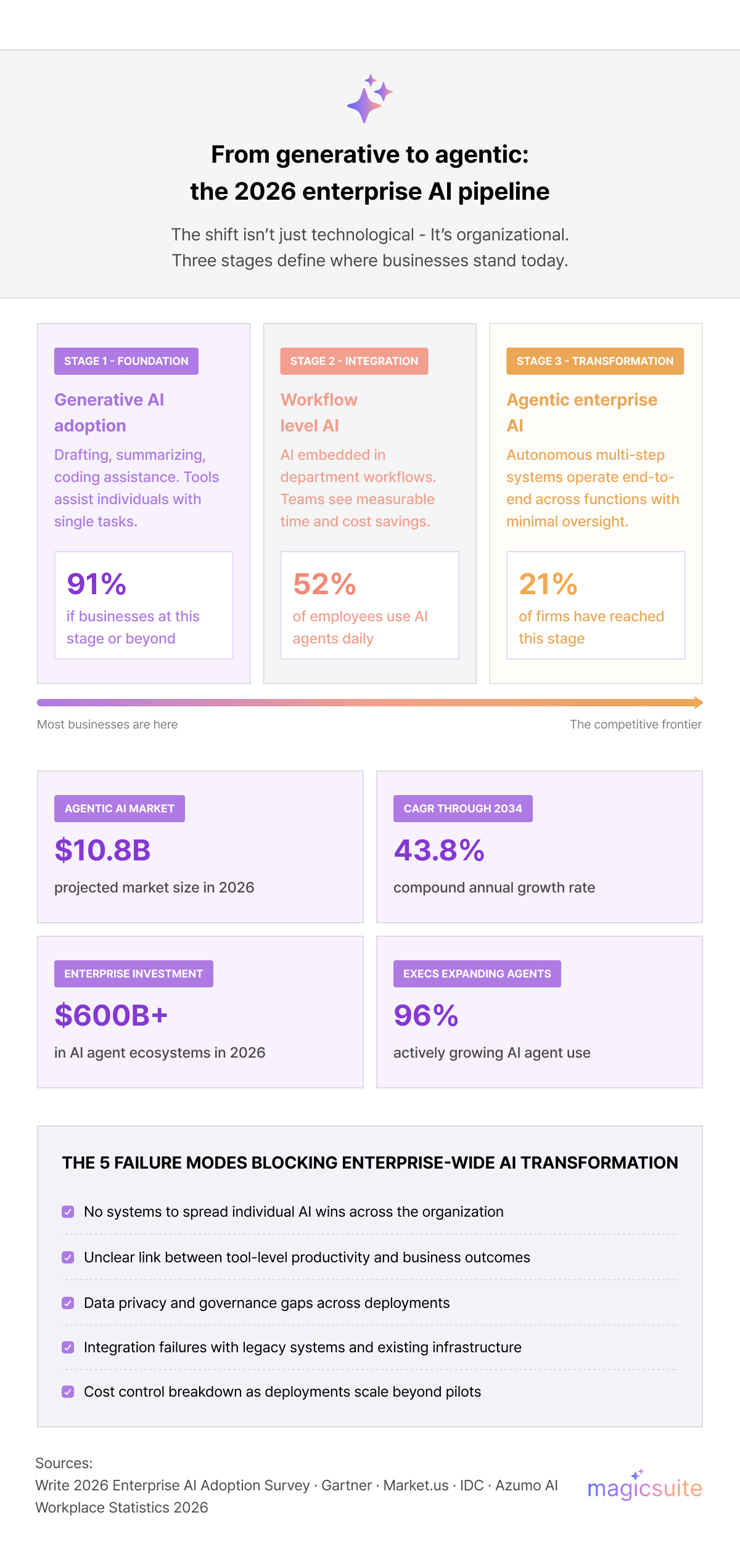
According to Writer's 2026 Enterprise AI Adoption Survey, conducted with Workplace Intelligence, 97% of executives report their company deployed AI agents in the past year. Gartner projects that by the end of 2026, 40% of enterprise applications will include task-specific AI agents. IDC expects AI copilots to be embedded in nearly 80% of enterprise workplace applications by year-end, reshaping how teams work, decide, and execute at every level.
Early adopters of agentic AI systems report 15.2% average cost savings and 22.6% productivity improvements, according to Gartner's 2025 findings. In concrete workflow terms: customer service agents are saving small teams 40-plus hours monthly, AI-powered invoicing and forecasting systems are accelerating financial close processes by 30–50%, and sales teams deploying AI qualification and outreach agents are seeing 2–3x improvements in pipeline velocity.
The global agentic AI market is projected to reach $10.8 billion in 2026, with a 43.8% compound annual growth rate forecasted through 2034, according to Market.us data. Enterprise investment in AI agent ecosystems has surpassed $600 billion in 2026, reflecting both market maturity and executive-level prioritization. According to a Market.us survey, 96% of enterprises are actively expanding their use of AI agents, and 83% of executives view agentic AI investment as essential to remaining competitive.
AI's original productivity value proposition — automating repetitive tasks — has expanded significantly. Where early AI tools handled simple data entry or scheduling, agentic systems now manage end-to-end workflows: from multi-stage customer interactions to autonomous financial reporting and compliance monitoring.
According to San Francisco Fed research, generative AI now saves workers an average of 5.4% of total work hours. For a standard 40-hour week, that translates to 2.2 hours reclaimed weekly — one full workday per month. Among frequent users, the gains are substantially larger: 27% of AI power users report saving more than 9 hours weekly by automating research, drafting, and administrative tasks.
The implication for workforce planning is direct. Time reclaimed from low-value tasks redirects human capacity toward judgment-intensive work that AI cannot replicate: complex problem-solving, client relationships, and strategic decision-making.
Generative AI's role in the enterprise has matured from drafting and summarization into deep workflow integration. ChatGPT alone has surpassed 800 million weekly active users globally as of mid-2025, with over 92% of Fortune 500 companies reporting active employee usage.
Accenture's real-world workplace analysis confirms that AI can increase productivity by up to 30%. PwC's industry research validates this further, documenting 27% productivity growth in AI-adopting industries versus 7% in those with limited AI adoption. For small and medium-sized businesses, NVIDIA's 2026 State of AI Report confirms that 88% of respondents report AI has increased annual revenue across some or all parts of their business.
Writer's 2026 survey documents an emerging performance divide that business leaders cannot afford to ignore. AI super-users are 5x more productive than their slow-to-adopt colleagues and 3x more likely to receive a raise or promotion. Organizations are responding: 92% of C-suite executives report actively cultivating an "AI elite" — employees who use AI tools at the highest levels of proficiency.
This bifurcation confirms that AI skills are now a primary driver of individual career trajectory and organizational output. Investing in AI literacy programs is not an HR initiative — it is a performance strategy.
The adoption surge has not eliminated employee anxiety. ManpowerGroup's 2026 Global Talent Barometer documents a sharp paradox: regular AI usage among workers rose 13% to reach 45%, while confidence in using technology fell by 18%. That confidence collapse indicates adoption is outpacing training and organizational support.
Gallup's latest workplace research reinforces this: only 15% of employees say their organization has communicated a clear plan or strategy for AI integration. Forty-nine percent of U.S. workers still report never using AI in their role, revealing a significant adoption divide that threatens to segment workforces into those who benefit from AI and those displaced by it.
Job displacement fears remain real. Writer's 2026 survey found that 60% of executives plan to reduce staff who cannot or will not adopt AI. SHRM's State of AI in HR 2026 report offers a more balanced data point: AI is 5.7 times more likely to shift job responsibilities and 3 times more likely to create new roles than to displace jobs outright. The risk is not replacement — it is irrelevant for employees who don't develop AI fluency.
Enterprise-wide AI transformation is proving harder than individual productivity gains. Writer's 2026 survey confirms that 79% of organizations face challenges scaling AI — a double-digit increase from 2025. The five failure modes that separate organizations achieving transformation from those stalling: absence of enterprise-wide systems for spreading individual wins, unclear links between tool-level productivity and business outcomes, data privacy and governance gaps, integration with legacy systems, and cost control as deployment scales.
A structured approach addresses these directly:
1. Audit before deploying. AI amplifies the systems it enters. Organizations with unresolved technical debt, siloed data, or fragmented processes will see AI accelerate those problems, not solve them.
2. Build systems, not just tools. Companies with dedicated Chief AI Officers — now 61% of enterprises, according to Azumo's research — are more likely to achieve measurable productivity gains because they coordinate AI deployment across functions rather than allowing fragmented department-level adoption.
3. Invest in AI training as a performance program. SHRM data shows 73% of HR directors adopted AI by 2025, but adoption at the individual contributor level lags significantly. The training gap is where most enterprise AI ROI is lost.
The economic case for AI integration strengthens with every reporting cycle. Oxford Economics' estimate that generative AI may contribute an additional $1 trillion to the U.S. economy over the next decade remains consistent with the trajectory confirmed by 2026 data. Organizations that integrate AI effectively are expected to see 1.5x revenue growth compared to those that do not, and companies demonstrating strong human-AI collaboration outperform competitors in retention and engagement metrics by 10% or more.
As AI agents move from controlled pilots to autonomous enterprise systems, governance has emerged as the defining challenge of the next phase. Writer's 2026 data reports that 67% of executives believe their company has already suffered a data leak due to unapproved AI tools, and 36% lack any formal plan for supervising AI agents. Gartner projects that more than 40% of agent projects will fail by 2027 — not due to capability limitations, but due to governance and integration failures.
By 2027, AI-related laws are expected to cover roughly 50% of the world's economies. Organizations building governance frameworks now hold a meaningful compliance advantage.
The organizations winning in 2026 are not those with the most AI tools — they are those building the organizational infrastructure to use AI systematically. Major professional services firms continue to lead by example: EY is targeting the upskilling of 400,000 employees in AI, Deloitte has committed $1.4 billion to tech training, and KPMG plans $2 billion in AI and cloud investment over five years. These are not discretionary bets. They are structural responses to a competitive environment where AI fluency determines throughput.

Luke is a technical market researcher with a deep passion for analyzing emerging technologies and their market impact. With a keen eye for data and trends, Luke provides valuable insights that help shape strategic decisions and product innovations. His expertise lies in evaluating industry developments and uncovering key opportunities in the ever-evolving tech landscape.