Small Language Models (SLMs) vs LLMs for Enterprise Chatbots
May 22, 2026
7
mins
SLMs outperform LLMs on cost and latency in domain-specific enterprise chatbots — hybrid wins both.
Key Takeaways
01Enterprise chatbot AI is shifting from bigger models to more efficient architectures — success now depends on latency, cost, accuracy, and governance.
02LLMs remain strong for broad and open-ended conversations — especially when chatbots need general reasoning and multi-domain flexibility.
03SLMs are increasingly valuable for domain-specific enterprise workflows — offering faster inference, lower cost, and stronger control over deployment.
04Security and compliance favor smaller, controlled models — especially when on-premise or edge deployment is required.
05The future is hybrid chatbot architecture — SLMs handle high-volume domain tasks while LLMs support complex reasoning and open-ended queries.
The Shift in Enterprise Chatbot Architecture
Enterprise AI is entering a phase of pragmatic optimization. While early adoption favored increasingly powerful large language models, organizations are now confronting a fundamental constraint: scaling intelligence is not the same as scaling efficiency.
This is particularly evident in Enterprise chatbot AI, where performance is measured not by general intelligence, but by:
Latency under load
Domain accuracy
Cost per interaction
Data governance and compliance
Recent industry signals reinforce this shift:
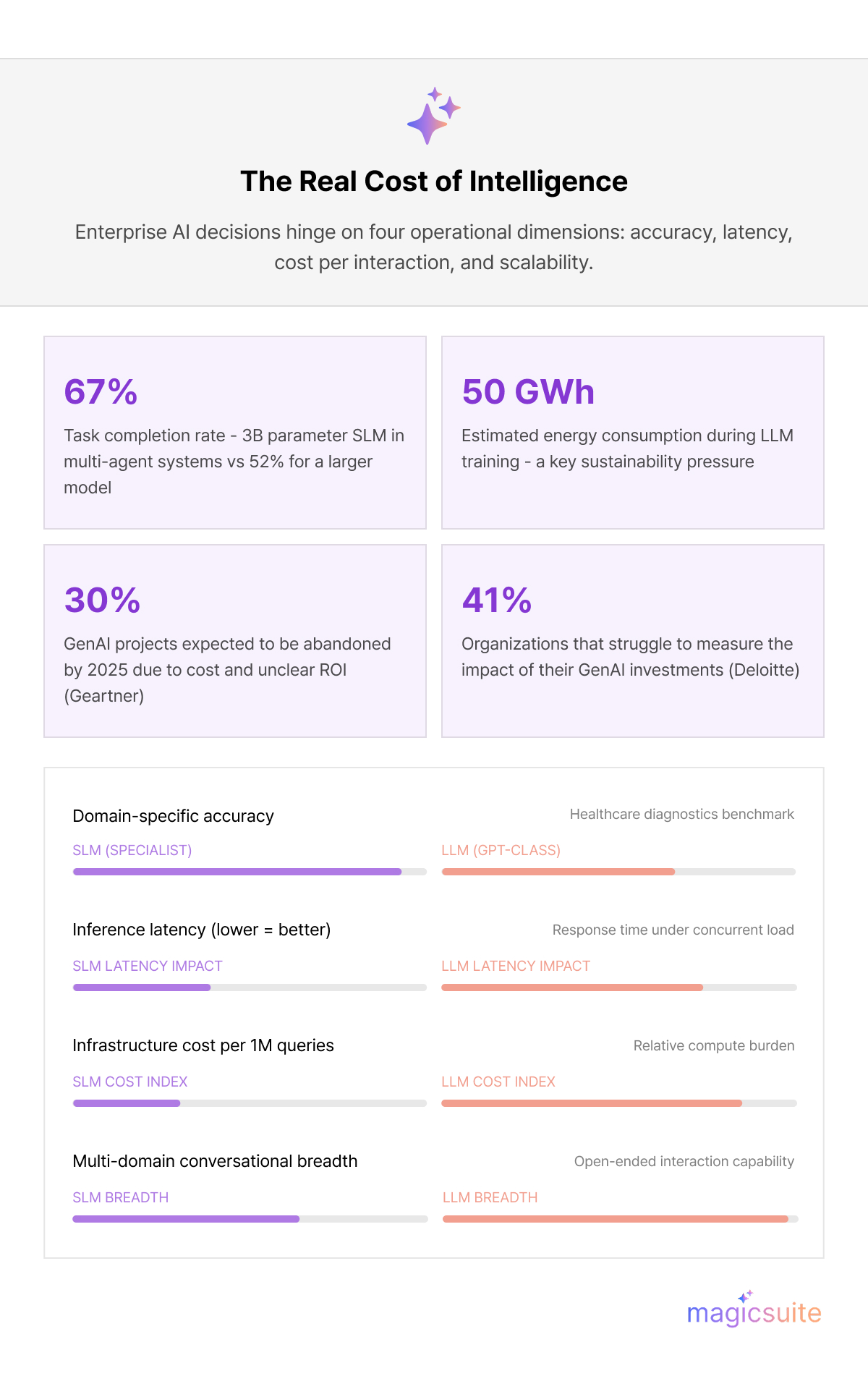
30% of GenAI projects are expected to be abandoned by 2025 due to cost and unclear ROI (Gartner)
41% of organizations struggle to measure GenAI impact (Deloitte)
Global AI spending is projected to reach$632 billion by 2028 (IDC)
These indicators highlight a critical transition: enterprises are moving from capability-driven AI adoption to efficiency-driven AI deployment. At the center of this transition lies the SLM vs LLM debate.
Understanding the Architectural Divide
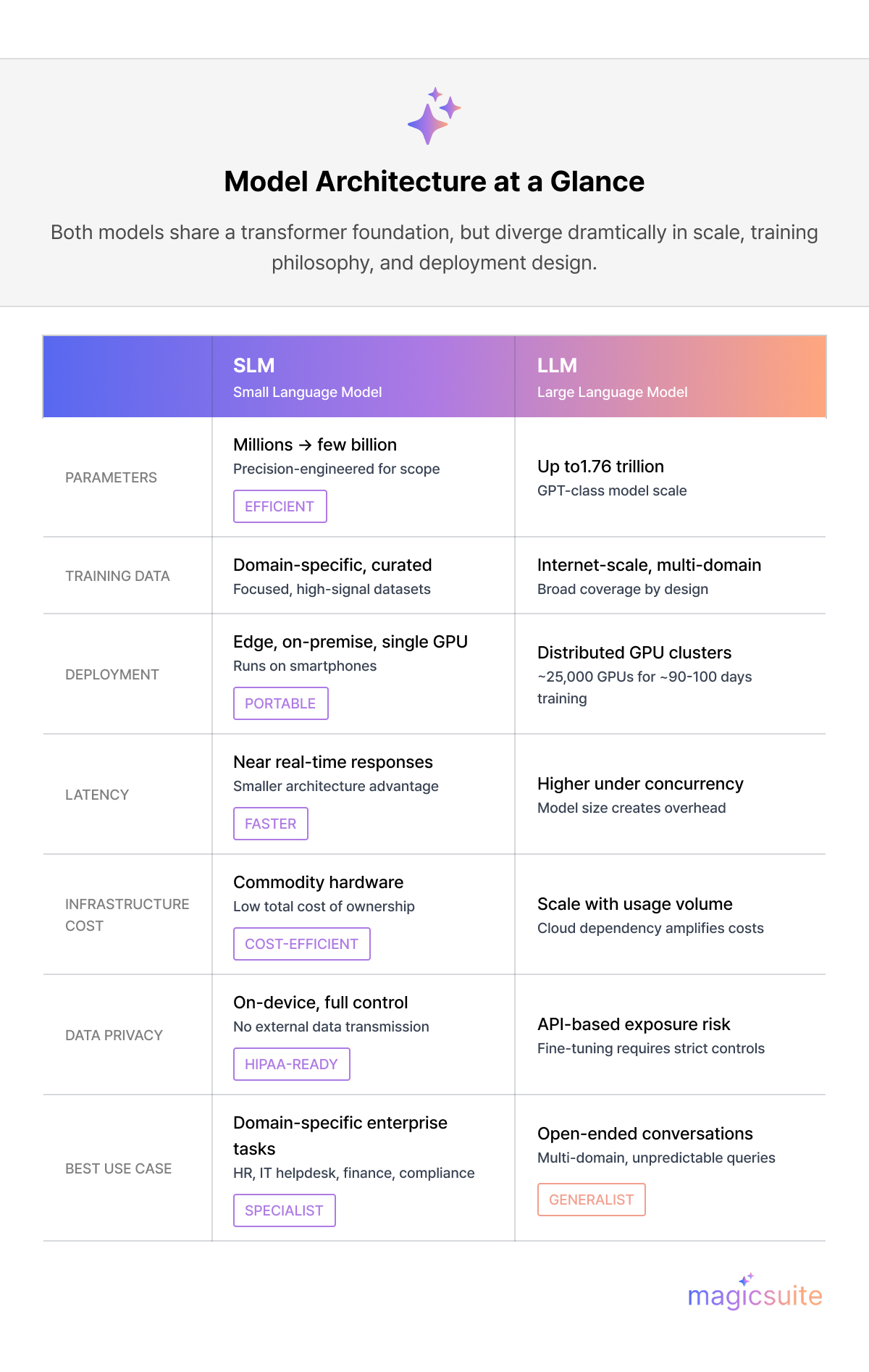
At a systems level, both AI chatbot models share a transformer-based foundation. However, their divergence lies in scale, training philosophy, and deployment design.
Large Language Models: Generalized Intelligence at Scale
Large language models are designed for broad adaptability:
Parameter scale: up to 1.76 trillion parameters (GPT-class models)
Training scope: internet-scale, multi-domain datasets
Infrastructure: distributed GPU clusters (e.g., 25,000 GPUs for ~90–100 days)
This enables:
Strong general reasoning
Multi-domain conversational ability
Complex, open-ended dialogue handling
However, this generality introduces trade-offs:
Higher hallucination risk in domain-specific queries
Increased inference latency under concurrency
Significant infrastructure and API dependency
Small Language Models: Precision Through Specialization
Small language models invert this philosophy. Instead of maximizing breadth, they optimize for depth within a defined domain.
Deployment: edge devices, on-premise, or lightweight cloud
Their architectural advantages include:
Faster inference and lower latency
Reduced computational footprint
Greater control over training data and outputs
Notably, SLMs can run on smartphones or single GPUs, compared to LLMs requiring distributed systems .
Performance Trade-offs in Enterprise Chatbot AI
The real distinction in Chatbot AI comparison emerges at the application layer, particularly in enterprise chatbot workflows.
Where LLMs Excel
LLM for chatbots remains dominant in:
Open-ended customer interactions
Multi-intent conversational flows
Knowledge discovery across domains
Their strength lies in contextual flexibility and long context windows, enabling more natural, human-like conversations.
Where SLMs Outperform
In contrast, SLM for chatbots is increasingly preferred for:
Domain-specific customer support
Internal enterprise assistants (HR, IT, finance)
Compliance-sensitive industries
Empirical and case-based insights show:
A specialized healthcare SLM can outperform GPT-level models in domain-specific diagnostics
A 3B parameter SLM achieved 67% task completion vs 52% for a larger model in multi-agent systems
This highlights a critical reality: Accuracy in enterprise chatbots is often domain-dependent—not scale-dependent.
Cost, Latency, and Scalability: The Hidden Constraints
Cost Structure
LLMs introduce a dual-layer cost burden:
Training cost (massive but infrequent)
Inference cost (continuous and scaling with usage)
Inference becomes the dominant factor in enterprise environments:
More users → higher compute demand → increased cost
Cloud dependency amplifies operational expenses
By contrast, lightweight AI models like SLMs:
Require significantly fewer compute resources
Can run on commodity hardware
Reduce total cost of ownership
Latency and Real-Time Performance
Latency is a decisive factor in Enterprise AI chatbots:
LLMs: higher latency due to model size and distributed inference
SLMs: near real-time responses due to smaller architecture
This makes SLMs particularly effective in:
Customer service automation
Real-time decision systems
Edge-based chatbot deployments
Scalability and Infrastructure
LLMs scale well in the cloud, but poorly in cost-sensitive environments. SLMs, however, scale differently:
Horizontally via multiple specialized models
Vertically through task-specific optimization
This enables a modular chatbot architecture, where multiple SLMs handle distinct workflows.
Security, Compliance, and Data Control
Data governance is becoming a primary constraint in enterprise AI adoption.
LLM Risks
API-based deployment exposes sensitive data
Fine-tuning requires strict compliance controls
External dependency increases risk surface
SLM Advantages
On-device or on-premise deployment
Reduced data transmission
Greater control over training datasets
This is particularly critical in:
Healthcare (HIPAA compliance)
Finance (regulatory reporting)
Government systems
Emerging Architecture: Hybrid AI Chatbot Systems
The most important trend is not SLM vs LLM, but SLM + LLM orchestration. Modern Enterprise chatbot AI systems are increasingly hybrid:
Hybrid Model Design
LLMs handle:
Complex reasoning
Unstructured queries
Multi-domain interactions
SLMs handle:
Domain-specific tasks
High-frequency queries
Real-time responses
This architecture introduces intelligent routing, where queries are dynamically assigned to the most efficient model.
Why Hybrid Wins
This approach solves three core enterprise challenges:
Cost optimization → SLMs handle bulk workload
Performance optimization → LLMs reserved for complexity
Scalability → modular, multi-model systems
This aligns with the broader rise of agentic AI, where multiple specialized agents collaborate.
Strategic Decision Framework for Enterprises
Choosing between AI chatbot models requires aligning technical capabilities with business objectives.
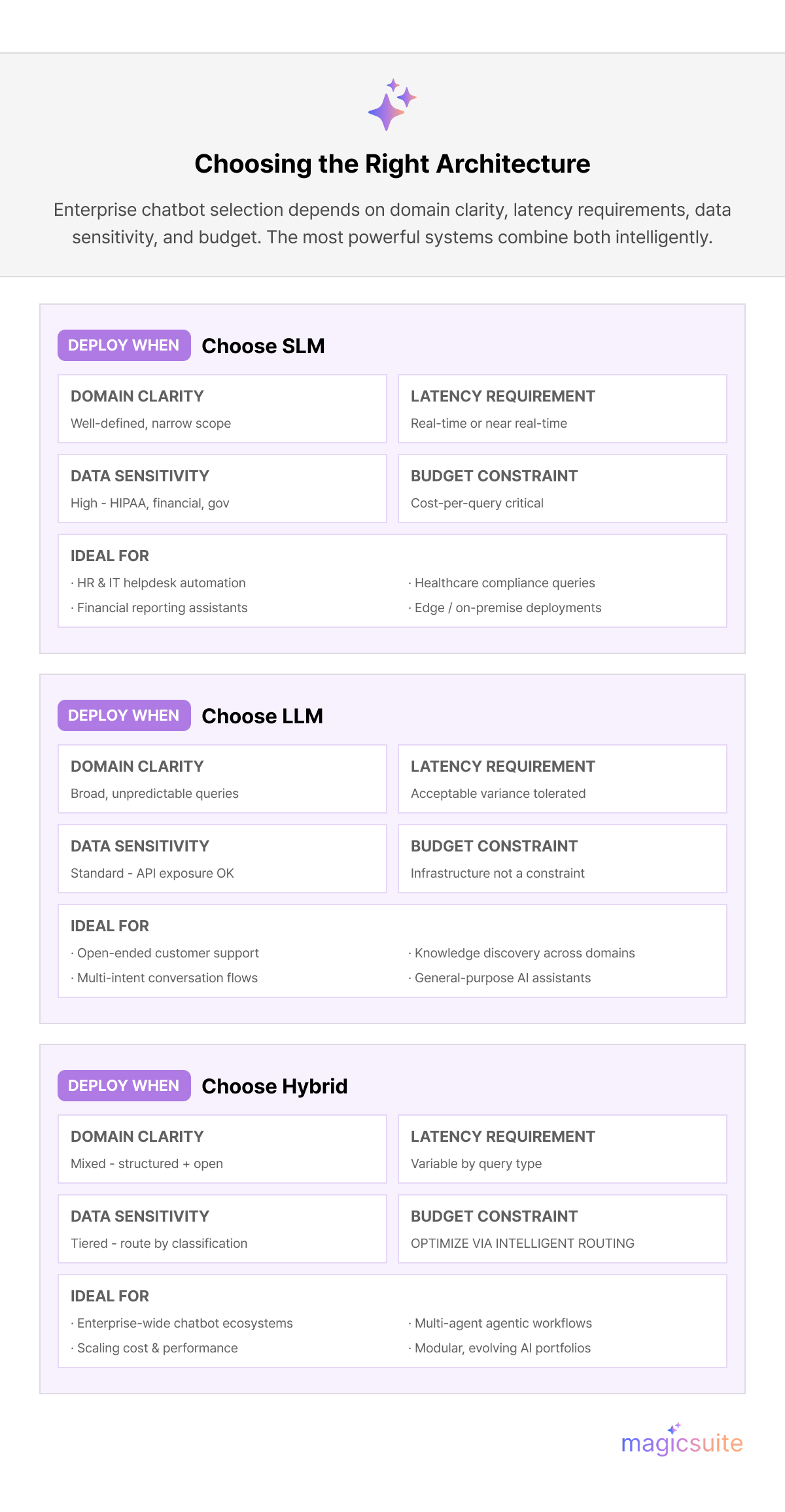
Use LLMs when:
The chatbot requires broad knowledge coverage
Queries are unpredictable or highly variable
Infrastructure budget is not a constraint
Use SLMs when:
The domain is well-defined
Latency and cost are critical
Data privacy is a priority
Use Hybrid Systems when:
Scaling enterprise-wide chatbot ecosystems
Supporting multi-agent workflows
Balancing cost with performance
The Future of Enterprise AI Chatbots
The trajectory of Enterprise AI chatbots is moving toward model specialization and orchestration, not monolithic intelligence.
Key forward-looking insights:
Enterprises will manage portfolios of models, not a single AI system
Model distillation will accelerate SLM adoption, compressing LLM intelligence into smaller architectures
Sustainability will drive preference for energy-efficient models (LLMs can consume ~50 GWh during training)
Edge AI and on-device inference will expand rapidly
Final Insight: From Intelligence to Efficiency
The core insight behind the SLM vs LLM debate is this: The future of enterprise AI is not about building the most intelligent model, it is about deploying the most appropriate intelligence per task.
Large language models will remain essential as general-purpose engines. Small language models will define the operational layer of enterprise AI.
The organizations that succeed will not choose between them—they will architect systems that combine both intelligently.
Enterprise Chatbot AI
Deploy the right model for every chatbot task.
MagicSuite helps enterprises build efficient chatbot systems using SLMs, LLMs, and hybrid AI orchestration — balancing speed, accuracy, governance, and cost at scale.
LLMs are large, general-purpose models designed for broad reasoning and open-ended dialogue. SLMs are smaller, specialized models optimized for defined domains, faster responses, lower cost, and controlled deployment.
Enterprises should use LLMs when chatbot queries are unpredictable, multi-domain, highly conversational, or require complex reasoning across broad knowledge areas.
SLMs are better when the domain is well-defined, latency and cost matter, data privacy is critical, or the chatbot handles repeated workflows such as HR, IT, finance, or regulated support tasks.
Hybrid systems route each query to the most efficient model. SLMs handle high-volume domain tasks, while LLMs are reserved for complex reasoning, unusual requests, and multi-domain conversations.
Yes. SLMs require fewer compute resources, can run on lighter infrastructure, and reduce inference costs for high-volume chatbot interactions compared with large cloud-based LLM deployments.
Hanna is an industry trend analyst dedicated to tracking the latest advancements and shifts in the market. With a strong background in research and forecasting, she identifies key patterns and emerging opportunities that drive business growth. Hanna’s work helps organizations stay ahead of the curve by providing data-driven insights into evolving industry landscapes.