

NLP AI chatbots combine intent detection and machine learning to handle 80% of customer queries.
An NLP AI chatbot is a system that understands and generates human language using natural language processing (NLP) and machine learning. NLP combines computational linguistics, machine learning, and deep learning to process text and speech at scale, enabling chatbots to interpret what users mean.
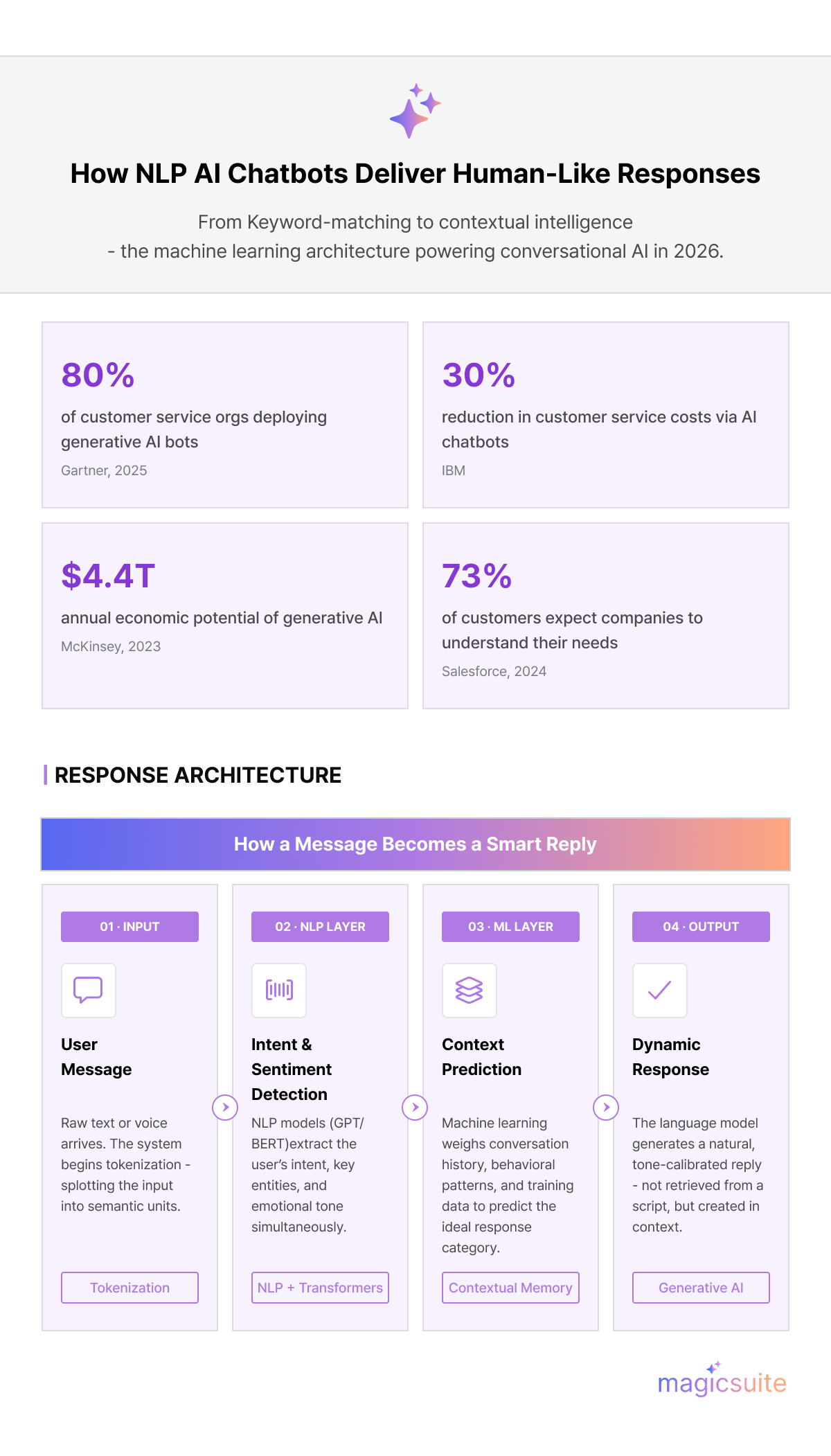
When a user sends a message, the chatbot processes it through a structured pipeline. It breaks the text into tokens, identifies the user's intent, extracts key entities such as names, dates, or product references, and detects emotional tone or sentiment. This pipeline allows the system to interpret ambiguous phrasing and respond with contextual relevance rather than surface-level keyword matching.
The distinction matters operationally. A rule-based system that receives "I need help with my order" can only match that phrase to a predefined flow. An NLP-powered system understands it as a purchase-related support request and routes it accordingly, even if the user writes "my package is messed up" instead.
Machine learning transforms a chatbot from a fixed lookup table into an adaptive system. Rather than repeating predetermined answers, a machine learning chatbot learns from user interactions, adjusts its predictions based on behavioral patterns, and improves accuracy over time without requiring engineers to manually update response libraries.
According to Gartner's 2025 projections, 85% of customer service organizations are expected to use generative AI-powered chatbots to support operations — reinforcing that adaptive learning is no longer a premium feature but a foundational requirement for competitive performance.
The quality gap between basic and advanced chatbots traces directly to the NLP model powering the response layer. Transformer-based architectures such as GPT and BERT represent the core shift from scripted to generative AI conversation systems.
Older chatbots followed rigid decision trees. If a user's input deviated from an expected phrase, the system either failed or delivered an irrelevant fallback response. Modern NLP models generate responses dynamically, maintaining context across multiple messages and adapting tone to match the conversational register of the user.
McKinsey estimates that generative AI could contribute $2.6 trillion to $4.4 trillion annually across industries, with conversational AI identified as a primary delivery channel. That figure reflects not just cost reduction but revenue enablement, customer interactions that convert, retain, and satisfy rather than frustrate.
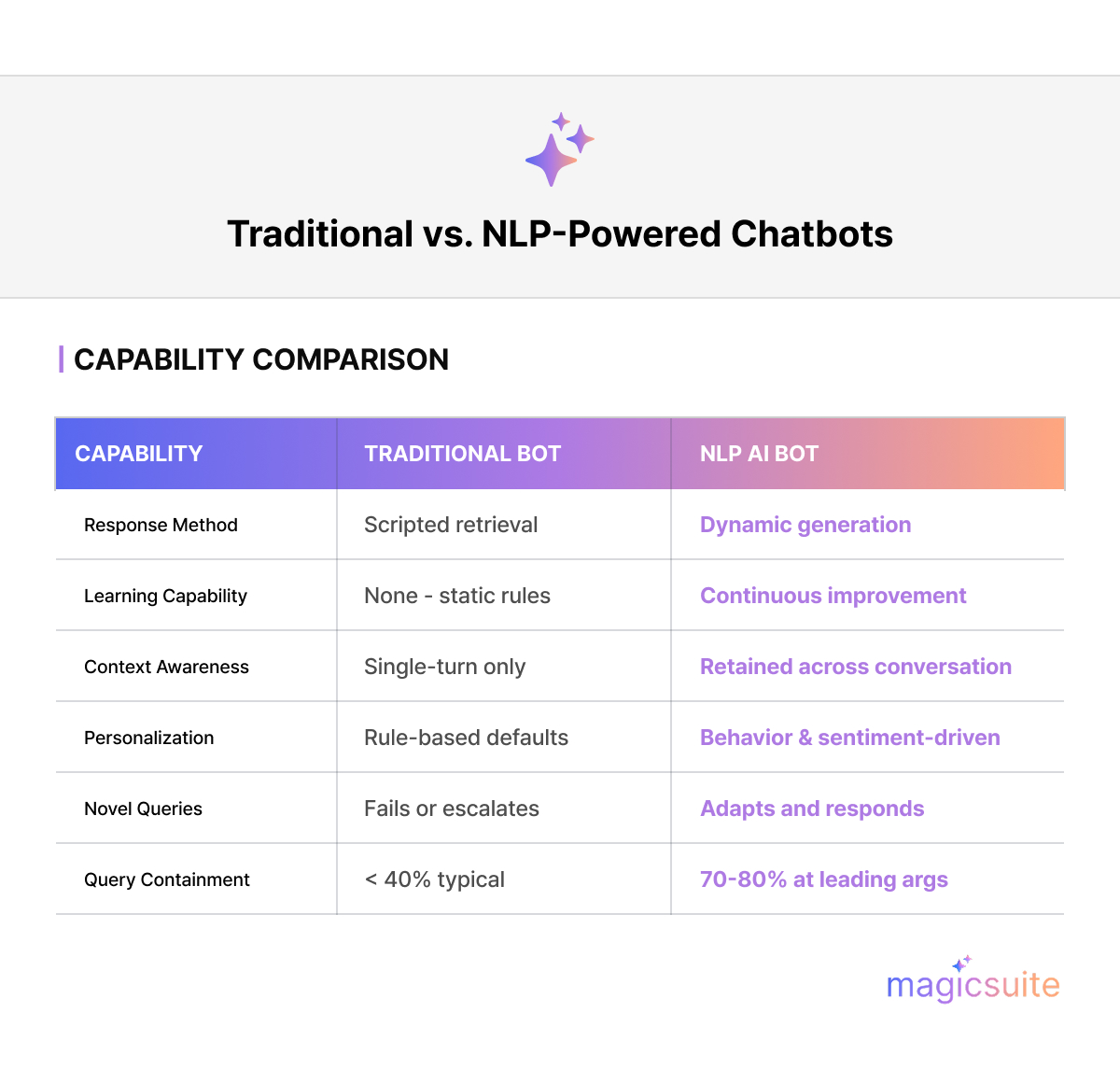
This gap explains why organizations replacing legacy chatbots with NLP-powered systems consistently report higher containment rates and lower escalation volumes.
An AI conversation system follows a structured generation process to produce each reply. Understanding this pipeline clarifies why response quality differs so significantly between systems built on different model types.
When a user sends a message, the system runs NLP analysis to extract intent and entities. The machine learning layer then predicts the most appropriate response category based on training data and conversation history. Finally, the AI language model generates the reply, producing a sentence that matches the user's context, tone, and the platform's communication standards.
The final step is where model quality becomes decisive. Large AI language models generate responses with natural sentence flow, coherent reasoning across multiple turns, and tone calibration that static systems cannot replicate. Recent studies confirm that large language models can reduce average response time from minutes to seconds while sustaining high contextual accuracy, a combination that directly improves both user experience and agent capacity.
Human-like interaction depends on three capabilities working together: emotional recognition, contextual memory, and adaptive response generation. Most chatbots execute one or two of these; the best-performing systems execute all three consistently.
Modern NLP AI chatbots use sentiment analysis to detect frustration, urgency, confusion, or satisfaction in real time. This detection layer allows the system to adjust its tone — responding with empathy when a user expresses dissatisfaction, or with efficiency when a user signals they want a direct answer. Without sentiment analysis, chatbots apply a uniform tone regardless of emotional context, which users consistently experience as robotic.
An intelligent chatbot retains conversation history throughout a session. This means users do not need to repeat information already provided, the system avoids contradicting its own earlier responses, and follow-up questions are answered with full reference to prior context.
Contextual memory is the single feature that most separates high-performing chatbots from their predecessors. Without it, even a system with strong NLP capabilities delivers a fragmented experience that erodes user trust over extended interactions.
The operational case for machine learning chatbots is measurable and consistent across industries. Cost reduction and customer experience improvement are the two primary value levers and the data on both is unambiguous.
AI-powered chatbots can reduce customer service costs by up to 30%, according to IBM. This reduction compounds across ticket volume: as a chatbot handles routine queries, human agents shift to high-complexity interactions where their judgment and empathy create disproportionate value. The result is not headcount reduction but capacity expansion — the same team handles more volume without proportional cost increases.
Industry reports from Zendesk and IBM confirm that AI chatbots now handle 70–80% of routine customer queries at leading organizations, a containment rate that fundamentally changes the economics of support operations.
Personalization at scale is the primary experience driver. A Salesforce report found that 73% of customers expect companies to understand their individual needs — a standard that rule-based chatbots structurally cannot meet. NLP-powered systems trained on behavioral and sentiment data deliver responses that reflect the customer's history, preferences, and current emotional state.
According to Zendesk's CX Trends Report, 72% of customers expect immediate responses, validating AI-driven chatbots as the primary mechanism for meeting that expectation without equivalent staffing increases. Organizations that close this gap report measurable improvements in satisfaction scores, repeat engagement, and customer retention.
Natural language processing allows chatbots to understand user input — parsing intent, extracting entities, and detecting sentiment. Machine learning determines the response strategy — predicting what answer fits the context based on training data and prior interactions. AI language models then generate the reply in natural, coherent language. Together, these three layers form the complete architecture of every modern AI conversation system.
Neither NLP nor machine learning delivers full performance independently. NLP without machine learning produces a system that understands input but cannot improve its responses over time. Machine learning without strong NLP produces a system that learns patterns but misinterprets the inputs feeding those patterns. The combination — with a capable language model at the generation layer — is what produces chatbot performance that users describe as genuinely helpful rather than merely functional.
Chatbots are transitioning from reactive query-answering tools to proactive, collaborative systems capable of initiating and managing multi-step interactions. The next generation of AI chatbot technology will operate across modalities, languages, and decision-making contexts simultaneously.
Four developments define the near-term trajectory. Multimodal chatbots will process and respond across text, voice, and image inputs within a single conversation. Real-time multilingual capability will allow a single system to serve global customer bases without language-specific model variants. Emotionally intelligent AI will move beyond sentiment detection toward genuine empathy modeling. And autonomous decision-making systems will handle complex, multi-variable queries that currently require human escalation.
Mark Zuckerberg, Chief Executive Officer of Meta, framed the directional shift clearly: organizations are moving toward coexistence with AI as a collaborative layer rather than a replacement mechanism. The practical implication is that chatbot investment decisions made today will determine which organizations have the infrastructure to absorb these capabilities as they mature.

Hanna is an industry trend analyst dedicated to tracking the latest advancements and shifts in the market. With a strong background in research and forecasting, she identifies key patterns and emerging opportunities that drive business growth. Hanna’s work helps organizations stay ahead of the curve by providing data-driven insights into evolving industry landscapes.