

AI-optimized funnels lift conversion 30% and cut CAC 25% - McKinsey maps where revenue leaks.

Every enterprise now has access to roughly the same generative AI models. What separates the winners from the rest is no longer model choice - it's what happens after deployment. Recent research from McKinsey, MIT, Gartner, and Deloitte converges on an uncomfortable finding: adoption has become nearly universal, but AI business value remains rare. The differentiator isn't intelligence at the model layer; it's workflow intelligence - how deeply AI is embedded into decision rights, handoffs, data flows, and daily operating rhythms. This article examines why AI investment ROI is concentrating in a small group of organizations, what separates them structurally from everyone else, and what enterprise leaders should prioritize next in their AI investment strategy.
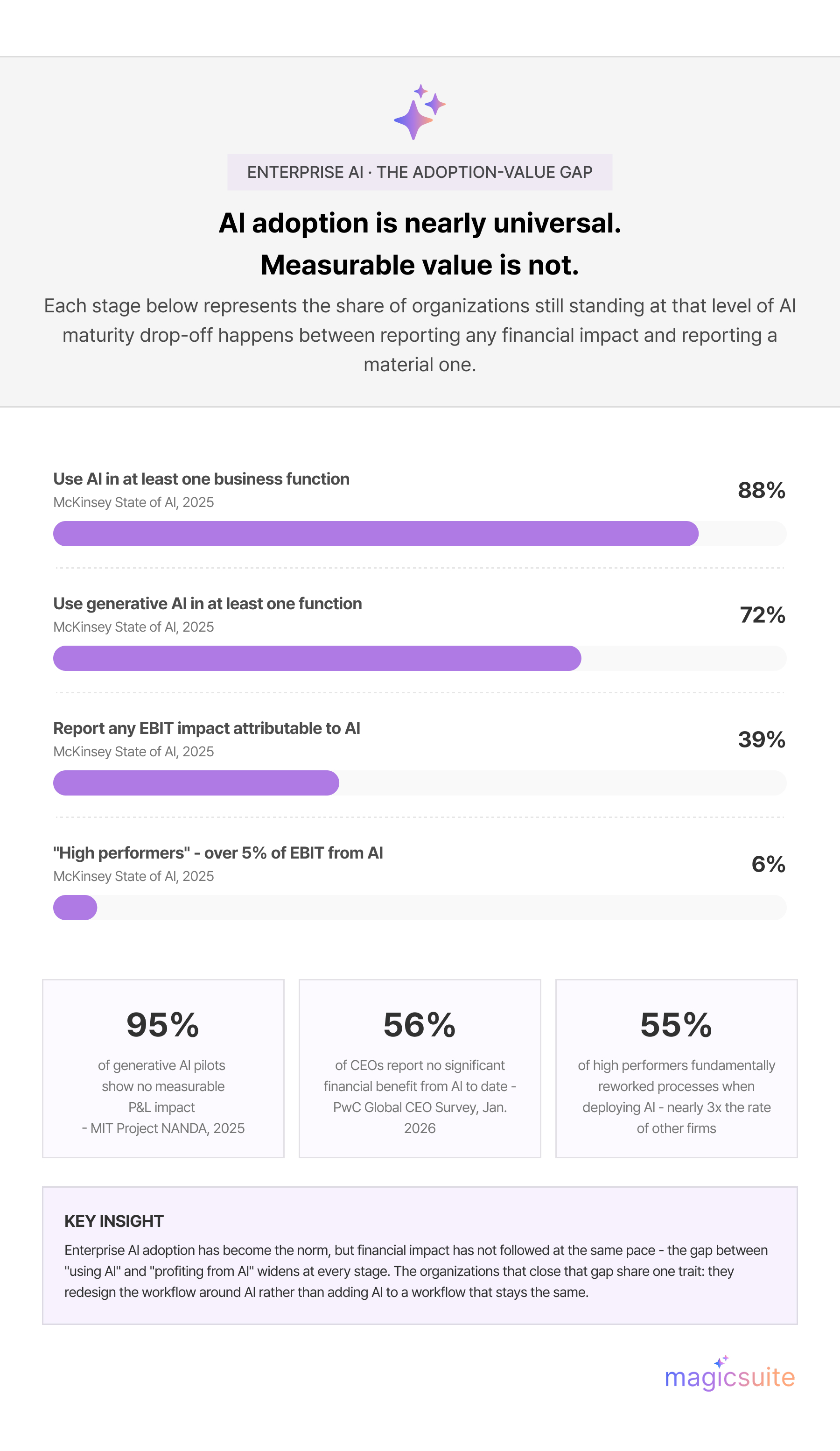
Enterprise AI adoption has crossed a threshold that would have seemed unlikely three years ago. McKinsey's State of AI research puts the share of organizations using AI in at least one business function at 88%, up roughly 10 percentage points from the prior year. Generative AI specifically has gone from a niche experiment to a default tool: the same McKinsey survey found 72% of organizations reporting generative AI use in at least one function, nearly double the rate from just two years earlier.
Yet adoption and value have decoupled. The most cited finding from MIT's Project NANDA - based on a review of more than 300 enterprise deployments, 52 structured interviews, and over 150 leadership survey responses - is that the large majority of generative AI pilots fail to produce any measurable financial return. McKinsey's own data shows a similar pattern from a different angle: only about 39% of organizations report any EBIT impact attributable to AI, and just 6% qualify as "high performers" attributing more than 5% of EBIT to AI-driven initiatives.
The consistent thread across these studies is that the bottleneck sits downstream of the model. It sits in how work is organized around it.

For much of the past three years, AI transformation strategy centered on model selection - which vendor, which parameter count, which benchmark score. That calculus has largely collapsed. Frontier model capability has become commoditized fast enough that most enterprises now have access to comparably powerful systems regardless of vendor. Real AI business transformation no longer starts with a model decision; it starts with a workflow decision.
MIT's researchers were explicit about what actually separates successful deployments from stalled ones. Their report states plainly that the divide between organizations capturing value and those that aren't is not explained by model quality or regulatory friction - it's explained by approach. The specific failure mode they identify is a "learning gap": tools that don't retain context, don't integrate with existing systems, and don't adapt to how a specific team actually works. Enterprise users interviewed for the report described the same generative AI tools they rely on personally as unreliable the moment those tools were dropped into enterprise workflows without adaptation.
This reframes the entire AI investment conversation. If model access is no longer scarce, the scarce resource becomes:
Gartner's research reinforces the point specifically: the firm predicts that through 2026, organizations will abandon 60% of AI projects unsupported by AI-ready data, based on a survey finding that 63% of organizations either lack, or are unsure they have, the right data management practices for AI. AI workflow optimization - not model selection - is what turns pilot activity into durable advantage. The model was rarely the reason.
Workflow intelligence is the capacity of an organization to embed AI into the sequence of decisions, handoffs, and judgment calls that make up real operational work - not just to deploy a chatbot next to that work. It is a systems-level capability, not a procurement decision, and it is quickly becoming the defining test of enterprise AI maturity.
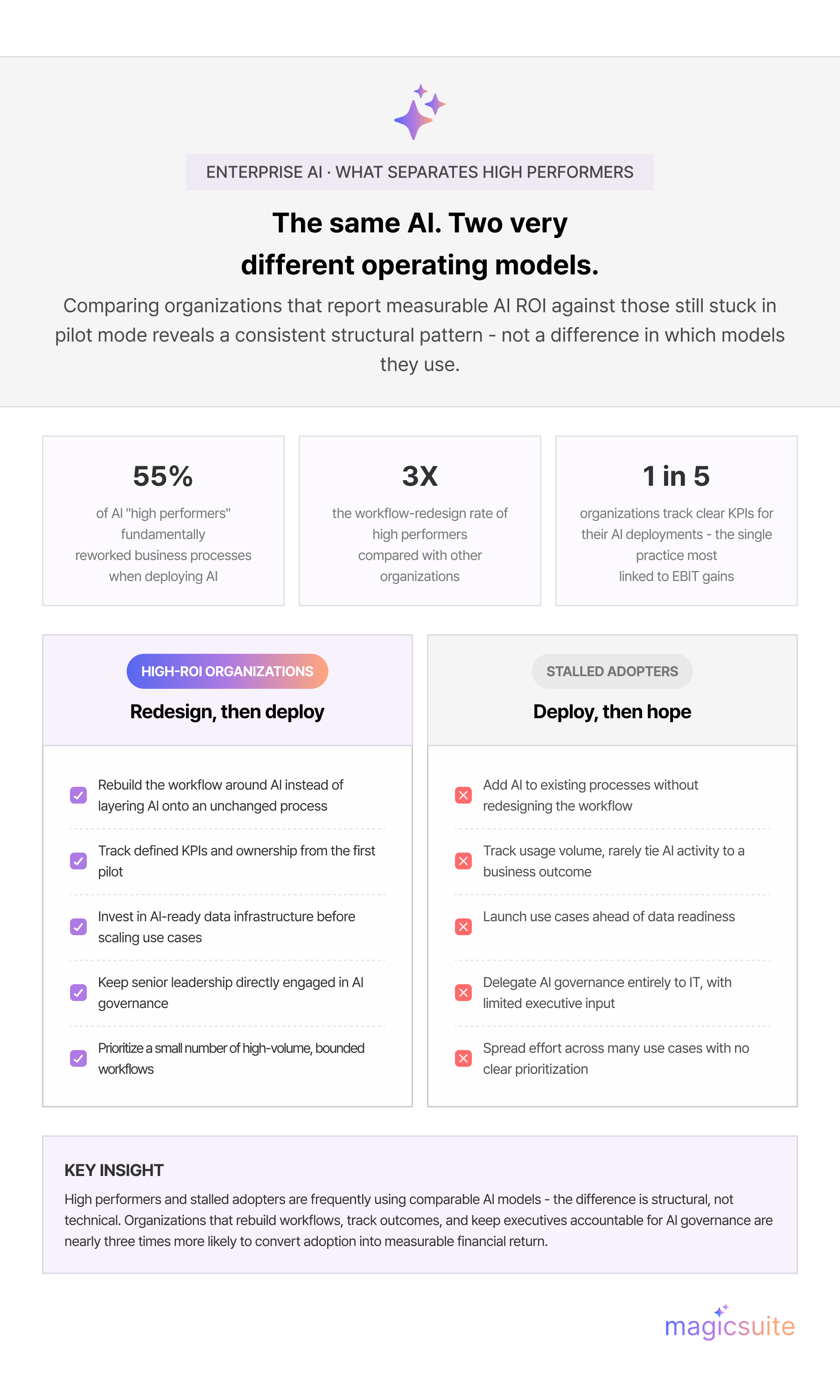
McKinsey's adoption-and-scaling research is instructive here. Analyzing twelve specific practices tied to generative AI deployment, the firm found consistent, positive correlations between each practice and bottom-line impact. The practice most strongly associated with EBIT impact was not model selection or compute investment - it was tracking well-defined KPIs for AI solutions. Notably, fewer than one in five organizations in the survey were actually tracking KPIs for their generative AI deployments, meaning the highest-leverage practice remains one of the least common.
The clearest evidence for the workflow thesis comes from McKinsey's own definition of "AI high performers" - the roughly 6% of surveyed organizations attributing more than 5% of EBIT impact to AI. Per McKinsey's November 2025 State of AI report, 55% of these high performers say they fundamentally reworked business processes when deploying AI - nearly three times the rate reported by other organizations. High performers are also more than three times as likely to say they're pursuing transformative, enterprise-wide change with AI rather than incremental efficiency gains.
Deloitte's State of AI in the Enterprise research, drawn from more than 3,200 senior leaders surveyed between August and September 2025, adds an organizational governance dimension: enterprises where senior leadership actively shapes AI governance - rather than delegating it entirely to technical teams - report meaningfully greater business value. Two-thirds of organizations in Deloitte's survey report productivity or efficiency gains from AI so far, but revenue growth remains largely aspirational: about 74% hope to grow revenue through AI, versus roughly 20% currently doing so. That gap between hope and realized value is, again, a workflow and execution gap more than a technology gap.
Comparing organizations that report measurable AI ROI against those still stuck in pilot mode reveals a consistent pattern across the McKinsey, Deloitte, MIT, and Gartner research. High performers tend to:
By contrast, organizations struggling to show returns typically share the inverse profile: broad experimentation across many use cases without prioritization, no consistent measurement framework, governance handled entirely by IT with limited executive involvement, and AI layered onto workflows that were never restructured to use it well. PwC's 2026 Global CEO Survey of 4,454 executives found only about 12% of CEOs reporting both a revenue gain and a cost reduction from AI simultaneously - a strong signal that most organizations are capturing, at best, a partial and narrow slice of AI's potential value.
Sources: McKinsey, Deloitte, Gartner
Even organizations with strong pilot results frequently stall when attempting to scale. The recurring obstacles identified across recent research into AI implementation include:
None of these are model problems. Each is a workflow, data, or organizational design problem - which is precisely why AI implementation success increasingly depends on operating-model decisions made well before a model is ever selected.

For organizations that get the workflow layer right, the returns are real and increasingly well-documented, even if enterprise-wide EBIT impact remains rare across the broader population. According to Deloitte's survey of 3,235 senior leaders, the gains already being captured concentrate in a few clear categories:
The pattern across these findings is consistent: the highest-value gains are narrow, operationally embedded, and tied to a specific workflow - not broad, enterprise-wide AI ambitions announced without a clear execution path. This is the practical meaning of generative AI ROI in 2026: value shows up where AI has been woven into a specific process with clear before-and-after metrics, not simply where it has been made available. Revenue impact, in particular, still lags cost and productivity gains - and closing that gap is where the workflow-intelligence advantage compounds fastest.
The strategic implication for enterprise leaders is direct. Model selection has become table stakes rather than a source of advantage - nearly every serious competitor has access to comparable capability, and global AI investment continues to accelerate regardless. The compounding advantage now accrues to organizations that treat AI transformation as an operating-model redesign problem rather than a software procurement problem.
That shift has practical implications for how enterprise AI strategy should be built:
Organizations that internalize this shift are the ones most likely to move from the 88% that have adopted AI into the small minority that can point to measurable enterprise value from it.
The story of enterprise AI in 2025 and 2026 is not a story about which models are most capable - it is a story about which organizations know how to absorb capable models into how they actually operate, a shift already visible in the AI market's broader impact on businesses. The research is remarkably consistent across McKinsey, MIT, Deloitte, Gartner, and PwC: adoption has become the norm, but return on AI investments remains concentrated among a small group of organizations that treated AI as a reason to redesign work, not merely a tool to accelerate it. For AI leaders and decision-makers, the long-term implication is clear. The next competitive advantage will not be won by whoever adopts the newest model first. It will be won by whoever builds the organizational and workflow intelligence to make any model - current or future - actually work inside the business.

Joseph is a Technical Communications Specialist responsible for translating complex technical concepts into clear, engaging, and accessible content for diverse audiences. He collaborates closely with technical teams, product experts, and stakeholders to develop documentation, reports, knowledge resources, and communication materials that support business objectives and enhance user understanding.