

Marketing automation hits $81bn by 2030 - but only 1% of firms are truly AI-mature. Here's why.

The numbers are no longer projections on a whiteboard — they're showing up on balance sheets. A new report from MarketsandMarkets places the global marketing automation market at $47.02 billion in 2025 and on a direct trajectory toward $81.01 billion by 2030, a compound annual growth rate of 11.5% that few industries sustain across a five-year horizon. What's driving this momentum isn't simply adoption volume. It's a fundamental shift in what AI-driven marketing can do: move from executing pre-written rules to learning, adapting, and acting in real time across every channel a customer touches.
For enterprise leaders, CMOs, and marketing technologists, this isn't a story about market size alone. It's about who captures value from this growth and who gets left behind. The gap between organizations that use AI tactically and those that deploy it strategically is widening fast — and the data that follows makes clear that the divergence has measurable, significant financial consequences.
The headline figure from MarketsandMarkets is straightforward: the marketing automation market will reach $81.01 billion by 2030. But the underlying mechanics are worth examining closely, because they reveal why this projection carries conviction where others have historically fallen short.
.png)
Three converging forces explain the acceleration. First, businesses are increasingly abandoning mass-broadcast strategies in favor of AI-powered marketing platforms capable of managing personalized campaigns simultaneously across email, mobile, social, and web. Second, behavioral analytics has matured to the point where real-time decision-making is no longer a premium enterprise feature — it's table stakes. Third, cloud-based deployment models have reduced the barrier to entry for small and mid-sized businesses, which now represent the fastest-growing segment in the market, expanding at a 15.2% CAGR through 2030.
The broader AI-in-marketing picture reinforces this growth story. Grand View Research pegs the global AI in marketing market at $20.44 billion in 2024, projecting a rise to $82.23 billion by 2030 at a 25% CAGR. This AI market growth trajectory — converging across automation, personalization, and analytics platforms — underscores how deeply AI capability and marketing infrastructure have become intertwined.
Key market drivers include:
If the broader digital marketing automation market represents the highway, Generative AI in marketing is the engine upgrade that changed what speeds are possible. The pace of adoption has been striking. According to McKinsey's State of AI research, 78% of organizations reported using AI in at least one business function in 2025, up from 55% the previous year. Within that group, sales and marketing saw the single greatest jump in generative AI adoption from 2023 to 2024 — making it the function where AI-driven value is both most visible and most contested.
McKinsey's economic analysis frames the opportunity in terms that are difficult to ignore: generative AI could unlock between $0.8 trillion and $1.2 trillion in incremental productivity across sales and marketing — on top of gains already captured through traditional analytical AI. This is not theoretical headroom. It maps directly to content creation acceleration, automated campaign optimization, predictive lead scoring, and AI-assisted customer journey orchestration.
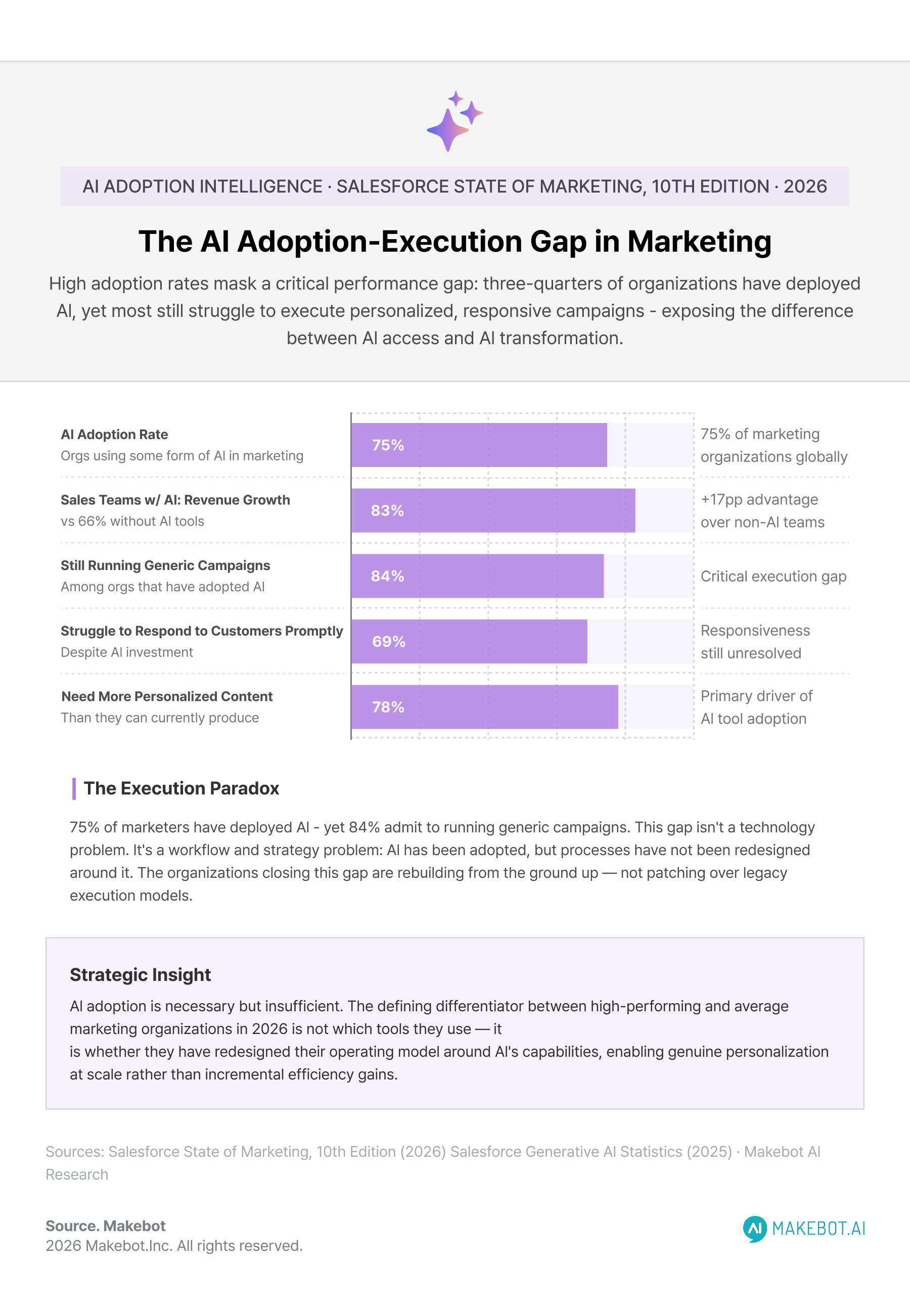
The Salesforce State of Marketing data adds granular texture to this transition. The Tenth Edition report, surveying nearly 4,450 marketing decision-makers in late 2025, surfaces several important realities:
The shift from experimentation to infrastructure is now well underway. But the organizations realizing the largest returns are not simply the ones with the most tools — they are the ones that have redesigned workflows around AI capabilities rather than bolting AI onto existing processes.
One of the most consequential findings in recent AI research is that the distribution of returns is highly unequal. The average ROI on generative AI investment sits at approximately 3.7x for every dollar invested, according to recent industry analysis — but the range behind that average tells a more important story.
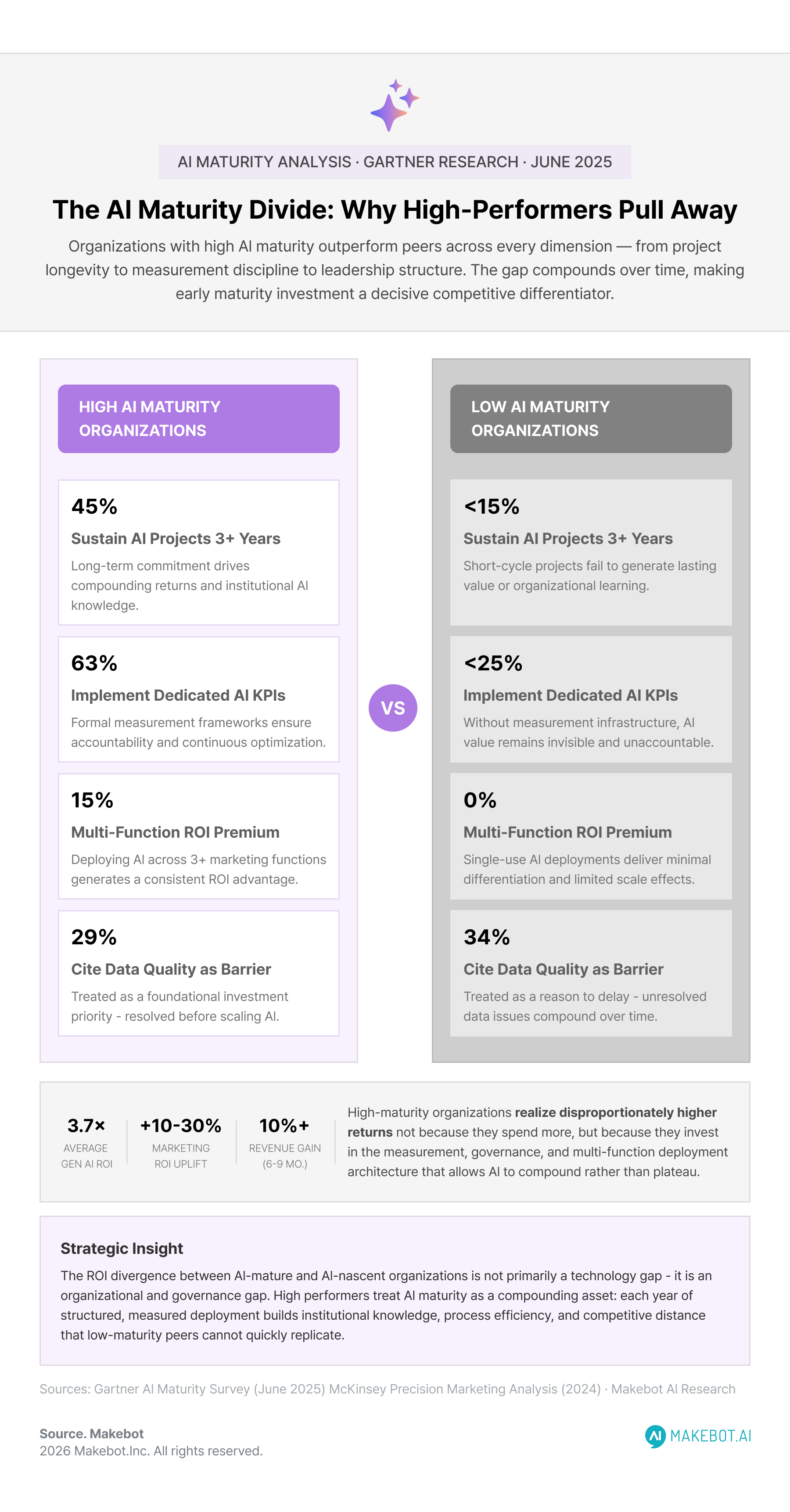
Gartner's June 2025 survey on AI maturity is illuminating here. Organizations with high AI maturity are significantly more likely to keep AI projects operational for three or more years (45% versus a much smaller fraction at low-maturity firms), implement dedicated measurement metrics (63% versus far fewer), and appoint dedicated AI leadership within 12 months. These are not incidental differences. They reflect a fundamentally different operating philosophy: one that treats AI as an enterprise-wide capability, not a departmental experiment.
What separates high performers in AI marketing automation from the rest comes down to several compounding factors:
The financial gap between adopters and laggards is becoming concrete. Companies using AI for marketing report a 10%+ revenue boost within six to nine months of full deployment. AI-powered personalization has demonstrated the ability to reduce customer acquisition costs by half while lifting marketing ROI by 10 to 30%, consistent with McKinsey's published analysis on precision marketing outcomes.
The growth trajectory of AI-powered marketing is not without its fault lines. Gartner's research introduces a critical concept that deserves serious attention from marketing leadership: the AI competency trap. This is the state in which organizations become stuck executing early-stage AI use cases — content repurposing, email subject line optimization, basic segmentation — without ever progressing to strategic differentiation.
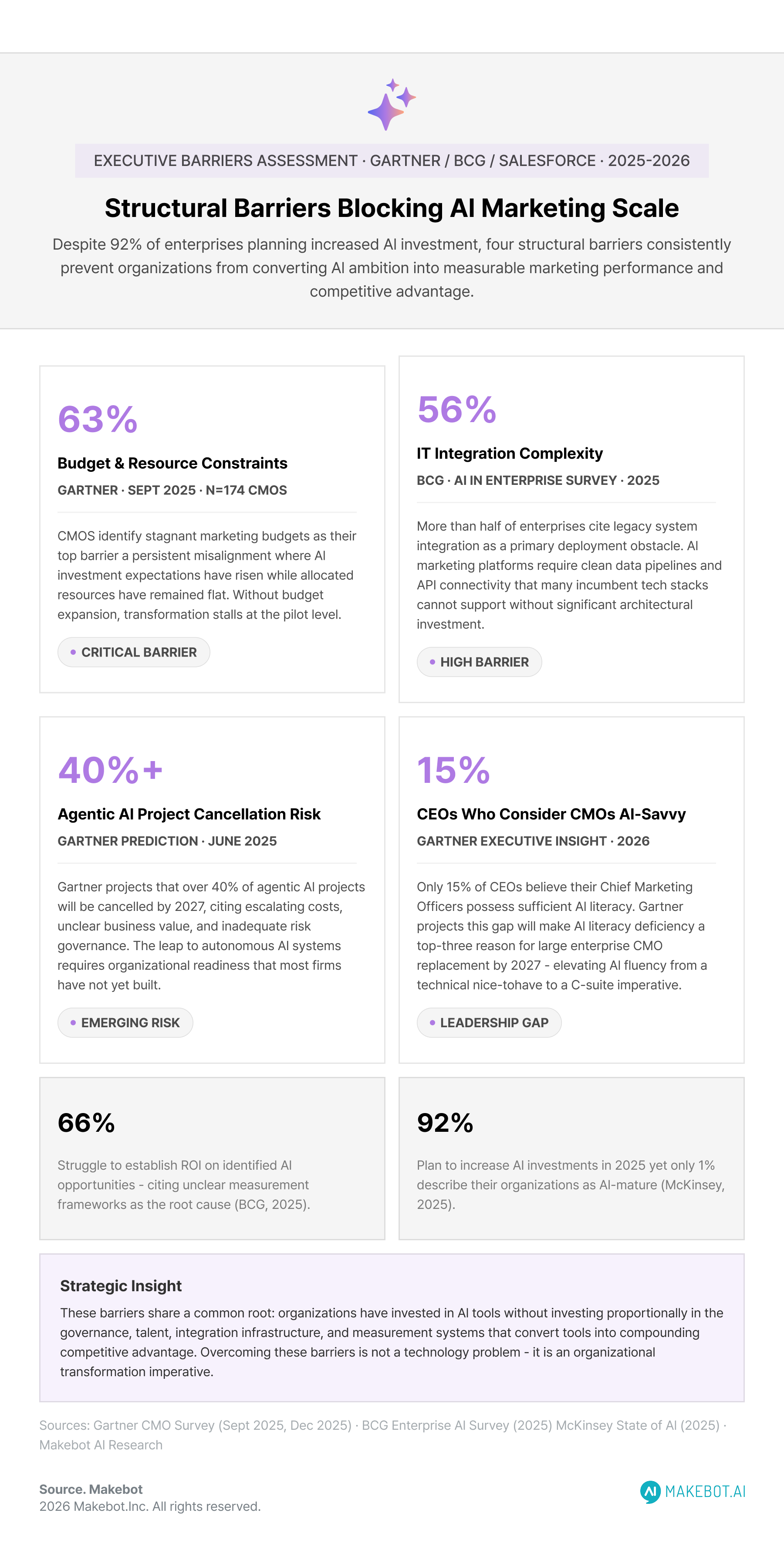
The May 2026 Gartner survey of 402 CMOs (conducted between August and October 2025) found that marketing leaders expect AI-driven automation to more than double from 16% of total marketing work in 2026 to 36% by 2028. But Gartner's analysts draw a sharp distinction between CMOs who are testing use cases and those they call "market shapers" — leaders who use AI to actively reshape competitive positioning rather than just execute campaigns more efficiently.
Kristina LaRocca-Cerrone, VP Analyst in the Gartner Marketing Practice, frames the challenge plainly: organizations that fail to make that shift risk blending into a sea of sameness as competitors use AI to shape markets, not just run them.
Several structural obstacles complicate this evolution:
These aren't reasons to slow AI adoption — they're reasons to invest in the organizational infrastructure that determines whether AI investments compound or stall.
Beyond the headline market figures, a set of structural AI marketing trends are quietly reconfiguring how campaigns are built, measured, and scaled. For organizations investing in digital marketing automation, understanding these shifts is now a strategic imperative — they determine which capabilities will separate leading organizations from the rest over the next three to five years.
Predictive segmentation and behavioral targeting have moved from advanced capability to expected practice. AI-based segmentation has delivered a 33% uplift in personalization effectiveness, with brands using clustering models reporting a 26% increase in campaign conversion rates in 2025. Nearly half of marketing teams (49%) now use AI to identify micro-segments based on behavioral patterns — a practice that was niche just two years ago.
Agentic AI in marketing represents the next wave. Unlike earlier AI systems that surfaced recommendations for human action, agentic systems plan and execute across multiple steps — scheduling campaigns, adjusting bids, testing creative variants, and responding to customer behavior without continuous human intervention. Gartner projects that at least 15% of day-to-day work decisions will be made autonomously through agentic AI by 2028, compared to 0% in 2024.
Omnichannel automation is becoming the standard operating model for enterprise marketing. Companies with strong omnichannel strategies retain an average of 89% of their customers, compared to just 33% for those with weak cross-channel engagement. The key infrastructure requirement is unified data: fragmented data limits automation accuracy, while consolidated back-end data enables smarter segmentation, more relevant messaging, and reliable measurement across touchpoints.
Content velocity and generation have been transformed by generative AI. Marketing teams now use AI to produce briefs, draft assets by persona and funnel stage, repurpose high-performing content, and optimize for SEO — all at a pace human teams cannot match. 93% of marketers reported that AI accelerated content creation in 2025, and 73% specifically used generative AI for copy and scripting.
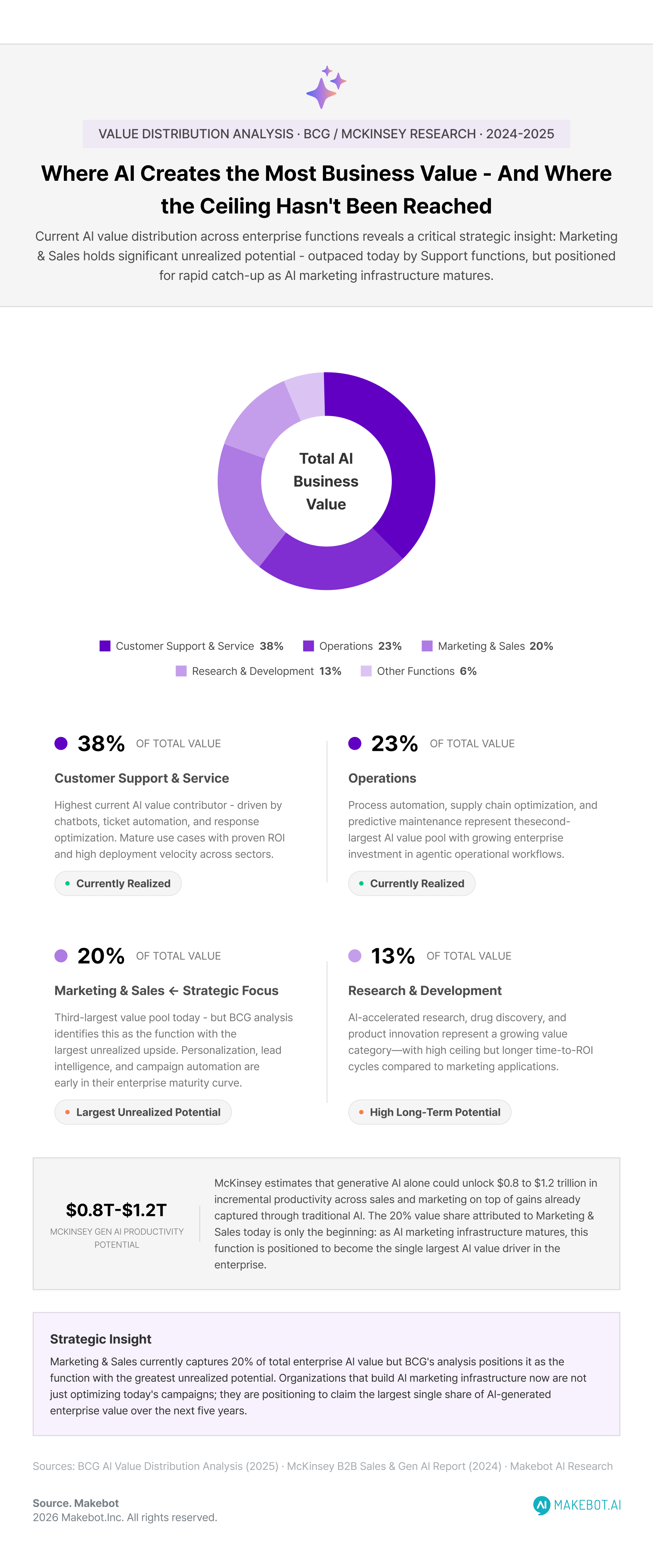
Not all AI-driven marketing investments generate equal returns. As AI in marketing continues to mature, the sectors and functions where it delivers the highest measurable impact offer a practical map for prioritizing deployment.
E-commerce and retail remain the clearest showcase for AI marketing ROI. AI-driven personalization in retail contexts can generate revenue increases of up to 41%, with shoppers who engage with AI-powered product recommendations 4.5x more likely to complete a purchase. AI-enabled dynamic pricing has contributed to a 12% sales lift across sectors.
B2B sales and marketing is experiencing structural transformation. The function saw the greatest surge in generative AI adoption in 2024, and McKinsey's B2B Pulse Survey indicates that early-stage gen AI application is now widespread across pipeline management, lead scoring, and customer communication. Forward-looking applications include AI agents functioning as virtual sales specialists — capable of handling routine inquiries, managing follow-ups, and surfacing real-time coaching for human representatives.
Financial services is emerging as a high-value deployment context. 43% of companies in financial services using AI reported significant boosts in operational efficiency, with applications spanning compliance automation, personalized customer communication, and risk-aware campaign targeting.
The BCG analysis of AI value distribution reinforces a critical strategic point: support functions like customer service generate 38% of AI's total current business value, but the largest unrealized potential sits within operations (23%), marketing and sales (20%), and R&D (13%). For CMOs, this suggests that the current wave of AI investment in marketing is not at its ceiling — it is closer to its floor.
For all the data supporting AI investment in marketing, the path from strategy to value remains difficult for a significant proportion of enterprises. Understanding why is as important as understanding what works.
Salesforce research on barriers to AI marketing automation adoption — and the broader marketing automation AI stack — identifies four primary friction points:
Notably, Salesforce's Tenth Edition State of Marketing report (surveying 4,450 marketers in late 2025) found that despite 75% of marketers adopting AI, 69% still struggle to respond to customers promptly, and 84% confess to running generic campaigns. Adoption and transformation are not the same thing.
The organizations that successfully close this gap share identifiable characteristics. They invest in data infrastructure before AI tooling, ensuring the quality and accessibility of customer data as a prerequisite for intelligent automation. They redesign workflows rather than augmenting legacy processes, understanding that AI performs differently when it operates within a purpose-built process versus when it is inserted as a patch. And they measure continuously — with 63% of high-maturity organizations implementing dedicated AI metrics, compared to a much smaller fraction of low-maturity peers.
The marketing automation market's trajectory toward $81 billion by 2030 is not simply a forecast — it is a reflection of a structural shift already underway in how businesses engage customers, allocate marketing investment, and compete for attention in an environment saturated with content. AI marketing automation has moved from experimental priority to core infrastructure, and the evidence from McKinsey, Gartner, Salesforce, and BCG collectively makes clear that the organizations achieving the strongest returns are those that have committed to deep, systematic AI integration rather than surface-level adoption.
What the data also makes clear is that the window for establishing AI-driven competitive advantage remains open, but it is closing. The gap between market shapers and those trapped in early-stage AI use cases is widening with each quarter. The question for marketing leadership in 2026 and beyond is not whether to invest in AI-driven marketing — that debate is settled. The question is whether the investment is accompanied by the workflow redesign, data infrastructure, measurement discipline, and organizational capability that determines whether AI compounds into a durable advantage or stalls in the pilot phase.
The $81 billion market projection rewards organizations that understand this distinction and build accordingly.

Joseph is a Technical Communications Specialist responsible for translating complex technical concepts into clear, engaging, and accessible content for diverse audiences. He collaborates closely with technical teams, product experts, and stakeholders to develop documentation, reports, knowledge resources, and communication materials that support business objectives and enhance user understanding.