Why AI Is Becoming the Operating System for Customer Experience
August 13, 2026
7
mins
AI churn models flag at-risk customers 90 days early - retention leaders earn 25% higher CLV.
KEY TAKEAWAYSAI + CX
01
AI-centric contact centers are already pulling ahead.
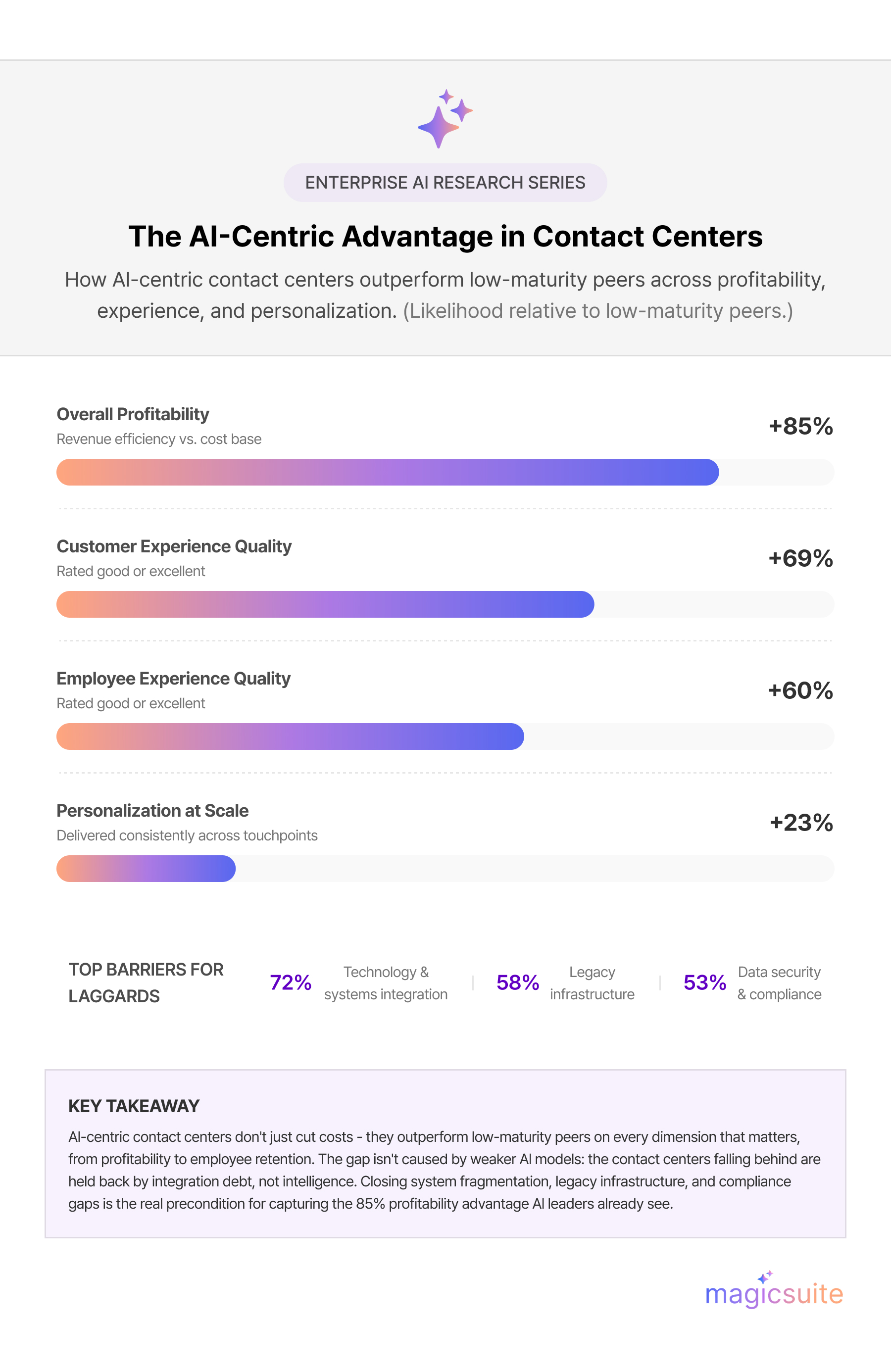
Deloitte Digital found they are 85% more profitable than low-maturity peers and 69% more likely to deliver good-to-excellent customer experiences.
02
AI adoption is now table stakes.
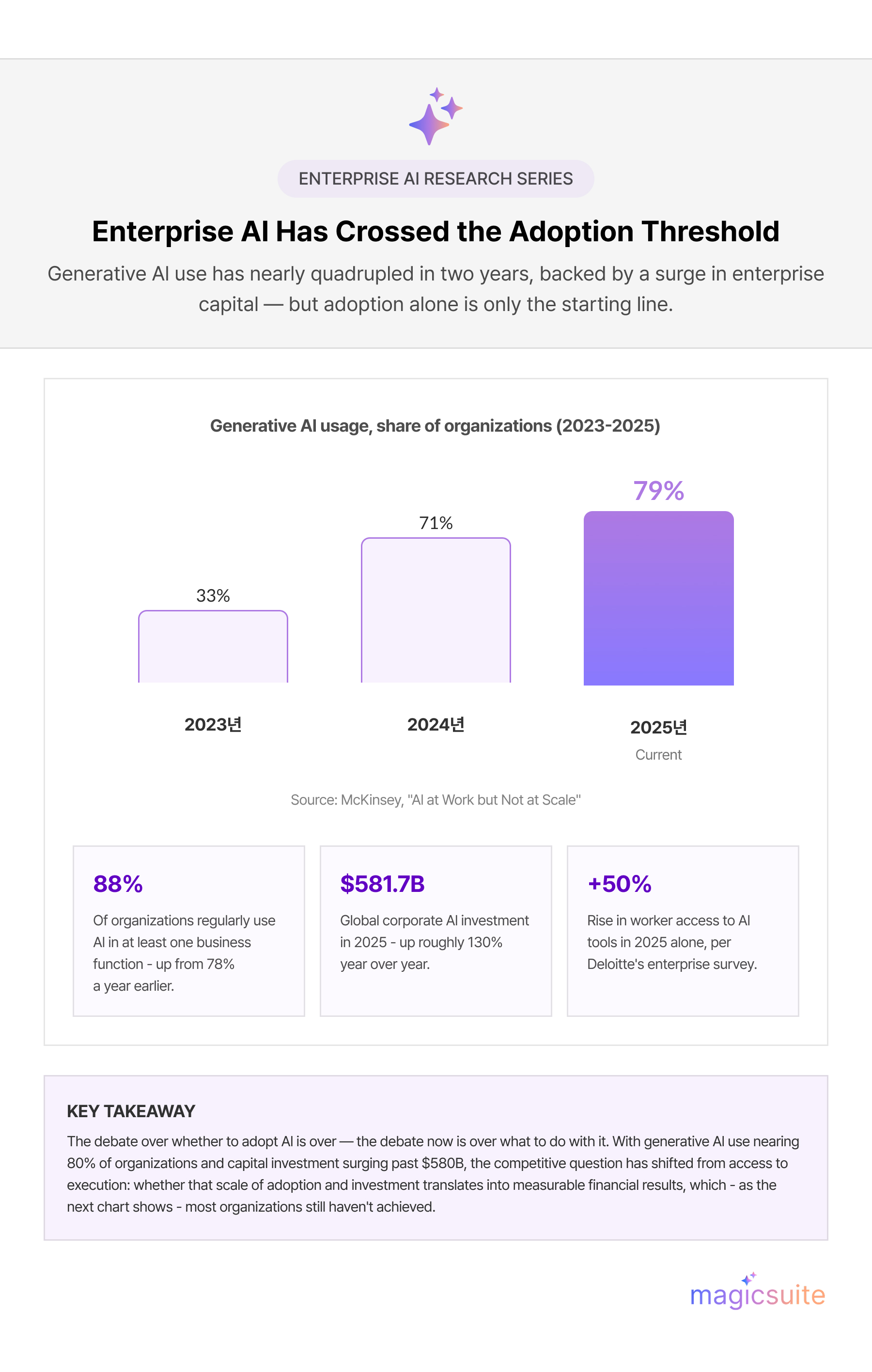
88% of organizations use AI in at least one business function, while generative AI adoption climbed from 33% in 2023 to 79% in 2025.
03
Customer service is moving from AI assistance to AI action.
Gartner predicts agentic AI will autonomously resolve 80% of common customer service issues by 2029, potentially reducing operational costs by about 30%.
04
Deployment alone does not guarantee business value.
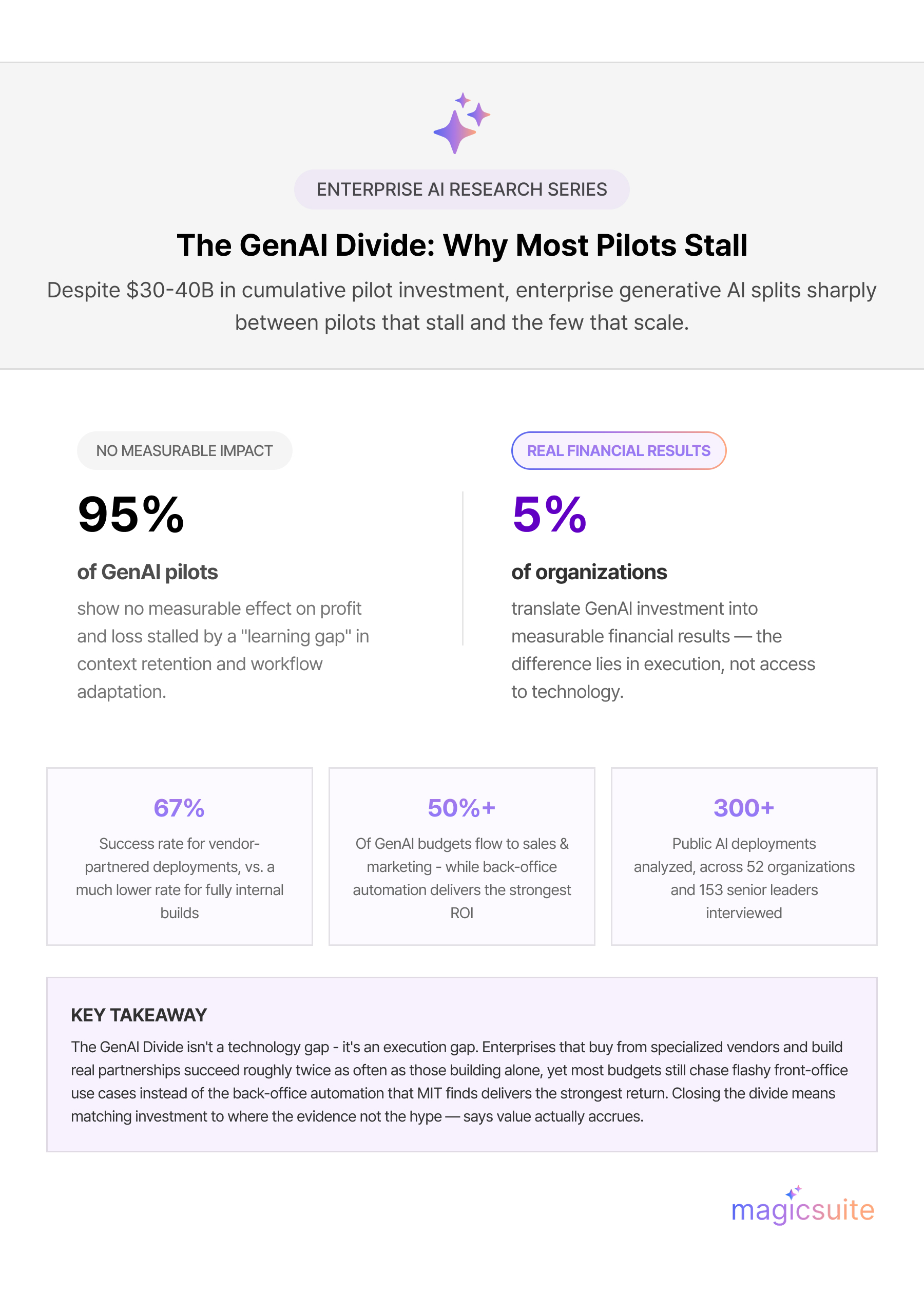
MIT Project NANDA reported that only about 5% of enterprise generative AI pilots produced measurable P&L impact, highlighting the importance of integration and workflow design.
05
The real differentiator is organizational design.
AI leaders combine workflow redesign, stronger data foundations, clear governance, and growth-oriented investment rather than treating AI as another isolated software tool.
Introduction
Enterprise software has always had an operating system-the invisible layer that decides how work actually gets done. For the past decade, that layer was built around dashboards, ticketing queues, and static rules engines. That is changing fast. Across contact centers, marketing platforms, and self-service portals,AI customer experience is no longer a bolt-on feature; it is becoming the coordination layer that decides what a customer sees, how quickly they're helped, and whether a business relationship deepens or ends. New research from Deloitte, McKinsey, Gartner, and PwC shows this shift is already producing measurable separation between AI leaders and everyone else. This article breaks down what the data actually says, why some enterprises capture outsized returns, and what it takes to turn AI from a pilot project into genuine operational infrastructure.
Within that broader wave, customer experience has emerged as one of the clearest proving grounds for AI-powered customer experience investment. Analysts increasingly framegenerative AI in customer experience as the starting point for this shift-not because it replaces human judgment, but because it removes the drafting, summarizing, and lookup work that used to slow every interaction down:
Deloitte's leaders rank customer support as the area where agentic AI is expected to have the highest impact, ahead of other high-potential use cases like supply chain management, R&D, and cybersecurity.
McKinsey finds that marketing and sales, strategy and corporate finance, and product and service development are the functions most commonly reporting revenue benefits from AI use, largely attributed to AI personalization, lead scoring, and content generation.
Gartner predicts that agentic AI will take on a growing share of customer interactions as it moves from generating text to taking autonomous action on a customer's behalf.
The direction of travel is unambiguous. The open question-the one separating winners from laggards-is execution.
Why AI-Centric Contact Centers Are Pulling Ahead
Deloitte Digital's 2026 Global Contact Center Survey offers one of the sharpest looks yet at what happens whenAI chatbot and agentic technologies are deployed well versus poorly. Comparing AI-centric contact centers to their low-maturity peers, the findings are stark:
85% more profitable overall
69% more likely to rate customer experiences as good or excellent
60% more likely to rate employee experiences as good or excellent
23% more likely to deliver personalized experiences at scale
These are not incremental differences-they represent a structural advantage. Deloitte's research also identifies what's holding the rest of the market back. Contact center leaders falling behind cite three recurring obstacles: integration of technology, systems, and tools (72%), legacy infrastructure (58%), and data security and compliance concerns (53%). In other words, the barrier usually isn't the AI model itself-it's the plumbing underneath it. Enterprises attemptingcustomer experience automation without first resolving system fragmentation tend to see AI amplify existing inefficiencies rather than replace them.
The Scaling Gap: Why 95% of Pilots Stall
Perhaps the most sobering data point in enterprise AI right now comes from MIT's Project NANDA. Its July 2025 report,The GenAI Divide: State of AI in Business, is based on a review of more than 300 publicly disclosed AI initiatives, structured interviews with 52 organizations, and survey responses from 153 senior leaders. The authors describe it as preliminary, non-peer-reviewed research, and the methodology has drawn some pushback from other analysts-but the headline finding has been widely cited: despite $30–40 billion in cumulative GenAI pilot investment, 95% of pilots delivered no measurable P&L impact, while only about 5% of organizations translated their AI investment into real financial results.
The reasons aren't primarily technical. MIT's research points to a "learning gap"-tools that can't retain context, adapt to workflows, or improve from feedback over time. Two patterns stand out for enterprises buildingconversational AI andLLM-powered systems:
Budget allocation is often misaligned: more than half of GenAI budgets go toward sales and marketing tools, yet MIT found the strongest ROI concentrated in back-office automation-reducing outsourcing costs and streamlining operations.
This matters directly for CX leaders, because customer-facing AI sits at the intersection of both patterns: it requires vendor-grade reliability and it competes for budget against flashier, less-proven use cases.
Why Some Organizations Get Dramatically Higher Returns
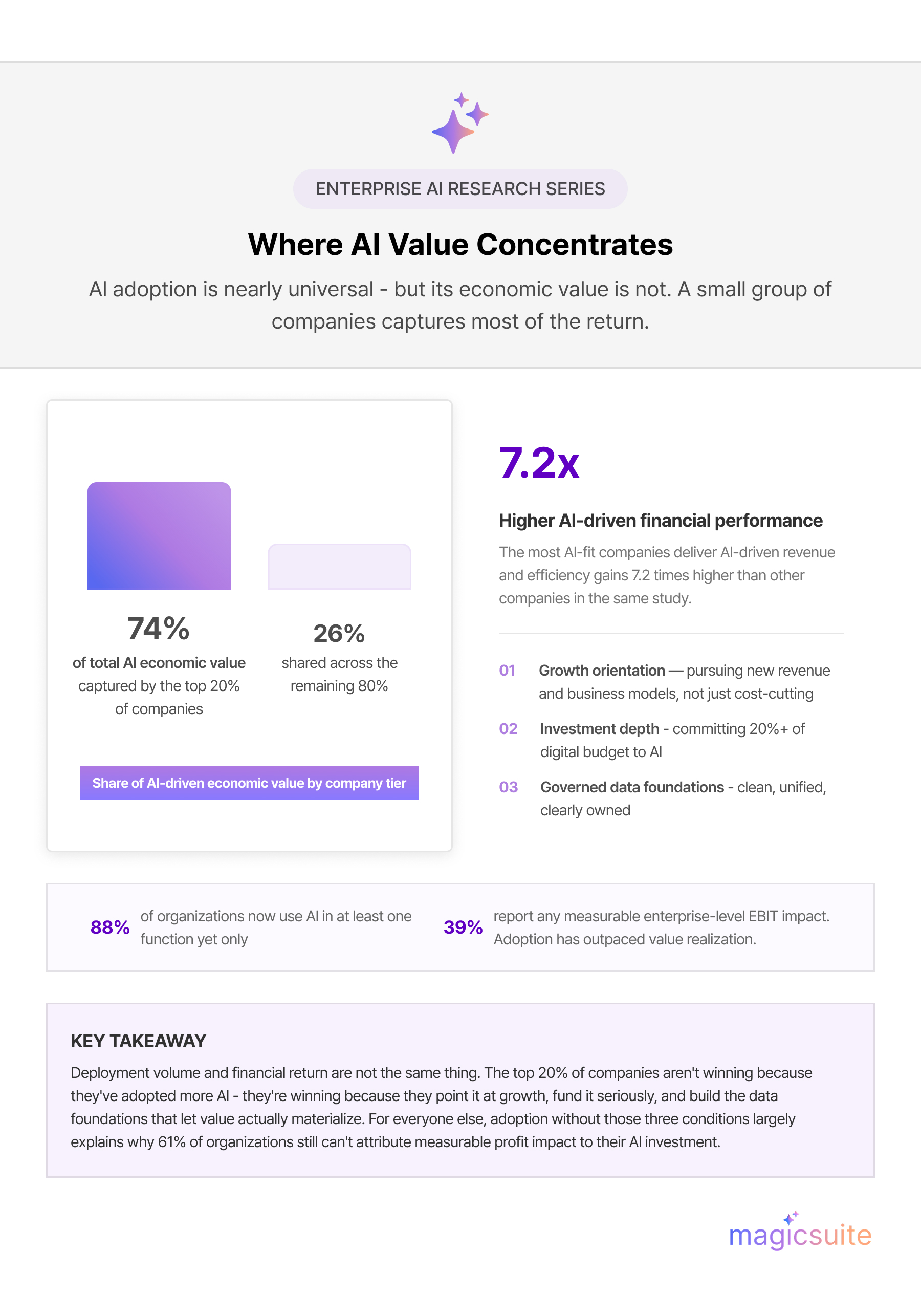
If adoption is nearly universal but value is concentrated, the natural question is: what separates the winners? PwC's 2026 AI Performance Study, surveying 1,217 senior executives across 25 sectors, offers the clearest answer to date. It found that the top 20% of companies capture nearly 74% of AI's total economic value-and the gap has little to do with how much AI a company has deployed.
Technical factors matter, but organizational factors matter more:
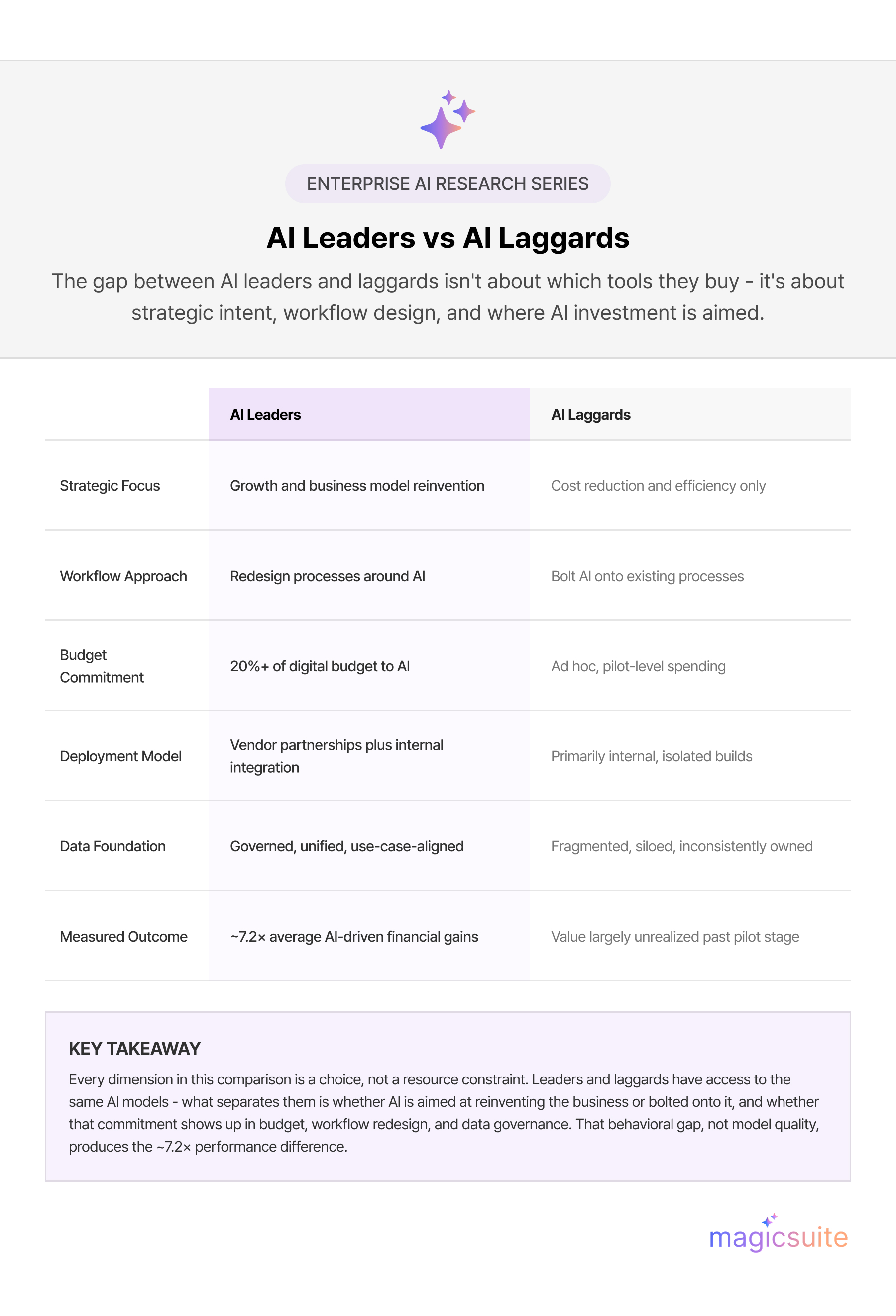
Strategic intent. McKinsey finds that high-performing organizations are more than three times more likely to pursue enterprise-level transformation rather than isolated efficiency gains, and are nearly three times as likely to have fundamentally redesigned their workflows around AI.
Growth orientation over cost-cutting. PwC's leaders are using AI to pursue new revenue streams and reinvent business models, not just trim headcount-and the most AI-fit companies in PwC's study deliver AI-driven financial performance 7.2 times as high as other companies.
Data and governance foundations. Both PwC and MIT point to the same underlying requirement: clean, well-governed data and clear ownership are prerequisites for scaling, not afterthoughts.
Where AI Is Already Reshaping the Customer Journey
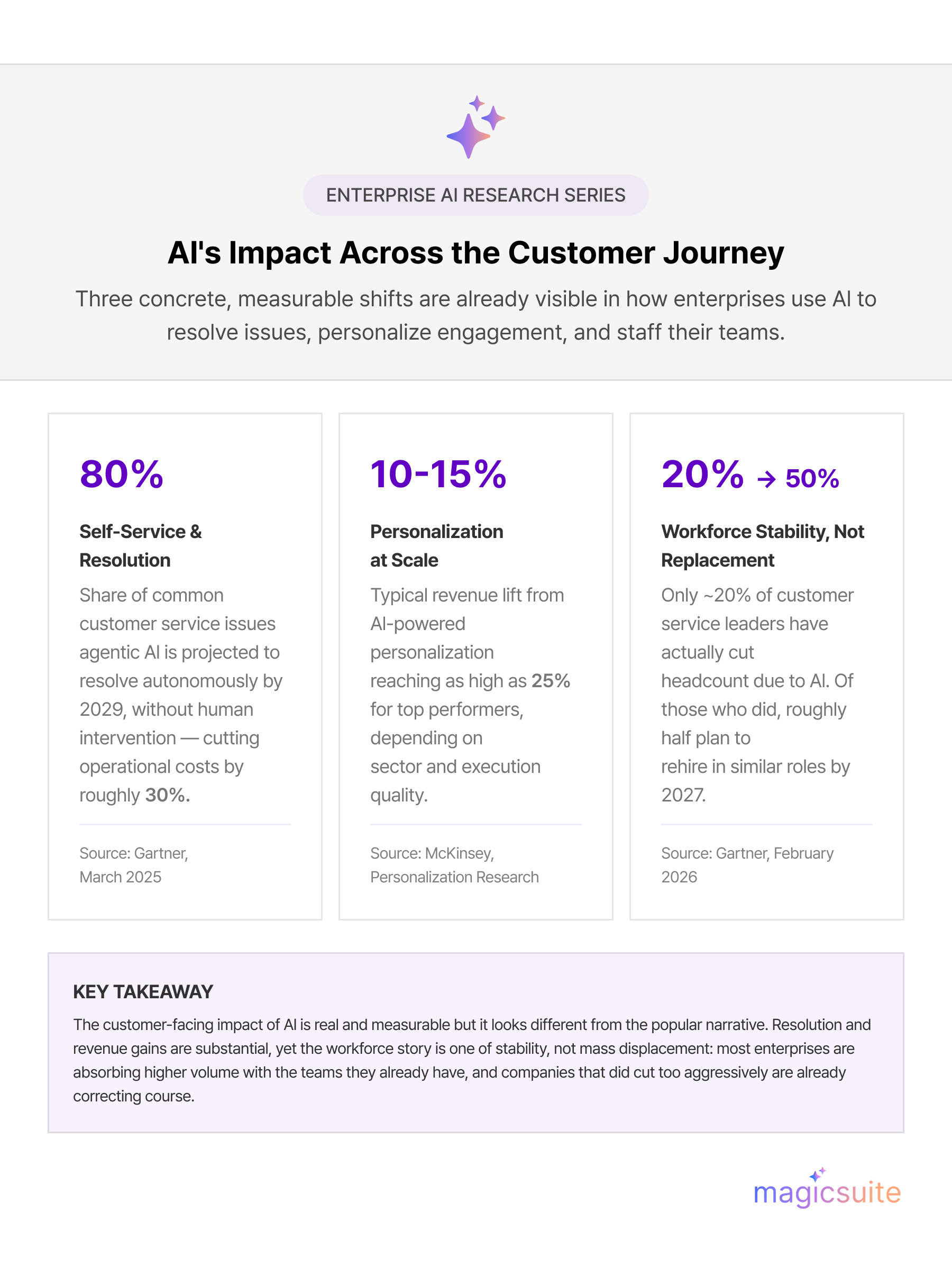
Beyond back-office metrics, several concrete shifts are visible in how enterprises use AI across the customer journey:
Self-service and resolution. Gartner predicts that by 2029, agentic AI will autonomously resolve 80% of common AI customer service issues without human intervention, reducing operational costs by roughly 30%-a shift already visible in why most customers now prefer self-service over waiting for a human.
Personalization at scale. McKinsey research shows personalization most commonly drives a 10–15% revenue lift, with company-specific gains reaching as high as 25% depending on sector and execution quality.
Agentic workflows. Enterprises are deploying autonomous agents for tasks like automatically rebooking flights, rerouting bags, or capturing and tracking action items from customer meetings-freeing human agents for complex, high-empathy interactions.
Workforce stability, not replacement. Despite headline predictions of labor disruption, Gartner also finds that only about 20% of customer service leaders have actually reduced agent headcount because of AI; most report handling higher volume with a stable workforce, and Gartner expects roughly half of companies that did cut service staff to rehire in similar roles by 2027.
AI Leaders vs. AI Laggards: A Side-by-Side View
Common Challenges When Scaling Enterprise AI
Even well-resourced organizations run into recurring friction points when moving from pilot to production:
Misaligned budget priorities. MIT found the largest GenAI budgets flowing to functions with comparatively weaker ROI, while higher-return functions like back-office automation remain underfunded.
Shallow workflow redesign. Deploying a chatbot on top of an unchanged process rarely produces the results a fully redesigned, AI-native workflow can deliver.
Conclusion: From Tool to Infrastructure
The direction of the data is consistent across every major research house: AI is no longer a discrete customer service feature-it is becoming the operating layer that coordinates how enterprises sense customer intent, resolve issues, and personalize engagement at scale. But the same research is equally clear that deployment alone does not guarantee value. The organizations pulling ahead are not simply the ones spending the most on AI; they are the ones treating it as a catalyst for structural change-rebuilding workflows, investing in data foundations, and pointing AI at growth rather than cost alone. For enterprises still in pilot mode, the strategic imperative for the next 12–24 months isn't choosing the right model or vendor. It's building the organizational conditions-data, governance, and workflow redesign-that let AI actually function as infrastructure rather than an experiment.
AI-POWERED CUSTOMER EXPERIENCE
Turn AI from a customer service tool
into your CX operating layer.
Build smarter customer experiences with AI-powered automation, conversational intelligence, and enterprise-ready workflows designed to help your teams respond faster, personalize at scale, and turn every interaction into measurable business value.
Enterprise AI for smarter, faster, and more connected customer experiences.
FAQ
Frequently Asked Questions
6 QUESTIONS
Generative AI produces content such as drafted responses, ticket summaries, and personalized messages. Agentic AI goes further by taking autonomous action, such as processing a refund or rebooking a flight, without requiring human approval at every step.
MIT Project NANDA attributes this primarily to a “learning gap”: tools that cannot retain context, adapt to real workflows, or improve from feedback over time. Misaligned budgets and isolated internal builds can further limit measurable returns.
Not broadly. Gartner reports that most organizations are maintaining relatively stable customer service headcount while using AI to handle higher interaction volumes. It also expects many companies that cut service staff because of AI to rehire similar roles by 2027.
McKinsey research points to a typical revenue lift of approximately 10–15% from effective personalization, with gains reaching as high as 25% for some top performers depending on sector and execution quality.
High performers focus AI on growth and business reinvention rather than cost reduction alone. They also invest more deeply, redesign workflows, strengthen their data foundations, establish clear governance, and tie AI initiatives to measurable business outcomes.
MIT Project NANDA's findings suggest that purchased tools combined with strong vendor partnerships reach successful deployment more often than fully internal builds. The right approach still depends on internal AI engineering capacity, data readiness, integration requirements, and the complexity of the customer experience workflow.
Source note:
Statistics and research findings in this article are based on the original publications listed above. Because enterprise AI research evolves quickly, readers should consult the linked source before citing individual figures elsewhere.
Hanna is an industry trend analyst dedicated to tracking the latest advancements and shifts in the market. With a strong background in research and forecasting, she identifies key patterns and emerging opportunities that drive business growth. Hanna’s work helps organizations stay ahead of the curve by providing data-driven insights into evolving industry landscapes.