

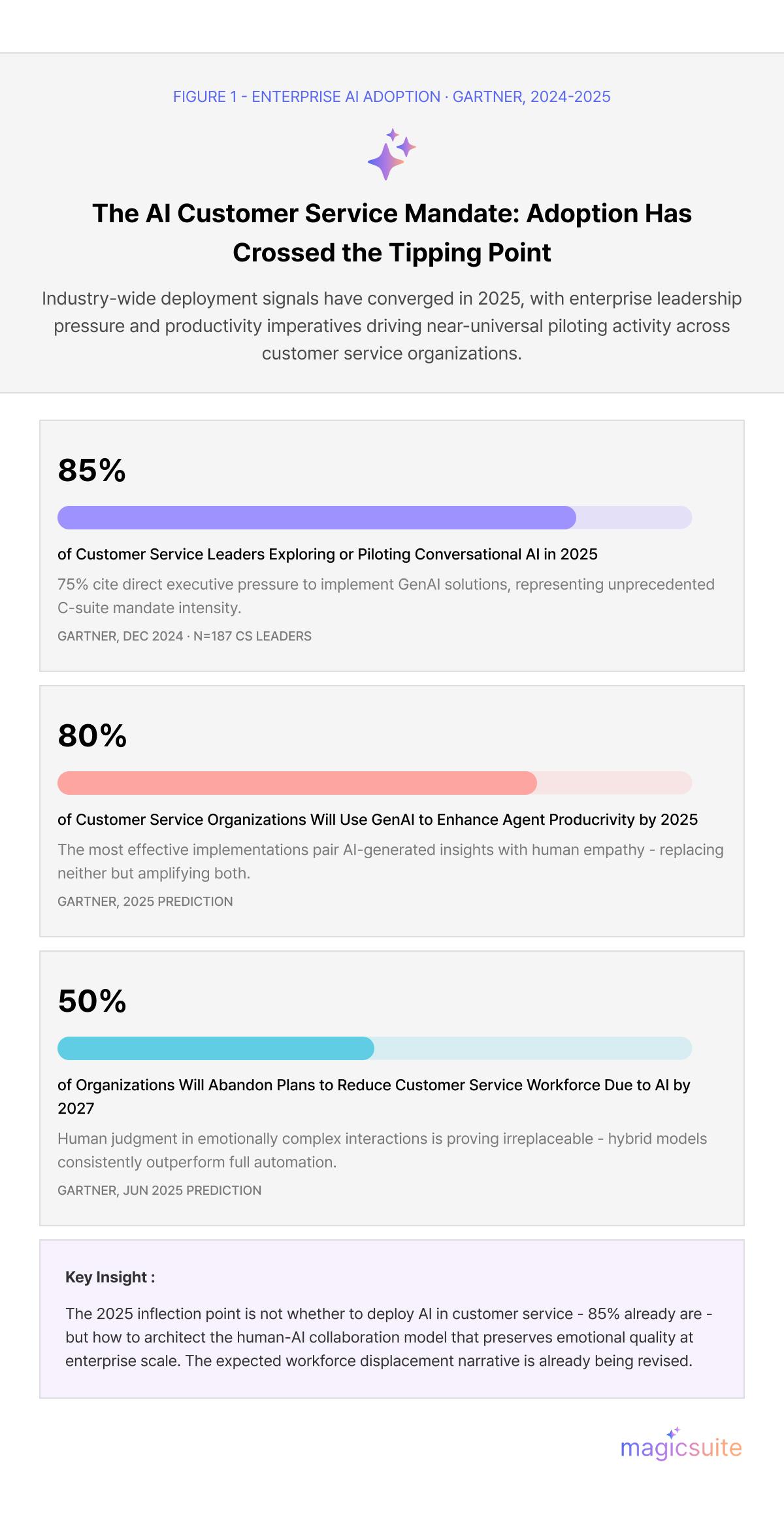
85% of CX leaders are piloting conversational AI - but 64% of customers would reject it if it fails.

Customer experience has entered a new era—one where speed and accuracy alone are no longer sufficient. Today's consumers expect more than efficient service; they want to feel understood. The rise of AI-powered customer experience platforms, capable of analyzing tone, detecting emotional cues, and adapting responses in real time, is fundamentally transforming how enterprises engage with the people they serve.
Yet building truly emotionally intelligent AI is not simply a matter of deploying a chatbot or layering automation onto existing workflows. It demands a rethinking of how organizations capture, interpret, and act on human emotion at scale. For CX leaders, the strategic imperative is clear: companies that successfully integrate empathetic AI into their customer journeys will outperform competitors in retention, loyalty, and long-term revenue growth. This article examines the technologies, frameworks, and enterprise approaches driving that transformation—and what separates the organizations getting it right from those still struggling to close the gap.
For years, customer experience strategy centered on reducing friction—faster load times, shorter queues, and more accessible self-service options. These improvements mattered. But as digital interactions multiplied and human touchpoints diminished, a different kind of gap emerged: the emotional one.
Research consistently shows that customers' emotional states at key interaction moments determine long-term loyalty more than any single transactional metric. Harvard Business Review research found that brands connecting with consumers on an emotional level outperform competitors by 85% in sales growth—a figure that reframes emotional intelligence not as a soft differentiator but as a hard business driver.
The challenge for enterprise CX teams is that emotional intelligence, by its nature, is difficult to systematize. Human agents develop it through experience, empathy, and contextual awareness. Historically, scaling that capability meant hiring more people. AI emotional intelligence changes that equation—provided the technology is designed with emotional fidelity, not just efficiency, at its core.
This shift in thinking is now visible across industries. In financial services, AI systems are being trained to recognize when a customer's speech patterns suggest anxiety or confusion before offering support escalation. In healthcare, virtual consultation platforms are deploying voice analysis tools that detect emotional distress during intake calls. In retail, AI customer engagement platforms personalize not just product recommendations but the tone and timing of every communication based on behavioral signals.
AI sentiment analysis is the technical foundation on which emotionally intelligent customer systems are built. At its core, sentiment analysis uses natural language processing (NLP) to classify the emotional valence of text and speech—positive, negative, or neutral—and increasingly, to detect more granular emotional states such as frustration, urgency, confusion, or satisfaction.
Modern conversational AI platforms go considerably further than simple sentiment scoring. They integrate multimodal signals—text, voice tone, response latency, and behavioral patterns—to build a dynamic emotional profile of each interaction. This profile informs real-time decisions: whether to de-escalate a conversation, change communication tone, offer a proactive resolution, or route the customer to a human agent.
The technical pipeline generally involves three layers:
Industry research and early enterprise deployments consistently show significant satisfaction gains when emotion-aware AI is implemented correctly—with some contact center studies reporting an uplift of 40% or more in customer satisfaction scores. However, outcomes vary considerably depending on data quality, model specificity, and whether the emotional taxonomy used in development reflects real-world interaction complexity. The technology is genuinely promising; the returns are real but not automatic.
If sentiment analysis provides the emotional context, AI personalization delivers the commercially valuable action. Hyper-personalization—the use of AI to tailor every aspect of the customer interaction to individual preferences, behaviors, and emotional states—has emerged as one of the most measurably impactful applications in the enterprise CX stack.
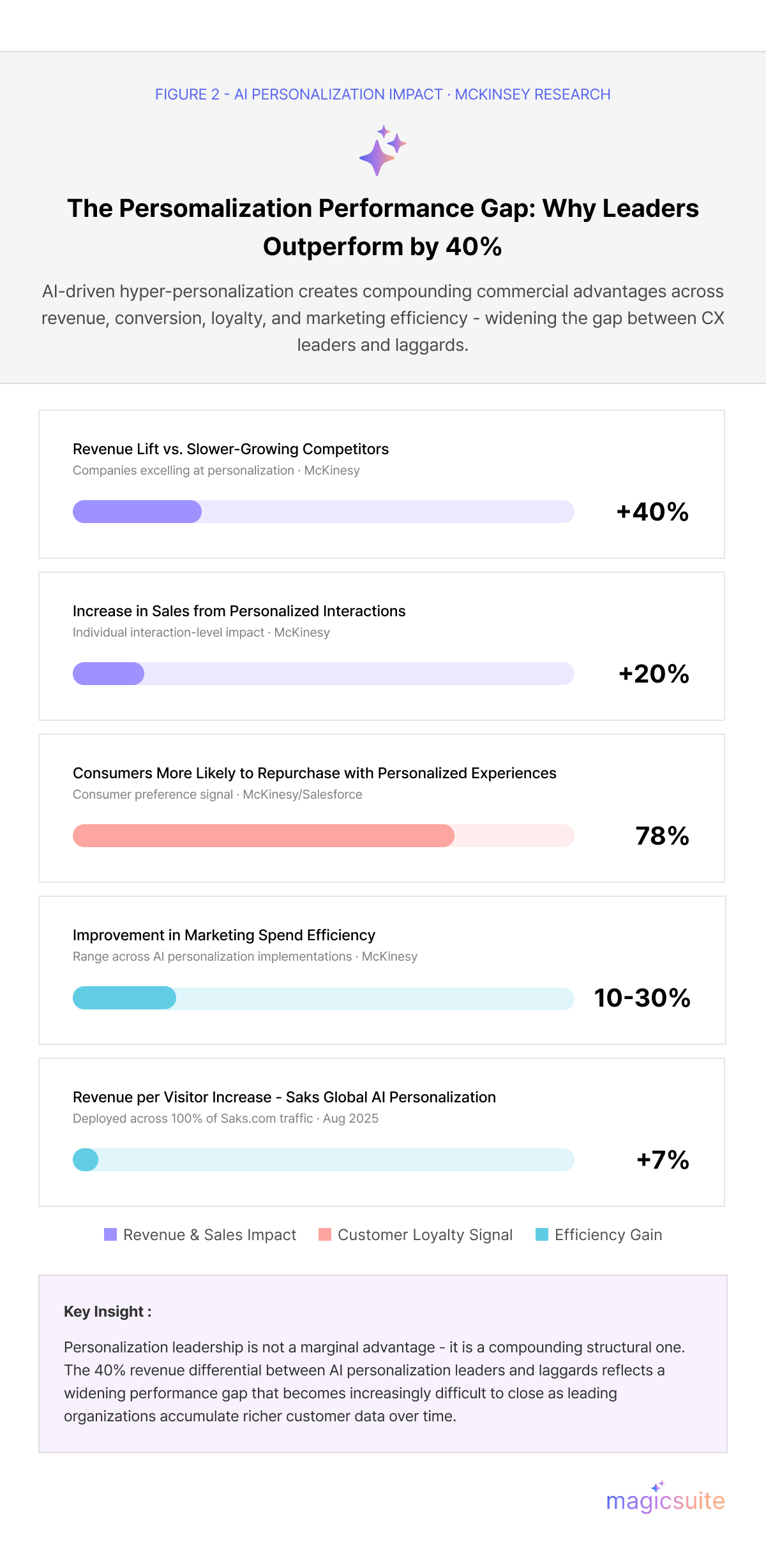
McKinsey research places personalized interactions at the center of revenue performance, with companies excelling at personalization generating revenue from those activities that is 40% higher than slower-growing competitors. More granularly, personalized customer interactions correlate with a 20% increase in sales and a 10–30% improvement in marketing spend efficiency. The consumer-side data is equally compelling: 78% of consumers say they are more likely to repurchase from a brand that delivers personalized experiences.
What makes AI-driven personalization qualitatively different from earlier segmentation approaches is its real-time operating cadence. Traditional CRM-based personalization worked from historical snapshots and demographic clusters. AI customer experience platforms, by contrast, continuously update customer models with each new interaction signal—adjusting recommendations, messaging, and service approaches within milliseconds.
Enterprise case evidence illustrates the scale of this impact:
The unifying principle across these cases is not the technology itself but the degree to which personalization is connected to emotional context. Customers respond not merely to relevant recommendations, but to interactions that feel attentive—as if the brand genuinely understands where they are in their journey.
One of the most consequential insights to emerge from enterprise AI deployments is that full automation is not the goal—and in emotionally complex interactions, it can actively harm outcomes. A growing body of CX research consistently shows that emotionally charged interactions handled by skilled human agents produce materially higher satisfaction scores than AI-only resolutions—with studies indicating differences of 30% or more in measured customer satisfaction outcomes.
The most effective model is collaborative: empathetic AI handling high-volume routine interactions while continuously supporting human agents with contextual intelligence, real-time sentiment scoring, and predictive escalation signals. Gartner's research confirms this direction: 80% of customer service organizations will use generative AI to enhance agent productivity and the overall customer experience by 2025, with the most effective implementations pairing AI-generated insights with human empathy and judgment rather than replacing one with the other.
In practice, this hybrid architecture functions across three dimensions:
This design philosophy explains a key finding from Gartner's December 2024 survey of 187 customer service leaders: while 85% plan to explore or pilot customer-facing conversational GenAI in 2025, with 75% reporting executive pressure to implement it, the most mature deployments are not replacing agents—they are fundamentally redefining what agents do. Gartner further predicts that by 2027, 50% of organizations that expected to significantly reduce their customer service workforce will abandon those plans, as the value of human judgment in complex interactions becomes increasingly evident.
The aggregate data on AI adoption in customer experience is compelling—until it is disaggregated. Deloitte's State of AI in the Enterprise 2026 report, drawing on surveys of 3,235 senior leaders across 24 countries conducted in August–September 2025, found that 66% of organizations report productivity and efficiency gains from AI. Yet only 34% are truly reimagining their business models through AI, and the AI skills gap is identified as the single largest barrier to broader integration.
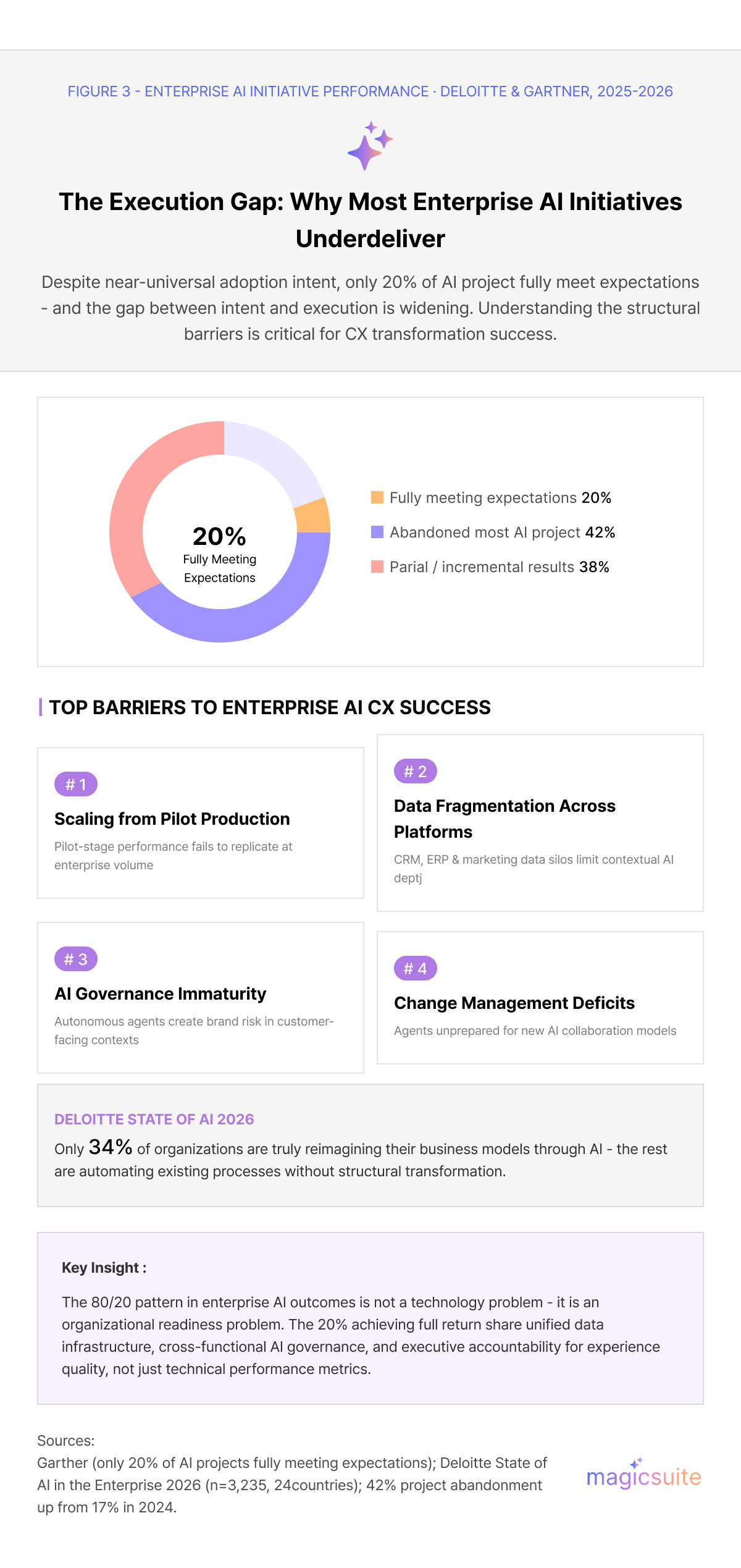
This adoption gap is a defining challenge for customer experience AI transformation. Organizations that deploy AI tools without restructuring the workflows, governance models, and talent capabilities around them tend to achieve incremental efficiency gains—automation of existing processes—rather than the experience-level breakthroughs that drive meaningful customer loyalty impact.
The failure rates are sobering. Research from Deloitte and Gartner indicates that 70–85% of AI initiatives fail to meet expected outcomes, and 42% of companies abandoned most AI projects in 2025, up from 17% in 2024. Only 20% of AI projects are fully meeting expectations (Gartner). Among the barriers most frequently cited:
Conversely, organizations that achieve high AI returns share a consistent set of characteristics: unified customer data infrastructure, cross-functional AI governance, iterative deployment models, and executive accountability for both technical and human-experience outcomes.
The commercial case for enterprise-grade AI sentiment analysis extends well beyond contact center performance. When emotional signal data is captured systematically across all customer touchpoints—chat, email, voice, social, in-app—it becomes a strategic intelligence asset that powers every layer of the AI-powered customer experience stack. From conversational AI interactions that adapt tone mid-dialogue to campaign systems that shift messaging based on real-time emotional signals, sentiment intelligence is the connective tissue between raw data and genuinely responsive engagement.
At the interaction level, dynamic tone-based routing identifies frustration or urgency mid-conversation and automatically escalates to senior agents, reducing resolution time and improving satisfaction. At the campaign level, real-time sentiment analysis across email and social channels allows marketing teams to identify what messaging resonates and adjust campaigns before underperformance compounds. At the product level, high concentrations of negative sentiment mapped to specific features or user flows reveal usability pain points before they surface in NPS scores—enabling proactive product improvement cycles.
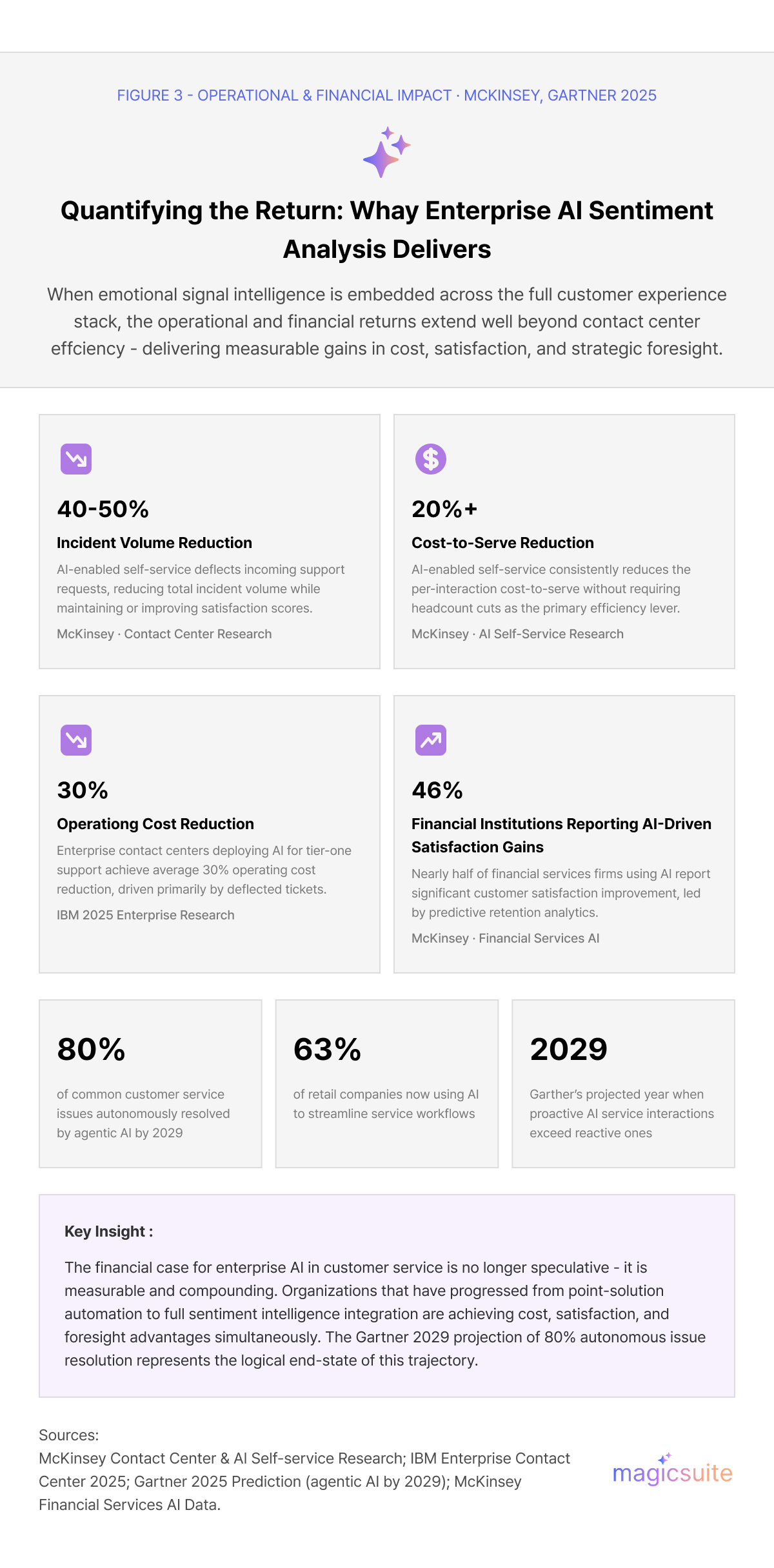
McKinsey research shows that AI-enabled self-service can reduce incidents by 40–50%, with cost-to-serve dropping more than 20% while maintaining or improving satisfaction. IBM's 2025 research on enterprise contact center deployments measured an average 30% operating cost reduction across organizations that deployed AI for tier-one support—driven primarily by deflected tickets rather than headcount cuts. Gartner further anticipates that proactive service interactions—powered by AI-predicted need—will outnumber reactive ones by the end of 2025, representing a structural shift from problem resolution to problem prevention.
The financial services sector illustrates this transition clearly. McKinsey data shows that 46% of financial institutions using AI reported significant gains in customer satisfaction, with AI-driven predictive analytics enabling early identification of at-risk customers and proactive retention interventions. In retail, 63% of companies now use AI to streamline service workflows, with the most sophisticated deployments linking sentiment intelligence to inventory, fulfillment, and returns processes for end-to-end experience coherence.
The deployment of emotionally intelligent AI in customer-facing contexts introduces a tension that CX leaders cannot afford to underestimate. While 71% of consumers in EMEA believe AI will eventually detect emotions and close the gap between human and machine interaction (ServiceNow Consumer Voice Report 2025, n=17,000), 69% of UK consumers say AI chatbots currently fail to understand emotional cues—and 64% of customers globally say they would prefer companies avoid AI if it compromises service quality (Gartner, 2024).
This consumer skepticism is not irrational. It reflects a lived experience gap between the promise of empathetic AI and the often-visible limitations of current-generation systems: scripted responses that misread context, escalation failures that strand customers in automated loops, and personalization that feels intrusive rather than attentive.
Generational patterns add further complexity. While younger consumers—particularly those aged 18–34—are more open to AI-mediated service, 62% of consumers aged 55 and over doubt that AI will ever understand emotions (ServiceNow Consumer Voice Report 2025). For enterprises serving broad demographics, this makes the hybrid human-AI model not merely a design preference but a strategic necessity.
Building consumer trust in emotionally intelligent AI requires several organizational commitments:
Enterprises that treat these as compliance minimums rather than experience design principles will find that the trust deficit compounds over time—eroding the CX gains that emotionally intelligent AI is intended to produce.
The growing body of enterprise AI research makes one pattern unmistakably clear: the variable that most consistently predicts AI CX success is not the sophistication of the technology but the organizational context in which it is deployed. Accenture research shows that 69% of leaders believe AI demands a full rethink of how systems and processes are built, yet the majority of organizations continue to treat AI as an enhancement to existing workflows rather than a catalyst for systemic redesign.
Deloitte's State of AI in the Enterprise findings reinforce this: twice as many leaders as last year report transformative AI impact, but that acceleration is concentrated among organizations that have invested in workforce readiness, data unification, and governance maturity—not simply in AI tooling.
The distinguishing characteristics of high-performing AI CX enterprises include:
The organizations achieving the highest AI returns are not moving faster—they are moving more systematically, treating emotional intelligence as a design standard rather than an aspirational feature.
The trajectory of AI customer experience investment points toward a fundamental structural change in how customer relationships are designed and maintained. As AI systems become more capable of detecting, interpreting, and responding to emotional context—and as enterprise data infrastructure matures to support real-time personalization at scale—the distinction between "service" and "relationship" will increasingly blur.
The near-term milestone is proactive care: AI systems that anticipate customer needs, identify emotional inflection points before they become complaints, and intervene with precisely calibrated support. McKinsey's "machine-triggered customer care" framework envisions a model in which the product itself becomes the service agent—detecting signals and initiating resolution before the customer experiences friction at all.
Beyond proactive service lies the longer arc of relationship intelligence: AI systems that accumulate longitudinal understanding of each customer's emotional patterns, preferences, and lifecycle stage, enabling enterprises to engage not just at moments of need but across the full span of customer relationships. Gartner projects that by 2029, agentic AI will autonomously resolve 80% of common customer service issues without human intervention, representing a complete inversion of today's model—where automation handles the exception rather than the rule.
This capability—when governed responsibly, designed empathetically, and deployed transparently—represents the fullest expression of what emotionally intelligent AI can deliver. The organizations that will lead this transition are those investing now not just in AI tools but in the organizational capabilities, data foundations, and ethical frameworks required to deploy those tools in ways that customers genuinely trust.
The emergence of emotionally intelligent AI in customer experience is not a feature upgrade—it is a strategic inflection point. As AI systems become more capable of reading and responding to human emotion at scale, the enterprises that invest in building these capabilities thoughtfully—with strong data foundations, transparent governance, and hybrid human-AI design—will define the next generation of customer relationships.
The data is clear: AI personalization drives measurable revenue impact, AI sentiment analysis reduces costs and improves satisfaction, and hybrid human-AI collaboration consistently outperforms full automation in emotionally complex contexts. But the returns are not evenly distributed. The organizations achieving transformative customer experience AI outcomes are those that treat emotional intelligence as a design standard—not an afterthought—and that build the organizational capabilities required to sustain it.
For CX leaders, the strategic question is no longer whether to invest in emotionally intelligent AI. It is whether the organizational infrastructure—the data, governance, talent, and culture—is ready to make that investment pay off at scale.

Luke is a technical market researcher with a deep passion for analyzing emerging technologies and their market impact. With a keen eye for data and trends, Luke provides valuable insights that help shape strategic decisions and product innovations. His expertise lies in evaluating industry developments and uncovering key opportunities in the ever-evolving tech landscape.