

Meta's WhatsApp AI agent is live globally - what 3.3B users and $80B in savings mean for CX teams.
For years, WhatsApp has been the world's most used messaging platform - a space for conversations between friends, families, and, increasingly, between customers and brands. But until now, most of that business use relied on manual responses, rigid scripted bots, or expensive custom integrations. That changes with Meta's most significant enterprise move to date.
On June 3, 2026, Meta unveiled its Meta Business Agent at the company's Conversations conference in London - a fully AI-powered customer service tool now available globally to businesses of all sizes across WhatsApp, Instagram, and Messenger. The announcement signals more than a product update. It marks Meta AI's formal entry into the enterprise market, positioning the company directly against OpenAI, Google, and Salesforce in the race to automate how businesses communicate with customers. For enterprises evaluating their AI customer support strategy, the implications are immediate and far-reaching.
The Meta Business Agent is not a traditional chatbot. Unlike rule-based predecessors that matched keywords to pre-written responses, this AI business agent understands context, executes actions, and handles multi-step workflows - all within the messaging interface where customers already spend their time.
According to Meta, the agent is capable of:
That last capability - the briefing feature - is especially notable for operations managers. Rather than starting the day with a backlog of unreviewed threads, business owners receive a distilled summary of what their AI handled, what needs follow-up, and where customer sentiment may warrant attention. This positions the tool less as a chatbot and more as an operational co-pilot.
Meta CEO Mark Zuckerberg framed the ambition plainly at the London event: "A clothing shop in Birmingham or a bakery in São Paulo can offer the same always-on, highly-personalized experience as a major brand." That democratization promise - enterprise-grade AI for small business budgets - is what separates this launch from previous incremental updates to WhatsApp Business.
Meta's global rollout did not emerge overnight. The company has spent nearly two years testing AI business agent capabilities for customer support automation in select markets, with India and Mexico serving as the primary proving grounds. These markets were deliberately chosen: both are among WhatsApp's largest user bases, with high rates of direct messaging between consumers and businesses, and distinct operational realities that stress-test any AI-powered tool.
The results of that testing were compelling enough to justify a global expansion. Before the London announcement, over one million businesses were already actively using earlier iterations of Meta's business AI across WhatsApp and Messenger - generating a dataset of real customer conversations that helped the system learn intent, refine response patterns, and improve escalation logic.
That scale of pre-launch deployment is itself a meaningful differentiator. Unlike AI tools deployed in controlled pilots, Meta's agent has been shaped by live interactions across languages, industries, and customer expectations at genuine volume. By the time it launched globally, it was already a production-grade tool, not a beta product.
Understanding why Meta's move matters requires appreciating the scale of the platform it is building on. WhatsApp is not simply a messaging app at this point - it is the dominant global communication infrastructure for business-to-consumer interaction.
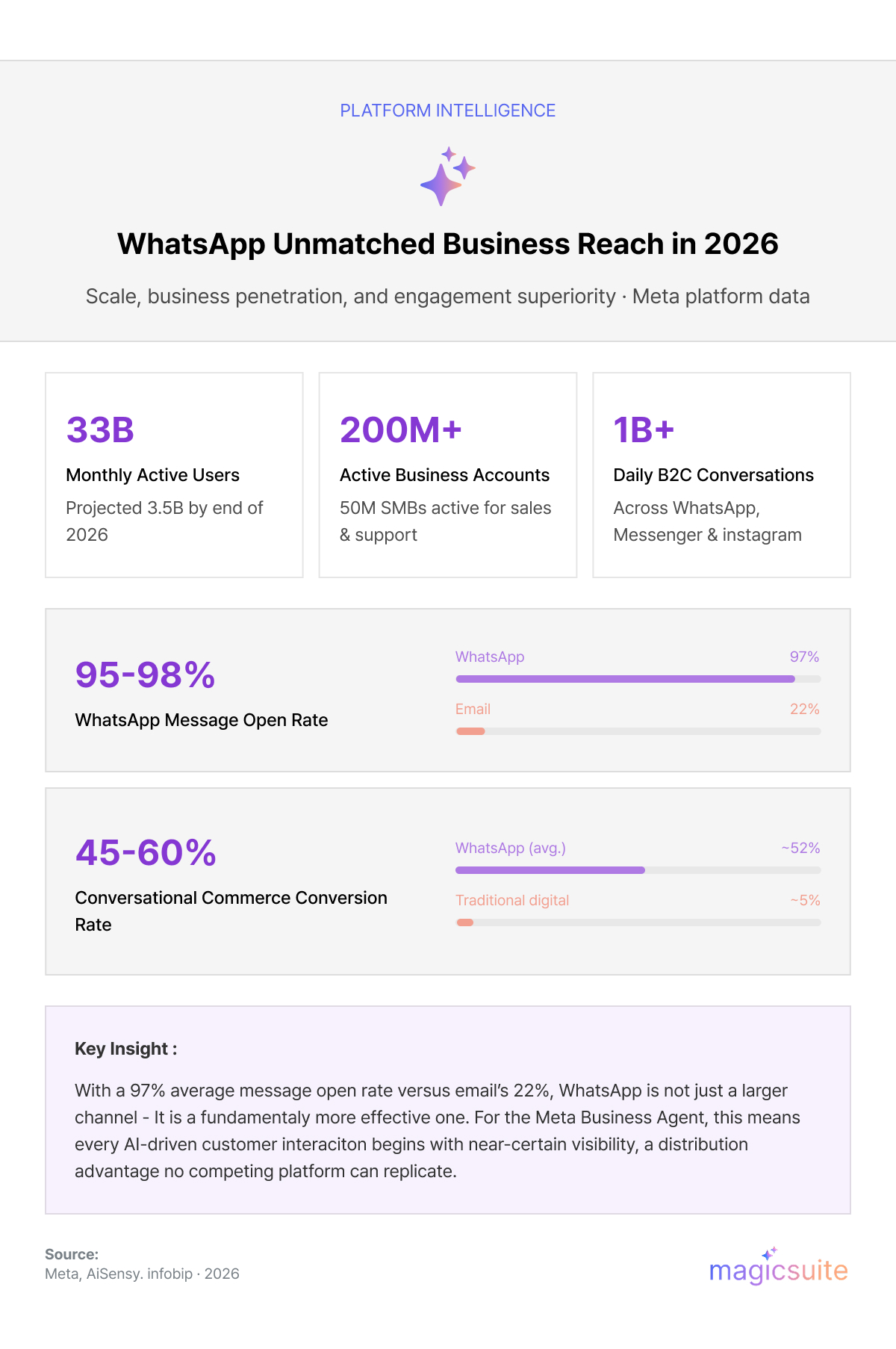
The numbers are striking:
These figures frame the opportunity Meta AI is now mobilizing. While competitors like OpenAI and Google are building AI agents that businesses must integrate into external platforms, Meta's WhatsApp AI infrastructure already sits inside the channel where billions of customers are conducting their daily commerce and support interactions. The distribution moat is real - and the Business Agent is Meta's play to monetize it.
Beyond the consumer-facing agent, Meta simultaneously launched the Meta Business Agent Platform - an enterprise infrastructure layer designed for organizations that need more than a plug-and-play chatbot.
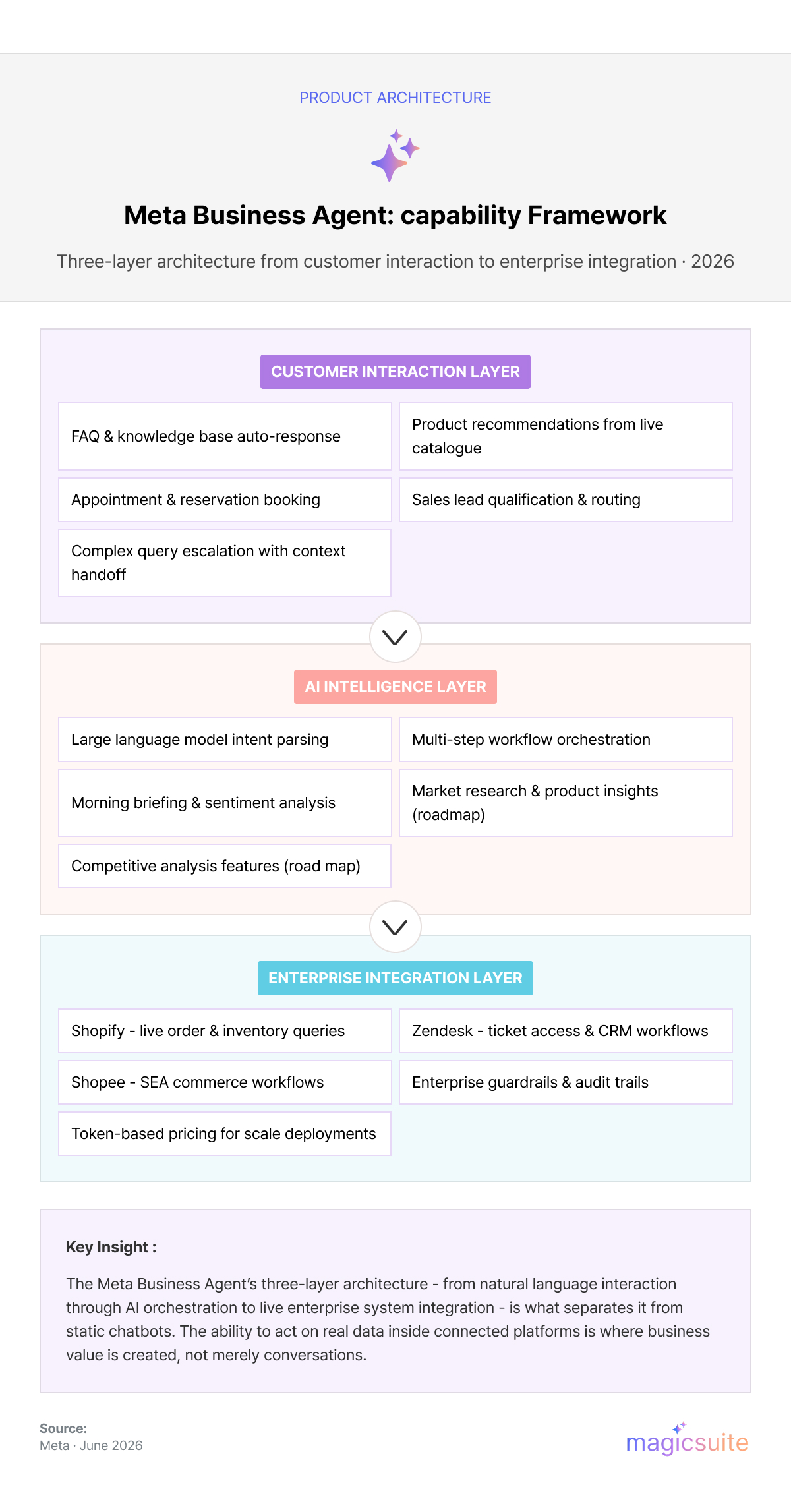
The platform enables large businesses to build, customize, and deploy agents at scale, with connections to hundreds of third-party systems. The most notable integrations announced include:
This capability is architecturally significant. An AI business agent that can query and act within a CRM or commerce platform is a fundamentally different product from one that reads from a static FAQ document. When a customer asks "Where is my order?" and the agent can look up the Shopify order in real time and respond with tracking details - that is not automation of conversation. It is customer support automation of operations, conducted through a conversational AI interface.
The platform also includes enterprise-grade controls, guardrails, and performance metrics, addressing one of the most consistent blockers in enterprise AI adoption: the need for oversight, compliance support, and audit trails before AI touches customer interactions at scale.
Meta's timing reflects an industry trajectory that has been accelerating for the better part of two years. The AI customer support market has moved decisively from pilot phase to production deployment, and the data confirms that urgency. Enterprises that have already deployed WhatsApp AI tools for customer engagement are reporting measurable gains across cost, speed, and satisfaction - raising the competitive bar for those still evaluating.
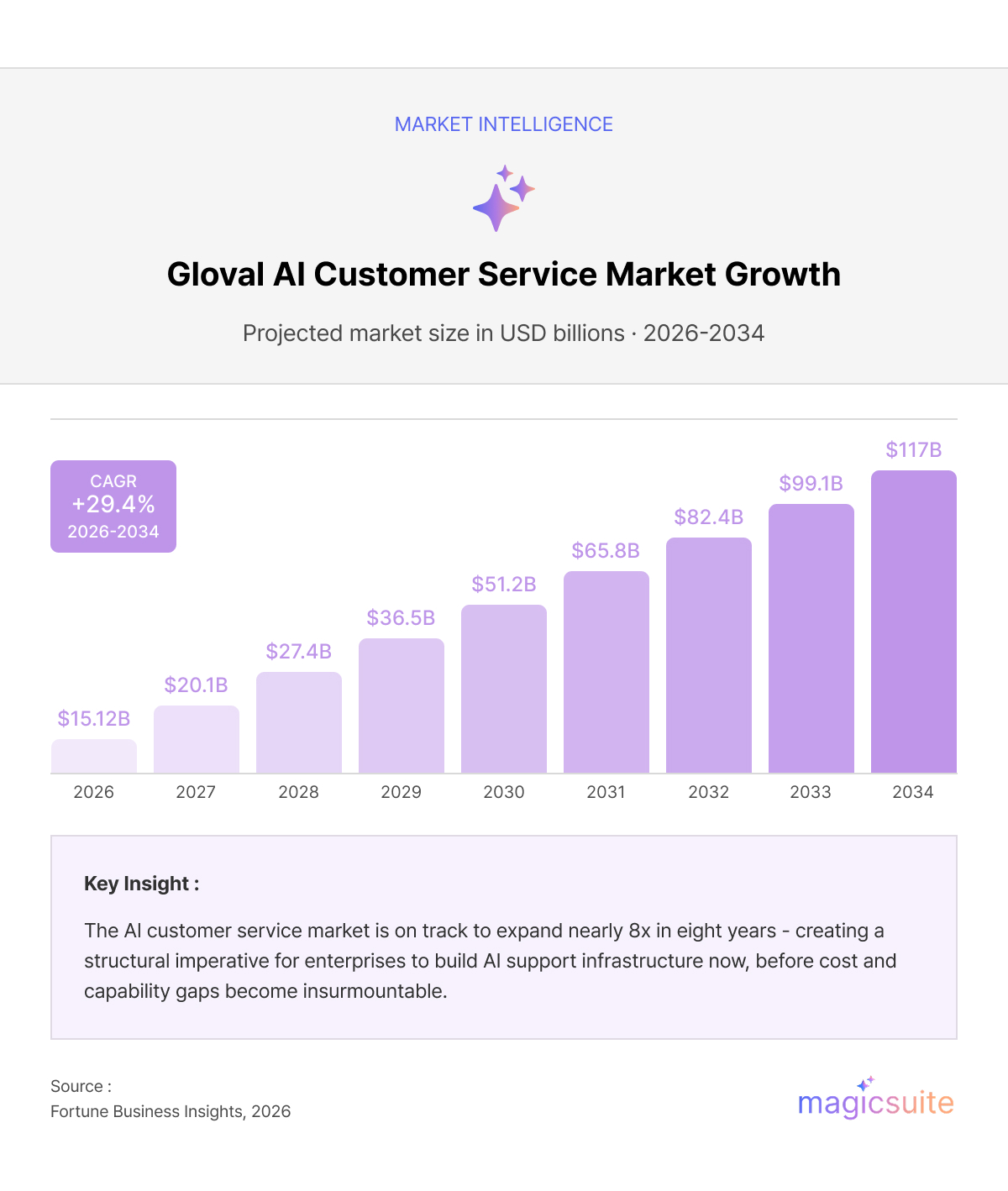
Key benchmarks from current research:
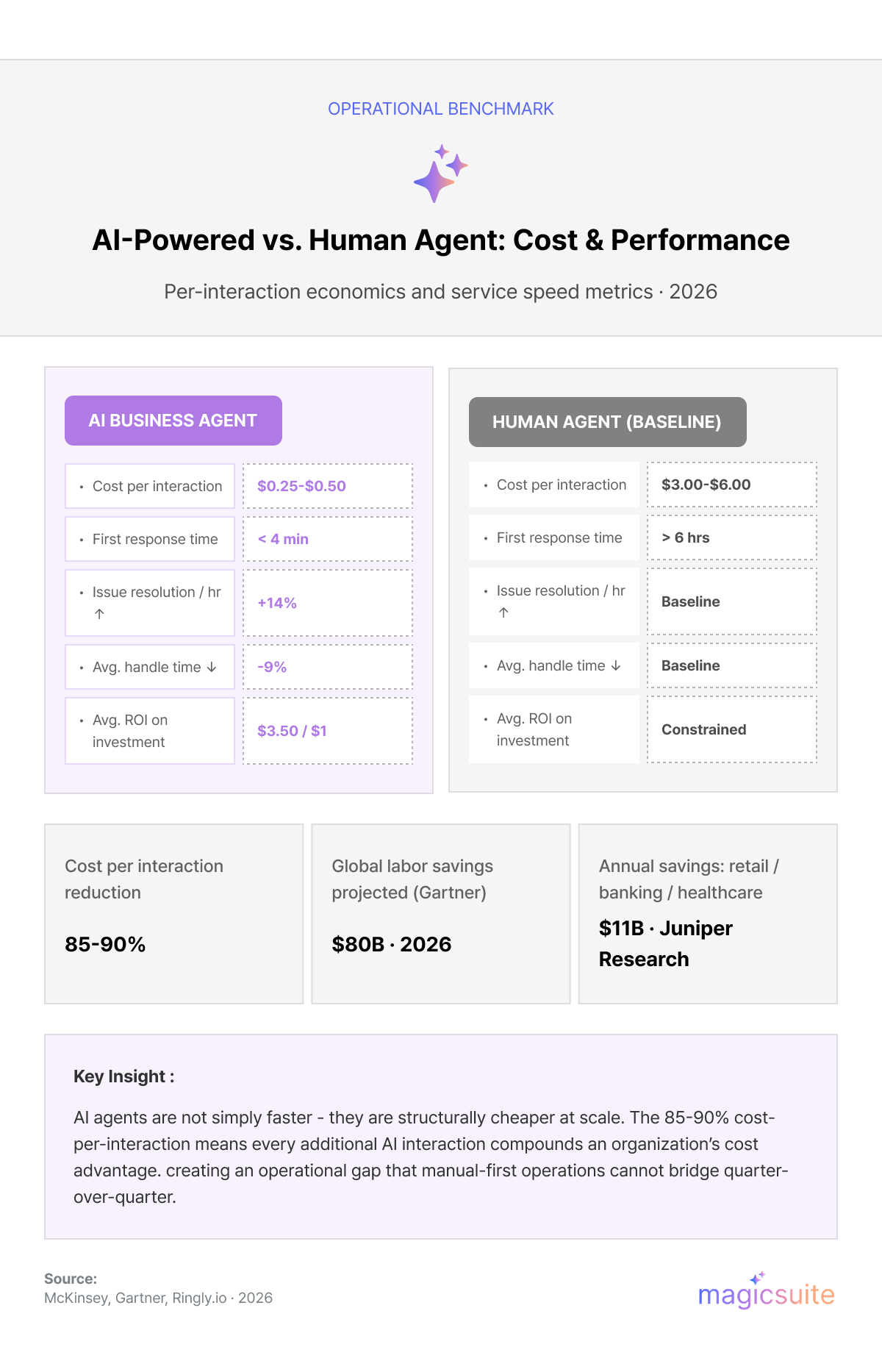
For businesses still relying primarily on manual support queues, the cost gap is widening every quarter. The companies scaling AI now are not just improving efficiency - they are structurally lowering their cost-to-serve in ways that are difficult to reverse-engineer without native AI infrastructure.
One of the more nuanced dimensions of the Meta Business Agent launch is how differently it affects small and medium-sized businesses versus large enterprises.
For SMBs, the value proposition is primarily access and speed. A clothing boutique or independent restaurant has never had affordable access to always-on, intelligent customer service automation. The Meta Business Agent changes that - and the initial free access tier removes the financial barrier entirely. For businesses operating across time zones or managing high inquiry volume with small teams, the ability to deploy an AI agent within minutes, without engineering resources, is transformative.
For enterprises, calculus is more strategic. Large organizations evaluating WhatsApp business automation need to weigh the platform's reach against questions of data governance, integration depth, and how Meta's agent compares with existing CRM-embedded AI tools from Salesforce, Microsoft, or Zendesk. The Business Agent Platform's connections to Shopify and Zendesk are a deliberate signal that Meta understands this audience - but enterprise procurement will require more detailed answers on compliance, data residency, and API extensibility before large-scale rollouts are approved.
That said, the competitive dynamic is clear. As Meta's head of product Naomi Gleit told Reuters directly: "This is definitely an enterprise play."
Meta's move into AI-powered customer service places it in direct competition with a field that includes OpenAI's Agentic Commerce Protocol (launched September 2025), Google's AI Mode shopping integrations, and enterprise platforms like Salesforce Agentforce and ServiceNow. But Meta's competitive position is meaningfully different from any of these players in one critical respect: native distribution.
OpenAI and Google are building AI capabilities that businesses deploy on top of existing infrastructure. Meta is deploying AI inside the communication channel where customers already initiate contact. The business messaging automation play is not just about the intelligence of the agent - it is about where that agent lives. And for billions of users across Southeast Asia, Latin America, South Asia, the Middle East, and Africa, that place is WhatsApp.
This geographic and demographic reality is why Meta's launch carries implications well beyond its immediate feature set. The platform does not need to convince businesses to migrate their customers to a new channel. The customers are already there.
Meta's approach to monetizing the Business Agent reflects lessons learned from how OpenAI and Microsoft have successfully priced AI for enterprise. The announced model includes:
This tiered approach is strategically sound. Free entry removes friction and accelerates adoption across Meta's 200 million business accounts. Paid tiers capture value from the businesses deriving measurable operational ROI. Token-based enterprise pricing aligns costs with scale, making the economics more predictable for large organizations while ensuring Meta's revenue grows as usage grows.
For context on the commercial opportunity: WhatsApp's paid messaging revenue has already crossed a $2 billion annual run rate in 2026. The Business Agent is positioned to expand that significantly - transforming what was historically a messaging fee revenue model into a software-as-a-service model anchored in AI usage.
For businesses evaluating whether and how to deploy the Meta Business Agent, the technical barrier is low - but the organizational requirements deserve attention. Deploying an AI agent within WhatsApp minutes is feasible; deploying one that genuinely improves customer experience and business outcomes requires thoughtful configuration.
Key factors that determine success in AI customer service and WhatsApp business automation deployments include:
Research from Verint confirms that 66% of businesses required more than six months to see measurable ROI from AI implementations - a reminder that deployment velocity and outcome velocity are not the same thing. The businesses that extract the most from tools like the Meta Business Agent invest as much in the surrounding process design as they do in the technology itself.
Meta has signaled a clear product roadmap that extends well beyond the June 2026 launch capabilities. Future features on the announced development path include:
These capabilities would meaningfully expand the agent from a customer-facing tool to an internal business intelligence layer - a shift that would place the Meta AI Business Agent in a different competitive category altogether, closer to an embedded business analyst than an AI-powered customer service bot.
In its best-case scenario projection, Gartner forecasts that agentic AI could drive approximately 30% of enterprise application software revenue by 2035, surpassing $450 billion globally - up from just 2% in 2025. Meta's current move positions the company to compete for a share of that market before incumbents have fully locked in enterprise relationships.
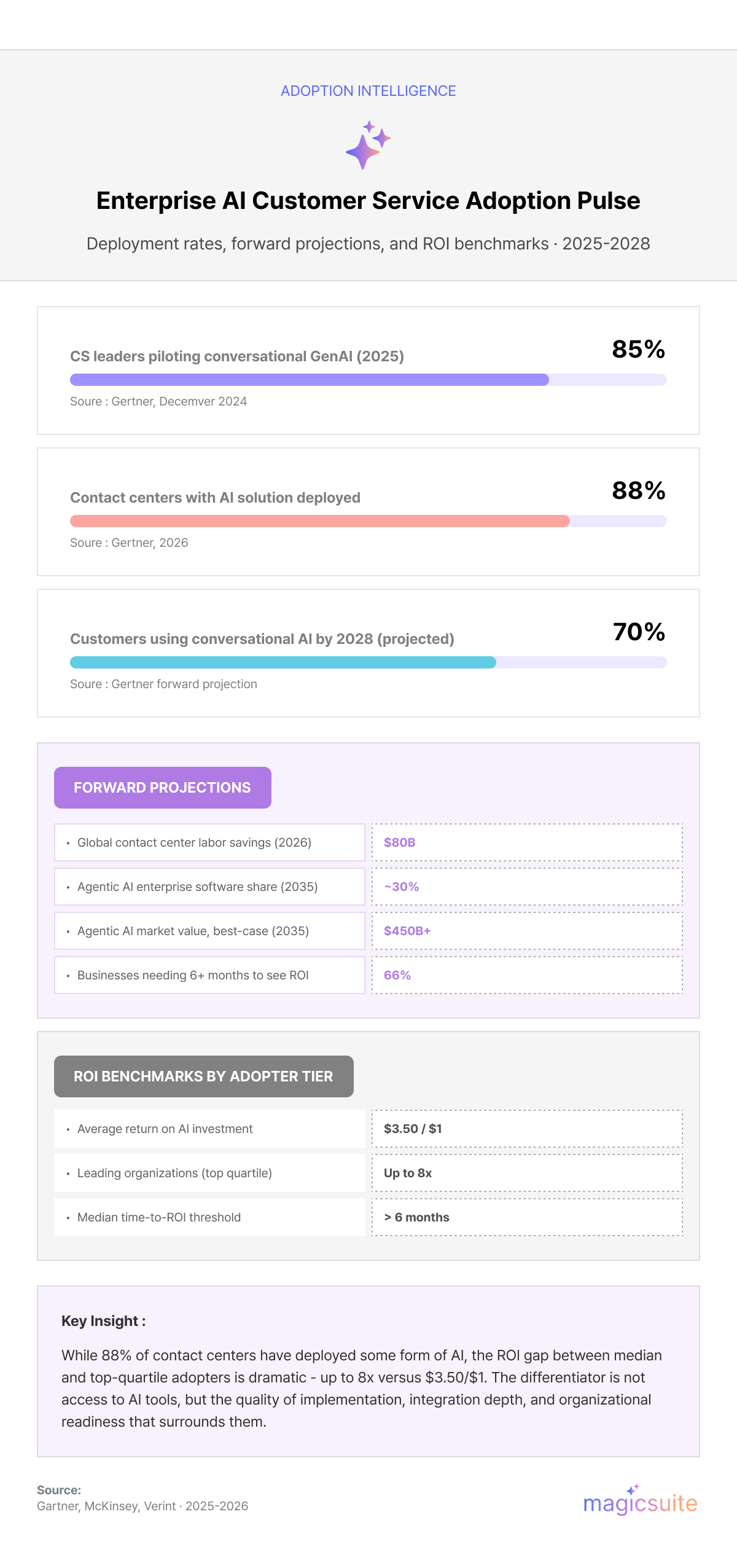
Meta's global launch of the Business Agent on WhatsApp is not a chatbot update. It is the company's formal declaration that enterprise AI - delivered through the messaging infrastructure where billions of customers already live - is its next major business. For small businesses, it is an equalizer: the ability to offer sophisticated, always-on customer service that was previously the exclusive domain of organizations with large support teams and custom technology budgets. For enterprises, it is a competitive signal requiring a response.
The underlying dynamics that make this launch consequential are not specific to Meta. Customer support automation is now a structural imperative across industries. The companies that deploy AI-powered customer service infrastructure earlier, iterate faster, and invest in the organizational practices that make AI effective will compound operational advantages over those still managing support queues manually. What Meta has done with this launch is lower the barrier to entry for that transformation - placing powerful AI customer service capabilities inside an application that 3.3 billion people already open every day.
The question for business leaders is no longer whether to deploy conversational AI. It is about how to be deliberate about how.

Hanna is an industry trend analyst dedicated to tracking the latest advancements and shifts in the market. With a strong background in research and forecasting, she identifies key patterns and emerging opportunities that drive business growth. Hanna’s work helps organizations stay ahead of the curve by providing data-driven insights into evolving industry landscapes.