

AI dynamic segments lift email CTR 29% - static personas cost brands 23% in missed conversions.

Every enterprise retailer has a revenue leak it rarely measures directly: the moment a shopper searches for something the catalog actually has, gets nothing useful back, and leaves. It doesn't show up as a single line item. It shows up scattered across abandoned sessions, suppressed conversion rates, and customer service tickets that never needed to exist. Product discovery - search, navigation, and recommendations - is the connective tissue of digital commerce, yet it remains one of the least modernized parts of the stack. Meanwhile, generative AI, retrieval-augmented generation (RAG), and AI shopping assistants have matured enough to close that gap. This article examines the verified cost of poor AI product discovery, why most enterprise AI investments still underdeliver, and what separates organizations converting AI-powered search into measurable revenue from those still stuck in pilot mode.
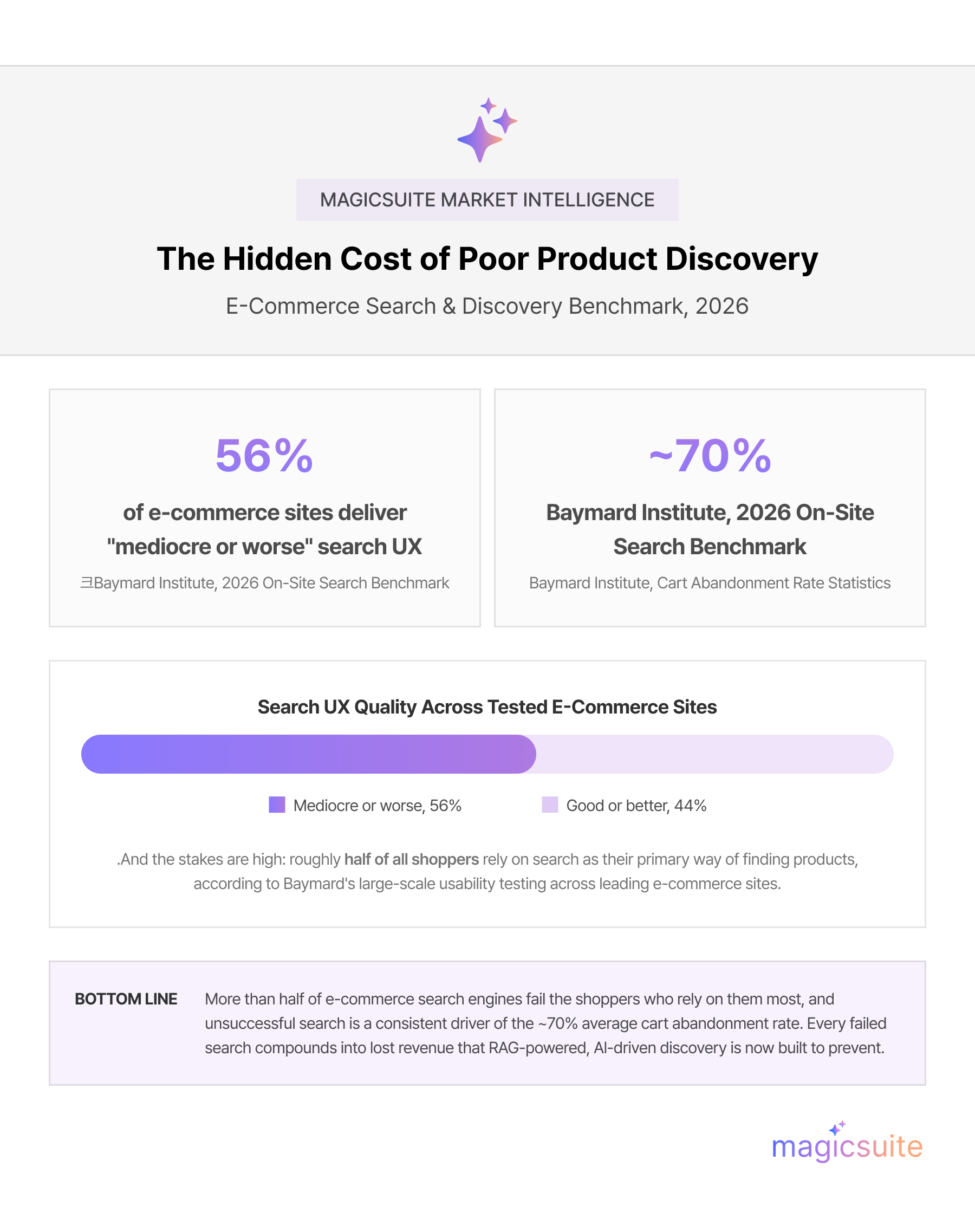
Product discovery failures are structural, not anecdotal. Baymard Institute - the independent UX research body that has benchmarked hundreds of leading e-commerce sites - found in its 2026 on-site search study that 56% of tested sites score "mediocre or worse" on search UX, despite roughly half of all shoppers relying on search as their primary way of finding products. Baymard's research program, which spans more than a decade of large-scale usability testing, has repeatedly identified the same root cause across benchmark cycles: search engines that require shoppers to type a retailer's exact internal terminology, with weak handling of synonyms, natural-language phrasing, and misspellings.
The downstream effect compounds. Cart abandonment has hovered around 70% globally for years across large-scale industry benchmarks, and while abandonment has many causes, unsuccessful product search is consistently cited as one of the top reasons shoppers leave without buying. Every failed search is a customer silently voting with their attention - and most retailers have no dashboard that captures it.

The paradox at the center of enterprise AI in 2026 is that adoption and impact have decoupled. McKinsey's Global Survey on the State of AI - fielded with nearly 2,000 respondents across 105 countries - found that 88% of organizations report using AI in at least one business function, up from 78% a year earlier. But only about one-third have begun scaling AI across the enterprise, and just 39% report any enterprise-level EBIT impact. A narrow segment - roughly 6% of respondents, which McKinsey classifies as "AI high performers" - attribute more than 5% of EBIT to AI and report significant enterprise value.
Stanford HAI's 2026 AI Index corroborates the broad pattern: its headline figures cite 88% organizational AI adoption, consistent with McKinsey's own number, while the report's dedicated economic analysis notes that generative AI specifically is used in at least one business function at 70% of organizations, with agent deployment still in the single digits across nearly all business functions. Read together, the two reports - produced independently, using different methodologies - tell a consistent story: enterprise AI is now table stakes, but scaled, agentic, financially attributable impact is still rare.
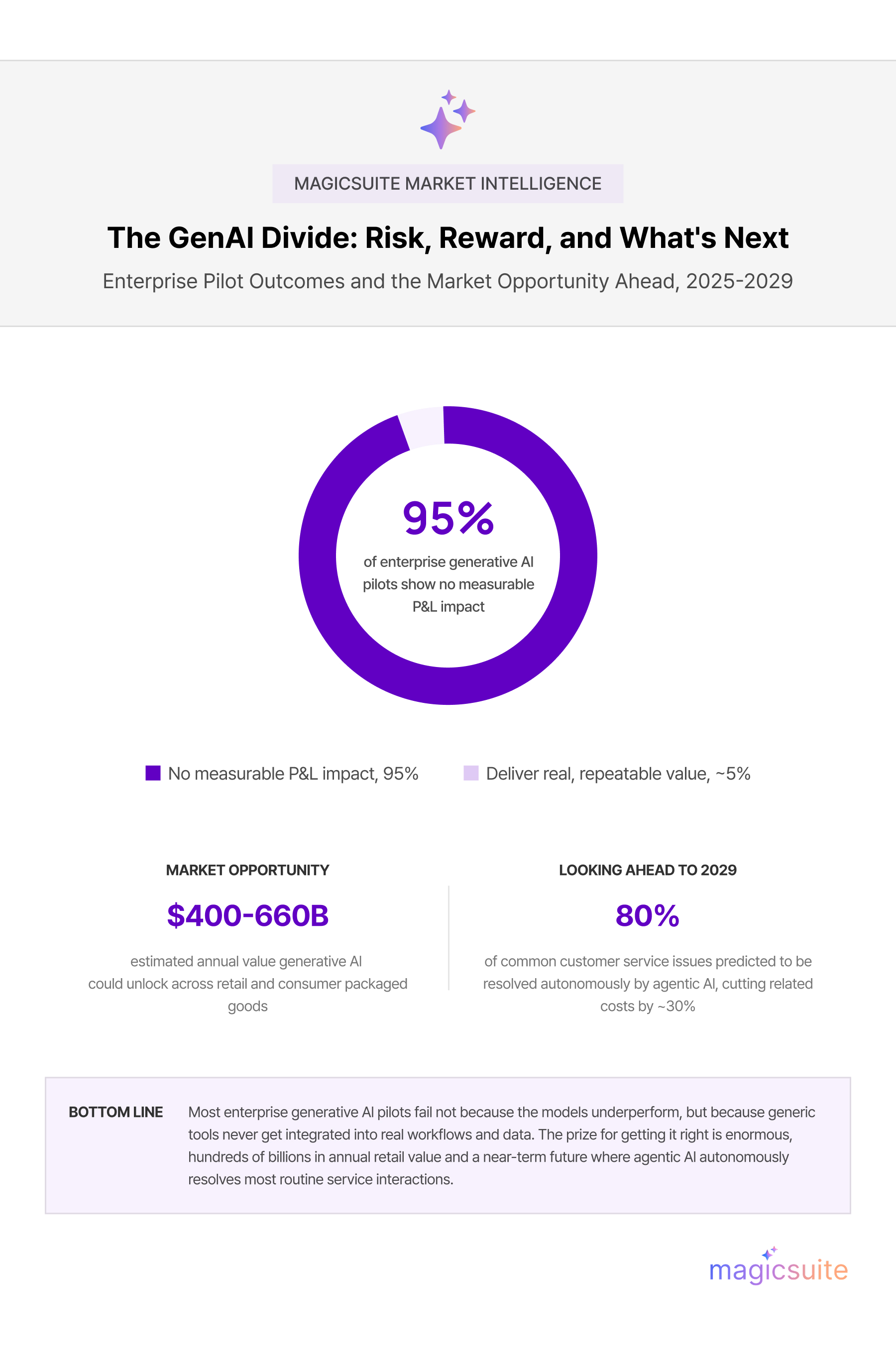
MIT's NANDA initiative sharpened the picture further. Its 2025 report, The GenAI Divide: State of AI in Business 2025, combined executive interviews with an analysis of roughly 300 publicly disclosed enterprise AI deployments and found that 95% of enterprise generative AI pilots deliver no measurable impact on profit and loss, while only about 5% extract significant, repeatable value. It is worth noting this is a single, not-yet-peer-reviewed study rather than a government or multi-source statistic - but its central finding is consistent with McKinsey's and PwC's data above. Crucially, the researchers attribute the "GenAI Divide" to organizational and integration failures - brittle, generic tools that don't learn from a company's own workflows - rather than to underlying model capability.
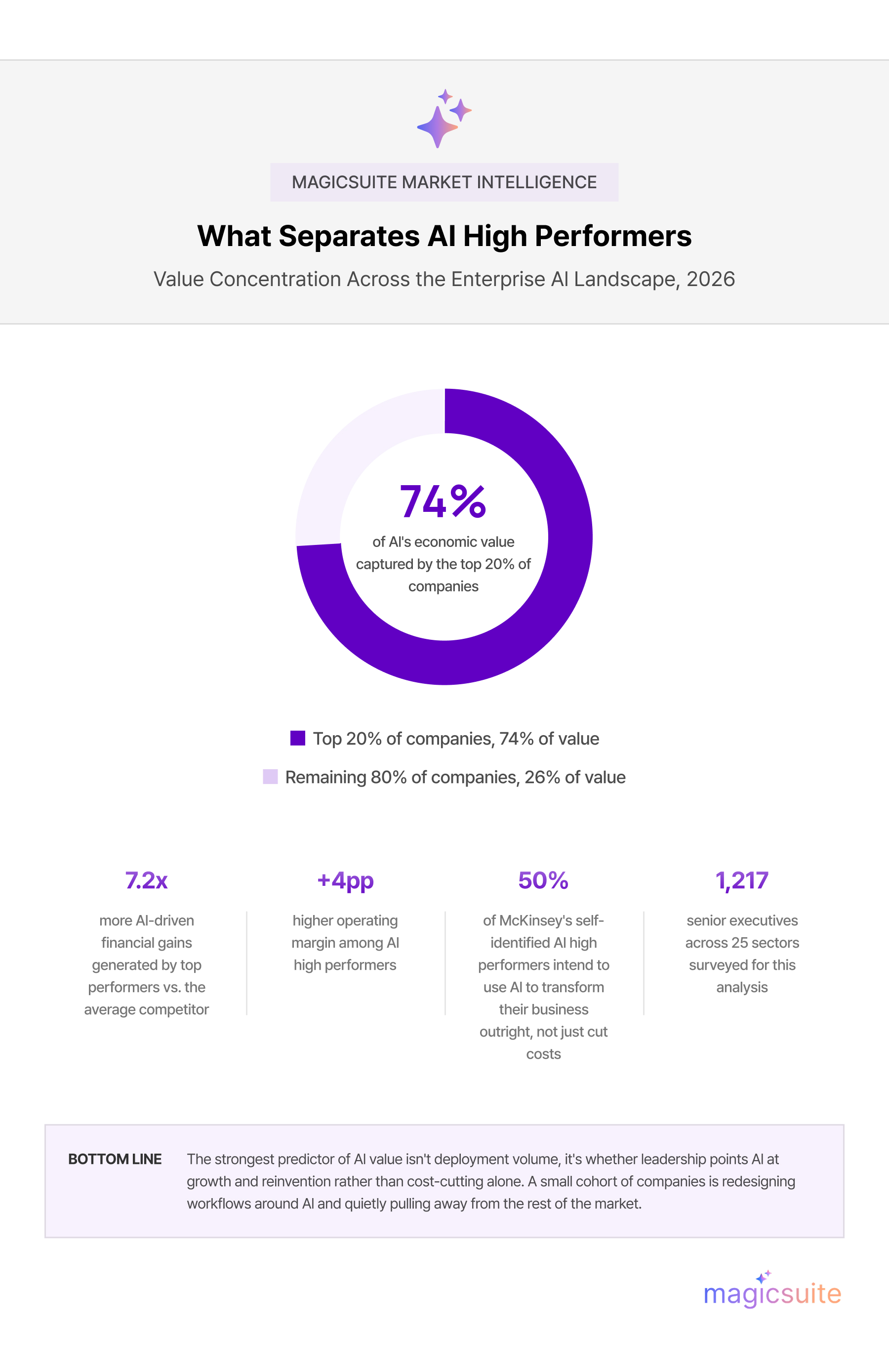
The gap between AI leaders and laggards is not primarily technical - it's a question of ambition and organizational design. PwC's April 2026 AI Performance Study, based on 1,217 senior executives across 25 sectors, found that the top-performing 20% of companies capture 74% of AI's total economic value, generating 7.2 times more AI-driven financial gains than the average competitor, with operating margins roughly 4 percentage points higher. The single strongest predictor wasn't how much AI a company deployed - it was whether leadership pointed AI at growth and business reinvention rather than cost-cutting alone.
McKinsey's own survey findings reinforce this directly: while 80% of respondents cite efficiency as an AI objective, the companies capturing the most value are disproportionately the ones that also target growth or innovation. Among McKinsey's self-identified AI high performers, half say they intend to use AI to transform their business outright, and most report redesigning workflows around AI rather than layering it onto unchanged processes - precisely the distinction PwC's research identifies as the strongest predictor of financial performance.

The technical shift underway is a move from static, keyword-matched search toward RAG-grounded, conversational systems that interpret intent rather than requiring exact-match queries. Retrieval-augmented generation lets an LLM draw on a retailer's live catalog, inventory, and product content to answer natural-language questions accurately - closing the exact gap Baymard's research identifies as the industry's most persistent weakness. Instead of forcing a shopper to guess internal taxonomy, an AI chatbot or AI shopping assistant can interpret a vague, needs-based query and surface relevant products, including items the shopper never thought to search for directly.
The commercial evidence is now substantial. Adobe Analytics' review of the 2025 U.S. holiday shopping season - covering more than a trillion site visits - found that traffic to retail sites from generative AI platforms rose 693% year over year, and that shoppers arriving through those channels converted 31% higher than traffic from traditional sources, with revenue per visit up 254% year over year. Shoppers referred by generative AI tools were also 33% less likely to bounce immediately and spent meaningfully more time engaging with product content. Salesforce separately estimated that AI agents and other generative AI tools influenced more than 20% of all online retail sales globally during the same holiday period.
McKinsey's foundational economic modeling still holds up as the reference point for scale: generative AI could add an estimated $400 billion to $660 billion annually in value across retail and consumer packaged goods, concentrated heavily in customer operations, marketing, and personalized engagement - the same functions where product discovery lives.
Even organizations that commit budget to generative AI frequently underdeliver for reasons that mirror the broader enterprise AI adoption gap:
Enterprises that treat product discovery as core infrastructure - not a UX afterthought - report outcomes across the full commercial funnel:
The data converges on one conclusion: the gap between AI adoption and AI impact is a leadership and architecture problem, not a capability problem. Product discovery sits at the center of that gap for every retailer and enterprise commerce business, because it is the single interaction point where poor data, rigid workflows, and legacy search technology intersect with real revenue. The organizations pulling ahead - McKinsey's 6% of high performers, PwC's top 20% - are not the ones with the flashiest chatbot. They are the ones that rebuilt product discovery on grounded, RAG-based enterprise AI foundations, tied it to clear ownership and measurement, and treated it as a growth lever rather than a cost line. As agentic and conversational commerce continue to reshape how shoppers find and buy products, the cost of standing still on discovery will only compound - and the organizations that move now will be the ones defining the next decade of retail competitiveness.

Hanna is an industry trend analyst dedicated to tracking the latest advancements and shifts in the market. With a strong background in research and forecasting, she identifies key patterns and emerging opportunities that drive business growth. Hanna’s work helps organizations stay ahead of the curve by providing data-driven insights into evolving industry landscapes.